Did you know that while over 1.59 million veterans are currently service-connected for PTSD, thousands remain “stuck” at a 50% rating because their documentation doesn’t clearly meet the va ptsd rating criteria for a higher award? It’s a common frustration to feel misunderstood by C&P examiners or lost in the complexity of VA math and legal codes. You’ve served your country with honor, and you shouldn’t have to fight a second war just to receive the disability compensation you’ve earned. 🇺🇸
We understand the anxiety that comes with hearing about “proposed” 2026 rating changes and the fear that your financial stability might be at risk. This guide is designed to provide clarity and peace of mind through accurate documentation. You’ll learn how to master the 38 CFR mental health standards and discover how to document your symptoms effectively to secure the rating you deserve. We’ll preview the 2026 compensation rates, explain why the “Five Functional Domains” model isn’t in effect yet, and show you how to translate your daily challenges into the precise medical evidence the VA values most.
Key Takeaways
- Learn how the VA evaluates mental health through 38 CFR § 4.130 and what specific symptoms trigger ratings from 0% to 100%.
- Understand the 2026 transition toward “Functional Domains” and how to accurately document your symptoms under the current va ptsd rating criteria.
- Identify the three essential pillars of a winning claim, including the critical link between your clinical diagnosis and your military service.
- Discover how high-quality Disability Benefits Questionnaires (DBQs) serve as the vital medical evidence needed to substantiate your claim’s severity.
- Gain a clear roadmap for pursuing a VA rating increase or Total Disability Individual Unemployability (TDIU) to secure your financial stability.
The 2026 Landscape: Understanding VA PTSD Rating Criteria
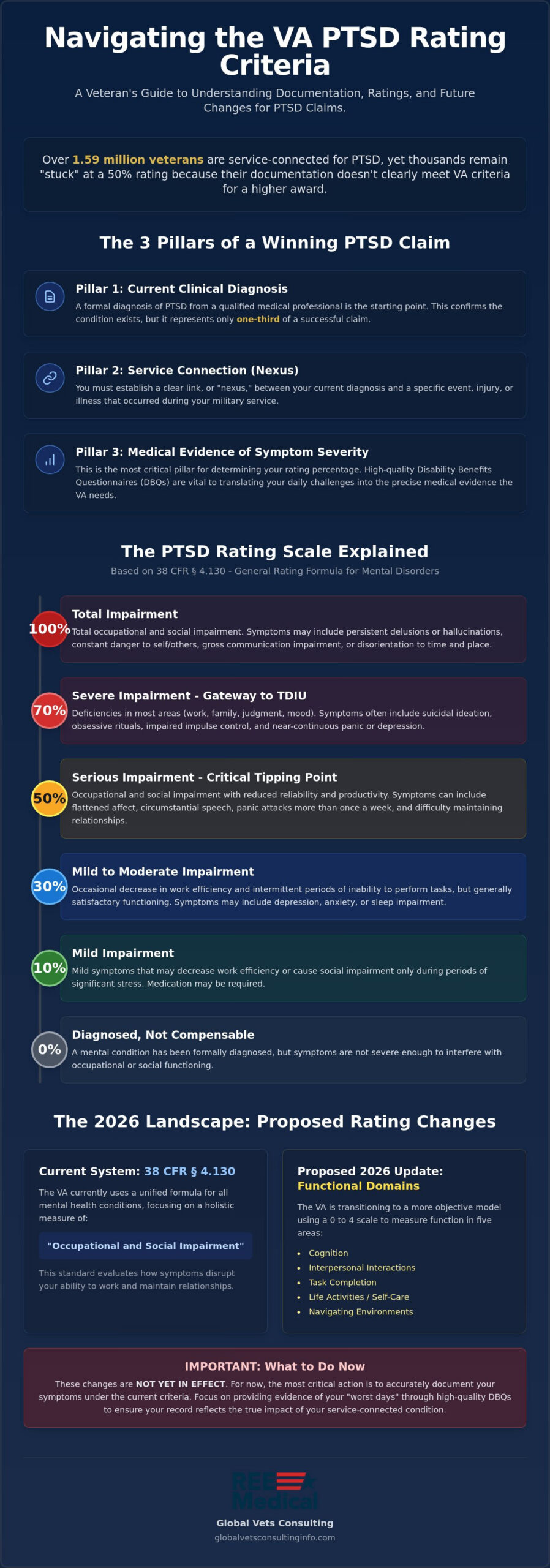
A current diagnosis is only 33% of the battle. While a clinical diagnosis proves the condition exists, it represents just a fraction of a successful claim. The remaining weight falls on your ability to provide medical evidence of symptom severity. The VA evaluates Post-Traumatic Stress Disorder under 38 CFR § 4.130, which is known as the General Rating Formula for Mental Disorders. This framework establishes the va ptsd rating criteria used to measure your level of disability based on how your symptoms impact your daily life. Occupational and social impairment is the foundational metric used to determine how your symptoms disrupt your ability to earn a living and maintain healthy relationships.
38 CFR § 4.130: The Current Gold Standard
The VA uses a unified formula for most mental health conditions. This means they group PTSD with other conditions like anxiety or depression. Because the VA prohibits “pyramiding,” you won’t receive separate ratings for multiple mental health diagnoses. Instead, they look at your overall level of impairment. If you have three different diagnoses, the VA will still issue a single score based on the highest level of symptoms you demonstrate under the va ptsd rating criteria.
While navigating the complexities of your claim, improving your daily social interactions at home can also be a vital part of your recovery; for veterans with canine companions, I Wuff You Dog Training offers behavior consulting to help foster a more supportive environment.
The 2026 Update: Functional Domains and WHODAS 2.0
The VA is currently transitioning toward a more objective model called the Five Functional Domains. This proposed system uses a 0 to 4 scale to measure how you function in areas like self-care, mobility, and social life. While this change aims to reduce subjectivity, occupational impairment remains the primary factor for now. It’s vital to document your “worst days” during C&P exams. If you only describe how you feel on a good day, the examiner might miss the functional limitations that qualify you for a higher rating. Accurate Disability Benefits Questionnaires (DBQs) are the best way to bridge the gap between these shifting standards and ensure your record reflects the true impact of your service.
The PTSD Rating Scale: From 0% to 100% Explained 📊
The VA uses a specific schedule to determine how your symptoms translate into a disability percentage. This schedule, found in 38 CFR § 4.130, measures the degree of “occupational and social impairment” you experience. A 0% rating confirms you have a service-connected diagnosis, but your symptoms don’t currently interfere with your work or social life. As you move into the 10% and 30% range, the VA looks for occasional decreases in work efficiency or mild social impairment. These lower ratings acknowledge the condition exists without finding it totally disruptive to your daily productivity.
The 50% to 70% range represents a critical tipping point in the va ptsd rating criteria. At a 50% rating, you might experience flattened affect, circumstantial speech, or weekly panic attacks. However, once you reach 70%, the evidence must show deficiencies in most areas, such as work, school, family relations, judgment, thinking, or mood. If you feel your current rating doesn’t reflect your daily reality, reviewing your medical evidence can help you identify specific gaps in your documentation that might be holding you back.
The 70% PTSD Rating: The Most Common High-Level Award
A 70% rating is often characterized by suicidal ideation, obsessive rituals that interfere with daily activities, and impaired impulse control. It’s a significant threshold because it acknowledges that your symptoms cause near-continuous distress. This level is also frequently the gateway to Total Disability Individual Unemployability (TDIU) benefits. If your PTSD prevents you from maintaining substantially gainful employment but you aren’t yet at the 100% schedular level, the 70% rating is often the key to receiving compensation at the maximum 100% rate.
What Constitutes ‘Total Impairment’ at 100%?
The 100% rating is reserved for total occupational and social impairment. Symptoms at this level include persistent delusions, hallucinations, or a constant danger of hurting yourself or others. You might experience gross impairment in communication or disorientation to time and place. Don’t assume you need to exhibit every symptom listed in the va ptsd rating criteria to qualify. The VA looks for a preponderance of symptoms that align with this highest level of severity to ensure you receive the financial stability you require.
The 3 Pillars of a Winning PTSD Claim
Securing a fair disability rating requires more than just showing up to an exam. To meet the va ptsd rating criteria, your claim must stand on three specific pillars. If even one of these is weak, the VA will likely issue a denial. Pillar one is a current clinical diagnosis that must strictly adhere to the DSM-5 Criteria for PTSD. Pillar two is the in-service stressor, which is the specific event that triggered your condition. Finally, pillar three is the medical nexus. This is the expert opinion that links your current diagnosis directly to your military service. Understanding what is a DBQ is essential here, as it’s the primary tool used to capture these pillars in a format the VA recognizes.
Proving the Stressor: Beyond the Battlefield
While combat stressors are often conceded based on awards like the Combat Action Ribbon, non-combat stressors require more legwork. You might be dealing with the aftermath of a training accident, Military Sexual Trauma (MST), or a significant personal loss during service. When documentation is thin, buddy statements and personal lay evidence become your best friends. These accounts from fellow service members or family help corroborate your story and provide the context that official records might lack. If you’re unsure how to document these events under the va ptsd rating criteria, you can get started with our education resources to learn how to build a stronger evidence file.
The Power of a Private DBQ in Your Claim
Many veterans find that a standard C&P exam feels rushed, often lasting only 15 minutes. This is rarely enough time to discuss the full scope of your “occupational and social impairment.” Utilizing a private mental health DBQ allows for a more thorough evaluation. Standardized medical documentation ensures that every symptom is accounted for, preventing the “lack of evidence” denials that plague so many claims. It puts the power back in your hands by ensuring your medical record is complete before it ever reaches the rater’s desk.
Next Steps: Rating Increases and TDIU for PTSD
If your current award doesn’t match your daily struggles, it’s time to take action. Start by reviewing your latest rating decision and C&P exam notes for inaccuracies. If the examiner missed key symptoms that meet the va ptsd rating criteria, gathering new medical evidence is your next priority. High-quality DBQs that reflect your current severity can fix these gaps in the record. Once your evidence is ready, you can file for a VA rating increase using a Fully Developed Claim (FDC) to help speed up the decision process.
Determining if you qualify for higher compensation also involves looking at your ability to work. If you find yourself struggling to stay employed or your symptoms are making it impossible to perform daily tasks, you need to document these changes immediately. Reliable medical evidence serves as the missing link between your current struggles and the fair rating you’ve earned through your service.
When to Apply for a PTSD Rating Increase
Symptoms rarely stay the same over decades of life. If you’ve experienced job loss, increased hospitalizations, or growing social isolation, these are clear signs your condition has worsened. You should file an “Intent to File” immediately to preserve your effective date while you gather your documentation. This simple step ensures you don’t lose out on potential back pay while building a stronger case under the va ptsd rating criteria.
TDIU: The 100% Pay Shortcut for PTSD
Sometimes, a veteran’s symptoms don’t perfectly hit the 100% schedular mark, yet they still can’t maintain a job. If your PTSD is rated at 70% but prevents you from working, you may be eligible for Total Disability Individual Unemployability (TDIU). This allows you to receive compensation at the 100% rate, which is $3,938.58 per month as of 2026. Success here often requires combining strong vocational evidence with a detailed mental health DBQ to prove that your service-connected condition is the primary reason you cannot maintain substantially gainful employment.
Secure the Future You Earned Today
Mastering the va ptsd rating criteria is the first step toward achieving the financial stability and peace of mind you deserve. You now understand that a clinical diagnosis is just the beginning; the real battle is won through precise medical evidence that documents your occupational and social impairment. Whether you’re seeking a rating increase or exploring TDIU eligibility, your documentation must be meticulous. By focusing on the three pillars of a winning claim and utilizing professional DBQs, you can ensure the VA sees the full reality of your service-connected condition.
Ready to secure the rating you deserve? Connect with our 24/7 Veteran Intake Specialist at Global Vets Consulting. Our team is veteran-owned and operated, providing expert DBQ documentation support and a 24/7 National Client Services Hotline. We specialize in mental health ratings education to help you move forward with confidence.
You don’t have to navigate this complex system alone. Take the next step toward your earned outcomes with a partner who understands your journey and respects your service. 🇺🇸
Frequently Asked Questions
What is the average VA disability rating for PTSD in 2026?
Most veterans service-connected for mental health conditions are rated at the 50% or 70% levels. While many individuals find themselves initially stuck at 50%, the 70% mark has become a common threshold for those who can document deficiencies in most areas of life. Achieving a 100% rating is less frequent and typically requires evidence of total social and occupational impairment or a successful claim for TDIU.
Can the VA reduce my PTSD rating if I start to feel better?
The VA can only reduce your rating if they prove there’s been a material and sustained improvement in your condition. They can’t lower your percentage based on a single exam or a temporary period of relief. If your rating has been in place for five years or more, it’s considered stabilized, which provides you with additional legal protections against arbitrary reductions. Additionally, the VA has indicated that existing ratings will be grandfathered under any 2026 rule changes.
Do I need a C&P exam if I submit a private DBQ for PTSD?
The VA will likely still request a C&P exam even if you provide a private Disability Benefits Questionnaire. Although a high-quality private DBQ can be “sufficient for rating purposes,” the VA often wants their own medical opinion on record. Your private documentation acts as a vital safeguard, ensuring the rater has a thorough account of your symptoms to compare against the often-brief findings of a standard C&P examiner.
What happens if my PTSD claim is denied for lack of evidence?
A denial for lack of evidence is a signal to gather more specific medical or lay documentation. You can file a Supplemental Claim to submit new evidence, such as a nexus letter or a more detailed DBQ that addresses the rater’s specific concerns. This process allows you to maintain your original effective date while you strengthen the “pillars” of your claim that the VA previously found insufficient.
How does the VA rate PTSD secondary to a physical injury like tinnitus?
The VA evaluates secondary PTSD using the standard va ptsd rating criteria found in 38 CFR § 4.130. If your tinnitus or another physical injury causes chronic distress that leads to a mental health diagnosis, you must provide a medical nexus linking the two. Once service connection is established, your rating is determined by your level of functional impairment, regardless of whether the condition is primary or secondary.

Article by
Willie Daniel
Willie Daniel is the Founder and Chief Executive Officer (CEO) of Global Vets Consulting (GVC) – National Veterans Disability Services, a veteran-led educational and medical evidence support organization dedicated to helping veterans better understand VA disability rating increases, DBQ medical evidence, secondary claims education, and C&P examination preparation.
He is a retired U.S. Army Medical Service Corps Officer with more than 27 years of honorable military service, a decorated Iraq combat veteran, and a retired federal official with the U.S. Department of Veterans Affairs. Throughout his military and federal career, Willie Daniel served in leadership, healthcare administration, operational, and veteran-support roles focused on improving services and support systems for servicemembers, veterans, and their families.
Drawing from decades of military leadership, healthcare administration, veteran advocacy, and federal government experience, Willie Daniel brings a practical, veteran-centered perspective to Global Vets Consulting’s educational articles, AI-powered veteran resources, video education initiatives, and outreach programs. His experience navigating military systems, medical documentation processes, and veteran-related administrative operations provides valuable insight into many of the challenges veterans face when seeking to better understand VA disability rating criteria, medical evidence, documentation strategies, and secondary condition education.
Through GVC’s “Veterans Helping Veterans” mission, his focus is on delivering clear, educational, and easy-to-understand information designed to empower veterans with knowledge, resources, and educational tools that may help them make more informed decisions regarding their individual VA disability journeys.
The information provided through GVC is intended for educational and informational purposes only and should not be considered legal or medical advice.
Disclaimer
Disclaimer: Global Vets Consulting, LLC (“GVC”) is a veteran-led educational and medical evidence support organization. GVC is not a law firm, is not a Veterans Service Organization (VSO), and is not affiliated with the U.S. Department of Veterans Affairs (VA) or any government agency.
Global Vets Consulting does not provide legal advice, medical advice, medical treatment, or healthcare services. GVC does not prepare, file, or submit VA disability claims on behalf of veterans. All information provided through this website, blog articles, videos, educational materials, AI tools, dashboards, templates, and communications is intended solely for general educational and informational purposes.
Veterans are encouraged to consult with accredited representatives, licensed attorneys, qualified medical providers, or Veterans Service Organizations regarding their specific legal, medical, or VA-related matters. VA disability decisions, ratings, and outcomes are determined solely by the U.S. Department of Veterans Affairs based on applicable laws, regulations, medical evidence, and individual circumstances. Past results do not guarantee future outcomes.