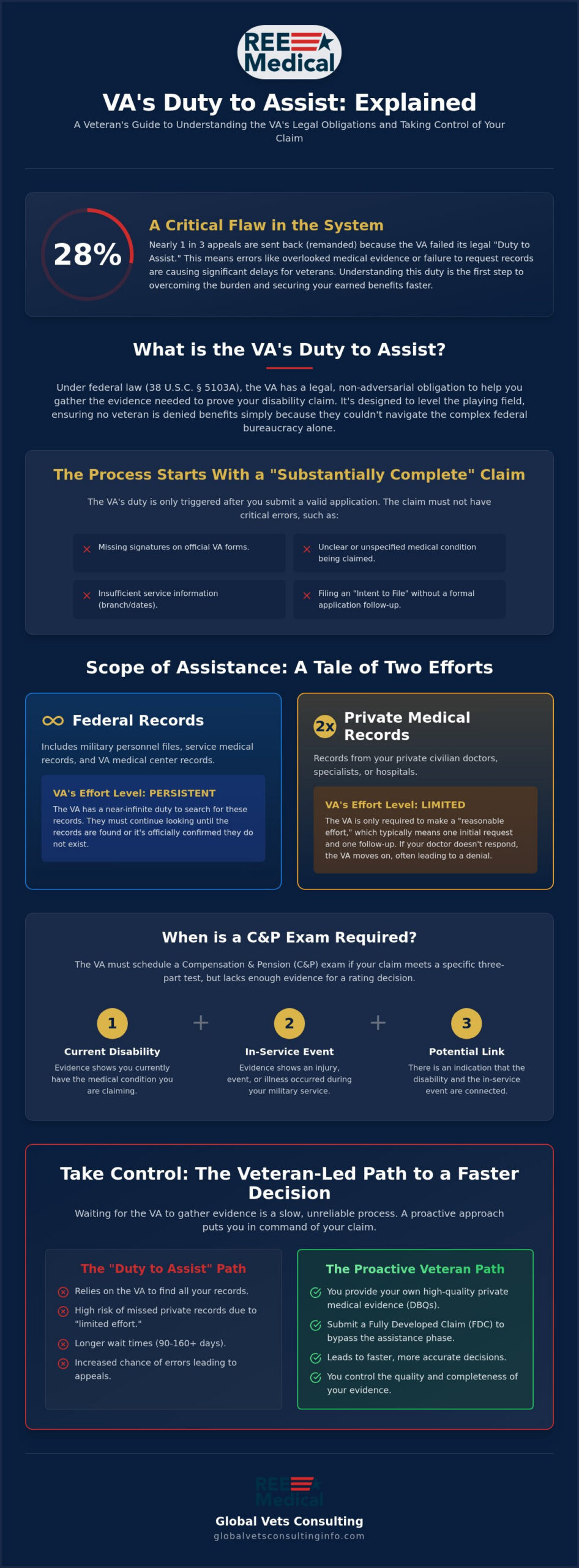
Did you know that roughly 28% of Board of Veterans’ Appeals cases are sent back because the VA failed its basic requirements? It’s exhausting to wait months for a decision only to find out the VA ignored key medical evidence or failed to request your records. Having the va duty to assist explained helps you understand that you shouldn’t have to be a legal expert just to secure the benefits you’ve earned through your service. We know this process feels like a heavy burden, but clarity is the first step toward a resolution.
While the VA has a legal obligation under 38 U.S.C. § 5103A to help gather your records, they often struggle with the sheer volume of claims, leading to oversight and delays. With rating increase claims currently taking between 90 and 160 days in 2026, identifying an error early can save you months of frustration. You deserve a partner who understands the intricacies of the bureaucratic system and can guide you through it with steady confidence.
This guide teaches you exactly what the VA is legally required to do and how to spot the specific errors that could be holding back your benefits. We will examine the legal obligations the VA must meet and how you can use better preparation to secure a faster, more accurate decision.
Key Takeaways
- Understand when the VA’s legal obligation to help you gather evidence begins and what constitutes a “substantially complete” claim to trigger the process.
- Having the va duty to assist explained helps you differentiate between the VA’s near-infinite duty to obtain federal records versus their limited attempts for private medical evidence.
- Learn how to identify common Duty to Assist errors, such as missed exams or overlooked records, that often trigger a remand during a Higher-Level Review.
- Discover why submitting a Fully Developed Claim (FDC) with private medical evidence can bypass the VA’s assistance phase and lead to a faster decision.
- Gain the tools to transition from waiting on the VA to taking control of your claim through high-quality medical evidence education and strategic preparation.
What is the VA Duty to Assist? 🇺🇸
The Department of Veterans Affairs (VA) operates under a unique legal mandate that requires them to help you prove your case. This requirement, established under 38 U.S.C. § 5103A, is known as the Duty to Assist. It ensures the claims process remains non-adversarial. Having the va duty to assist explained helps you realize that the burden of gathering evidence doesn’t rest entirely on your shoulders. The agency is legally obligated to take proactive steps to obtain the records and exams necessary to decide your claim.
This law exists to level the playing field. You are one individual navigating a massive federal bureaucracy, and it’s easy to feel overwhelmed by the requirements for a VA disability claim. The goal of this duty is to ensure that no veteran is denied benefits simply because they couldn’t access a specific military record or afford a private medical evaluation. It transforms the process from a cold, administrative hurdle into a partnership where the VA must help you find the evidence needed to support your service connection.
The ‘Substantially Complete’ Application Rule
The VA doesn’t begin its search for evidence the moment you decide to file. Their legal duty is only triggered once you submit what is known as a “substantially complete” application. If your paperwork is missing critical details, the VA isn’t required to help you until those gaps are filled. Common issues that can stall your progress include:
- Missing signatures on official VA forms.
- Failing to clearly state the specific medical condition you are claiming.
- Insufficient information to identify your branch or dates of service.
- Submitting an “Intent to File” without following up with the formal application.
A substantially complete application serves as the legal catalyst that forces the VA to begin gathering evidence on your behalf. Once this threshold is met, the agency must start the work of requesting your personnel files and scheduling necessary examinations.
The Scope of Assistance: Records, Exams, and Evidence 🇺🇸
The VA’s obligation to help you isn’t a blanket promise to find every document in existence. Instead, it’s a tiered system based on where your records are located. For federal records, like your military personnel file or medical records from a VA medical center, the agency has a near-infinite duty to search. They must keep looking until the records are found or it’s confirmed that they don’t exist. Private medical records are handled with much less persistence. The agency typically makes an initial request and at least one follow-up before they stop their search. If your doctor doesn’t respond, the VA moves forward with whatever they have, which often leads to a claim denial.
The duty also extends to identifying “inferred” claims. If you file for a knee condition but your medical evidence clearly shows a secondary back issue, the VA is legally required to recognize and develop that claim. Understanding the va duty to assist explained in these terms allows you to spot where the agency might be falling short. The goal is to act as an investigator on your behalf, as outlined in the VA’s Duty To Assist guidelines, ensuring no evidence is left behind.
Reasonable Effort vs. Persistent Effort
The VA defines “reasonable effort” for private records as two attempts. If those fail, the burden shifts entirely back to you. This is a common point of failure in many claims. You can take control of this process by providing your own private DBQs. Doing so ensures the evidence is accurate and complete without waiting for an administrative clerk to chase down your old doctor. If you’re unsure how to organize your evidence, exploring educational resources on medical documentation can help you stay ahead of the curve.
When is a C&P Exam Required?
The VA must schedule a Compensation and Pension (C&P) exam if your claim meets a specific three-part test. First, there must be evidence of a current disability. Second, there must be evidence of an event or injury in service. Third, there must be an indication that the two are linked, but the VA lacks enough data to assign a rating. Providing comprehensive medical evidence upfront can sometimes satisfy these requirements, potentially making a new exam unnecessary and speeding up your decision. When you have the va duty to assist explained, you see that the exam is a tool for the VA to fill gaps, not a mandatory hurdle you must always clear.
Duty to Assist Errors: What Happens When the VA Fails? ⚠️
A Duty to Assist (DTA) error is a formal acknowledgment that the VA failed to meet its legal obligations during the initial review of your claim. This specific type of error is typically identified during a Higher-Level Review (HLR). When a senior rater determines that the agency missed a critical step, such as failing to request a specific medical record or neglecting to schedule a necessary C&P exam, they must intervene. This oversight is a direct violation of the standards set in 38 CFR § 3.159. Having the va duty to assist explained in this context reveals that the VA essentially “de-decides” your claim, moving it back into the supplemental lane to fix the mistake.
This correction process is a vital part of the VA disability claims process. While it can be disheartening to have your claim sent back, it ensures that your final rating is based on a complete and accurate picture of your health. If you are struggling with a complex claim, professional evidence education can help you avoid these procedural traps from the start.
Common Signs of a DTA Error in Your Decision Letter
Your decision letter often contains clues that the VA dropped the ball. Look for specific phrases like “the record is incomplete” or “a medical opinion was not requested.” These statements indicate that the rater realized evidence was missing but made a decision anyway. Finding a DTA error is technically a strategic win. It keeps your original effective date alive, ensuring you receive the full backpay you are owed once the error is corrected and the claim is finally approved.
The Downside: The ‘Hamster Wheel’ of Claims
The primary frustration with DTA errors is the timeline. Fixing these mistakes often forces you into the “hamster wheel,” where your claim cycles through the system for an additional 4 to 12 months. This delay occurs because the VA must now perform the tasks they should have completed initially. If you find yourself in this position after a VA claim denied for lack of evidence, it is critical to stay engaged and ensure the VA actually gathers the specific records they missed.
Taking Control: Why Private Evidence Beats Waiting for the VA
Relying on the VA to hunt down your records is a passive strategy that often leads to unnecessary delays. While having the va duty to assist explained shows you what the agency owes you, it doesn’t account for the administrative friction that can stall your life for months. The VA’s “reasonable effort” for private records ends after just two attempts. You can bypass this hurdle by submitting a Fully Developed Claim (FDC). This “Ready-to-Rate” approach minimizes the VA’s need to intervene, which can significantly speed up your decision time in 2026.
You shouldn’t let the VA decide what a “thorough search” looks like for your health history. Taking charge of your medical documentation ensures the rater has every piece of the puzzle on day one. Utilizing professional DBQ preparation is a strategic move that bypasses the wait for VA-scheduled exams. It puts the control back in your hands and ensures your evidence isn’t left to chance.
The Power of the Private DBQ
A private physician often provides a more detailed evaluation than a standard 15-minute C&P exam. A well-written DBQ addresses the VA’s legal obligations by providing the precise medical opinions and symptom documentation required for a rating. This proactive documentation essentially satisfies the VA’s duty for them. It transforms your claim from a pile of questions into a clear path for approval, ensuring the rater has the high-quality evidence they need to make a favorable decision without further development.
Ready to Secure Your Benefits? 📞
- 🇺🇸 Call our 24/7 National Client Services Hotline for guidance on your medical evidence.
- 🌐 Contact our 24/7 AI Veteran Intake Specialist at GlobalVetsConsultingInfo.com to get started.
Secure the VA Rating You Deserve 🇺🇸
Having the va duty to assist explained provides a clear roadmap for what you should expect from the agency, but it also highlights the risks of a passive approach. You now know that while the VA has a legal obligation to gather records, their “reasonable effort” often falls short for private medical evidence. By identifying Duty to Assist errors early or preventing them entirely through a Fully Developed Claim, you protect your effective date and reduce the time spent in the administrative “hamster wheel.”
We are a veteran-owned and operated service that’s been supporting the community since 2021. We specialize in detailed Disability Benefits Questionnaires that provide the technical accuracy raters require. To start your journey toward a faster decision, get your professional DBQ today at Global Vets Consulting. Our 24/7 AI Veteran Intake Specialist is ready to help you organize your medical evidence and take the guesswork out of the process. You’ve served your country with honor; now it’s time to ensure the system serves you with the same level of integrity.
Frequently Asked Questions
What is a Duty to Assist error in a VA claim?
A Duty to Assist error occurs when a Higher-Level Reviewer identifies that the VA failed to obtain necessary evidence before making a decision. This usually happens because a rater missed a medical record or didn’t schedule a required C&P exam. Since this violates federal law, the VA must reopen your claim to gather the missing information while keeping your original filing date active.
How long does it take the VA to fix a Duty to Assist error?
Fixing these errors generally adds 4 to 5 months to your processing time, as the claim must return to the supplemental lane for development. In 2026, supplemental claim reviews are averaging this timeframe for completion. This delay is often called the “hamster wheel” because you’re forced to wait while the agency performs the administrative tasks they should’ve completed during the initial review.
Does the VA have a duty to assist with supplemental claims?
The VA is legally required to assist with supplemental claims once you provide new and relevant evidence. Having the va duty to assist explained for this stage means the agency must help develop that specific new evidence, such as scheduling a new exam if your condition has worsened. They won’t, however, re-search for old records that were already reviewed unless you point out a specific error.
Can I provide my own medical evidence instead of waiting for the VA to help?
You can take control of your timeline by submitting a Fully Developed Claim (FDC) with your own private medical evidence. Using private Disability Benefits Questionnaires (DBQs) ensures the rater has comprehensive data immediately, often making the VA’s assistance phase unnecessary. This proactive approach can help you bypass the standard 90 to 160 day wait for rating increases by providing a “Ready-to-Rate” package.
What happens if the VA fails its duty to assist?
If the VA fails its duty, they’ll likely deny your claim for a lack of evidence, but you can correct this through a Higher-Level Review. Having the va duty to assist explained gives you the terminology to challenge a denial if the VA didn’t make a “reasonable effort” to find your records. A successful challenge preserves your backpay and forces the agency to fix the procedural mistake.

Article by
Willie Daniel
Willie Daniel is the Founder and Chief Executive Officer (CEO) of Global Vets Consulting (GVC) – National Veterans Disability Services, a veteran-led educational and medical evidence support organization dedicated to helping veterans better understand VA disability rating increases, DBQ medical evidence, secondary claims education, and C&P examination preparation.
He is a retired U.S. Army Medical Service Corps Officer with more than 27 years of honorable military service, a decorated Iraq combat veteran, and a retired federal official with the U.S. Department of Veterans Affairs. Throughout his military and federal career, Willie Daniel served in leadership, healthcare administration, operational, and veteran-support roles focused on improving services and support systems for servicemembers, veterans, and their families.
Drawing from decades of military leadership, healthcare administration, veteran advocacy, and federal government experience, Willie Daniel brings a practical, veteran-centered perspective to Global Vets Consulting’s educational articles, AI-powered veteran resources, video education initiatives, and outreach programs. His experience navigating military systems, medical documentation processes, and veteran-related administrative operations provides valuable insight into many of the challenges veterans face when seeking to better understand VA disability rating criteria, medical evidence, documentation strategies, and secondary condition education.
Through GVC’s “Veterans Helping Veterans” mission, his focus is on delivering clear, educational, and easy-to-understand information designed to empower veterans with knowledge, resources, and educational tools that may help them make more informed decisions regarding their individual VA disability journeys.
The information provided through GVC is intended for educational and informational purposes only and should not be considered legal or medical advice.
Disclaimer
Disclaimer: Global Vets Consulting, LLC (“GVC”) is a veteran-led educational and medical evidence support organization. GVC is not a law firm, is not a Veterans Service Organization (VSO), and is not affiliated with the U.S. Department of Veterans Affairs (VA) or any government agency.
Global Vets Consulting does not provide legal advice, medical advice, medical treatment, or healthcare services. GVC does not prepare, file, or submit VA disability claims on behalf of veterans. All information provided through this website, blog articles, videos, educational materials, AI tools, dashboards, templates, and communications is intended solely for general educational and informational purposes.
Veterans are encouraged to consult with accredited representatives, licensed attorneys, qualified medical providers, or Veterans Service Organizations regarding their specific legal, medical, or VA-related matters. VA disability decisions, ratings, and outcomes are determined solely by the U.S. Department of Veterans Affairs based on applicable laws, regulations, medical evidence, and individual circumstances. Past results do not guarantee future outcomes.