

What if the most important medical appointment of your life isn’t actually about your health? It’s natural to feel a surge of anxiety when that notice arrives in the mail. Most veterans walk into these rooms expecting a standard checkup, only to feel “lowballed” or misunderstood by a contractor who seems to be rushing through the process. Understanding exactly What Happens at a C&P Exam is the first step toward overcoming that uncertainty and ensuring your symptoms are documented correctly.
We’re here to help you navigate this process with steady confidence. You deserve a clear mental map of the appointment so you can arrive prepared to secure the rating you’ve earned. This guide provides a step-by-step look at the forensic nature of the exam, the critical role of the Disability Benefits Questionnaire (DBQ), and how to present your symptoms accurately. We’ll also cover how the 2026 policy regarding medication’s effect on disability ratings changes the way you should discuss your daily functioning. By the end of this article, you’ll have the tools to turn a stressful event into a successful piece of medical evidence for your claim.
Key Takeaways
- Distinguish the exam as a forensic evaluation rather than a treatment appointment to set the right expectations for your interaction with the examiner.
- Walk through the logistical details of What Happens at a C&P Exam, including check-in procedures and how the examiner uses the DBQ to interview you.
- Learn to navigate the “Tough Guy” trap by focusing on your symptoms at their most severe to ensure your rating reflects your true level of impairment.
- See why a completed Disability Benefits Questionnaire (DBQ) is the most effective tool for guiding the examiner and substantiating your medical evidence.
- Prepare for the impact of 2026 policy changes that require examiners to evaluate your functioning while using medication and treatment.
Understanding the Purpose of the C&P Exam in 2026 🌐
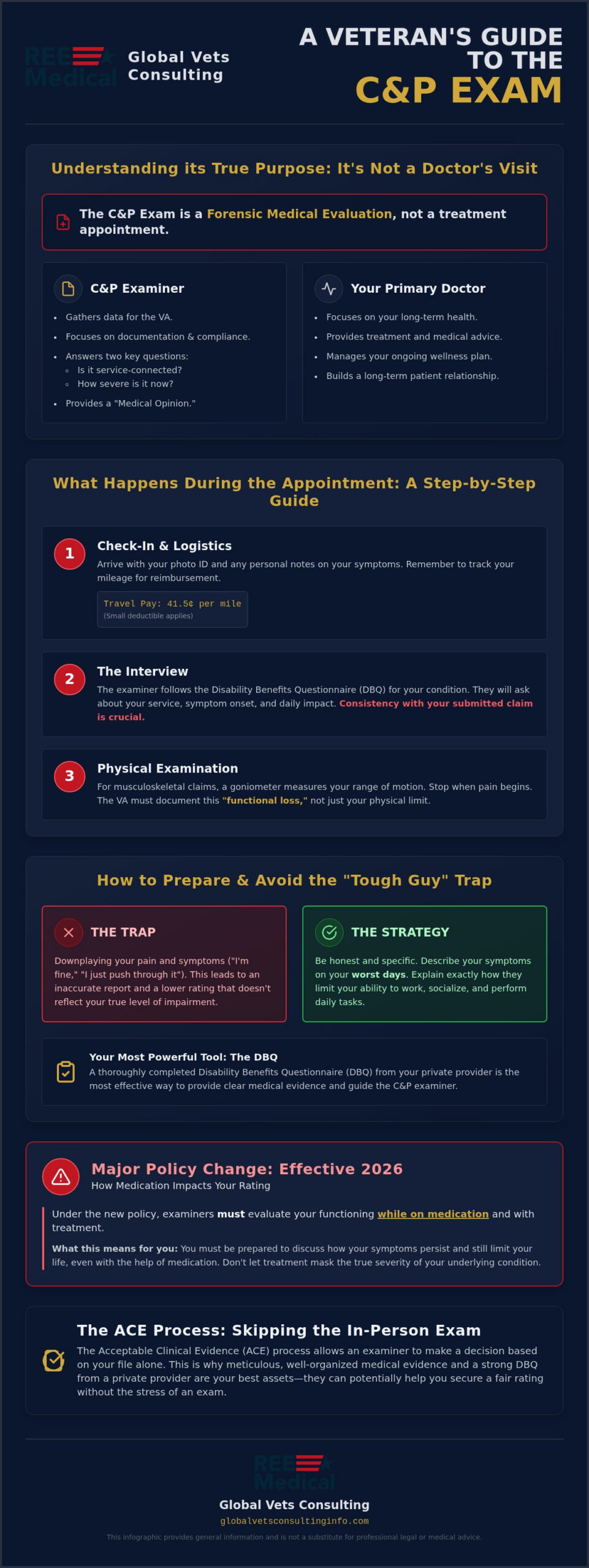
The C&P exam stands for Compensation and Pension. In 2026, the VA continues to shift its workload toward third-party contractors like VES, QTC, and OptumServe to handle these evaluations. It’s vital to understand that this is a forensic medical evaluation, not a standard checkup. The examiner’s job isn’t to heal you, provide medical advice, or write a prescription. Instead, they’re gathering data to answer two specific questions: is your condition service-connected, and how severe are your symptoms right now? Knowing exactly What Happens at a C&P Exam helps you prepare for this forensic environment where documentation is the only currency that matters.
When you’re wondering What Happens at a C&P Exam, think of it as a fact-finding mission for the VA. The examiner reviews your records and observes your physical or mental state to provide a “Medical Opinion.” This opinion often dictates whether the VA grants your claim or denies it. They’re looking for evidence that matches the VA’s specific rating criteria, so your goal is to be a clear, honest source of information regarding your disability.
The Examiner vs. Your Primary Care Doctor
Don’t walk into the room expecting medical advice or a plan to manage your pain. Your primary care doctor focuses on your long-term wellness; a C&P examiner focuses on compliance and documentation. They are essentially a witness for the VA’s administrative process. This is especially true for forensic mental health evaluations, where the goal is to map your symptoms to specific legal criteria. You don’t need to convince them you’re a good person. You need to provide the specific medical evidence they require to fill out their forms correctly.
When the VA Skips the Exam: The ACE Process
Sometimes, the VA won’t ask you to show up in person. This is called the Acceptable Clinical Evidence (ACE) process. If your medical evidence is thorough and your DBQs are completed correctly by private providers, the examiner might simply review your file. This happens when the paperwork tells the whole story without needing a physical examination. Providing meticulous documentation upfront is the best way to ensure the VA has everything they need for a fair rating without the stress of an extra appointment.
Step-by-Step: What Actually Happens During the Appointment 📞
Walking into the clinic for your VA claim exam often feels like a high-stakes interrogation, but it’s actually a structured sequence of events. Understanding the mechanics of What Happens at a C&P Exam can help lower your stress and keep you focused on the mission. Your appointment begins at the front desk. You’ll need your photo ID and any notes you’ve prepared regarding your symptoms. If you’re driving yourself, keep track of your mileage. As of July 2026, the VA reimburses travel at 41.5 cents per mile, though a small deductible of $3 for a one-way trip or $6 for a round trip applies, capped at $18 per month.
Once you’re called back, the interview portion starts. The examiner will follow a specific script based on the Disability Benefits Questionnaire (DBQ) for your condition. They’ll ask about your military service, when your symptoms began, and how they impact your daily life. It’s essential to be consistent with the VA disability claims process step by step documentation you’ve already submitted. Any contradictions between your written statement and your verbal answers can create “red flags” for the rater.
The Review of Medical History
The examiner usually reviews your C-File (Claims File) before you enter the room. This file contains your service treatment records and any private medical evidence you’ve provided. They are looking for a “nexus,” which is the clear link between your service and your current diagnosis. If your records are disorganized, it makes their job harder and increases the chance of a mistake. This is why having a clear, professional roadmap of your medical history is vital for a successful outcome.
Physical Exams: Range of Motion and Functional Loss
For musculoskeletal claims, the examiner will use a goniometer to measure your range of motion. This tool measures the exact degree to which you can bend or extend a joint. Don’t push through the pain. The VA is required to record “functional loss,” which means the point where pain begins, not just where your joint physically stops moving. Under the February 17, 2026, policy update, examiners must evaluate your disability based on your functioning while using medication. Be prepared to discuss how your symptoms persist even with treatment. If you want to ensure your evidence is presented clearly before you even walk in, consider how expertly prepared DBQs can serve as your primary evidence.
How to Prepare: Avoiding Common Mistakes and the “Tough Guy” Trap 🇺🇸
Many veterans walk into the exam room and fall into the “tough guy” trap. You’ve been trained to embrace the suck and push through pain, but doing that here will result in a lower rating. When considering What Happens at a C&P Exam, you must remember the “Worst Day” rule. You aren’t being evaluated on how you feel during that specific 30-minute window; you’re being evaluated on the totality of your disability. If you’re having a “good day” during the appointment, you must still describe your symptoms at their most severe.
Avoid the “fine” reflex at all costs. When the examiner asks how you’re doing, answering with “I’m doing okay” or “I’m fine” is often recorded as a lack of symptoms. Instead, be specific about your limitations. Functional loss is the inability to perform a task due to pain, even if movement is possible. This distinction is vital because the VA rates you on how your condition interferes with your life and work. Buddy statements from spouses or fellow service members can provide the necessary context that a short exam might miss, reinforcing the reality of your daily struggles.
Mental Health Exam Specifics
Talking about your mental state can be difficult, but accuracy is essential for a DBQ for mental health conditions. The examiner will focus on “Social and Occupational Impairment.” This isn’t a judgment of your character; it’s a measurement of how your symptoms, like anxiety or depression, affect your ability to maintain relationships and hold a job. Be honest about your struggles without filtering the details to sound more “put together” than you actually are.
Preparing Your “Cheat Sheet”
Don’t rely on your memory alone. Bring a written list of your symptoms and how they impact your daily routine. This “cheat sheet” ensures you don’t forget a critical detail when the pressure is on. It also helps you verify that the examiner addresses every condition listed on your claim. Reviewing the official Disability Benefits Questionnaires (DBQs) beforehand allows you to see the exact questions the examiner is required to ask. If you’re feeling overwhelmed by the requirements, you can get professional DBQ preparation assistance to ensure your medical evidence is bulletproof before your appointment.
Beyond the Exam: The Role of DBQs in Securing Your Rating 🌍
Understanding what is a dbq for va claims is the most powerful way to influence What Happens at a C&P Exam. These forms are the gold standard of medical evidence because they translate your symptoms into the VA’s specific rating language. When you walk into an appointment with a privately prepared DBQ already in your file, you’ve provided the examiner with a clear roadmap of your condition. It ensures they don’t miss key symptoms that could lead to an inaccurate rating.
If the findings from the examiner contradict your private medical evidence, you have options. The VA is required to consider all evidence fairly, and a well-documented private opinion carries significant weight. If your va claim was denied for lack of evidence, it usually means the link between your service and your current symptoms wasn’t clear enough. Strengthening your documentation with professional education is the best way to resolve these gaps and secure the benefits you earned.
Leveraging Professional DBQ Preparation
Global Vets Consulting specializes in helping you document the full picture of your disability. Our veteran-owned team understands that a short appointment can’t always capture years of chronic pain or mental health struggles. By providing education on accurate medical evidence, we help you prepare a DBQ that matches the VA’s own rating criteria exactly. This level of meticulousness reduces the chance of human error during the What Happens at a C&P Exam process.
Requesting a Rating Increase
Your health can change over time, and your rating should reflect that reality. If your service-connected condition gets worse, you can use a dbq for va disability rating increase to substantiate your need for more compensation. This form provides the medical proof that your symptoms now meet a higher percentage threshold under the law. Don’t wait for the system to catch up to your needs. Take the initiative to document your functional loss with precision. Ready to secure the evidence you need? Connect with Global Vets Consulting today!
Take Command of Your VA Claim Outcome
You now have a clear mental map of the forensic environment you’ll encounter during your appointment. By focusing on your symptoms at their most severe and utilizing a Disability Benefits Questionnaire (DBQ) to guide the conversation, you can ensure the examiner captures the full reality of your disability. Knowing exactly What Happens at a C&P Exam allows you to walk into that room as an informed advocate for your own health, rather than a passive participant in a bureaucratic process. Preparation is the difference between a denied claim and a successful rating.
Our team at Global Vets Consulting provides the veteran-owned expertise and national support you need for all VA conditions. With our 24/7 AI Veteran Intake Specialist and dedicated focus on medical evidence education, we help you bridge the gap between your military history and the benefits you’ve earned. Don’t leave your future to chance or a rushed contractor’s notes. You’ve served with honor; now let’s work together to secure the compensation you deserve.
🇺🇸 Get the Medical Evidence You Need – Start Your DBQ Assessment Now
Frequently Asked Questions
How long does a C&P exam usually last?
A C&P exam typically lasts between 15 minutes and one hour, depending on the complexity of your claimed condition. Mental health evaluations often require a longer discussion to cover social and occupational impairment, while a physical exam for a single joint might be much faster. Regardless of the time spent in the room, the examiner is required to address every specific question on the DBQ to ensure your medical evidence is complete.
Can I bring a spouse or a friend to my C&P exam?
You are generally allowed to bring a spouse, friend, or family member to your appointment, but the final decision rests with the individual examiner. Having a witness can be helpful for those with memory issues or severe anxiety. Your companion can provide valuable context regarding how your symptoms affect your daily life, effectively acting as a real-time buddy statement to support your claim for a VA rating increase.
What should I do if I disagree with the C&P examiner’s findings?
If you disagree with the examiner’s report, you should immediately write a Statement in Support of Claim to document your specific concerns. Clearly explain any symptoms the examiner ignored or any physical measurements that were taken incorrectly. Understanding What Happens at a C&P Exam helps you identify these errors early so you can request a new evaluation or submit additional medical evidence to counter the contractor’s findings.
Do I need a C&P exam if I already submitted a private DBQ?
The VA may still order an appointment even if you’ve submitted a private DBQ, though a well-prepared form often leads to an ACE review instead. An ACE review allows the examiner to complete the evaluation based solely on your existing medical records without an in-person visit. Providing high-quality evidence upfront reduces the likelihood of an extra exam and speeds up the average processing time, which is currently around 80 days.
What happens if I miss my scheduled VA claim exam?
Missing a scheduled exam without good cause can lead to an immediate denial of your disability claim. If an emergency arises, you must contact the VA or the contract provider immediately to reschedule. Knowing What Happens at a C&P Exam includes understanding the importance of attendance. The VA generally allows one rescheduling request, but failing to show up twice will result in a decision based only on the evidence already in your file.

Article by
Willie Daniel
Willie Daniel is the Founder and Chief Executive Officer (CEO) of Global Vets Consulting (GVC) – National Veterans Disability Services, a veteran-led educational and medical evidence support organization dedicated to helping veterans better understand VA disability rating increases, DBQ medical evidence, secondary claims education, and C&P examination preparation.
He is a retired U.S. Army Medical Service Corps Officer with more than 27 years of honorable military service, a decorated Iraq combat veteran, and a retired federal official with the U.S. Department of Veterans Affairs. Throughout his military and federal career, Willie Daniel served in leadership, healthcare administration, operational, and veteran-support roles focused on improving services and support systems for servicemembers, veterans, and their families.
Drawing from decades of military leadership, healthcare administration, veteran advocacy, and federal government experience, Willie Daniel brings a practical, veteran-centered perspective to Global Vets Consulting’s educational articles, AI-powered veteran resources, video education initiatives, and outreach programs. His experience navigating military systems, medical documentation processes, and veteran-related administrative operations provides valuable insight into many of the challenges veterans face when seeking to better understand VA disability rating criteria, medical evidence, documentation strategies, and secondary condition education.
Through GVC’s “Veterans Helping Veterans” mission, his focus is on delivering clear, educational, and easy-to-understand information designed to empower veterans with knowledge, resources, and educational tools that may help them make more informed decisions regarding their individual VA disability journeys.
The information provided through GVC is intended for educational and informational purposes only and should not be considered legal or medical advice.
Disclaimer
Disclaimer: Global Vets Consulting, LLC (“GVC”) is a veteran-led educational and medical evidence support organization. GVC is not a law firm, is not a Veterans Service Organization (VSO), and is not affiliated with the U.S. Department of Veterans Affairs (VA) or any government agency.
Global Vets Consulting does not provide legal advice, medical advice, medical treatment, or healthcare services. GVC does not prepare, file, or submit VA disability claims on behalf of veterans. All information provided through this website, blog articles, videos, educational materials, AI tools, dashboards, templates, and communications is intended solely for general educational and informational purposes.
Veterans are encouraged to consult with accredited representatives, licensed attorneys, qualified medical providers, or Veterans Service Organizations regarding their specific legal, medical, or VA-related matters. VA disability decisions, ratings, and outcomes are determined solely by the U.S. Department of Veterans Affairs based on applicable laws, regulations, medical evidence, and individual circumstances. Past results do not guarantee future outcomes.