
You are sitting in a quiet waiting room, your heart is racing, and your mind goes blank the moment the doctor asks, “How have you been feeling lately?” It is a common experience for many veterans facing a C&P Exam Depression, where the pressure to summarize years of mental health struggles in a short window feels overwhelming. You probably worry that if you don’t say the exact right words, or if the examiner is having a bad day, you will receive a rating that doesn’t reflect your reality. It is frustrating to feel like your future depends on a single conversation where you might freeze up and forget your most critical symptoms.
We understand these challenges because we have been in your boots. This guide will show you exactly how to translate your lived experience into the specific medical language the VA uses to determine benefits, ensuring you feel prepared and confident. You will learn what to expect during the appointment, how the Disability Benefits Questionnaire (DBQ) dictates your results, and how to document your symptoms accurately to secure the rating you deserve. By following this methodical approach, you can turn a stressful event into a clear path toward the compensation you earned through your service.
Key Takeaways
- Understand that your C&P Exam Depression is a forensic medical evaluation designed to measure your “Occupational and Social Impairment” rather than a typical therapy session.
- Learn the specific criteria under 38 CFR § 4.130 that VA examiners use to determine if your symptoms qualify for a rating between 0% and 100%.
- Gain confidence for your appointment by reviewing your medical history and personal statements so you don’t freeze up when discussing your post-service struggles.
- Discover how a private Disability Benefits Questionnaire (DBQ) serves as a vital safeguard, providing the VA with comprehensive medical evidence to support your true rating.
Understanding the C&P Exam for Depression 🇺🇸
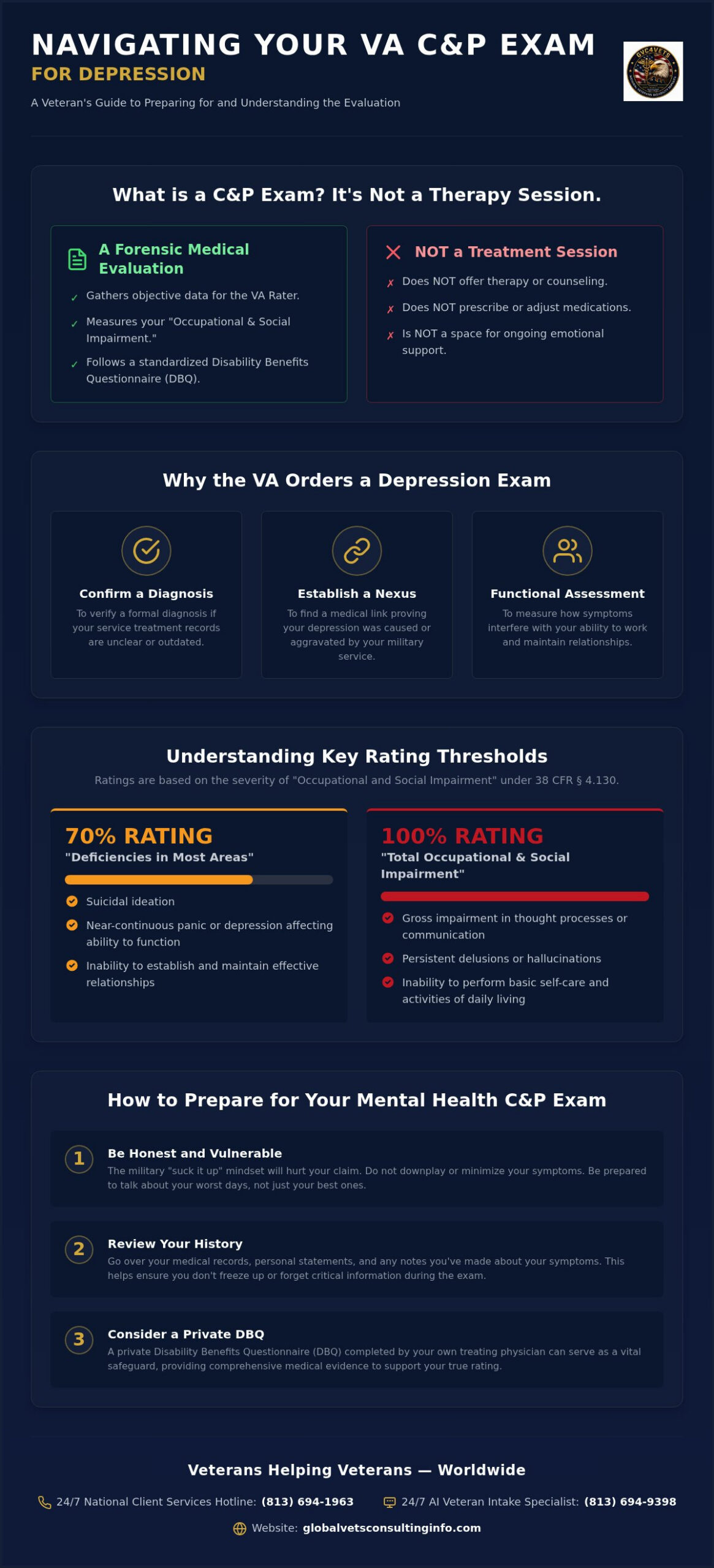
The Compensation and Pension (C&P) exam is often the most misunderstood part of the disability process. It is vital to remember that this appointment is a forensic medical evaluation rather than a treatment session. The doctor isn’t there to prescribe medication or offer therapy. Their objective is to gather data for the VA Rater to determine your service connection and level of “Occupational and Social Impairment.” A C&P Exam Depression evaluation serves as the critical bridge between your military service and your final VA rating.
During the evaluation, the examiner follows a specific template called a Disability Benefits Questionnaire (DBQ). This document standardizes how they record your symptoms. Every box they check directly influences your percentage. Being clear about your worst days is essential for an accurate outcome because the Rater relies almost entirely on this standardized report to make their decision.
Why the VA Orders a Depression Exam
The VA typically schedules an exam for three specific reasons:
- Confirming a Diagnosis: They need to verify a formal diagnosis if your service treatment records are unclear or outdated.
- Establishing a Nexus: They must find a medical link proving your depression was caused or aggravated by your time in uniform.
- Functional Assessment: They need to see how your symptoms interfere with your ability to work and maintain relationships.
The Role of Medical Evidence in Your Claim
Your medical records are the foundation of your case, but the VA views the C&P exam as the current “snapshot” of your health. It carries significant weight because it reflects your condition at this exact moment. Understanding where the exam fits in the VA disability claims process step by step helps you see it as a manageable hurdle. Preparing for a C&P Exam Depression requires combining strong medical evidence with a clear exam performance to ensure your rating matches your lived experience.
What the VA Examiner is Really Rating: The Criteria
The VA doesn’t just guess your disability rating. They follow a specific legal framework found in 38 CFR § 4.130, the Schedule of Ratings for Mental Disorders. This schedule provides the precise language examiners use to categorize your symptoms. Ratings for depression range from a 0% non-compensable status to a 100% total impairment rating. When you attend your C&P Exam Depression, the examiner is analyzing the frequency, severity, and duration of your symptoms to see how they disrupt your daily life.
The primary focus is something called “Occupational and Social Impairment.” This isn’t just a medical term; it is a measure of how depression prevents you from functioning like you used to before your service. The rater wants to see if your condition makes it impossible to hold a job or keep a stable home life.
Understanding Occupational and Social Impairment
Occupational impairment appears when you have trouble following instructions from a supervisor or struggle to complete tasks on time. It’s the reason you might have a “spotty” work history or find it difficult to stay focused in a professional environment. Social impairment is about your life outside of work. Are you isolating from friends? Do you find yourself avoiding family gatherings because you can’t face people? These are the real-world impacts the VA needs to hear. For more details on these categories, you can review our guide on the DBQ for mental health conditions.
The 70% vs. 100% Rating Threshold
The difference between rating levels often comes down to specific symptoms that indicate severe distress. A 70% rating is common for veterans who experience “deficiencies in most areas.” This includes suicidal ideation, near-continuous panic attacks, or a complete inability to maintain stable relationships. Moving to a 100% rating requires evidence of “total social and occupational impairment.” This usually involves a gross impairment in communication, persistent delusions, or an inability to perform basic self-care. If you feel your current rating doesn’t match your symptoms, seeking medical evidence education might be the right next step to ensure you’re prepared for the evaluation process.
How to Prepare for Your Mental Health C&P Exam Day
Walking into the room for your C&P Exam Depression requires a total shift in mindset. You spent years in the military learning to “suck it up,” but this is the one environment where that habit will actively hurt your claim. You must be willing to be vulnerable and honest about your internal struggles rather than “toughing it out” like you did in basic training. Before your appointment, take time to review your medical history and any personal statements you previously submitted. You should be ready to discuss your life in three distinct stages: your life before service, the events during your time in uniform, and the specific struggles you face post-service.
It is also vital to understand that the evaluation often starts before you even sit down in the examiner’s office. Many examiners observe your behavior from the moment you enter the building, noting how you interact with the front desk staff or how you carry yourself in the waiting room. If you tell the doctor you are too depressed to leave the house but you arrive looking perfectly polished and cheerful, it creates a discrepancy in their report.
The ‘Worst Day’ Rule
One of the biggest traps veterans fall into is answering the question “How are you?” with “I’m doing okay.” If you provide that standard response, the examiner may check the box for “no impairment.” You should never describe how you feel on a “good” day. Instead, focus on your symptoms during your worst days. Be specific with your data. Instead of saying “I’m tired a lot,” tell them, “I stay in bed for three days straight once a month because I cannot face the world.” This concrete detail helps the examiner understand the depth of your condition.
Common Mistakes to Avoid at the Exam
- Mistake #1: Clean-shaving and wearing a suit if you usually struggle with hygiene due to your depression. Your appearance should reflect your actual daily struggle.
- Mistake #2: Bringing up non-service-connected stressors, like a recent divorce or financial issues, as the primary cause of your depression. Focus on the service connection.
- Mistake #3: Treating the examiner like a therapist. They are there to evaluate your history and symptoms, not to provide treatment or emotional support.
If you feel overwhelmed by the thought of explaining your history, our team provides C&P examination preparation education to ensure you feel ready to speak your truth on exam day.
How a Private DBQ Can Protect Your Depression Claim
A contract examiner usually spends only 15 to 45 minutes assessing your entire mental health history. This brief window makes it difficult for a stranger to capture the full scope of your daily struggle. In contrast, a private doctor who knows your long-term history can provide a much more comprehensive view. Submitting a private Disability Benefits Questionnaire (DBQ) provides the VA Rater with “competent and credible” medical evidence that they must legally weigh against the findings of the C&P examiner.
Independent medical evidence ensures your symptoms are recorded using VA-standard language, protecting your claim from a potentially rushed or unfavorable evaluation during a C&P Exam Depression. This proactive approach ensures the rater sees a complete picture of your life rather than a 20-minute snapshot.
Supplementing the C&P with Independent Evidence
It is a strategic decision to secure a private DBQ for your VA claim before your appointment. The VA is required to consider all evidence of record, not just the C&P findings. Using independent evidence allows you to document the specific frequency and severity of your symptoms on your own terms.
Why Veterans Choose Global Vets Consulting Worldwide 🌎
Global Vets Consulting specializes in educating veterans on how to secure the vital documentation needed for an accurate VA rating increase. We are veteran-owned and operated, and we understand the meticulousness required to navigate the system successfully. Our mission is to ensure no veteran is left behind due to incomplete medical paperwork.
Contact us anytime for immediate assistance:
- ☎️ 24/7 National Client Services Hotline
- 🤖 24/7 AI Veteran Intake Specialist
- 🌐 GlobalVetsConsultingInfo.com
Take Command of Your Disability Rating 🇺🇸
Navigating the bureaucratic complexities of a C&P Exam Depression doesn’t have to be a source of anxiety. While the VA system is rigid, being equipped with technical accuracy and comprehensive medical evidence puts you back in the driver’s seat. You have served your country with honor; ensuring your disability rating reflects your true level of impairment is simply the final mission of your service journey. By prioritizing meticulous documentation and professional education, you move closer to the benefits you’ve rightfully earned.
Global Vets Consulting Worldwide has been veteran-owned and operated since 2021. We specialize in mental health DBQ education and are dedicated to simplifying the claims process for our community. Whether you are preparing for an upcoming evaluation or seeking a rating increase, we are here to provide the direct, expert support you deserve.
Immediate Support Available 24/7:
- ☎️ 24/7 National Client Services Hotline
- 🌐 Get the medical evidence you need for your VA claim at Global Vets Consulting
Stand firm in your truth and take the next step toward a fair outcome. We are ready to assist you every step of the way.
Frequently Asked Questions
Is the C&P exam for depression hard to pass?
A C&P Exam Depression isn’t a test with a “passing” score; it is a forensic evaluation of your mental health. The challenge isn’t “passing,” but rather ensuring the examiner understands the full depth of your occupational and social impairment. You achieve a favorable outcome by being honest about your symptoms and providing specific examples of how depression affects your ability to work and maintain relationships.
What happens if I miss my C&P exam for depression?
Missing your scheduled exam can result in the VA denying your claim for “failure to prosecute.” If you cannot attend, you should notify the VA or the exam contractor as soon as possible to request a reschedule for good cause. Failing to show up without notice often leads the VA to make a decision based only on existing records, which rarely results in the rating you deserve.
Can I bring my spouse or a friend with me to my mental health exam?
You can request to have a spouse or close friend accompany you, but the examiner has the final authority to allow them into the room. It’s often beneficial to have a partner present because they see the symptoms you might live with but fail to notice, such as irritability or chronic fatigue. If the examiner denies your request, your witness should stay nearby to help you decompress after the appointment.
How long does a C&P exam for depression usually take?
Most mental health evaluations take between 15 and 45 minutes to complete. This limited time frame is why many veterans feel their C&P Exam Depression was “rushed” or incomplete. To make the most of these minutes, you should have a clear list of your symptoms and functional limitations ready so you don’t forget important details when the pressure is on.
Can a private DBQ replace the need for a C&P exam?
A private DBQ can sometimes allow the VA to skip the physical exam through the ACE process, but they usually still order a C&P. The real value of a private DBQ isn’t necessarily replacing the VA’s exam, but providing a “competent and credible” counter-balance to it. This ensures the VA Rater sees your long-term medical history rather than just a brief snapshot from a contract doctor.

Article by
Willie Daniel
Willie Daniel is the Founder and Chief Executive Officer (CEO) of Global Vets Consulting (GVC) – National Veterans Disability Services, a veteran-led educational and medical evidence support organization dedicated to helping veterans better understand VA disability rating increases, DBQ medical evidence, secondary claims education, and C&P examination preparation.
He is a retired U.S. Army Medical Service Corps Officer with more than 27 years of honorable military service, a decorated Iraq combat veteran, and a retired federal official with the U.S. Department of Veterans Affairs. Throughout his military and federal career, Willie Daniel served in leadership, healthcare administration, operational, and veteran-support roles focused on improving services and support systems for servicemembers, veterans, and their families.
Drawing from decades of military leadership, healthcare administration, veteran advocacy, and federal government experience, Willie Daniel brings a practical, veteran-centered perspective to Global Vets Consulting’s educational articles, AI-powered veteran resources, video education initiatives, and outreach programs. His experience navigating military systems, medical documentation processes, and veteran-related administrative operations provides valuable insight into many of the challenges veterans face when seeking to better understand VA disability rating criteria, medical evidence, documentation strategies, and secondary condition education.
Through GVC’s “Veterans Helping Veterans” mission, his focus is on delivering clear, educational, and easy-to-understand information designed to empower veterans with knowledge, resources, and educational tools that may help them make more informed decisions regarding their individual VA disability journeys.
The information provided through GVC is intended for educational and informational purposes only and should not be considered legal or medical advice.
Disclaimer
Disclaimer: Global Vets Consulting, LLC (“GVC”) is a veteran-led educational and medical evidence support organization. GVC is not a law firm, is not a Veterans Service Organization (VSO), and is not affiliated with the U.S. Department of Veterans Affairs (VA) or any government agency.
Global Vets Consulting does not provide legal advice, medical advice, medical treatment, or healthcare services. GVC does not prepare, file, or submit VA disability claims on behalf of veterans. All information provided through this website, blog articles, videos, educational materials, AI tools, dashboards, templates, and communications is intended solely for general educational and informational purposes.
Veterans are encouraged to consult with accredited representatives, licensed attorneys, qualified medical providers, or Veterans Service Organizations regarding their specific legal, medical, or VA-related matters. VA disability decisions, ratings, and outcomes are determined solely by the U.S. Department of Veterans Affairs based on applicable laws, regulations, medical evidence, and individual circumstances. Past results do not guarantee future outcomes.