

Could your dermatitis be more severe than a brief exam suggests? A Dermatitis VA Rating can depend on more than how your skin looks on one day. The areas affected, treatment history, and evidence connecting the condition to service may all matter.
If you’re unsure which flare-ups or medical records best show your condition, you’re not alone. This guide explains the general rating factors and how to organize evidence, including treatment records and a physician-completed Disability Benefits Questionnaire (DBQ). You’ll also learn what documentation may help clarify service connection and what steps to consider if your current rating doesn’t reflect the condition documented in your records.
Independent medical documentation can help describe your condition clearly, but it can’t guarantee a particular VA decision. For veteran-to-veteran support, call the 24/7 National Client Services Hotline or 24/7 AI Veteran Intake Specialist Brittany™ at (727) 350-8387. You can also find VA benefits education and resources at https://www.GlobalVetsConsultingInfo.com.
Key Takeaways
- Understand how the Dermatitis VA Rating considers affected skin areas and treatment when evaluating severity.
- Keep dated notes on symptoms, flare-ups, affected areas, and treatment, and organize them with relevant medical records to show how your condition changes over time.
- A diagnosis alone doesn’t establish service connection. Evidence about when the condition began and its possible connection to service may help explain the basis for a claim.
- If your current rating may not reflect documented severity, consider DBQ documentation support. You file the claim, and the VA decides the outcome. Call the 24/7 National Client Services Hotline or 24/7 AI Veteran Intake Specialist Brittany™ at (727) 350-8387, or visit https://www.GlobalVetsConsultingInfo.com.
What a dermatitis VA rating evaluates: symptoms and service connection
Dermatitis is a general term for skin inflammation that can cause itching, redness, rashes, or scaling. It may be ongoing or occur in flare-ups, and its pattern can vary. For a general overview of its forms and characteristics, see What is Dermatitis?
A dermatitis diagnosis describes a skin condition; VA service connection and a disability rating depend on evidence that meets applicable VA rules. A diagnosis alone doesn’t establish that the condition began during service, resulted from an in-service event or exposure, or is connected to another service-connected condition. The Dermatitis VA Rating process therefore involves documenting both the condition and the basis for connecting it to service.
Which symptoms may be described in a dermatitis claim?
Describe what you experience without trying to diagnose yourself. Relevant details may include itching, inflammation, rashes, scaling, and recurring flare-ups. Dated notes can help distinguish symptoms that persist from episodes that come and go. For each flare, record when it starts and improves, where it appears, and how it affects daily activities. Keep entries factual and make them close to the time of the symptoms, rather than relying on memory later.
How does service connection relate to a dermatitis rating?
Medical evidence can document a current diagnosis and symptoms, while service-related evidence may help establish when the condition began or what may have contributed to it. Depending on the circumstances, relevant evidence could include service records, treatment history, or a medical explanation connecting the condition to service. Symptoms by themselves don’t establish that connection, and eligibility isn’t automatic. The VA evaluates the evidence under applicable rules.
For an overview of how evidence fits into the broader process, review the VA disability claims process step by step. Separating evidence of a diagnosis from evidence of service connection can help you see what your records already establish and what may need further documentation.
Dermatitis VA rating criteria: how affected areas and treatment fit
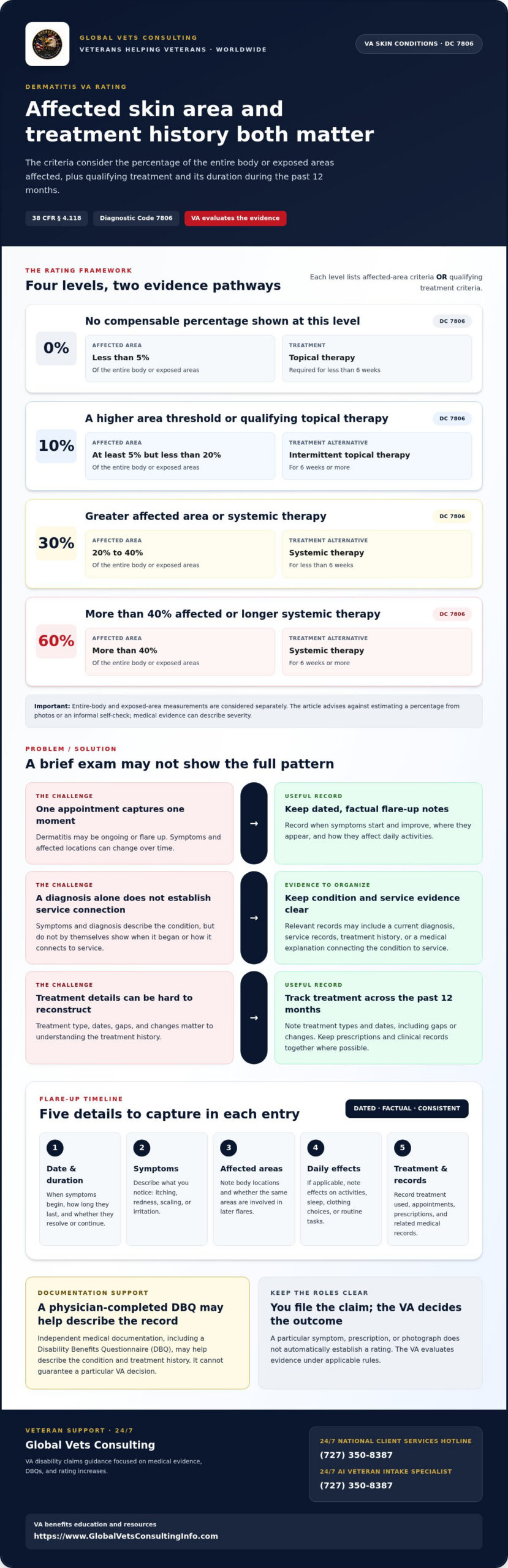
The Dermatitis VA Rating uses criteria in 38 CFR § 4.118, Diagnostic Code 7806. The VA Schedule of Ratings for Skin Conditions sets out the official framework. In general, the criteria consider the percentage of the entire body or exposed areas affected, along with qualifying treatment and its duration during the past 12 months. A particular symptom, prescription, or photograph doesn’t automatically establish a rating.
| Rating level | General criteria under DC 7806 |
|---|---|
| 0% | Less than 5% of the entire body or exposed areas affected, with topical therapy required for less than 6 weeks. |
| 10% | At least 5% but less than 20% of the entire body or exposed areas affected, or intermittent topical therapy for 6 weeks or more. |
| 30% | 20% to 40% of the entire body or exposed areas affected, or systemic therapy for less than 6 weeks. |
| 60% | More than 40% of the entire body or exposed areas affected, or systemic therapy for 6 weeks or more. |
How does the VA consider affected skin areas?
The entire-body measure considers affected skin across the whole body. Exposed areas are considered separately from total body surface. Don’t estimate a percentage from photos or an informal self-check. Instead, note the locations affected and when symptoms occur, and use medical evidence to describe severity.
How can treatment history affect dermatitis evaluation?
Topical therapy is applied to the skin; systemic therapy is treated separately in the criteria. Keep a record of treatment types and dates across the 12-month period, including gaps or changes. The schedule distinguishes treatment categories and duration, so one medication or brief course doesn’t determine the outcome by itself. Independent medical documentation, including a DBQ, may help describe the condition and treatment history. Learn about documentation support at Global Vets Consulting.
Build clearer dermatitis evidence with symptom and treatment records
A consistent record can show how dermatitis changes over time, not just what was visible at one appointment. To make your Dermatitis VA Rating evidence easier to review, keep dated notes and organize them with relevant medical records. Be specific and factual. Don’t exaggerate symptoms or treat a single observation as proof of a recurring pattern.
What should a dermatitis symptom timeline include?
Use the same simple sequence each time you make an entry:
- Date and duration: Record when symptoms begin, how long they last, and whether they resolve or continue.
- Symptoms: Describe what you notice, such as itching, redness, scaling, or irritation, in your own words.
- Affected areas: Note the body locations involved and whether the same areas are affected during later flare-ups.
- Daily effects: Briefly record how symptoms affect ordinary activities, sleep, clothing choices, or routine tasks, if applicable.
- Treatment and records: Note treatment used and relevant appointments or medical records. Keep prescriptions and clinical documentation together where possible.
This timeline can help distinguish recurring symptoms from a one-time observation. If details change, record what changed and when instead of rewriting earlier entries.
How do DBQs and C&P examinations fit into the evidence?
A clinician uses a Disability Benefits Questionnaire (DBQ) to document medical findings relevant to the condition. A DBQ is evidence, not a VA decision, and it doesn’t set or guarantee a rating. During a Compensation and Pension (C&P) examination, give a clear account of your history and symptoms. The VA evaluates the complete claim record.
A doctor isn’t required to file a claim, but independent medical documentation can make a big difference in describing the condition. You can review this DBQ guide for VA rating increases to understand how documentation may support an increase request. For help understanding dermatitis documentation and DBQs, explore veteran benefits resources.
Dermatitis rating increase: practical next steps and documentation support
If your records show worsening dermatitis or treatment that isn’t reflected in your current rating, updated evidence may help describe the condition’s documented severity. A higher Dermatitis VA Rating isn’t automatic: the VA reviews the evidence and decides the outcome. You remain responsible for filing your claim.
What can a veteran do if the current rating seems too low?
Start by reviewing the rating decision alongside your medical records. Identify what the evidence already describes and what may need clearer documentation, such as recurring flare-ups, affected areas, treatment history, or changes in severity. Focus on current, factual records rather than assumptions about what rating should apply. A DBQ can document medical findings, but it doesn’t replace your claim or determine the VA’s decision. For more on how this evidence can support an increase request, see the DBQ guide for a VA disability rating increase.
How does Global Vets Consulting support documentation?
Increase Claims (DBQ) provides independent medical documentation support for veterans whose current rating may not reflect their documented condition. The process is straightforward: start with a Free Consultation before you pay anything, access your physician, then receive evidence for your claim. This is documentation support, not claim filing or medical treatment. A physician isn’t required to file, but independent medical documentation can make a big difference in describing your condition. No rating is guaranteed.
For support with your next documentation step, explore VA disability documentation support.
Take a clear next step with your dermatitis evidence
Compare the records you have with what they actually document, then decide whether additional medical evidence could help describe your condition. Organizing your records can help you approach a Dermatitis VA Rating decision with greater clarity, but the VA makes the rating decision and no outcome is guaranteed.
If independent documentation support would help, Global Vets Consulting offers flat-rate pricing with no commissions, no percentages, and no surprises. Start with a free consultation before you pay anything. Call the 24/7 National Client Services Hotline or 24/7 AI Veteran Intake Specialist Brittany™ at (727) 350-8387, or visit Global Vets Consulting to explore your options.
You’ve taken time to understand what your records can show. Keep building on that work, one clear step at a time.
Frequently Asked Questions
What VA rating can dermatitis receive?
A Dermatitis VA Rating can range from 0% to 60% under the current skin-condition criteria. The affected-area thresholds are less than 5%, 5% to under 20%, 20% to 40%, and more than 40%, with treatment-based criteria also applying at some levels. These categories describe the schedule, not a guaranteed result. The VA weighs the evidence in your individual record before assigning a rating.
How does the VA rate dermatitis?
The VA evaluates dermatitis under the applicable skin-condition criteria and considers evidence that describes its severity. Medical records, examination findings, and treatment history can help show how the condition presents over time. A single photograph or prescription may not capture the full picture. Review the current schedule in 38 CFR § 4.118, and don’t treat any one piece of evidence as a rating decision.
Can I get a VA rating for dermatitis without a doctor?
Yes. You don’t need a doctor in order to file a VA claim, and you remain responsible for submitting it. Still, independent medical documentation makes a big difference when it clearly describes your condition. A DBQ may record medical findings, but it isn’t a VA decision. It can provide clinical detail for the VA to consider alongside your other claim records.
What evidence can help support a dermatitis rating increase?
Evidence may include recent treatment records, examination findings, and notes that show changes since the VA last evaluated your condition. If flare-ups now affect different areas or treatment has changed, dated records can help show when those changes began. Compare the evidence with the current rating criteria, then identify any gaps. Keep descriptions consistent and factual, even when symptoms vary.
Does a DBQ guarantee a higher dermatitis VA rating?
No. A DBQ documents medical findings; it doesn’t guarantee an increase or decide how the VA will rate your claim. The VA considers the full record under its applicable criteria. Global Vets Consulting connects veterans with independent physicians for documentation, while you remain responsible for filing your claim. A DBQ is one part of the evidence, not a promise of a particular decision.

Article by
Willie Daniel
Willie Daniel is the Founder and Chief Executive Officer (CEO) of Global Vets Consulting (GVC4Vets) – National Veterans Disability Services, a veteran-led educational and medical evidence support organization dedicated to helping veterans better understand VA disability rating increases, DBQ medical evidence, secondary claims education, and C&P examination preparation.
He is a retired U.S. Army Medical Service Corps Officer with more than 27 years of honorable military service, a decorated Iraq combat veteran, and a retired federal official with the U.S. Department of Veterans Affairs. Throughout his military and federal career, Willie Daniel served in leadership, healthcare administration, operational, and veteran-support roles focused on improving services and support systems for servicemembers, veterans, and their families.
Drawing from decades of military leadership, healthcare administration, veteran advocacy, and federal government experience, Willie Daniel brings a practical, veteran-centered perspective to Global Vets Consulting’s educational articles, AI-powered veteran resources, video education initiatives, and outreach programs. His experience navigating military systems, medical documentation processes, and veteran-related administrative operations provides valuable insight into many of the challenges veterans face when seeking to better understand VA disability rating criteria, medical evidence, documentation strategies, and secondary condition education.
Through GVC’s “Veterans Helping Veterans” mission, his focus is on delivering clear, educational, and easy-to-understand information designed to empower veterans with knowledge, resources, and educational tools that may help them make more informed decisions regarding their individual VA disability journeys.
The information provided through GVC is intended for educational and informational purposes only and should not be considered legal or medical advice.
Disclaimer
Disclaimer: Global Vets Consulting, LLC (“GVC”) is a veteran-led educational and medical evidence support organization. GVC is not a law firm, is not a Veterans Service Organization (VSO), and is not affiliated with the U.S. Department of Veterans Affairs (VA) or any government agency.
Global Vets Consulting does not provide legal advice, medical advice, medical treatment, or healthcare services. GVC does not prepare, file, or submit VA disability claims on behalf of veterans. All information provided through this website, blog articles, videos, educational materials, AI tools, dashboards, templates, and communications is intended solely for general educational and informational purposes.
Veterans are encouraged to consult with accredited representatives, licensed attorneys, qualified medical providers, or Veterans Service Organizations regarding their specific legal, medical, or VA-related matters. VA disability decisions, ratings, and outcomes are determined solely by the U.S. Department of Veterans Affairs based on applicable laws, regulations, medical evidence, and individual circumstances. Past results do not guarantee future outcomes.