
The difference between a 30% and a 70% disability rating often comes down to just one or two specific medical descriptors buried in your documentation. It’s frustrating when a C&P examiner seems to downplay your symptoms, or when you’re struggling to find the right Keyword Search Term to help explain your condition to a rater. You aren’t alone in feeling that the VA’s medical jargon is designed to be confusing, leading to a constant anxiety that your claim will be denied due to a supposed lack of evidence.
We understand that managing these complex administrative processes feels like a second job. That’s why we’ve designed this guide to help you speak the rater’s language. You’ll learn how specific terminology in your Disability Benefits Questionnaire (DBQ) determines your success and how the May 1, 2026, update to the M21-1 manual has broadened the path for secondary claims. We’ll provide a list of terms that accurately reflect the severity of your condition, ensuring you’re prepared for your next evaluation. This guide moves from broad concepts of support to actionable steps, giving you the tools to bridge the gap between your physical reality and the VA’s documentation requirements.
Key Takeaways
- Understand how VA raters use specific medical terminology as a Keyword Search Term to identify the severity of your conditions within a DBQ.
- Learn to deconstruct the “search intent” of a VA rater to ensure your medical evidence aligns with the Schedule for Rating Disabilities.
- Identify critical clinical descriptors for mental health and migraine claims, such as “prostrating” or “social impairment,” that trigger higher ratings.
- Discover why accurate, professionally prepared medical documentation is the most reliable way to bridge the gap between your symptoms and a successful claim.
Why ‘Keyword Search Terms’ Matter in Your VA Disability Claim Evidence
In the veteran community, a “keyword” is more than just a phrase; it refers to the specific clinical language used in a Disability Benefits Questionnaire (DBQ) to document your symptoms. Within the Veterans’ disability benefits system, VA raters scan for a Keyword Search Term to match your medical records to the Schedule for Rating Disabilities. Claim keywords are the bridge between your lived experience and the VA’s legal requirements.
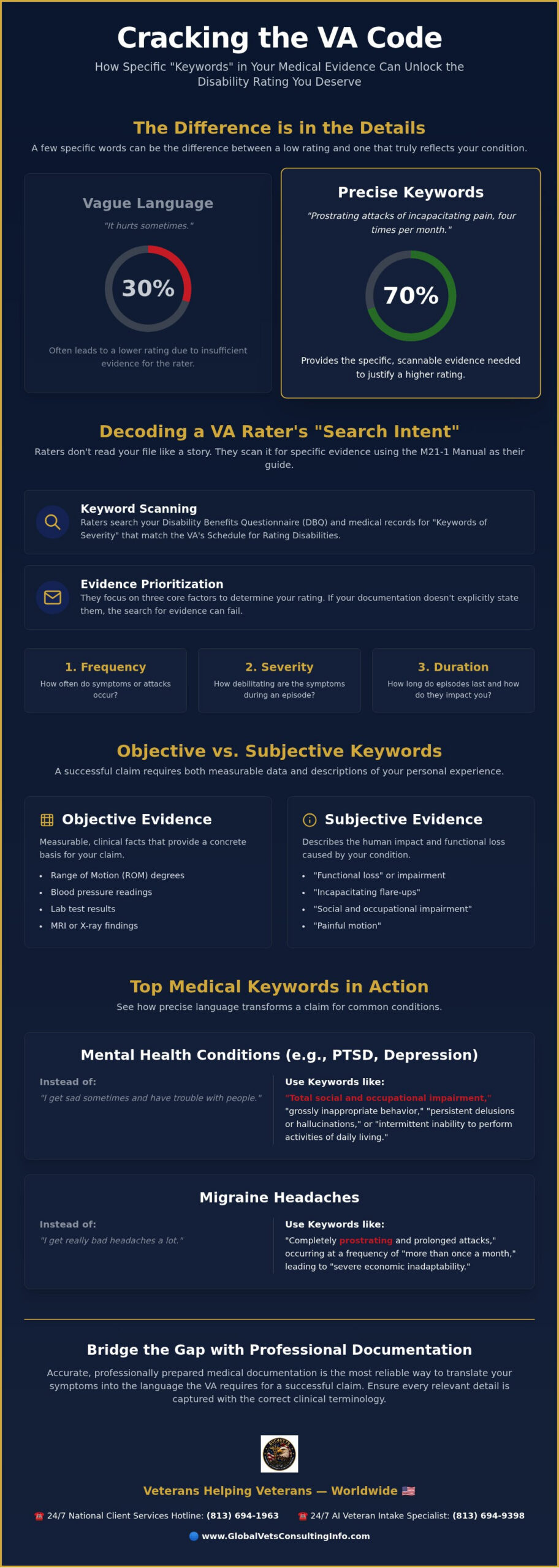
VA raters are trained to scan your records for specific indicators of severity. If your documentation uses vague language, the rater won’t have the evidence they need to justify a higher rating. For example, stating “it hurts sometimes” provides very little for a rater to work with. However, using a Keyword Search Term like “prostrating attacks” or “incapacitating episodes” gives the rater the exact clinical data they need. Precision in your documentation is the most effective way to reduce the risk of a denial based on a supposed lack of evidence.
The Role of the DBQ in ‘Searching’ for Evidence
Standardized forms like the DBQ help the VA find the evidence they need quickly. These documents are structured to highlight the most relevant medical facts, allowing raters to see the full scope of your condition at a glance. A private DBQ is often more thorough than a standard C&P exam because it allows for a meticulous review of your history without the time constraints often found in government-contracted evaluations. This thoroughness ensures that every relevant symptom is captured using the correct terminology.
How Terminology Impacts Your Service Connection
Establishing a service connection for secondary conditions requires a clear medical link. You must use specific descriptors to show how your new condition was caused or worsened by your existing disability. Precise terminology helps you avoid common traps where symptoms are ignored or downplayed. By using clear, clinical descriptors, you create a permanent record that supports your claim and reinforces the legitimacy of your earned benefits.
Decoding the DBQ: How the VA Uses Searchable Medical Evidence
VA raters approach your file with a specific “search intent.” They aren’t looking for a story; they are hunting for “Keywords of Severity” that justify specific VA disability ratings. Every checkbox on a DBQ corresponds to a specific percentage, but the rater needs the supporting text to back it up. If your documentation lacks the right Keyword Search Term, the rater might default to the lowest possible rating regardless of your actual level of pain.
Following the VA disability claims process step by step ensures your evidence is indexed correctly from the start. Raters prioritize three main factors: frequency, severity, and duration. If your medical records don’t explicitly state how often an attack occurs or how long it lasts, the search for evidence fails. Understanding which Keyword Search Term describes your specific frequency is often the difference between an approval and a denial. This is where professional Secondary VA Claims Education becomes vital to ensure your records are complete.
Objective vs. Subjective Keywords
Your claim relies on two types of data. Objective keywords include measurable facts like Range of Motion (ROM) degrees, blood pressure readings, or MRI findings. Subjective keywords describe the human element, such as “functional loss,” “flare-ups,” or “social impairment.” Both are necessary. An objective “reduced ROM” tells the rater you can’t move, but a subjective “incapacitating flare-up” explains why you can’t work.
The M21-1 Manual: The VA’s Internal ‘Search Engine’
The M21-1 Adjudication Procedures Manual is the rulebook raters use to process claims. It functions like a search engine algorithm. If a rater doesn’t see the exact phrases listed in the manual, they often can’t award a higher rating. A doctor might describe your condition accurately in medical terms, but if those terms don’t match the M21-1 requirements, your claim could stall. Ensuring your doctor uses VA-aligned language is the key to a successful outcome.
Top Medical Keywords for Common VA Conditions
Precision in your medical evidence is the most effective way to ensure your rating reflects the true severity of your symptoms. When a rater reviews your file, they are looking for specific clinical triggers. Using a precise Keyword Search Term in your documentation allows the rater to check the necessary boxes for a higher rating without ambiguity. Different conditions require different “power words” to meet the criteria found in the VA’s rating schedule.
For migraines, the word “prostrating” is the gold standard; it tells the rater your headaches are so severe you must lie down in a dark room. Without this specific term, the rater may not grant the 30% or 50% rating you deserve. Similarly, musculoskeletal claims rely on terms like “functional loss” or “guarded movement.” These descriptors prove that your injury isn’t just painful, but that it actually limits your ability to move or work. If you are dealing with nerve pain, keywords like “paresthesia,” “numbness,” and “radiculopathy” are essential for documenting neurological impairment.
Keywords for Mental Health Ratings
Mental health claims are heavily dependent on the specific language used in your DBQ. The difference between a 30% and 70% rating often hinges on the phrase “occupational and social impairment.” A rater looks for keywords like “flat affect” or “suicidal ideation” to determine if your condition is severe enough for a higher compensation tier. Choosing the right Keyword Search Term to describe your daily struggles is vital, as the jump from “mild” to “severe” descriptors can change your monthly compensation by thousands of dollars. We provide specialized Mental Health Ratings Education to help you understand these critical distinctions.
Secondary Conditions: The ‘Keywords’ of Connection
When you file a secondary service-connected claim, the most important words are those that establish a “nexus” or link. You must use connection keywords like “aggravated by” or “proximate result of” to show the VA how your primary condition caused a new one. This is common when linking tinnitus to anxiety or back pain to radiculopathy. Under the May 2026 policy updates, the “but-for” causation standard is clearer, making these descriptors even more important. If your medical evidence doesn’t explicitly state that your secondary condition was “aggravated by” your service-connected disability, the rater may deny the claim for lack of connection.
Beyond the Keywords: Professional DBQ Preparation with Global Vets 🇺🇸
Identifying the correct Keyword Search Term is a vital first step, but knowing the words isn’t the same as having them documented by a medical professional. The VA requires clinical evidence that adheres to strict formatting and legal standards. Simply telling an examiner about your pain won’t result in a VA rating increase if that information isn’t captured within the right checkboxes and narrative summaries of a DBQ. We provide the Independent Medical Evidence Education you need to bridge the gap between your physical reality and the VA’s documentation requirements.
Our “Veterans Helping Veterans” ethos means we don’t just see a claim number; we see a life of service that deserves respect. We ensure your story is told with technical precision, using the specific clinical descriptors that raters are trained to find. Since 2020, Global Vets Consulting has connected over 100,000 veterans with a network of independent medical professionals. This experience allows us to help you prepare documentation that is accurate, thorough, and “VA-ready” from the moment it’s submitted.
Why Professional DBQ Services Prevent Denials
A standard doctor’s note often lacks the specific “Keyword Search Term” needed to trigger a higher disability percentage. Most primary care physicians aren’t familiar with the M21-1 manual or the Schedule for Rating Disabilities. They might note that you have “back pain,” but they may fail to document “functional loss” or “incapacitating episodes.” A specialized DBQ ensures that every symptom is categorized correctly, preventing the common “lack of evidence” denials that frustrate so many veterans. By focusing on VA compliance, we help you present a clear, undeniable case for the benefits you’ve earned.
Take Action: Secure Your Earned Rating Today
Don’t leave your disability rating to chance. Our team is ready to assist you with the education and resources necessary to maximize your claim success. 🌎
- 24/7 National Client Services Hotline: 📞 (800) 555-VETS
- 24/7 AI Veteran Intake Specialist: Available at GlobalVetsConsultingInfo.com
- Direct Website: GlobalVetsConsultingInfo.com
Click here to Get the Professional DBQ Documentation You Deserve and start your journey toward a fair and accurate VA rating today.
Take Control of Your Disability Rating Journey
We’ve explored how the VA rater uses specific clinical terminology to index your evidence and why the DBQ is the most critical document in your file. Using a precise Keyword Search Term isn’t just about semantics; it’s about making sure your physical and mental struggles are translated into the legal language the VA requires for an accurate rating. You now understand that the difference between a denial and an approval often rests on the specific descriptors used by your medical provider.
Since 2021, our veteran-owned and operated team has specialized in high-accuracy DBQ documentation. We understand the system because we’ve lived it. We maintain a 24/7 National Client Services Hotline to ensure you always have a steady guide by your side. You don’t have to navigate these complex administrative hurdles alone. We provide the meticulousness and integrity your claim deserves.
🇺🇸 Start Your DBQ Process with Global Vets Consulting
You’ve earned these benefits through your service and sacrifice. Take the next step with confidence and ensure your medical evidence finally reflects the truth of your condition. We look forward to serving you.
Frequently Asked Questions
What is the most important keyword for a VA disability claim?
The most important keywords are those that explicitly define the frequency, severity, and duration of your symptoms. These terms provide the rater with the necessary data to apply the Schedule for Rating Disabilities accurately. For instance, using “incapacitating” for back pain or “prostrating” for migraines triggers specific rating tiers that general descriptions of pain simply cannot reach. Your documentation must focus on these three pillars to justify a higher percentage.
Can using specific keywords in my DBQ cause a claim denial?
Using specific keywords won’t cause a denial as long as they accurately reflect your diagnosed condition and medical history. A denial typically occurs when there’s a mismatch between your clinical records and the descriptors used in the DBQ. This is why thorough preparation is essential to ensure that every Keyword Search Term used in your documentation is backed by objective medical evidence and doesn’t appear contradictory to your treatment notes.
How do I find the ‘keywords’ for my specific medical condition?
You can find the specific descriptors for your condition by reviewing the VA Schedule for Rating Disabilities, which is public information. This document outlines the exact clinical criteria raters use to assign a percentage to your disability. We also provide specialized educational resources that help you translate your daily experiences into the technical language used in the M21-1 manual, ensuring you find the right Keyword Search Term for your unique symptoms.
Does the VA check if my DBQ keywords match my C&P exam results?
VA raters are required to review all medical evidence, which includes comparing your private DBQ keywords against the findings of your C&P examination. If there’s a significant discrepancy between the two reports, the rater may seek a third-party medical opinion or ask for clarification. Ensuring your private documentation is meticulous and evidence-based helps establish a strong foundation that is difficult for an examiner to overlook during their review.
Is it legal to use a private company for DBQ preparation?
It is entirely legal and often beneficial to use a private company for DBQ preparation and medical evidence education. Veterans have a clear right to submit evidence from independent medical professionals to support their claims. While we don’t file claims or provide legal representation, we help you secure the high-accuracy documentation needed to ensure your actual level of impairment is recognized by the VA through the proper channels.

Article by
Willie Daniel
Willie Daniel is the Founder and Chief Executive Officer (CEO) of Global Vets Consulting (GVC) – National Veterans Disability Services, a veteran-led educational and medical evidence support organization dedicated to helping veterans better understand VA disability rating increases, DBQ medical evidence, secondary claims education, and C&P examination preparation.
He is a retired U.S. Army Medical Service Corps Officer with more than 27 years of honorable military service, a decorated Iraq combat veteran, and a retired federal official with the U.S. Department of Veterans Affairs. Throughout his military and federal career, Willie Daniel served in leadership, healthcare administration, operational, and veteran-support roles focused on improving services and support systems for servicemembers, veterans, and their families.
Drawing from decades of military leadership, healthcare administration, veteran advocacy, and federal government experience, Willie Daniel brings a practical, veteran-centered perspective to Global Vets Consulting’s educational articles, AI-powered veteran resources, video education initiatives, and outreach programs. His experience navigating military systems, medical documentation processes, and veteran-related administrative operations provides valuable insight into many of the challenges veterans face when seeking to better understand VA disability rating criteria, medical evidence, documentation strategies, and secondary condition education.
Through GVC’s “Veterans Helping Veterans” mission, his focus is on delivering clear, educational, and easy-to-understand information designed to empower veterans with knowledge, resources, and educational tools that may help them make more informed decisions regarding their individual VA disability journeys.
The information provided through GVC is intended for educational and informational purposes only and should not be considered legal or medical advice.
Disclaimer
Disclaimer: Global Vets Consulting, LLC (“GVC”) is a veteran-led educational and medical evidence support organization. GVC is not a law firm, is not a Veterans Service Organization (VSO), and is not affiliated with the U.S. Department of Veterans Affairs (VA) or any government agency.
Global Vets Consulting does not provide legal advice, medical advice, medical treatment, or healthcare services. GVC does not prepare, file, or submit VA disability claims on behalf of veterans. All information provided through this website, blog articles, videos, educational materials, AI tools, dashboards, templates, and communications is intended solely for general educational and informational purposes.
Veterans are encouraged to consult with accredited representatives, licensed attorneys, qualified medical providers, or Veterans Service Organizations regarding their specific legal, medical, or VA-related matters. VA disability decisions, ratings, and outcomes are determined solely by the U.S. Department of Veterans Affairs based on applicable laws, regulations, medical evidence, and individual circumstances. Past results do not guarantee future outcomes.