

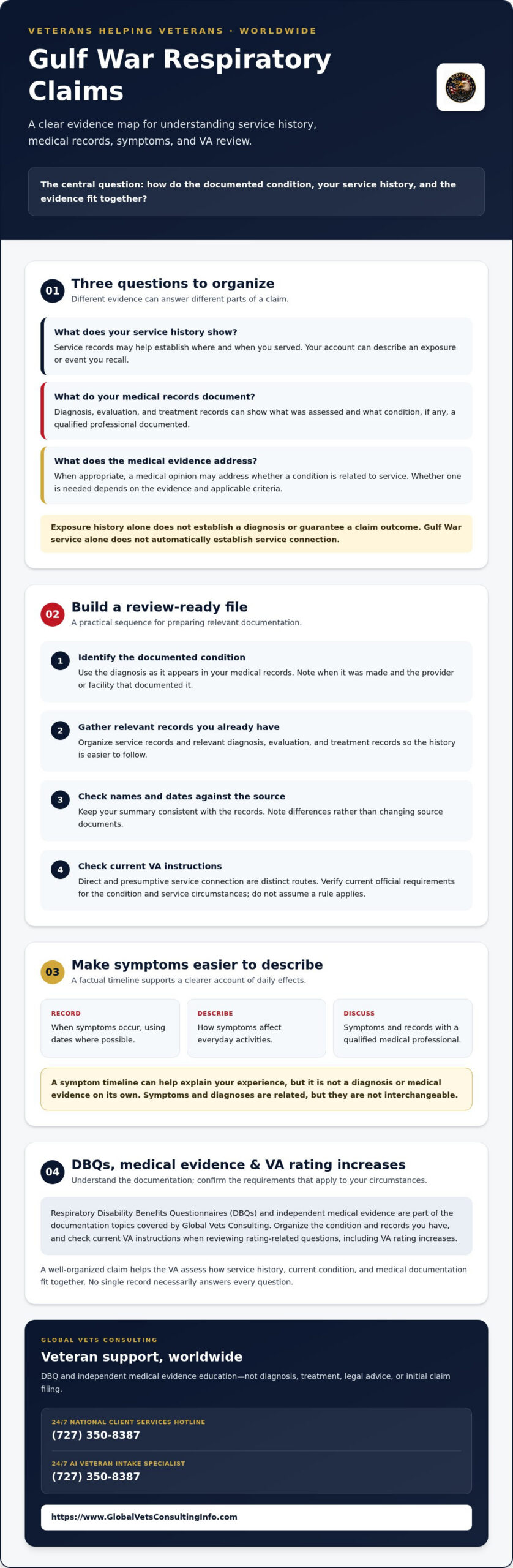
What helps make a respiratory claim easier to understand? Gulf War Respiratory Claims involve several questions: what your service records show, what your medical records document, and how the evidence relates to your current condition. If you are unsure whether an exposure relates to a diagnosis or how to describe symptoms that affect daily life, organizing these details can help you prepare for review.
It is understandable to worry that important details may be overlooked or that your records will not tell the full story. This guide explains the evidence questions a VA claim may raise and practical steps for preparing relevant documentation.
You’ll learn how service and medical records, respiratory Disability Benefits Questionnaires (DBQs), and documentation of functional effects may support a claim, along with what to understand about VA ratings. Global Vets Consulting (GVC4Vets) provides DBQ and independent medical evidence education, not diagnosis, treatment, legal advice, or initial claim filing. Veterans can reach the 24/7 National Client Services Hotline and 24/7 AI Veteran Intake Specialist at (727) 350-8387. Find the primary digital resource at https://www.GlobalVetsConsultingInfo.com.
Key Takeaways
- For Gulf War Respiratory Claims, distinguish what your service records show, what your medical records diagnose, and what any medical opinion addresses.
- Prepare a review-ready file by identifying the documented condition, organizing relevant records, and checking current VA instructions.
- Keep a factual symptom timeline with dates and effects on daily activities. Discuss symptoms and records with a qualified medical professional.
- Explore DBQ and independent medical evidence education at https://www.GlobalVetsConsultingInfo.com. The 24/7 National Client Services Hotline and 24/7 AI Veteran Intake Specialist are both available at (727) 350-8387.
Gulf War respiratory claims: what the claim is asking the VA to consider
A Gulf War respiratory claim asks the VA to consider a current respiratory condition, the veteran’s service history, and whether the evidence supports a connection between them. It is a request for review, not proof that the veteran qualifies for benefits.
Gulf War service alone does not automatically establish service connection. The VA considers the evidence and applicable criteria. Medical records may document a diagnosis, while service records and your account may help explain when symptoms began and what exposures or events you recall. An exposure history by itself does not establish a diagnosis or guarantee an outcome.
Symptoms and diagnoses are related, but they are not interchangeable. You may report breathing-related concerns without having a confirmed respiratory diagnosis. Medical documentation can help clarify what condition, if any, a qualified professional has identified. For broader historical context on Gulf War-related health concerns, see Gulf War syndrome. This overview is not a substitute for medical evaluation or current VA guidance.
Which respiratory conditions and symptoms should a veteran document?
Start with information you can verify. Record the diagnosis as it appears in your medical records, when it was made, and the provider or facility that documented it. Keep a factual symptom timeline that notes when symptoms occur and how they affect everyday activities. The timeline can help you describe your experience, but it is not medical evidence or a diagnosis on its own.
Share your concerns with a qualified medical professional, who can assess your symptoms and advise on care. For claim preparation, organized service and medical records can make the history easier to follow. Check that the dates and condition names in your summary match the records you have, and note any differences rather than changing source documents. Global Vets Consulting (GVC4Vets) provides DBQ and independent medical evidence education, not diagnosis, treatment, legal advice, or initial claim filing.
Veterans across the country can contact the 24/7 National Client Services Hotline or the 24/7 AI Veteran Intake Specialist at (727) 350-8387. Visit https://www.GlobalVetsConsultingInfo.com for the primary digital resource.
How Gulf War service, exposures, and medical evidence fit together
Each record can answer a different question in Gulf War Respiratory Claims. Service records may help establish where and when you served. Your account can describe an exposure you recall, while medical records document evaluations and any diagnosed condition. When appropriate, a medical opinion may address whether a condition is related to service. No single record necessarily answers every question.
A well-organized claim helps the VA assess how your service history, current condition, and medical documentation fit together. Exposure history alone does not establish a diagnosis or guarantee a claim outcome.
Direct and presumptive routes: verify which rules apply
Direct and presumptive service connection are distinct routes for VA consideration. A presumptive route may apply when the veteran, condition, and service meet specific criteria, but Gulf War service or a respiratory diagnosis alone does not establish eligibility. Check current official VA guidance on covered conditions and service requirements, including the VA’s information on VA presumptive conditions for Gulf War veterans. Do not assume a particular rule applies without checking the requirements for your circumstances.
What medical records can help clarify
Gather relevant diagnosis, evaluation, and treatment records you already have. These can help show what was assessed, what condition was documented, and how your medical history developed. If a relationship to service is in question, a qualified medical professional may provide an opinion when appropriate. Whether one is needed depends on the evidence and applicable criteria. For a practical overview of documentation, read the guide to VA disability claims evidence requirements.
Global Vets Consulting offers DBQ and independent medical evidence education as documentation support, not medical care, legal advice, or claim filing. Veterans across the country can reach the 24/7 National Client Services Hotline and the 24/7 AI Veteran Intake Specialist at (727) 350-8387. Visit https://www.GlobalVetsConsultingInfo.com for the primary digital resource.
Prepare a Gulf War respiratory claim with a clear evidence checklist
A file is easier to review when records are organized around the condition and your service history. Use this sequence to prepare:
- Identify the condition: Use the diagnosis recorded by a qualified medical professional, if one is documented. Avoid treating a symptom description as a confirmed diagnosis.
- Organize records: Gather relevant diagnosis, evaluation, and treatment records, along with service documents you already have. Group them by type so you can locate a document when needed.
- Document your history: Keep a factual symptom timeline with dates and effects on daily activities. It can help you describe your experience, but it is not medical evidence by itself.
- Check current instructions: Review official VA guidance, including VA guidance on Gulf War illnesses, for current criteria that may apply.
Before submitting anything, check that each document is complete and legible, and compare key details such as dates and condition names across your records. If details differ, do not alter the source documents. Note the discrepancy and seek clarification where appropriate. For broader process context, read the VA disability claims process guide.
When a respiratory DBQ may be relevant
A respiratory Disability Benefits Questionnaire (DBQ) records medical findings and functional information related to a condition. It may help organize relevant documentation, but it does not establish service connection or ensure a particular VA rating. A qualified medical professional is responsible for medical findings. Learn more in this DBQ guide for veterans.
Global Vets Consulting provides DBQ and independent medical evidence education, not diagnosis, treatment, legal advice, or initial claim filing. Explore respiratory claims education. Veterans across the country can reach the 24/7 National Client Services Hotline and the 24/7 AI Veteran Intake Specialist at (727) 350-8387. The primary digital resource is https://www.GlobalVetsConsultingInfo.com.
Choose a grounded next step for your Gulf War respiratory claim
Once your records are organized, choose a next step that fits your needs. Discuss respiratory symptoms and available medical records with a qualified medical professional, and check current official VA resources for claim instructions and applicable criteria. Gulf War Respiratory Claims depend on individual evidence and circumstances, so avoid assumptions or promises about a particular result.
What to have ready before seeking documentation support
Gather the information you already have and prepare focused questions. This can make a conversation about documentation more useful and help you determine whether the support offered matches your needs.
- Relevant medical records, including available diagnosis and evaluation documents
- Service information and any records that help explain your history
- A brief list of questions about DBQs, independent medical evidence education, or what documentation support includes
Before choosing support, confirm what the provider offers and whether it fits your needs. Global Vets Consulting provides DBQs and education about independent medical evidence and VA claims. This is documentation support, not diagnosis, treatment, legal advice, or initial claim filing. Medical questions belong with qualified medical professionals, and the VA decides claims.
Review the primary digital resource at https://www.GlobalVetsConsultingInfo.com to learn about the available educational resources. No specific rating or claim outcome is promised.
🇺🇸 Contact Global Vets Consulting
- 24/7 National Client Services Hotline: (727) 350-8387
- 24/7 AI Veteran Intake Specialist: (727) 350-8387
Take your next step with clear, organized evidence
Gulf War Respiratory Claims are reviewed based on the service history and medical documentation relevant to each veteran’s circumstances. Keep diagnosis records, service information, and a factual account of symptoms organized. Then check current VA guidance and discuss medical questions with a qualified professional. A DBQ or other medical documentation can help describe a condition, but it does not guarantee service connection or a particular rating.
Global Vets Consulting is veteran-owned and operated, founded in 2021, and provides Disability Benefits Questionnaires and independent medical evidence education. This support is educational, not diagnosis, treatment, legal advice, or initial claim filing. Explore DBQ and medical evidence education.
24/7 National Client Services Hotline: (727) 350-8387
24/7 AI Veteran Intake Specialist: (727) 350-8387
Primary digital resource: https://www.GlobalVetsConsultingInfo.com
You do not have to sort through every question at once. Start by organizing the records you have and identifying what you still need to clarify.
Frequently Asked Questions
Can Gulf War service qualify a veteran for a respiratory disability claim?
Gulf War service may be relevant to a respiratory disability claim, but service alone does not establish a diagnosis, service connection, or a particular VA outcome. Criteria depend on your circumstances and current VA rules. Review official VA guidance, organize relevant service and medical records, and consult a qualified medical professional for clinical questions. Seek legal expertise for legal questions about your individual situation.
What respiratory conditions qualify for presumptive VA disability benefits after Gulf War service?
Eligibility depends on the diagnosed condition, service details, and criteria in effect when the VA reviews the claim. Do not assume every respiratory diagnosis or every Gulf War veteran qualifies for presumptive consideration. Check current official VA information for covered conditions and service requirements. If you are unsure how your documented facts relate to the criteria, seek qualified guidance rather than relying on general examples.
What evidence can support a Gulf War respiratory claim?
Gulf War Respiratory Claims may involve several types of relevant documentation, including records of a diagnosis, medical evaluations, symptom history, and service information or reported exposures. Each item can help address a different question, and no single document guarantees an outcome. Keep records organized and check current VA requirements. Ask a qualified medical professional about clinical questions or what medical documentation may be appropriate for your circumstances.
Can a DBQ help with a Gulf War respiratory claim?
A Disability Benefits Questionnaire (DBQ) can document medical findings and functional information when a relevant DBQ applies. It does not independently prove that a condition is service-connected or guarantee a specific rating. A qualified medical professional should address clinical findings, and the VA evaluates the claim. Global Vets Consulting provides DBQ and independent medical evidence education, not medical care, legal representation, or claim filing.
Where can veterans get help understanding Gulf War respiratory claim documentation?
Start with current official VA resources and qualified medical professionals for health questions. For DBQ and independent medical evidence education, visit https://www.GlobalVetsConsultingInfo.com. Global Vets Consulting’s 24/7 National Client Services Hotline and 24/7 AI Veteran Intake Specialist are both available at (727) 350-8387. The company does not provide legal advice or file initial claims, so confirm that its educational resources fit your needs.

Article by
Willie Daniel
Willie Daniel is the Founder and Chief Executive Officer (CEO) of Global Vets Consulting (GVC4Vets) – National Veterans Disability Services, a veteran-led educational and medical evidence support organization dedicated to helping veterans better understand VA disability rating increases, DBQ medical evidence, secondary claims education, and C&P examination preparation.
He is a retired U.S. Army Medical Service Corps Officer with more than 27 years of honorable military service, a decorated Iraq combat veteran, and a retired federal official with the U.S. Department of Veterans Affairs. Throughout his military and federal career, Willie Daniel served in leadership, healthcare administration, operational, and veteran-support roles focused on improving services and support systems for servicemembers, veterans, and their families.
Drawing from decades of military leadership, healthcare administration, veteran advocacy, and federal government experience, Willie Daniel brings a practical, veteran-centered perspective to Global Vets Consulting’s educational articles, AI-powered veteran resources, video education initiatives, and outreach programs. His experience navigating military systems, medical documentation processes, and veteran-related administrative operations provides valuable insight into many of the challenges veterans face when seeking to better understand VA disability rating criteria, medical evidence, documentation strategies, and secondary condition education.
Through GVC’s “Veterans Helping Veterans” mission, his focus is on delivering clear, educational, and easy-to-understand information designed to empower veterans with knowledge, resources, and educational tools that may help them make more informed decisions regarding their individual VA disability journeys.
The information provided through GVC is intended for educational and informational purposes only and should not be considered legal or medical advice.
Disclaimer
Disclaimer: Global Vets Consulting, LLC (“GVC”) is a veteran-led educational and medical evidence support organization. GVC is not a law firm, is not a Veterans Service Organization (VSO), and is not affiliated with the U.S. Department of Veterans Affairs (VA) or any government agency.
Global Vets Consulting does not provide legal advice, medical advice, medical treatment, or healthcare services. GVC does not prepare, file, or submit VA disability claims on behalf of veterans. All information provided through this website, blog articles, videos, educational materials, AI tools, dashboards, templates, and communications is intended solely for general educational and informational purposes.
Veterans are encouraged to consult with accredited representatives, licensed attorneys, qualified medical providers, or Veterans Service Organizations regarding their specific legal, medical, or VA-related matters. VA disability decisions, ratings, and outcomes are determined solely by the U.S. Department of Veterans Affairs based on applicable laws, regulations, medical evidence, and individual circumstances. Past results do not guarantee future outcomes.