
Did you know that your 10% tinnitus rating might be the key to unlocking a 50% disability rating for headaches, even if the VA hasn’t explained how to bridge that gap? It’s incredibly frustrating to deal with the constant ringing in your ears, only to have it trigger debilitating attacks that force you into a dark room for hours. You’ve served your country and earned your benefits, yet the complexity of “VA math” and the fear of a denial letter often make the claims process feel like an impossible hurdle. 🇺🇸
If you’re struggling with severe pain that interferes with your work and family life, you aren’t alone. We understand the stress of trying to prove that your service-connected ringing is the direct cause of your neurological symptoms. This guide provides a clear path to successfully claiming migraines secondary to tinnitus so you can secure the higher monthly compensation you deserve in 2026. We’ll walk you through the latest rating criteria, the necessity of a medical nexus, and how professional documentation like a DBQ can turn a potential denial into a 30% or 50% rating. It’s time to stop feeling ignored and start building a claim that stands on solid medical evidence.
Key Takeaways
- Understand the physiological link between chronic tinnitus and migraine triggers to strengthen your medical evidence.
- Learn the exact definition of “prostrating” attacks required to qualify for a 30% or 50% VA disability rating.
- Discover the strategic steps for linking migraines secondary to tinnitus to ensure your claim is fully developed before submission.
- Identify why professional DBQ preparation is a critical component for overcoming common VA rating hurdles in 2026.
- Gain a clear, step-by-step path to increasing your monthly compensation through secondary service connection.
The Medical Link: How Migraines are Secondary to Tinnitus
Establishing a secondary service connection is a specific legal process where you prove a new medical issue is either caused or aggravated by an existing service-connected disability. For many veterans, this means linking migraines secondary to tinnitus. While tinnitus is often rated at a flat 10%, its impact on your neurological health is often far more reaching than just a simple ringing in the ears. 🇺🇸
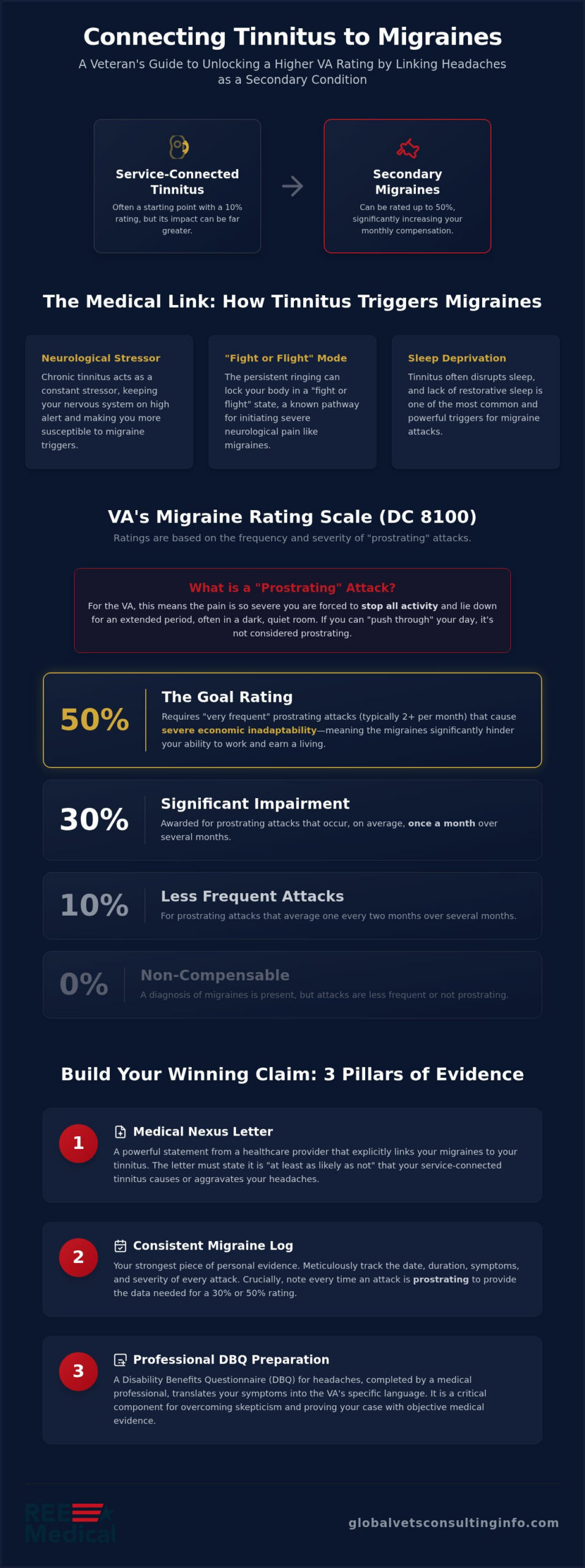
The physiological link between these two conditions is well-documented. Chronic tinnitus isn’t just a sound; it’s a constant neurological stressor that keeps your autonomic nervous system in a state of high alert. This persistent “fight or flight” mode, combined with the sleep deprivation common among those with ear ringing, acts as a primary trigger for severe migraine attacks. You can find more details in this Tinnitus Overview, which highlights how the condition affects the brain’s processing centers and overall well-being.
Even if you experienced headaches before your military service, you can still win a claim through the “aggravation” pathway. This means the VA acknowledges that your service-connected tinnitus has made your pre-existing migraines significantly worse. To bridge these two conditions, you must establish a medical nexus. This is a formal statement from a healthcare provider explaining the “how” and “why” behind the connection, usually stating it’s “at least as likely as not” that the tinnitus caused or worsened the headaches.
Why the VA Scrutinizes Tinnitus-Migraine Links
The VA sees a high volume of claims for migraines secondary to tinnitus, which naturally leads to higher levels of skepticism from Raters. In 2026, a simple personal statement saying your ears ring and then your head hurts is rarely enough to secure a rating. The VA now demands specific medical rationale that explains the neurological pathways involved. Without a detailed Disability Benefits Questionnaire (DBQ) or a strong nexus letter, many veterans face a quick denial regardless of how severe their symptoms actually are. They want to see professional medical evidence that connects the dots for them.
VA Ratings for Migraines: Aiming for the 50% Standard
Understanding how the VA evaluates your symptoms is the first step toward a successful claim for migraines secondary to tinnitus. The VA uses Diagnostic Code 8100 to determine your percentage. This scale ranges from a 0% non-compensable rating to a maximum of 50%. According to the VA’s official rating schedule for migraines, the jump from 10% to 50% depends entirely on the frequency of “prostrating” attacks and their impact on your ability to earn a living. 🇺🇸
What does “prostrating” actually mean to a VA Rater? It’s not just a bad headache. It refers to a level of pain so severe that you’re forced to stop all activity and lie down in a dark, quiet room for an extended period. If you can still push through your day or finish a shift, the VA likely won’t consider the attack prostrating. To reach a 30% rating, you must show these attacks happen on average once a month over several months. The 50% rating is the highest schedular amount available, requiring “very frequent” prostrating attacks that result in “severe economic inadaptability.”
Documenting Economic Inadaptability
If you’re missing several days of work each month or have been passed over for promotions due to your condition, you’re experiencing economic inadaptability. In 2026, VA raters typically interpret “frequent” as prostrating attacks occurring two or more times per month over a sustained period. This documentation is vital for proving that migraines secondary to tinnitus aren’t just a nuisance but a direct barrier to your livelihood. It’s about showing the Rater that your service-connected symptoms prevent you from maintaining steady employment.
The Migraine Log: Your Best Piece of Evidence
A headache log is your strongest piece of evidence when building your case. It should track the date, duration, and specific symptoms of every attack. Most importantly, it must note whether the attack was prostrating. This data directly feeds into your medical evidence and helps your doctor provide an accurate assessment. You can learn more about how this information is used in our article on What is a DBQ?. Keeping an accurate log ensures your healthcare provider has the facts needed to support your claim. If you need help organizing your documentation, our team offers secondary VA claims education to help you prepare for your next step.
Building Your Evidence: DBQs and Nexus Letters
Winning a claim for migraines secondary to tinnitus requires more than just telling your story. You need to speak the VA’s language through a Disability Benefits Questionnaire (DBQ). While a Compensation and Pension (C&P) exam is the standard path, these appointments are often rushed and incomplete. A private DBQ allows your medical provider to conduct a thorough review of your migraine logs and history. This ensures that every prostrating attack and every missed workday is recorded with the precision required for a 50% rating. 🇺🇸
To bridge the gap between your ears and your head, your evidence must satisfy the three elements of a medical nexus:
- Current Diagnosis: You must have a formal diagnosis of migraines from a qualified medical professional.
- Evidence of a Secondary Link: There must be proof that your headaches are related to your service-connected tinnitus.
- Medical Rationale: A doctor must provide the “why” by explaining the neurological pathways connecting the two conditions.
This isn’t just a simple statement from a physician. It’s a professional opinion based on established science and your specific clinical records. The legal standard for this link is “at least as likely as not.” This means there’s a 50% or greater probability that your tinnitus caused or aggravated your migraines. If your evidence is competent and credible, the VA should resolve any doubt in your favor. In 2026, the quality of your medical evidence is the single most important factor in whether your claim is approved or denied.
How Professional Documentation Prevents Denials
Many veterans find their VA Claim Denied for Lack of Evidence because they relied on a five-minute C&P exam rather than comprehensive documentation. Providing the Rater with a completed DBQ and a strong nexus letter for migraines secondary to tinnitus removes the guesswork from the process. It forces the VA to address your specific medical evidence rather than relying on a generic medical opinion.
If you’re ready to stop the cycle of denials, we can help you with Disability Benefits Questionnaires (DBQ) to ensure your claim is fully developed.
Winning Your Claim with Global Vets Consulting 🇺🇸
Global Vets Consulting stands as a leader in medical evidence education and professional DBQ preparation. We operate with a “Veterans Helping Veterans” ethos because we’ve walked in your boots and navigated the same complex systems. Our mission is to simplify the process of documenting conditions like migraines secondary to tinnitus, ensuring your medical evidence is thorough, accurate, and ready for a Rater’s review. We don’t just provide forms; we provide a clear path to the benefits you’ve earned. 🇺🇸
We guide you through every step of developing a “Fully Developed Claim.” This starts with a comprehensive intake process where we identify the specific medical documentation you need to succeed. By providing standardized, professional DBQs, we help you present a clear, undeniable picture of your symptoms to the VA. This methodical approach reduces the likelihood of a denial based on insufficient evidence or a rushed C&P exam. Our goal is to move your claim from a pile of paperwork to a successful rating decision.
Our Secondary Claims Education Service
We specialize in helping you understand the complex link between your service-connected ringing and your neurological symptoms. Our migraines secondary to tinnitus education service focuses on bridging the gap with credible medical rationale that the VA cannot ignore.
- 24/7 AI Veteran Intake Specialist: Access immediate guidance and start your intake journey at any time of day or night.
- Expert Evidence Gathering: We show you how to document prostrating attacks and economic impact with precision.
- Professional Partnership: Benefit from a team that values meticulousness and your long-term well-being.
Ready for a VA Rating Increase?
If your headaches have worsened or your current rating doesn’t reflect the severity of your pain, it’s time to take action. You can learn more about the process in our guide on How to Use a DBQ for a VA Disability Rating Increase. You have a right to the compensation that reflects your sacrifice. We’re here to ensure you have the professional documentation needed to secure it. 🌐
Don’t let the complexity of the system keep you from your earned outcomes. Contact our 24/7 National Client Services Hotline today to get started on your path to a higher rating.
📞 24/7 National Client Services Hotline
🌐 Website: GlobalVetsConsultingInfo.com
Secure Your Earned Benefits with Professional Documentation
You now have the strategic roadmap to bridge the gap between your service-connected ringing and your debilitating headaches. Success in 2026 requires a clear understanding of how migraines secondary to tinnitus are rated and the specific medical evidence needed to prove your case. By tracking your prostrating attacks and obtaining a thorough medical nexus, you can move toward the 30% or 50% rating that reflects the true impact on your life and your livelihood.
Global Vets Consulting is here to serve as your mission-driven partner. As a veteran-owned organization, we provide standardized medical documentation that meets the latest VA requirements. If you’re ready to stop the cycle of frustration and secure the compensation you deserve, Connect with Global Vets Consulting for Professional DBQ Support today. Our 24/7 National Client Services Hotline is available at (800) 555-VETS to help you start your journey toward a successful rating increase. You’ve served your country with honor; now it’s time to ensure the system works for you. Stay focused, stay documented, and don’t give up on the benefits you’ve earned.
Frequently Asked Questions
Can I file for migraines if I am already rated 10% for tinnitus?
Yes, you can and should file for a secondary condition if your headaches are related to your ear ringing. Your 10% tinnitus rating serves as the necessary primary condition to establish migraines secondary to tinnitus. You’ll need to provide medical evidence showing that the tinnitus either caused your headaches or makes them significantly worse over time through the “aggravation” pathway.
What evidence does the VA need for migraines secondary to tinnitus?
The VA requires three specific elements: a formal diagnosis, evidence of your current tinnitus rating, and a medical nexus letter. This nexus must provide a clear rationale explaining how the neurological stress of tinnitus triggers your migraine attacks. Including a private Disability Benefits Questionnaire (DBQ) is often the most effective way to ensure the VA has the specific details required for a 30% or 50% rating.
How much does a 50% migraine rating pay in 2026?
Your monthly payment for a 50% migraine rating is determined by your total combined disability percentage and whether you have dependents. Following the 2.8% COLA increase for 2026, a veteran rated at 30% alone receives $552.47 per month. A 50% rating for migraines is the highest schedular amount allowed and can lead to a substantial increase in your total monthly compensation once it’s factored into your combined VA math.
Will the VA automatically connect my migraines to my tinnitus?
No, the VA never assumes a connection between two separate disabilities. You must proactively prove the link through medical evidence and a strong nexus statement that uses the phrase “at least as likely as not.” Raters look for specific medical rationale that explains the physiological relationship between the constant ringing in your ears and the onset of prostrating headache attacks.
What happens if my secondary claim for migraines is denied?
A denial isn’t the end of the road; it’s often a sign that your medical evidence was insufficient or lacked a clear nexus. You can file a Supplemental Claim or request a Higher-Level Review to have your case reconsidered by a more senior Rater. In many cases, submitting a more thorough DBQ or a stronger medical nexus letter provides the “new and relevant” evidence needed to secure an approval.

Article by
Willie Daniel
Willie Daniel is the Founder and Chief Executive Officer (CEO) of Global Vets Consulting (GVC) – National Veterans Disability Services, a veteran-led educational and medical evidence support organization dedicated to helping veterans better understand VA disability rating increases, DBQ medical evidence, secondary claims education, and C&P examination preparation.
He is a retired U.S. Army Medical Service Corps Officer with more than 27 years of honorable military service, a decorated Iraq combat veteran, and a retired federal official with the U.S. Department of Veterans Affairs. Throughout his military and federal career, Willie Daniel served in leadership, healthcare administration, operational, and veteran-support roles focused on improving services and support systems for servicemembers, veterans, and their families.
Drawing from decades of military leadership, healthcare administration, veteran advocacy, and federal government experience, Willie Daniel brings a practical, veteran-centered perspective to Global Vets Consulting’s educational articles, AI-powered veteran resources, video education initiatives, and outreach programs. His experience navigating military systems, medical documentation processes, and veteran-related administrative operations provides valuable insight into many of the challenges veterans face when seeking to better understand VA disability rating criteria, medical evidence, documentation strategies, and secondary condition education.
Through GVC’s “Veterans Helping Veterans” mission, his focus is on delivering clear, educational, and easy-to-understand information designed to empower veterans with knowledge, resources, and educational tools that may help them make more informed decisions regarding their individual VA disability journeys.
The information provided through GVC is intended for educational and informational purposes only and should not be considered legal or medical advice.
Disclaimer
Disclaimer: Global Vets Consulting, LLC (“GVC”) is a veteran-led educational and medical evidence support organization. GVC is not a law firm, is not a Veterans Service Organization (VSO), and is not affiliated with the U.S. Department of Veterans Affairs (VA) or any government agency.
Global Vets Consulting does not provide legal advice, medical advice, medical treatment, or healthcare services. GVC does not prepare, file, or submit VA disability claims on behalf of veterans. All information provided through this website, blog articles, videos, educational materials, AI tools, dashboards, templates, and communications is intended solely for general educational and informational purposes.
Veterans are encouraged to consult with accredited representatives, licensed attorneys, qualified medical providers, or Veterans Service Organizations regarding their specific legal, medical, or VA-related matters. VA disability decisions, ratings, and outcomes are determined solely by the U.S. Department of Veterans Affairs based on applicable laws, regulations, medical evidence, and individual circumstances. Past results do not guarantee future outcomes.