
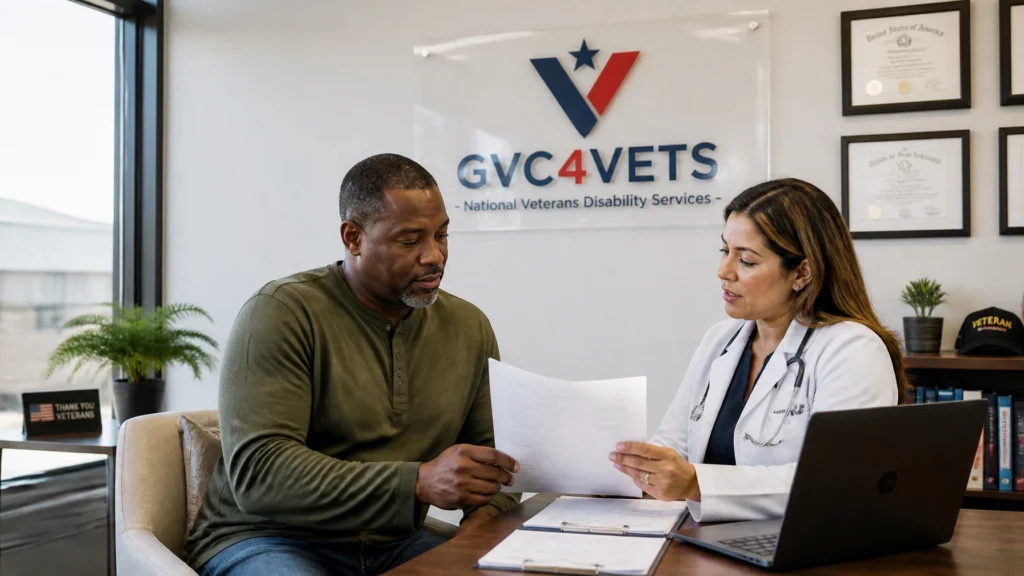
What if the reason your claim keeps getting denied, or stuck at a meager 10%, isn't because your symptoms aren't real, but because your strategy is fundamentally flawed?
Too many veterans approach the VA disability system like a lottery, tossing in every ache and pain hoping something sticks. In the world of VA compensation, "more" is rarely "better." If you are filing for fifteen different 0% or 10% ratings, you are hemorrhaging your most valuable asset: time. To secure the benefits you earned, you need to stop thinking like a patient and start thinking like a strategist. You need a blueprint that prioritizes high-value ratings, those with the highest potential for a 50%, 70%, or 100% evaluation, to maximize your Return on Investment (ROI).
At GVC4Vets, we’ve seen over 100,000 veterans navigate this labyrinth. We know that the difference between a 10% "participation trophy" and a life-changing 90% or 100% rating often comes down to understanding the "language of the rater" and the rigid requirements of 38 CFR Part 4.
Table of Contents
- The Gateway Strategy: Tinnitus as a Multiplier
- The "Silent" 50%: Sleep Apnea and Secondary Connection
- Mental Health: The Engine of a High-Value Claim
- Mastering the C&P Exam: Objective Evidence vs. Subjective Pain
- The ROI Checklist: Your Mission Blueprint
- Frequently Asked Questions
Key Takeaways
- Prioritize Secondary Claims: A 10% tinnitus rating is a strategic "gateway" to higher-value secondary conditions like insomnia or depression.
- CPAP is King for Sleep Apnea: Under current criteria, a documented medical necessity for a CPAP machine typically triggers a 50% rating for sleep apnea.
- Function Over Pain: The VA rates based on occupational and social impairment, not just the level of physical pain.
- Objective Evidence: Use DBQs and Nexus Letters to bridge the gap between your symptoms and service connection.
1. The Gateway Strategy: Tinnitus as a Multiplier
Let’s be blunt: Tinnitus is capped at 10% per 38 CFR § 4.87 (Diagnostic Code 6260). Whether the ringing is in one ear or both, and no matter how loud it gets, you are never getting more than 10% for it alone.
However, savvy veterans know that a tinnitus service connection is the ultimate "gateway condition." It is the foundation upon which you can build high-value secondary claims. For example, if the constant ringing causes chronic sleep disturbances, you aren't just looking for "trouble sleeping", you are looking at insomnia disorder secondary to tinnitus.
Under the General Rating Formula for Mental Disorders, insomnia isn't capped at 10%. It can be rated at 30%, 50%, 70%, or even 100% depending on its impact on your life. By securing that initial 10% for tinnitus, you open the door to ratings that actually move the needle on your combined total.

2. The "Silent" 50%: Sleep Apnea and Secondary Connection
Sleep apnea is one of the most misunderstood yet highest-value claims available. Many veterans are denied because they cannot prove it started in service. The "hack" here is the secondary connection.
If you have service-connected PTSD, depression, or even chronic back pain that has led to weight gain (obesity as an intermediary step), you may be eligible for obstructive sleep apnea (OSA) as a secondary condition.
Strategic Tip: If a medical professional determines that a Continuous Positive Airway Pressure (CPAP) machine is required for your treatment, you meet the criteria for a 50% rating under current VA standards. Do not just tell the C&P examiner you are tired; provide the diagnostic sleep study and proof of CPAP prescription. This is objective medical evidence that a rater cannot ignore.
Pes Planus (Flat Feet) vs. Plantar Fasciitis
Veterans often confuse these two, leading to "pyramiding" errors or missed opportunities.
- Pes Planus (Flat Feet): A structural deformity of the foot. Rated under DC 5276, it can go up to 50% if "pronounced" and bilateral.
- Plantar Fasciitis: Inflammation of the tissue. Often rated lower (usually 10-30% max).
Strategy: If you have both, ensure your dbq for flat feet accurately reflects the calcaneal eversion and "loss of longitudinal arch" to aim for the higher structural rating rather than just the inflammatory one.
3. Mental Health: The Engine of a High-Value Claim
If you want to reach 100% P&T (Permanent and Total), your mental health rating is often the primary driver. Whether it’s PTSD, Major Depressive Disorder (MDD), or Generalized Anxiety Disorder (GAD), the VA uses a single rating schedule: 38 CFR § 4.130.
The "hack" here is shifting your focus. The VA doesn't care how "sad" you feel; they care about how your symptoms affect your occupational and social functioning.
- 30% Rating: Occasional decrease in work efficiency.
- 50% Rating: Reduced reliability and productivity.
- 70% Rating: Deficiencies in most areas, such as work, school, family relations, judgment, thinking, or mood.
When speaking with a provider at GVC4Vets, be specific. Don't say "I'm stressed." Say "My anxiety causes me to miss three days of work a month because I cannot leave my house," or "I have outbursts of rage that have led to formal reprimands from my supervisor." Use the "language of the rater" to describe your functional impairment.

4. Mastering the C&P Exam: Objective Evidence vs. Subjective Pain
The Compensation and Pension (C&P) exam is where most claims go to die. Why? Because veterans rely on the examiner to "find" their disability.
Stop doing this. The C&P exam is a tactical encounter. You must provide the examiner with objective data points.
- Verify: Ensure the examiner has reviewed your private medical records and DBQs before the exam starts.
- Confirm: If you are there for a physical condition (like a va claim for sciatica), ensure they use a goniometer to measure your range of motion. If they "eyeball" it, the exam is invalid.
- Identify: Point out the specific diagnostic codes you believe apply to your condition.
Remember, the examiner is looking for "preponderance of evidence." If you show up with a professionally prepared Disability Benefits Questionnaire (DBQ) from an independent physician in the GVC4Vets network, you have already done 90% of the work for them.

5. The ROI Checklist: Your Mission Blueprint
Before you hit "submit" on your next VA claim appeal or initial filing, verify you have completed these high-value steps:
- Diagnosis: Do you have a formal medical diagnosis (e.g., DSM-5 for mental health, Sleep Study for OSA)?
- Nexus: Do you have a medical nexus letter explicitly stating your condition is "at least as likely as not" caused by your service or a primary condition?
- Functional Impact: Have you documented how the condition affects your ability to work and maintain relationships?
- Secondary Links: Have you looked for high-value secondaries (like depression secondary to tinnitus)?
- Expert Review: Has a licensed physician reviewed your DBQ to ensure it is VA-compliant?
Comparison: Low-Value vs. High-Value Strategy
| Feature | Low-Value Approach (The "Shotgun" Method) | High-Value Approach (The GVC4Vets Method) |
|---|---|---|
| Focus | Filing 10 small physical claims (10% each) | Filing 1-2 high-impact claims (50-70% each) |
| Evidence | Relying solely on VA medical records | Using independent DBQs and Nexus Letters |
| Logic | "The VA will see I'm hurting." | "Here is the 38 CFR code and my functional impairment." |
| Outcome | Often 20-40% total after "VA Math" | Higher probability of 70-100% total |
Frequently Asked Questions
Q: Can I claim Sleep Apnea if I didn't have a sleep study in the military?
A: Yes. This is where a secondary service connection is vital. If you can link your sleep apnea to a condition that is service-connected (like PTSD, weight gain from a back injury, or rhinitis), you can win the claim without an in-service diagnosis.
Q: Is Tinnitus always just 10%?
A: Under DC 6260, the maximum schedular rating is 10%. Don't waste time fighting for a 20% tinnitus rating; it doesn't exist. Instead, focus on using that 10% to service-connect secondary mental health or neurological conditions.
Q: What is the fastest way to increase my rating?
A: Focus on "high-value" conditions like Mental Health (up to 100%), Sleep Apnea (up to 50% with CPAP), and Migraines (up to 50%). These conditions have clear, objective criteria that can significantly boost your combined rating quickly.
Q: Why was my claim denied even though I have a diagnosis?
A: A diagnosis is only one-third of the "Caluza Triangle." You also need service connection (the Nexus) and a link to active duty. Most denials occur because the veteran fails to provide a strong enough Nexus Letter connecting the current diagnosis to their time in service.

At Global Vets Consulting (GVC4Vets) – National Veterans Disability Services, we don't just "help with paperwork." We provide the tactical medical evidence you need to stop wasting time and start getting the ROI you deserve for your years of service. Don't let a "rushed C&P exam" or "administrative delays" dictate your future.
Ready to build your high-value strategy? Contact GVC4Vets today to connect with our network of over 800 independent physicians.
Global Vets Consulting (GVC4Vets) – National Veterans Disability Services
Explore our Services | Contact a Consultant