
What if the VA’s “combined rating” system isn’t the only way to reach the maximum compensation you deserve? You’ve likely felt the weight of financial stress after realizing that a 70% rating doesn’t cover the mortgage when your service-connected conditions make it impossible to maintain a steady job. It’s exhausting to battle “VA math” while your symptoms make a standard 40-hour work week a thing of the past. You aren’t alone in this frustration, and you shouldn’t have to settle for less than the full support you earned through your sacrifice.
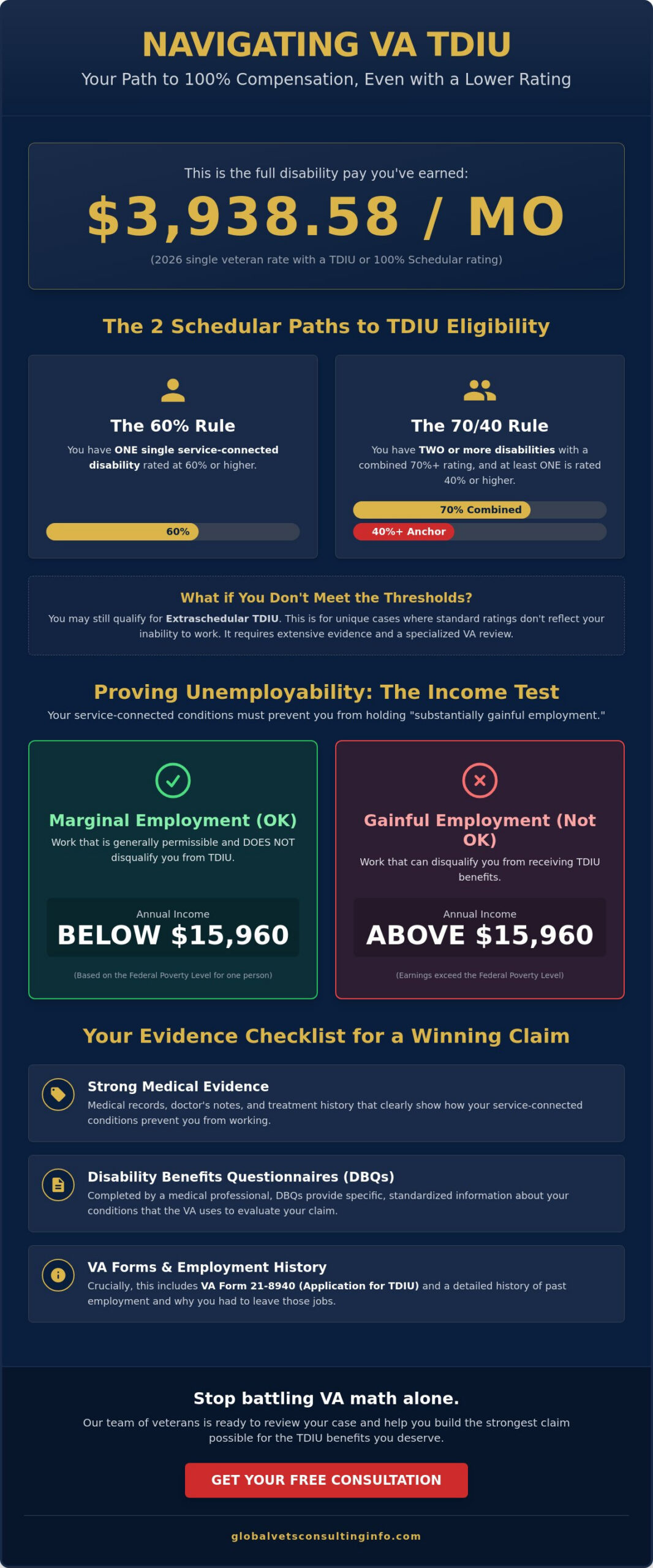
By understanding the specific tdiu eligibility requirements for 2026, you can bridge the gap between your current rating and the 100% pay rate of $3,938.58 per month. This guide provides a clear, step-by-step masterclass on navigating the 60/70/40 rule and the latest employment criteria. We will examine how to document marginal employment below the $15,960 annual threshold and outline a roadmap for gathering the medical evidence needed to turn a potential denial into a successful claim for your future.
Key Takeaways
- Learn how to access 100% disability pay at the $3,938.58 monthly rate even if your combined rating is lower than 100%. 🇺🇸
- Master the specific tdiu eligibility requirements for 2026, including the 60% single or 70% combined rating thresholds.
- Identify the critical income limits that separate “marginal employment” from work that could disqualify your claim.
- Discover the essential evidence checklist, including the role of DBQs, needed to prove your service-connected conditions prevent gainful employment.
What is TDIU and How Does It Provide 100% Pay?
Total Disability Individual Unemployability (TDIU) is a specific program managed by the Department of Veterans Affairs (VA). It ensures veterans receive maximum compensation when their disabilities prevent them from working. 🇺🇸
Key facts about how TDIU works for you:
- 100% Compensation: You receive the full monthly pay rate, currently $3,938.58 for a single veteran in 2026.
- Rating vs. Pay: Your medical rating stays the same (e.g., 70% or 80%), but your monthly check reflects the 100% rate.
- Economic Bridge: It serves as a vital link between a partial disability rating and the total pay you need to support your family.
- Employment Focus: This benefit is designed for those who cannot maintain “substantially gainful employment” due to service-connected conditions. 🌎
Understanding tdiu eligibility requirements is essential because “VA math” often fails to account for the reality of your daily struggles. While your combined rating might not reach 100%, the functional impact of your symptoms might still keep you out of the workforce. 📞
The Difference Between 100% Schedular and TDIU
The primary difference lies in how the VA evaluates your situation. A 100% Schedular rating is based purely on medical symptoms. TDIU is based on the economic impact of those symptoms. 🇺🇸
Benefits you receive under TDIU include:
- Dependant Healthcare: Access to CHAMPVA for your spouse and children.
- State Benefits: Eligibility for property tax breaks and other veteran-specific state exemptions.
- Family Security: Potential eligibility for VA Survivors Pension and DIC for your loved ones.
- Full Recognition: The same ancillary benefits as a veteran with a 100% schedular rating.
This approach prioritizes your financial security by acknowledging that your service-connected disabilities are the sole barrier to your employment. 🇺🇸
VA Rating Thresholds: The ‘Schedular’ TDIU Requirements
To qualify for these benefits, you must meet specific percentage thresholds known as “schedular” requirements. These are the most common and direct paths the VA provides for approval. According to official guidelines for VA Individual Unemployability, there are two primary ways to satisfy the rating portion of the tdiu eligibility requirements. First, you might have one single service-connected disability rated at 60% or higher. Second, you may have two or more disabilities that reach a combined rating of 70%, provided that at least one of those conditions is rated at 40% or more.
Understanding the 40/70 Rule for Combined Ratings
Many veterans find themselves confused by how the VA calculates combined percentages. It isn’t simple addition. Instead, the VA uses a “whole person” concept where each subsequent disability is a percentage of what’s left of your “healthy” self. For example, a veteran with a 40% rating for PTSD and a 40% rating for a back condition doesn’t reach 80%. Instead, they land at the 64% mark, which the VA rounds up to a 70% combined rating. This specific combination meets the 40/70 rule because the total is 70% and at least one condition is at least 40%. You can learn more about this calculation logic in our guide on the VA Disability Claims Process Step by Step: A 2026 Veteran’s Guide.
What is Extraschedular TDIU?
If you don’t meet the 60% or 40/70 thresholds but your disabilities still prevent you from working, you aren’t necessarily out of options. You can apply for “extraschedular” TDIU. This path is reserved for veterans with unique circumstances that the standard rating schedule doesn’t fully capture. These cases require a referral to the Director of Compensation Service for a specialized review. While this is a more difficult route that demands exceptional medical documentation, it remains a vital safety net for those with complex health challenges. If you are unsure where your ratings stand, reviewing your options with a knowledgeable veteran advocate can help clarify your path forward.
Proving Unemployability: Gainful vs. Marginal Employment
Meeting the rating threshold is only half the battle. To satisfy the tdiu eligibility requirements, you must also demonstrate that your service-connected conditions prevent you from maintaining “substantially gainful employment.” 🇺🇸
The VA uses specific financial markers to judge your work status:
- Gainful Employment: Any position where you earn more than the federal poverty level. 🌎
- Marginal Employment: Work that earns less than the annual threshold. For 2026, this limit is $15,960.
- Income Reality: If you earn less than this amount, your work is considered “marginal” and won’t disqualify your claim.
Some veterans earn more than the poverty limit but still qualify through “protected environments”:
- Family-owned businesses where you receive significant accommodations.
- Sheltered workshops designed specifically for individuals with disabilities.
- Jobs where your earnings don’t reflect your actual ability to compete in the open labor market.
The VA is legally prohibited from using your age or conditions not related to your service as a reason to deny your claim. Your eligibility depends solely on how your service-connected symptoms impact your ability to work. You can find more context on how these impacts are categorized by reading About VA Disability Ratings. 🇺🇸
How the VA Evaluates Your Work History
The VA takes a deep dive into your professional background to build a complete picture of your situation:
- Five-Year Review: They typically review your employment history and education level over the last five years.
- VA Form 21-4192: They contact past employers to ask why you left or if you had special accommodations on the job.
- Primary Barrier: You must show that your service-connected health issues are the main reason you aren’t working.
If you need help documenting these workplace limitations, we provide medical evidence education to help you build a stronger case. 📞
The TDIU Evidence Checklist: Winning Your Claim 🇺🇸
Now that you understand the tdiu eligibility requirements, you need a concrete strategy to prove your case to the VA. Success depends on the quality of your documentation. You can’t rely on the VA to find the evidence for you; you must present a complete package that leaves no room for doubt. Your evidence must bridge the gap between your medical diagnosis and your inability to function in a workplace.
Your winning evidence package should follow these four essential steps:
- Step 1: VA Form 21-8940. This is your formal application for increased compensation based on unemployability. Accuracy here is vital, as this form tracks your work and disability history.
- Step 2: Current DBQs. You need Disability Benefits Questionnaires for every condition listed on your application to show current severity.
- Step 3: A Nexus Letter. This medical opinion must explicitly link your inability to work directly to your service-connected conditions.
- Step 4: SSDI Records. If Social Security has already approved you for disability benefits for the same conditions, these records serve as powerful supporting evidence for your VA claim.
Why a Private DBQ is Your Secret Weapon
A private DBQ allows your doctor to spend the necessary time documenting your specific functional limitations. Unlike a rushed C&P examiner, a private physician can record critical details like your need for frequent breaks or an inability to stand for more than 15 minutes. These specific details are the foundation of meeting tdiu eligibility requirements because they prove you can’t maintain a standard job. You can learn more about how these forms work in our guide: What is a DBQ? A Veteran’s Guide to Disability Benefits Questionnaires in 2026.
Gathering Lay Evidence and Buddy Statements
Medical records are vital, but they don’t always tell the whole story of your workday struggles. Statements from former co-workers or supervisors can be highly persuasive. They can describe the accommodations you needed or the specific reasons you could no longer perform your duties before leaving. Family members can also provide “Lay Evidence” regarding how your disabilities impact your daily life and energy levels outside of work. To get started on your path to 100% pay, ensure your medical evidence is bulletproof with a professional DBQ review.
Take Command of Your VA Compensation
Navigating the path to 100% pay through TDIU is a mission that requires precision and the right documentation. You’ve seen how the 60/70/40 rule works and why staying below the 2026 federal poverty level of $15,960 is a critical factor for marginal employment claims. By following a structured evidence checklist and focusing on your functional limitations, you can overcome the hurdles of complex VA regulations and secure the compensation you’ve earned. Mastering the tdiu eligibility requirements is the first step toward long-term financial peace of mind for you and your family.
We’re here to stand with you as a knowledgeable advocate. As a veteran-owned and operated team, we are specialists in Disability Benefits Questionnaires (DBQ) designed to capture the true impact of your service-connected conditions. Our 24/7 AI Veteran Intake Specialist is available right now to help you begin your journey toward a rating increase. Contact Global Vets Consulting for expert DBQ documentation support today!
You served your country with honor and dedication. Now it’s time to ensure the system provides the support you were promised. You have the roadmap; now take the next step toward the 100% pay rate you deserve.
Frequently Asked Questions 🇺🇸
Can I work at all while receiving TDIU benefits?
Yes, you can work as long as your income is considered marginal. This means your annual earnings must stay below the federal poverty level, which is $15,960 for 2026. You may also work in a “protected environment,” such as a family-owned business or a sheltered workshop where you receive special accommodations. These specific work settings allow you to earn more while still maintaining your 100% pay rate. 🌎
Is TDIU permanent or can the VA take it away later?
TDIU is not always permanent unless the VA designates your status as Permanent and Total. The VA can re-evaluate your rating if they see evidence of medical improvement or if you maintain gainful employment for 12 consecutive months. If you’ve held your rating for 20 years or are over age 70, your benefits are generally protected from reduction. It’s important to keep your medical evidence current to protect your status. 📞
What happens to my TDIU if I reach retirement age?
Your benefits won’t change when you reach retirement age. The VA cannot legally use your age as a factor to deny or terminate your unemployability benefits. You’re entitled to receive your VA disability compensation and Social Security retirement benefits at the same time. This ensures you maintain financial stability regardless of your age, provided your service-connected conditions still prevent you from working in the traditional labor market. 🇺🇸
Can I get TDIU for mental health conditions like PTSD or anxiety?
Yes, mental health conditions are one of the most common reasons veterans qualify for these benefits. If your PTSD, anxiety, or depression symptoms make it impossible to stay focused or interact with co-workers, you may meet the tdiu eligibility requirements. You must provide medical evidence showing that your mental health symptoms are the primary barrier to your employment. Using professional DBQs can help ensure these functional limitations are clearly documented for the rater. 📞
Does the VA consider my non-service-connected disabilities for TDIU?
No, the VA only considers conditions that are officially service-connected. If a non-service-connected injury or illness is the reason you can’t work, the VA won’t grant TDIU. Your medical evidence must prove that your service-connected disabilities are the sole reason you cannot maintain substantially gainful employment. This is why linking your symptoms directly to your military service through a nexus letter and proper documentation is so vital for a successful claim. 🌎

Article by
Willie Daniel
Willie Daniel is the Founder and Chief Executive Officer (CEO) of Global Vets Consulting (GVC) – National Veterans Disability Services, a veteran-led educational and medical evidence support organization dedicated to helping veterans better understand VA disability rating increases, DBQ medical evidence, secondary claims education, and C&P examination preparation.
He is a retired U.S. Army Medical Service Corps Officer with more than 27 years of honorable military service, a decorated Iraq combat veteran, and a retired federal official with the U.S. Department of Veterans Affairs. Throughout his military and federal career, Willie Daniel served in leadership, healthcare administration, operational, and veteran-support roles focused on improving services and support systems for servicemembers, veterans, and their families.
Drawing from decades of military leadership, healthcare administration, veteran advocacy, and federal government experience, Willie Daniel brings a practical, veteran-centered perspective to Global Vets Consulting’s educational articles, AI-powered veteran resources, video education initiatives, and outreach programs. His experience navigating military systems, medical documentation processes, and veteran-related administrative operations provides valuable insight into many of the challenges veterans face when seeking to better understand VA disability rating criteria, medical evidence, documentation strategies, and secondary condition education.
Through GVC’s “Veterans Helping Veterans” mission, his focus is on delivering clear, educational, and easy-to-understand information designed to empower veterans with knowledge, resources, and educational tools that may help them make more informed decisions regarding their individual VA disability journeys.
The information provided through GVC is intended for educational and informational purposes only and should not be considered legal or medical advice.
Disclaimer
Disclaimer: Global Vets Consulting, LLC (“GVC”) is a veteran-led educational and medical evidence support organization. GVC is not a law firm, is not a Veterans Service Organization (VSO), and is not affiliated with the U.S. Department of Veterans Affairs (VA) or any government agency.
Global Vets Consulting does not provide legal advice, medical advice, medical treatment, or healthcare services. GVC does not prepare, file, or submit VA disability claims on behalf of veterans. All information provided through this website, blog articles, videos, educational materials, AI tools, dashboards, templates, and communications is intended solely for general educational and informational purposes.
Veterans are encouraged to consult with accredited representatives, licensed attorneys, qualified medical providers, or Veterans Service Organizations regarding their specific legal, medical, or VA-related matters. VA disability decisions, ratings, and outcomes are determined solely by the U.S. Department of Veterans Affairs based on applicable laws, regulations, medical evidence, and individual circumstances. Past results do not guarantee future outcomes.