
What if you could stop relying on a fifteen minute C&P exam to determine the next ten years of your financial security? Utilizing a DBQ for VA Claims allows you to take control of your medical evidence rather than leaving your future to chance. It’s incredibly frustrating to wait months for an appointment only to feel like the examiner barely listened to your symptoms before moving to the next patient. Many veterans face this exact struggle, watching their claims get denied due to a lack of evidence or confusing jargon that fails to reflect their true physical or mental limitations.
We’ll show you how these standardized forms provide the “smoking gun” evidence required to substantiate your symptoms and secure a higher disability rating. This guide explains how to document your conditions with precision, helping you move through the Fully Developed Claim lane faster so you can finally achieve the peace of mind you deserve. By speaking the VA’s language through professional documentation, you ensure your sacrifices are accurately recognized and rewarded.
Key Takeaways
- Learn how a DBQ for VA Claims acts as a bridge between your medical history and the VA’s rating criteria to ensure your symptoms are correctly documented.
- Identify the specific evidence requirements for different body systems to avoid common filing errors that lead to denials.
- Compare the advantages of private medical evidence education over standard C&P exams to take full control of your claim’s narrative.
- Discover the strategic steps to transition into the Fully Developed Claim lane for a significantly faster decision process.
- Understand how standardized documentation can provide the “smoking gun” evidence needed to secure the maximum rating for your service-connected conditions.
Understanding the Role of DBQs for VA Claims in 2026
A Disability Benefits Questionnaire (DBQ) is a standardized form designed to capture the specific medical information the Department of Veterans Affairs needs to assign an accurate rating. Think of it as a translator that turns a medical diagnosis into a specific VA disability percentage. In 2026, the VA relies heavily on these forms to manage a record-high volume of claims, which reached over 3 million in the last fiscal year. By using a DBQ for VA Claims, you provide the evidence in a format the VA already knows how to read, which is especially critical for those filing in the Fully Developed Claim (FDC) lane to secure a faster decision.
Why the VA Moved to Standardized DBQs
Before these forms existed, doctors wrote long narrative reports that were often difficult for raters to interpret. This led to inconsistent ratings and long delays. The VA transitioned to check-box forms to ensure all medical evidence aligns exactly with the VA Schedule for Rating Disabilities (VASRD). This structure allows the Rating Veteran Service Representative (RVSR) to identify key symptoms and severity levels instantly. Instead of hunting through messy clinical notes, the rater sees a clear picture of your functional impairment, which reduces the chance of a “lack of evidence” denial.
The 2026 Landscape: The Elizabeth Dole Act and You
Recent legislation, specifically the Elizabeth Dole 21st Century Veterans Healthcare and Benefits Improvement Act of 2025, has reinforced the veteran’s right to submit private medical evidence. This act requires that medical contractors and private providers use standardized formats to streamline electronic sharing. Having a clear VA disability claims process step by step plan is essential to ensure your private evidence is actually reviewed. For instance, when pursuing VA benefits for PTSD, a properly completed DBQ ensures that every social and occupational impairment is documented according to the current rating schedule, leaving no room for examiner oversight.
Key Condition Categories and DBQ Evidence Requirements
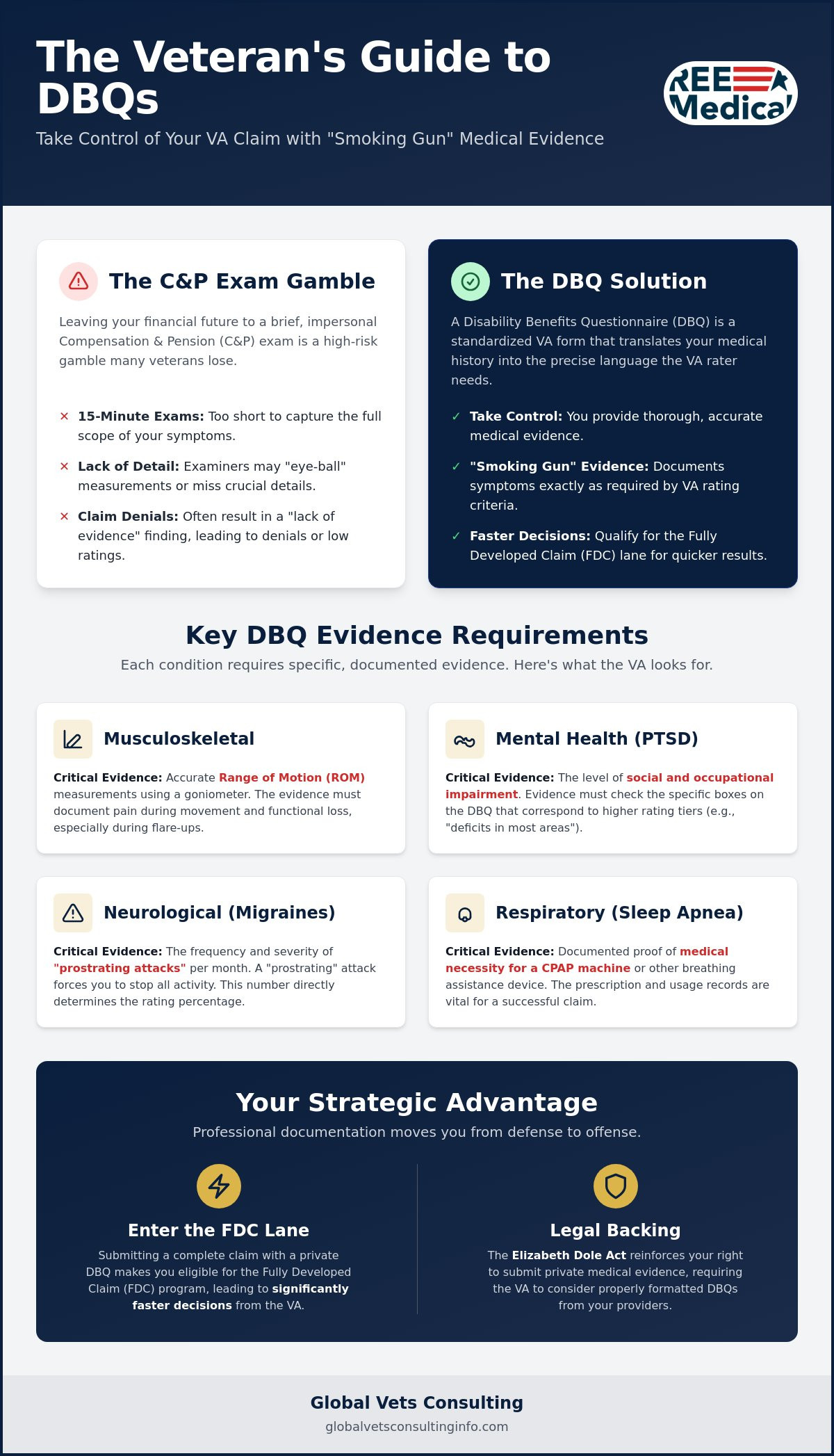
The Department of Veterans Affairs provides dozens of Public Disability Benefits Questionnaires (DBQs), but submitting the wrong one can stall your claim for months. Each form is tailored to a specific body system. Choosing the correct DBQ for VA Claims is the first step in ensuring your evidence matches the VA’s rating schedule. For musculoskeletal claims, the focus is almost entirely on range of motion (ROM). Examiners are required to use a goniometer to measure your movement, yet many veterans report that C&P examiners simply “eye-ball” the results. A private DBQ ensures these measurements are recorded accurately, capturing the flare-ups and pain that a quick exam might miss.
Establishing a secondary service connection for conditions like GERD or Sleep Apnea is often where claims fail. You need a medical nexus that clearly links the secondary issue to a primary service-connected disability. A private DBQ allows for a more thorough review of your medical history than a standard contract exam, which often lasts less than twenty minutes. This is why many veterans seek out specialized medical evidence education to understand how to bridge these gaps effectively and prove their secondary conditions are related to their service.
Mental Health and PTSD DBQs
The DBQ for mental health conditions is unique because it prioritizes social and occupational impairment over a simple diagnosis. To reach higher rating tiers, your evidence must show how your condition affects your ability to work and maintain relationships. The VA rates these on a scale of 10%, 30%, 50%, 70%, or 100%. If your paperwork doesn’t explicitly check the boxes for “deficits in most areas” or “total occupational impairment,” you won’t receive the rating your symptoms actually warrant.
Neurological and Respiratory Conditions
For neurological conditions like migraines, the frequency of “prostrating attacks” is the deciding factor. A prostrating attack means you are forced to stop all activity and seek a dark, quiet room. If your DBQ for VA Claims doesn’t document the exact number of these attacks per month, the VA will likely assign a lower percentage. Similarly, respiratory claims for Sleep Apnea require specific evidence regarding the use of a CPAP machine and its medical necessity. Ensuring these details are captured correctly is the difference between a denial and a successful rating.
Private DBQs vs. C&P Exams: Taking Control of Your Medical Evidence
A Compensation & Pension (C&P) exam is often the most stressful part of the claims process. You might spend months waiting for an appointment, only to have a VA-contracted doctor rush you through the door in fifteen minutes. This brief encounter rarely captures the full scope of your daily struggles. In contrast, a private DBQ for VA Claims allows you to work with a provider who takes the time to review your entire medical history. This comprehensive approach ensures that every symptom is documented before the VA even schedules an appointment, effectively pre-empting a potentially negative or inadequate C&P exam.
If your VA claim was denied for lack of evidence, a private DBQ serves as the “new and relevant evidence” needed for a Supplemental Claim. It fills the gaps left by previous examiners and provides a professional medical opinion that the VA must consider. Taking control of your evidence means you aren’t just a number in a crowded system; you’re an informed advocate for your own health and benefits.
The Advantage of Private Medical Evidence
Private doctors often provide a much more detailed “Nexus” than contract examiners. This medical link is what connects your current diagnosis to your time in service. Under VA regulations, this is considered “Competent Medical Evidence.” The VA is legally required to weigh this evidence equally with the results of a C&P exam. If your private DBQ for VA Claims is more thorough and supported by clinical data, it can override a superficial contractor report that misses key details of your disability.
How to Use a DBQ for a Rating Increase
Waiting for the VA to notice your condition has worsened is a recipe for a stagnant rating. You should be the one to initiate the process by documenting worsening symptoms through how to use a DBQ for a VA disability rating increase. Proactive documentation is essential for several reasons:
- It establishes a clear timeline of your condition’s progression.
- It uses the VA’s own rating criteria to prove you qualify for a higher percentage.
- It reduces the chance of a “re-evaluation” resulting in a rating reduction.
Securing high-quality medical evidence is the most effective way to protect your benefits. If you’re ready to substantiate your claim with professional support, you can get started with expert medical evidence education today.
How to Submit a Winning Claim with Professional DBQ Support
Submitting a successful claim isn’t just about filing paperwork; it’s about presenting a strategic narrative of your service-connected health. By following a methodical approach, you can move your application from the “pending” pile to an approved rating. Using a professional DBQ for VA Claims ensures that your evidence is complete from the start, which is the most effective way to avoid the back-and-forth requests for information that often stall progress for months.
- Step 1: Identify all service-connected conditions and potential secondary links. Don’t overlook how a primary injury, like a knee strain, might lead to secondary issues like back pain or depression.
- Step 2: Secure a professional DBQ that accurately reflects your current level of disability. Ensure the medical provider documents your symptoms during your worst days, not just how you feel the hour of the exam.
- Step 3: Submit your claim through the Fully Developed Claim (FDC) lane. This bypasses the standard backlog by certifying that you’ve provided all necessary evidence up front. While the average processing time is currently between 71.3 and 77.7 days, an FDC often moves faster.
- Step 4: Monitor your claim status through the VA portal. If the VA schedules a C&P exam anyway, bring a copy of your private DBQ for VA Claims to provide a clear medical baseline for the examiner.
The Global Vets Consulting Difference 🌎
We operate with a “Veterans Helping Veterans” mission, providing the peer-to-peer support you won’t find in a cold, bureaucratic office. Since 2021, we’ve focused on independent medical evidence education to empower you with the tools needed for a successful rating. Our 24/7 AI Veteran Intake Specialist is available around the clock to help you begin the process, ensuring you never have to wait for business hours to seek guidance. Professional education on medical evidence prevents common filing mistakes that lead to years of unnecessary appeals.
Final Checklist for Your VA Claim
Before you hit the submit button, run through this final list to ensure your documentation is bulletproof. Every “check-box” on the DBQ must be supported by clinical findings or your specific patient history. If a box is checked without a corresponding note, the VA may find the evidence insufficient. Verify that the form is signed by a licensed medical professional and includes their full credentials and contact information. If you’re feeling overwhelmed by the jargon or the process, call our 24/7 National Client Services Hotline at 📞 813-553-3335 for immediate assistance. We’re here to ensure your sacrifices are documented with the meticulousness they deserve.
Secure Your VA Rating with Accurate Evidence
You’ve earned your benefits through service, and your medical documentation should reflect the true extent of your sacrifices. Utilizing a DBQ for VA Claims allows you to move from a passive participant to an active advocate in your disability claim. We’ve explored how these standardized forms provide the “smoking gun” evidence needed to bypass the uncertainty of rushed C&P exams and bridge the gap for secondary service connections. This proactive approach ensures your conditions are documented correctly the first time.
Global Vets Consulting is veteran-owned and operated, bringing specialized expertise in rating increases and secondary claims education to your corner. We’re committed to helping you navigate the system with steady confidence and professional authority. If you’re ready to substantiate your claim with high-quality medical evidence, our 24/7 National Client Services Hotline is available at 📞 813-553-3335 for immediate assistance. Get the Professional DBQ Support You Earned at Global Vets Consulting today. You’ve served your country; now it’s time to ensure your benefits serve you. 🇺🇸
Frequently Asked Questions
Can I fill out my own DBQ for a VA claim?
No, a veteran cannot legally complete their own Disability Benefits Questionnaire. The form must be filled out and signed by a licensed medical professional who has the credentials to evaluate your specific condition. While you should provide your doctor with a detailed history of your symptoms and how they affect your daily life, the clinical findings and the final signature must come from the healthcare provider to be considered valid evidence.
Does the VA have to accept a DBQ from a private doctor?
Yes, the VA is legally required to accept and weigh private medical evidence under current regulations and the Elizabeth Dole Act of 2025. As long as the DBQ for VA Claims is completed by a qualified professional and contains the necessary clinical data, it is considered “competent medical evidence.” The VA must give this evidence the same consideration as a report from one of their own contracted examiners.
How much does a private DBQ cost for veterans?
The cost of a private medical evaluation varies significantly depending on the complexity of the condition and the provider’s expertise. Some providers charge based on the time required to review extensive medical records, while others have flat rates for specific body systems. It is important to remember that the VA does not reimburse veterans for the cost of private medical exams or the completion of these forms.
What is the difference between a DBQ and a Nexus Letter?
A DBQ focuses on the current severity and frequency of your symptoms to determine your disability percentage according to the rating schedule. A Nexus Letter is a separate document that provides a medical opinion linking your current condition to your military service. While a DBQ for VA Claims tells the VA “how bad” your condition is, a Nexus Letter tells them “how it started” because of your service.
Will a private DBQ help me avoid a C&P exam?
Submitting a private DBQ does not guarantee that the VA will skip a C&P exam, but it makes a decision without one much more likely. If you submit a Fully Developed Claim with all the necessary medical evidence, the rater may have everything they need to assign a rating immediately. If you are still called for a C&P exam, your private documentation serves as a critical baseline to ensure the contractor doesn’t overlook your symptoms.

Article by
Willie Daniel
Willie Daniel is the Founder and Chief Executive Officer (CEO) of Global Vets Consulting (GVC) – National Veterans Disability Services, a veteran-led educational and medical evidence support organization dedicated to helping veterans better understand VA disability rating increases, DBQ medical evidence, secondary claims education, and C&P examination preparation.
He is a retired U.S. Army Medical Service Corps Officer with more than 27 years of honorable military service, a decorated Iraq combat veteran, and a retired federal official with the U.S. Department of Veterans Affairs. Throughout his military and federal career, Willie Daniel served in leadership, healthcare administration, operational, and veteran-support roles focused on improving services and support systems for servicemembers, veterans, and their families.
Drawing from decades of military leadership, healthcare administration, veteran advocacy, and federal government experience, Willie Daniel brings a practical, veteran-centered perspective to Global Vets Consulting’s educational articles, AI-powered veteran resources, video education initiatives, and outreach programs. His experience navigating military systems, medical documentation processes, and veteran-related administrative operations provides valuable insight into many of the challenges veterans face when seeking to better understand VA disability rating criteria, medical evidence, documentation strategies, and secondary condition education.
Through GVC’s “Veterans Helping Veterans” mission, his focus is on delivering clear, educational, and easy-to-understand information designed to empower veterans with knowledge, resources, and educational tools that may help them make more informed decisions regarding their individual VA disability journeys.
The information provided through GVC is intended for educational and informational purposes only and should not be considered legal or medical advice.
Disclaimer
Disclaimer: Global Vets Consulting, LLC (“GVC”) is a veteran-led educational and medical evidence support organization. GVC is not a law firm, is not a Veterans Service Organization (VSO), and is not affiliated with the U.S. Department of Veterans Affairs (VA) or any government agency.
Global Vets Consulting does not provide legal advice, medical advice, medical treatment, or healthcare services. GVC does not prepare, file, or submit VA disability claims on behalf of veterans. All information provided through this website, blog articles, videos, educational materials, AI tools, dashboards, templates, and communications is intended solely for general educational and informational purposes.
Veterans are encouraged to consult with accredited representatives, licensed attorneys, qualified medical providers, or Veterans Service Organizations regarding their specific legal, medical, or VA-related matters. VA disability decisions, ratings, and outcomes are determined solely by the U.S. Department of Veterans Affairs based on applicable laws, regulations, medical evidence, and individual circumstances. Past results do not guarantee future outcomes.