
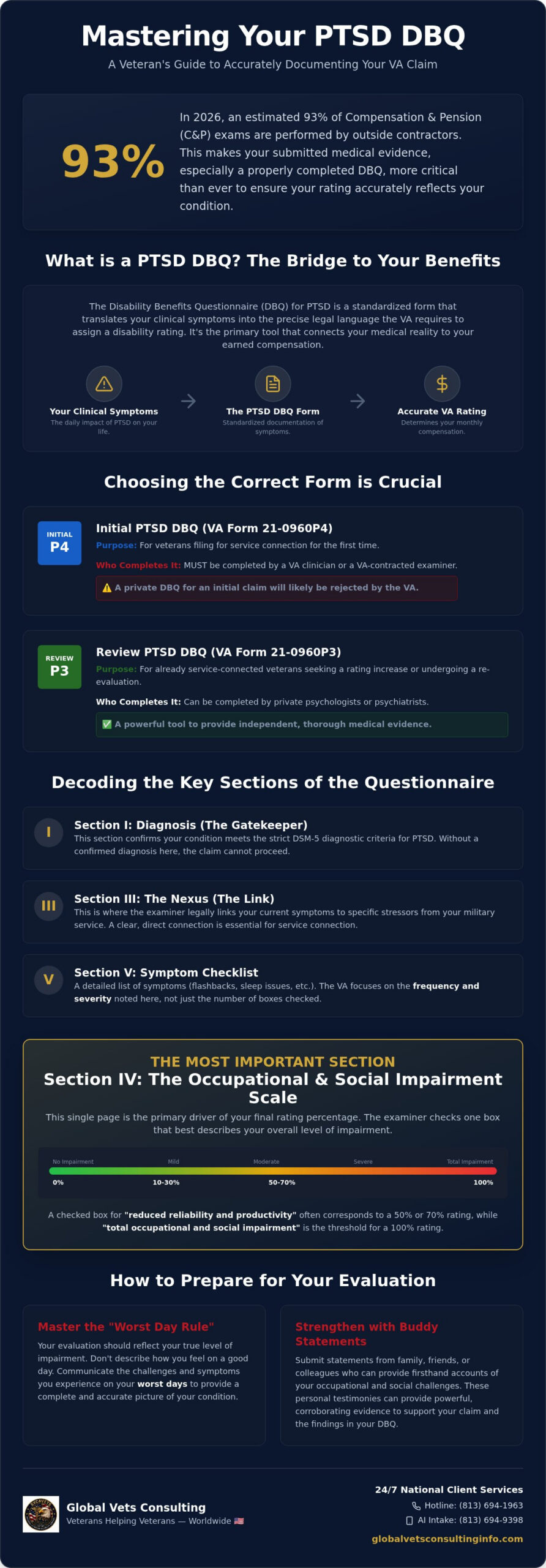
Did you know that in 2026, approximately 93% of Compensation and Pension (C&P) exams are performed by outside contractors? This means the person evaluating your ptsd dbq might not be a VA employee, which makes it vital that your paperwork speaks the language of the rating schedule. 🇺🇸
It’s natural to feel anxious about recounting your trauma to a stranger or worry that an examiner might lowball your rating because they don’t see the full reality of your daily life. You’ve earned your benefits, and the thought of them being decided by a confusing clinical checklist is stressful. We’re here to help you master the complexities of the Disability Benefits Questionnaire so your medical evidence accurately reflects your service-connected symptoms. We’ll break down the difference between legal and clinical terminology and explain the Occupational and Social Impairment scale. This guide ensures you understand the 2026 mental health rating changes and walk into your evaluation with the confidence you deserve.
Key Takeaways
- Learn how the ptsd dbq serves as a translation tool that converts your clinical symptoms into the legal language required for an accurate VA rating.
- Identify the critical sections of the form, including DSM-5 diagnostic requirements and how to properly document the nexus between your service and your stressors.
- Understand why a private medical evaluation often provides more thorough evidence than a standard C&P exam for veterans seeking a rating increase.
- Master the “Worst Day Rule” to ensure your questionnaire reflects your true level of impairment rather than just how you feel on the day of the exam.
- Discover how to use Buddy Statements to strengthen your medical evidence and provide a complete picture of your occupational and social challenges.
What is a PTSD DBQ? Understanding the Core of Your Claim
The Disability Benefits Questionnaire, or ptsd dbq, is the primary bridge between your medical diagnosis and the monthly compensation you’ve earned through your service. While your medical records might contain hundreds of pages of notes, a VA Rater needs specific information to assign a percentage based on federal law. This standardized form translates complex clinical observations into the precise legal criteria used for rating. By using a structured format, the VA can process claims much faster than they would by reading through traditional, disorganized narrative medical records. 🇺🇸
Think of the DBQ as a roadmap for the examiner. It ensures that every symptom of Post-traumatic stress disorder is documented according to the VA’s Schedule for Rating Disabilities. This documentation acts as the essential evidence link that justifies your disability rating and ensures your medical evidence matches the VA’s requirements.
Initial vs. Review PTSD DBQs: Which Do You Need?
Selecting the correct form is the first step in avoiding a claim denial or a lengthy delay. The Initial PTSD DBQ (VA Form 21-0960P4) is strictly for veterans filing for service connection for the first time. Per regulations updated in October 2025, these forms must be completed by a VA clinician or a VA-contracted examiner; you cannot use a private doctor for an initial claim. If you submit a private DBQ for an initial claim, the VA will likely reject it and schedule you for a contract exam anyway.
In contrast, the Review PTSD DBQ (VA Form 21-0960P3) is for veterans who are already service-connected and are seeking a va rating increase or are undergoing a scheduled re-evaluation. Since these veterans have already established service connection, the VA allows private psychologists or psychiatrists to complete this version. This is a powerful tool if your symptoms have worsened over time and you want an independent expert to evaluate your condition. Using the correct ptsd dbq ensures your evidence is valid from the moment you hit submit.
Decoding the Form: Key Sections of the PTSD Questionnaire
When you look at a ptsd dbq, it’s helpful to view it as a legal argument rather than just a medical checkup. The form is structured to lead a VA Rater through a specific logic path: first confirming a diagnosis, then establishing a service connection, and finally determining how much the condition impairs your life. Section I is the gatekeeper, ensuring your condition meets the strict DSM-5 criteria. According to the National Institute of Mental Health, these criteria include specific clusters of symptoms like re-experiencing and hyperarousal that must be present for a formal diagnosis. 🇺🇸
Section III is where the “nexus” is documented. This part of the form requires the examiner to link your current symptoms to specific stressors from your military service. Without a clear connection here, the rest of the form won’t matter for your claim. Finally, Section VII covers clinical findings, which are the objective observations the doctor makes during your interview, such as your appearance, speech patterns, and mood.
The Occupational and Social Impairment Scale
Section IV is arguably the most important page in your entire claim file. This is where the examiner selects a single checkbox that summarizes your overall level of functioning. The options range from “no symptoms” to “total occupational and social impairment.” That final box is the threshold for a 100% rating. If the examiner selects “reduced reliability and productivity,” your rating will likely fall into the 50% or 70% range. It’s vital that the symptoms reported elsewhere in the document actually support the box checked in this section. If you want to feel more prepared for this specific part of the evaluation, mental health ratings education can help you understand how these legal categories work.
Section V: Specific Symptoms Checklist
This section is a list of various symptoms like flashbacks, sleep disturbances, and suicidal ideation. While it’s tempting to just check every box that applies, the VA focuses on frequency and severity. A symptom that happens once a month is rated differently than one that occurs daily. The examiner must provide enough detail to show the VA Rater exactly how these symptoms prevent you from holding a steady job or maintaining healthy relationships. In 2026, the VA is placing more emphasis on functional domains like task completion and interpersonal functioning, making the details in this checklist more critical than ever.
Private PTSD DBQs vs. C&P Exams: Protecting Your Claim
Many veterans walk into a Compensation and Pension (C&P) exam expecting a deep, therapeutic conversation about their history. Instead, they often find themselves in a cold office for just 15 to 30 minutes before the examiner rushes them out the door. These high-volume contract exams frequently result in an incomplete ptsd dbq that fails to capture the true severity of your symptoms. Taking control of your evidence is the best way to prevent a rushed examiner from overlooking your daily struggles. 🇺🇸
Choosing a private evaluation changes the dynamic of your claim. A private provider has the time to conduct a thorough review of your entire medical history and listen to your experiences without a stopwatch running. When you submit this comprehensive documentation upfront, it transforms your filing into a Fully Developed Claim (FDC). This proactive approach gives the VA the evidence they need to make a decision immediately. In many cases, a high-quality private DBQ that is actionable and sufficient can even waive the need for a C&P exam entirely, saving you months of waiting and unnecessary anxiety.
Winning the Evidence Battle
If you’ve already received a rating that doesn’t match your impairment, a private ptsd dbq acts as a powerful rebuttal to a negative C&P exam. The VA is legally required to consider all competent medical evidence you submit. They can’t simply ignore a private doctor’s findings because they prefer their own contractor’s report. If your evidence is more detailed and follows the correct diagnostic criteria, it carries significant weight during a supplemental claim or a request for a rating increase.
Don’t let a single bad exam dictate your future. If you’ve struggled with past filings, learn how to recover from a claim denied for lack of evidence to get your benefits back on track. Taking control of your medical documentation is the best way to ensure the system works for you. If you’re ready to strengthen your file, our Independent Medical Evidence Education can guide you through the process of securing the documentation you deserve.
How to Prepare for Your Evaluation and Avoid Common Mistakes
Walking into a medical evaluation without a plan is a risk you don’t need to take. To ensure your ptsd dbq accurately reflects your life, you must follow the ‘Worst Day’ Rule. This means describing your symptoms as they are during your most severe episodes, not just how you feel in the quiet office of the examiner. If you tell the doctor you’re “doing fine” because you’re having a rare good day, the VA will take that literally and likely assign a lower rating than you deserve. 🇺🇸
Pride and military stoicism often get in the way of a successful claim. You’ve been trained to push through, but this is the time to be fully transparent about your struggles. It’s also helpful to bring a “Buddy Statement” from a spouse, family member, or fellow veteran who sees your daily challenges. These personal accounts provide the necessary context that a brief clinical interview might miss. Before your appointment, take the time to review our dbq for mental health conditions guide to understand the specific evidence the VA is looking for.
Common DBQ Mistakes That Lead to Denials
- Inconsistent symptoms: Denials often happen when the specific symptoms checked in Section V don’t logically align with the level of impairment selected in Section IV.
- Missing stressors: You must provide enough detail for the VA to verify the specific events that caused your condition; vague descriptions lead to delays.
- Unsigned forms: It sounds simple, but many claims are stalled because a provider missed a required signature block or a mandatory field on the ptsd dbq.
The Global Vets Consulting Difference
At Global Vets Consulting, we operate with a “Veterans Helping Veterans” ethos. We understand the system because we’ve lived it. Our team ensures your documentation is meticulous and meets the VA’s high standards for medical evidence. We offer a clear path forward with a 24/7 AI Veteran Intake Specialist to start your journey whenever you’re ready. 🌐
Don’t leave your future to chance. Contact Global Vets Consulting today for professional DBQ support and ensure your claim accurately reflects your service. 📞
Take Control of Your VA Rating Today
Mastering the ptsd dbq is about more than just filling out a form; it’s about ensuring your service and sacrifice are documented in the precise language the VA understands. You now have the tools to navigate Section IV with confidence and understand how the “Worst Day Rule” protects your claim from being lowballed. Private medical evidence serves as a powerful shield against rushed contract exams, providing the thoroughness your health history deserves. 🇺🇸
Since 2021, our veteran-owned and operated team has specialized in the complexities of mental health ratings to bridge the gap between your clinical reality and legal requirements. We understand the high stakes of these evaluations because we’ve been in your boots. With our 24/7 National Client Services Hotline, you never have to navigate this bureaucratic system alone. 📞 Get the medical evidence your claim deserves—Contact Global Vets Consulting now
Your journey toward a rating that matches your actual impairment starts with meticulous documentation. You’ve served your country with honor; now let’s ensure the system honors your health and well-being. We’re ready to stand with you as you secure the benefits you’ve earned. 🌎
Frequently Asked Questions
Can a private doctor fill out a PTSD DBQ for the VA?
A private psychologist or psychiatrist can complete a ptsd dbq for you, but this is restricted to review claims or rating increases. If you’re filing for service connection for the first time, the VA requires a clinician from their own staff or a third-party contractor to perform the evaluation. For veterans already rated and seeking a higher percentage, submitting a private questionnaire is a legitimate way to provide thorough medical evidence. 🇺🇸
What is the difference between an initial PTSD DBQ and a review DBQ?
The primary difference lies in the veteran’s current status and who is authorized to sign the form. An Initial PTSD DBQ (VA Form 21-0960P4) is for those establishing service connection for the first time and must be handled by VA-affiliated providers. The Review ptsd dbq (VA Form 21-0960P3) is used for veterans already service-connected who need to document worsening symptoms. This version allows for private medical evidence and focuses on changes in your impairment.
Does a PTSD DBQ guarantee a specific VA rating?
No medical document guarantees a specific rating because the final decision rests with a VA Rater, not the medical examiner. The questionnaire acts as the evidence used to justify a rating based on the legal criteria found in the Schedule for Rating Disabilities. While a well-documented form makes a higher rating more likely, the Rater examines your entire claims file, including service records and buddy statements, before making a determination. 🇺🇸
What happens if my C&P exam DBQ contradicts my private DBQ?
If your private evidence contradicts a C&P exam, the VA is required to weigh both documents based on their clinical depth and accuracy. Under the “Equipoise Rule,” if the evidence is found to be in approximate balance, the VA must give the benefit of the doubt to the veteran. This is why ensuring your private provider is thorough and follows DSM-5 criteria is vital for overcoming a rushed or negative contract exam.
How long is a completed PTSD DBQ valid for a VA claim?
A completed questionnaire is typically considered current medical evidence for one year from the date it was signed. However, the VA prefers evidence that reflects your most recent level of impairment, especially if you’re filing for an increase. If your symptoms have significantly worsened since your last evaluation, submitting a new form ensures the Rater sees your current reality rather than outdated data from months ago. 🇺🇸

Article by
Willie Daniel
Willie Daniel is the Founder and Chief Executive Officer (CEO) of Global Vets Consulting (GVC4Vets) – National Veterans Disability Services, a veteran-led educational and medical evidence support organization dedicated to helping veterans better understand VA disability rating increases, DBQ medical evidence, secondary claims education, and C&P examination preparation.
He is a retired U.S. Army Medical Service Corps Officer with more than 27 years of honorable military service, a decorated Iraq combat veteran, and a retired federal official with the U.S. Department of Veterans Affairs. Throughout his military and federal career, Willie Daniel served in leadership, healthcare administration, operational, and veteran-support roles focused on improving services and support systems for servicemembers, veterans, and their families.
Drawing from decades of military leadership, healthcare administration, veteran advocacy, and federal government experience, Willie Daniel brings a practical, veteran-centered perspective to Global Vets Consulting’s educational articles, AI-powered veteran resources, video education initiatives, and outreach programs. His experience navigating military systems, medical documentation processes, and veteran-related administrative operations provides valuable insight into many of the challenges veterans face when seeking to better understand VA disability rating criteria, medical evidence, documentation strategies, and secondary condition education.
Through GVC’s “Veterans Helping Veterans” mission, his focus is on delivering clear, educational, and easy-to-understand information designed to empower veterans with knowledge, resources, and educational tools that may help them make more informed decisions regarding their individual VA disability journeys.
The information provided through GVC is intended for educational and informational purposes only and should not be considered legal or medical advice.
Disclaimer
Disclaimer: Global Vets Consulting, LLC (“GVC”) is a veteran-led educational and medical evidence support organization. GVC is not a law firm, is not a Veterans Service Organization (VSO), and is not affiliated with the U.S. Department of Veterans Affairs (VA) or any government agency.
Global Vets Consulting does not provide legal advice, medical advice, medical treatment, or healthcare services. GVC does not prepare, file, or submit VA disability claims on behalf of veterans. All information provided through this website, blog articles, videos, educational materials, AI tools, dashboards, templates, and communications is intended solely for general educational and informational purposes.
Veterans are encouraged to consult with accredited representatives, licensed attorneys, qualified medical providers, or Veterans Service Organizations regarding their specific legal, medical, or VA-related matters. VA disability decisions, ratings, and outcomes are determined solely by the U.S. Department of Veterans Affairs based on applicable laws, regulations, medical evidence, and individual circumstances. Past results do not guarantee future outcomes.