
What if the most powerful tool for your claim isn’t a long letter to the VA, but a single, precise medical document? You’ve likely noticed your symptoms are getting worse, yet you worry that a rushed C&P exam will result in a low-ball rating that ignores your daily reality. It’s stressful to feel like you’re fighting a system that relies on “VA math” rather than the truth of your service-connected conditions. Strategically using a dbq for va rating increase allows you to take control of the narrative by providing a clear, legal snapshot of your health that is difficult for the VA to ignore.
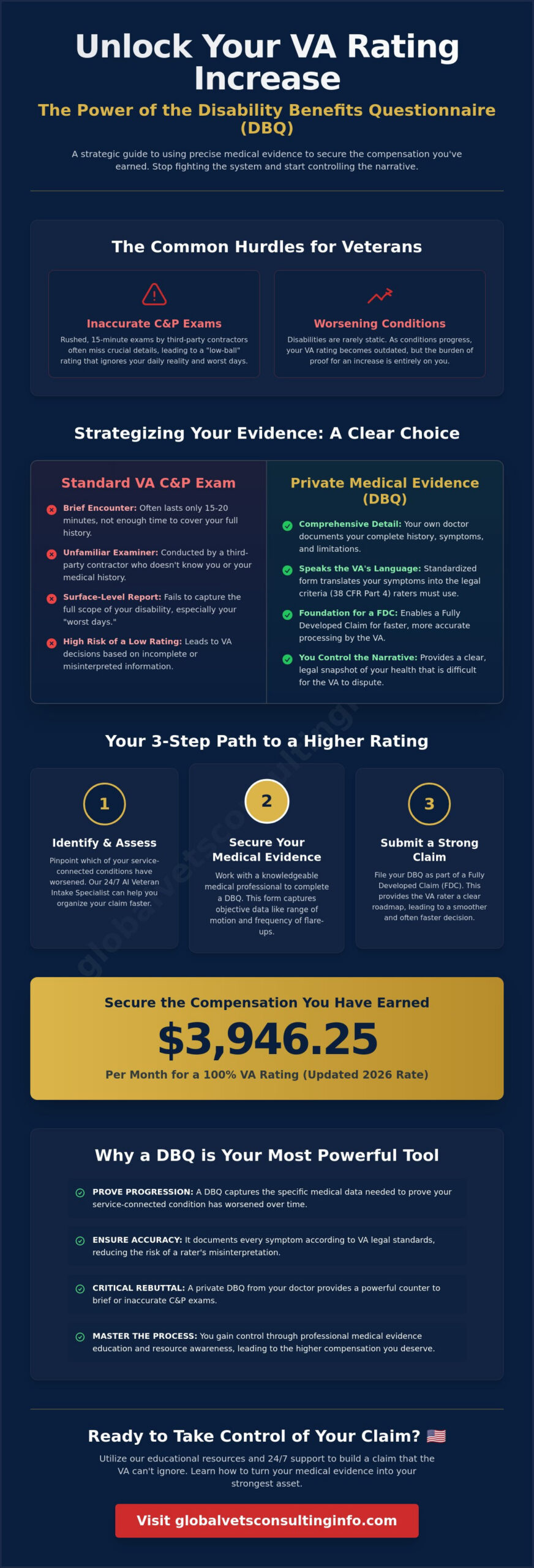
In this 2026 strategy guide, we’ll show you how to document your limitations to secure the compensation you’ve earned, including the updated 2026 rates where a 100% rating now provides $3,946.25 per month. 🇺🇸 We’ll explain how to use private evidence to bypass common hurdles and move your claim through the system with more confidence and speed. You’ll learn how to turn the Disability Benefits Questionnaire into a strategic asset that forces the VA to view your disability through the lens of the law rather than an examiner’s opinion.
Key Takeaways
- Understand how a Disability Benefits Questionnaire (DBQ) captures the specific medical data needed to prove your service-connected condition has progressed.
- Learn the strategic advantage of using a dbq for va rating increase to ensure every symptom is accurately documented according to VA legal standards.
- Discover why a private DBQ provides a critical rebuttal to brief or inaccurate C&P exams conducted by third-party contractors.
- Identify which of your service-connected conditions have worsened by utilizing a 24/7 AI Veteran Intake Specialist for a faster, more organized claims process.
- Master the step-by-step approach to securing the higher monthly compensation you’ve earned through professional medical evidence education and resource awareness.
The Strategic Role of the DBQ in a VA Rating Increase
A Disability Benefits Questionnaire (DBQ) is a standardized form designed to capture the specific medical data the VA requires to evaluate your condition. When you’re seeking an increase, this document serves as the primary evidence that your service-connected disability has progressed in severity. Using a dbq for va rating increase gives you the opportunity to have your own doctor document symptoms that a third-party contractor might overlook during a brief, 15-minute exam. A DBQ acts as the critical bridge that translates your clinical medical diagnosis into the specific legal language required by the VA’s rating schedule.
Why Your Current Rating May Be Outdated
Disabilities are rarely static. Conditions like degenerative disc disease or mental health struggles often worsen as you age, yet the VA doesn’t automatically track your decline. The burden of proof for an increase lies entirely with you. If your daily limitations have increased since your last rating, your current percentage no longer reflects your reality. Securing updated medical evidence is the only way to ensure your compensation matches your current level of impairment.
DBQs as the Foundation of a Fully Developed Claim (FDC)
Submitting a completed DBQ upfront is a strategic move that places your submission into the Fully Developed Claim lane. This allows for faster processing because the VA has the necessary evidence to make a decision without seeking additional records. You can learn more about this by reviewing our guide on the VA Disability Claims Process Step by Step: A 2026 Veteran’s Guide. By using a dbq for va rating increase, you provide a clear roadmap for the rater to follow, which often results in a smoother experience and a more accurate outcome.
How a DBQ Translates Symptoms into a Higher Percentage
The VA doesn’t simply guess your disability rating; they rely on a strict legal framework found in 38 CFR Part 4, known as the Schedule for Rating Disabilities. When using a dbq for va rating increase, you’re effectively providing the VA rater with a document that mirrors this legal code. The form’s “check-the-box” design ensures that your symptoms are organized in a way that matches the VA’s specific criteria for each percentage level. A VA rater is specifically searching for medical keywords and functional limitations within the DBQ fields that trigger certain percentage thresholds.
Mapping Symptoms to the Schedule for Rating Disabilities
Every condition has a “General Rating Formula” that determines its value. For example, musculoskeletal conditions are often rated based on “Range of Motion” and the “Frequency of Flare-ups.” If your doctor uses a goniometer to provide objective measurements, those numbers become undeniable evidence that your condition has worsened. You can view these official forms via the Public Disability Benefits Questionnaires to see exactly how the VA expects your symptoms to be reported. By documenting your limitations as the VA defines them, you reduce the risk of a rater misinterpreting your medical history.
Avoiding the “Low-Ball” Rating
One of the biggest mistakes veterans make is downplaying their symptoms or failing to describe their “worst days” during an evaluation. If you only talk about how you feel on a “good day,” the VA will likely assign a lower rating that doesn’t account for your actual impairment. Using a dbq for va rating increase allows you to capture the full scope of your disability, including how it impacts your ability to work and perform daily tasks. For a deeper dive into this strategy, read our guide on How to Use a DBQ for a VA Disability Rating Increase in 2026. If you need help understanding which forms apply to your specific conditions, our educational resources can provide the clarity you need to move forward. 🇺🇸
Private DBQs vs. VA C&P Exams: Strategizing Your Evidence
Compensation and Pension (C&P) exams are often brief encounters with third-party contractors who don’t know your history. This can lead to a surface-level report that fails to reflect your daily struggles or the true progression of your disability. By using a dbq for va rating increase, you submit a comprehensive medical snapshot that serves as a professional rebuttal to a potentially rushed or biased C&P report. Since the policy updates in 2021, the VA is legally required to consider private medical evidence as long as it is “sufficient for rating purposes.” This means your private evidence can carry as much weight as a VA-ordered exam if it’s documented correctly.
Is a Private DBQ Better Than a C&P Exam?
The difference often comes down to time and thoroughness. A typical C&P examiner may spend less than 20 minutes evaluating a condition you’ve lived with for decades. In contrast, a private specialist conducts a deep dive into your medical history and current symptoms. This level of detail is vital because of the “Equipoise Rule.” This legal principle states that when evidence for and against a claim is roughly equal, the benefit of the doubt must go to the veteran. A strong private DBQ levels the playing field and forces the VA to acknowledge the severity of your symptoms.
Ensuring Your Private DBQ is “Sufficient for Rating”
The VA will only accept a private form if it contains specific elements. It must be signed by a qualified provider and include a clear statement confirming they reviewed your military and medical records. Missing even one checkbox can give the VA a reason to order another exam or deny the increase. You can find the Official VA DBQ Information online to verify the current requirements for your condition. If you want to maximize your chances, read our breakdown of the Benefits of Using a Private DBQ for Your VA Claim. With the VA’s increasing scrutiny of private submissions in 2026, many veterans are turning to professional DBQ preparation services to ensure their forms are bulletproof before reaching an adjudicator’s desk. Should the VA ignore this evidence, your next tactical move is a Higher-Level Review (HLR) to force a senior rater to acknowledge your documentation. Ready to take the next step? Visit Global Vets Consulting to access our educational resources on rating increases today. 🇺🇸
Steps to Secure Your Increase with Global Vets Consulting
Securing an accurate rating shouldn’t be a source of constant stress. By using a dbq for va rating increase, you’ve already taken the most important tactical step toward getting the compensation you’ve earned. Global Vets Consulting provides the educational resources and documentation support you need to navigate this process with precision. We follow a methodical, four-step path to ensure your claim is as strong as possible.
- Step 1: Contact our 24/7 National Client Services Hotline for an initial intake. It’s your first point of contact to establish your specific needs and goals.
- Step 2: Work with our 24/7 AI Veteran Intake Specialist to identify which conditions have worsened. This tool helps pinpoint exactly where your medical evidence needs to be strengthened.
- Step 3: Receive standardized, professional DBQ documentation. These forms are prepared to accurately reflect your limitations and functional impairment in the language the VA understands. Learn how expert DBQ preparation services can help ensure your documentation meets the VA’s exact technical standards and avoids costly clerical errors.
- Step 4: Submit your Fully Developed Claim (FDC) to the VA with confidence. By providing all necessary evidence upfront, you reduce the need for back-and-forth requests and move toward a faster decision.
The Global Vets Difference: Mission-Driven Support
We’re veteran-owned and operated. We speak the language of service and sacrifice because we’ve been in your boots. Our focus is on meticulous documentation and reducing the anxiety of the bureaucratic process. We aren’t a law firm or a VSO; we’re a dedicated consulting partner that values integrity and the well-being of the veterans we serve. We treat your claim with the sense of duty and respect it deserves.
Ready to Take Action?
Don’t let an outdated rating dictate your quality of life in 2026. The 2.8% COLA increase for this year means that securing the correct rating has a significant impact on your monthly financial stability. Take control of your future today by reaching out to our team. We’re ready to help you document the truth of your service-connected conditions and secure the benefits you earned through your service. 🇺🇸
📞 24/7 National Client Services Hotline
🤖 24/7 AI Veteran Intake Specialist
🌐 Worldwide: GlobalVetsConsultingInfo.com
Take Control of Your Disability Rating Today
Strategic documentation is the difference between a denied claim and the compensation you need to support your family. A thorough DBQ serves as the legal blueprint for your claim, providing the necessary evidence to counter a rushed C&P exam. By documenting your symptoms with precision, you ensure the VA rater sees the full impact of your service-connected conditions rather than just a brief snapshot. using a dbq for va rating increase is the most direct path to aligning your monthly compensation with your actual daily limitations.
As a veteran-owned and operated firm, Global Vets Consulting specializes in standardized medical documentation that speaks the VA’s language. Our team is available through our 24/7 National Client Services Hotline to help you prepare a Fully Developed Claim that stands up to scrutiny. Ready for the rating you deserve? Contact Global Vets Consulting today!
You served your country with honor, and you’ve earned the right to a rating that reflects your sacrifice. Don’t let the complexity of the system keep you from the benefits you’re owed. We’re here to guide you every step of the way as you secure your future. 🇺🇸
Frequently Asked Questions
Can I use a private DBQ for a VA rating increase instead of a C&P exam?
Yes, you can submit a private DBQ to support your claim, but the VA may still require you to attend a Compensation and Pension exam. While the VA increased its scrutiny of private submissions in March 2026, these forms remain valid medical evidence. using a dbq for va rating increase helps establish a baseline of severity before you ever step into a VA-contracted exam room. Always attend any scheduled VA exams to avoid an automatic denial.
How much does a private DBQ cost for a VA claim?
The cost of a private DBQ varies significantly depending on the complexity of the medical condition and the provider’s level of review. Industry averages in early 2026 show prices ranging from a few hundred dollars to over $1,500 for a package that includes a full record review. It’s important to remember that the VA doesn’t pay for these private evaluations. You should view this as an investment in securing your earned benefits.
What happens if the VA ignores my private DBQ?
If the VA ignores your private evidence, your next tactical step is filing a Higher-Level Review (HLR). A senior rater will examine your file to determine if the previous decision missed key evidence. Under the Appeals Modernization Act, you have multiple lanes to challenge a low-ball rating. Ensuring your DBQ is “sufficient for rating purposes” upfront reduces the chance of it being brushed aside by a distracted rater during the initial review.
Can a DBQ be used for secondary service-connected conditions?
Yes, DBQs are designed to document symptoms for both primary and secondary service-connected conditions. Whether you’re seeking an increase for a back injury or filing for secondary depression, using a dbq for va rating increase ensures the connection between your conditions is clinically documented. Using standardized forms for secondary claims helps the VA see how one service-connected disability has caused or aggravated another, making the rating process much clearer for the examiner.
How long does it take for the VA to process a rating increase with a DBQ?
The VA’s goal for processing claims in 2026 is 125 days, though many veterans see decisions much sooner. As of April 2026, the average completion time for a claim was approximately 80.7 days. Submitting a completed DBQ through the Fully Developed Claim lane can often speed up this timeline. This is because the rater has all the necessary medical evidence in a standardized format and doesn’t need to spend time seeking additional records from outside providers.

Article by
Willie Daniel
Willie Daniel is the Founder and Chief Executive Officer (CEO) of Global Vets Consulting (GVC) – National Veterans Disability Services, a veteran-led educational and medical evidence support organization dedicated to helping veterans better understand VA disability rating increases, DBQ medical evidence, secondary claims education, and C&P examination preparation.
He is a retired U.S. Army Medical Service Corps Officer with more than 27 years of honorable military service, a decorated Iraq combat veteran, and a retired federal official with the U.S. Department of Veterans Affairs. Throughout his military and federal career, Willie Daniel served in leadership, healthcare administration, operational, and veteran-support roles focused on improving services and support systems for servicemembers, veterans, and their families.
Drawing from decades of military leadership, healthcare administration, veteran advocacy, and federal government experience, Willie Daniel brings a practical, veteran-centered perspective to Global Vets Consulting’s educational articles, AI-powered veteran resources, video education initiatives, and outreach programs. His experience navigating military systems, medical documentation processes, and veteran-related administrative operations provides valuable insight into many of the challenges veterans face when seeking to better understand VA disability rating criteria, medical evidence, documentation strategies, and secondary condition education.
Through GVC’s “Veterans Helping Veterans” mission, his focus is on delivering clear, educational, and easy-to-understand information designed to empower veterans with knowledge, resources, and educational tools that may help them make more informed decisions regarding their individual VA disability journeys.
The information provided through GVC is intended for educational and informational purposes only and should not be considered legal or medical advice.
Disclaimer
Disclaimer: Global Vets Consulting, LLC (“GVC”) is a veteran-led educational and medical evidence support organization. GVC is not a law firm, is not a Veterans Service Organization (VSO), and is not affiliated with the U.S. Department of Veterans Affairs (VA) or any government agency.
Global Vets Consulting does not provide legal advice, medical advice, medical treatment, or healthcare services. GVC does not prepare, file, or submit VA disability claims on behalf of veterans. All information provided through this website, blog articles, videos, educational materials, AI tools, dashboards, templates, and communications is intended solely for general educational and informational purposes.
Veterans are encouraged to consult with accredited representatives, licensed attorneys, qualified medical providers, or Veterans Service Organizations regarding their specific legal, medical, or VA-related matters. VA disability decisions, ratings, and outcomes are determined solely by the U.S. Department of Veterans Affairs based on applicable laws, regulations, medical evidence, and individual circumstances. Past results do not guarantee future outcomes.