

What if the most powerful tool to overturn your VA denial isn’t just more evidence, but a document that forces the rater to see your condition through a precise clinical lens? It’s exhausting to receive a decision letter that feels like it was written about someone else, especially after a rushed C&P exam. You’ve likely felt the frustration of a system that seems to prioritize its own contractors over your long term private medical records. Using a dbq to appeal a va decision is a strategic way to bridge that gap, ensuring your symptoms are documented with the meticulous detail the VA requires for a rating increase or service connection.
We know the appeals process often feels like a maze of confusing lanes and strict deadlines. You deserve a clear path forward that treats your history of service with the respect it’s earned. This guide explains how a comprehensive Disability Benefits Questionnaire serves as the new and relevant evidence needed to win a Supplemental Claim in 2026. We will walk through the specific appeal dockets, how to avoid common boilerplate flags that trigger scrutiny, and the exact steps to take to ensure your private medical evidence is finally heard.
Key Takeaways
- Learn how to use your VA denial letter as a tactical map to identify the specific evidence gaps that caused your claim to fail.
- Discover the strategic advantage of using a dbq to appeal a va decision to provide the “new and relevant evidence” required for a Supplemental Claim.
- Find out how to request your C&P exam results to pinpoint medical inaccuracies that a private provider can address with standardized documentation.
- Understand your rights under the VA’s duty to assist when submitting private medical evidence and how to handle requests for additional exams.
- Stay informed on 2026 policy changes regarding standardized medical forms to ensure your documentation isn’t flagged for being generic or incomplete.
Navigating the VA Appeal Process After a Denial
Receiving a denial letter from the Veterans Benefits Administration (VBA) is not the end of your claim. It is the start of your appeal strategy. To protect your effective date and potential back pay, you must take action based on these critical factors:
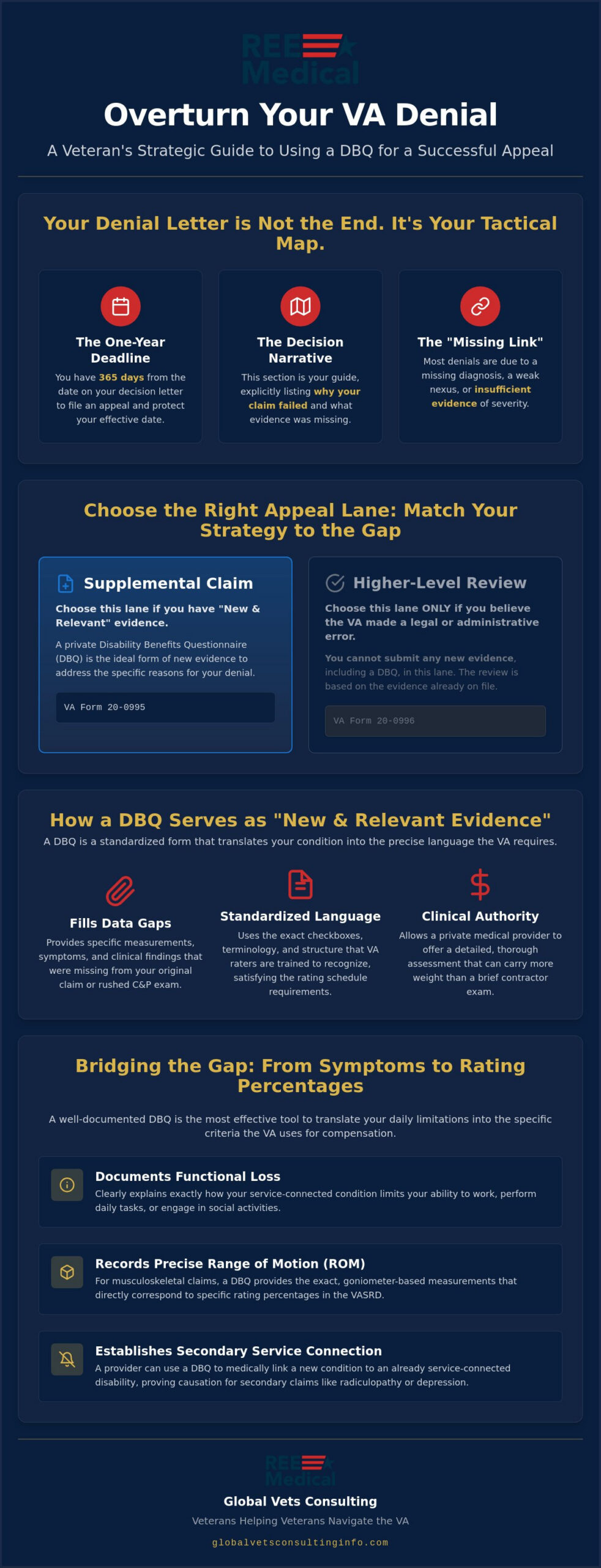
- The One-Year Deadline: You have exactly 365 days from the date on your decision letter to file an appeal. Missing this window often results in losing your original effective date.
- The Decision Narrative: This section of your denial letter is your tactical map. It explicitly lists why your claim was denied and what evidence was missing.
- Identifying the “Missing Link”: Most denials occur because of a missing diagnosis, a weak nexus (service connection), or insufficient evidence regarding the severity of your symptoms.
Choosing the right path requires a “Veterans Helping Veterans” approach. You need to match your appeal lane to the specific gap identified in your denial narrative.
Supplemental Claim vs. Higher-Level Review (HLR)
Understanding the difference between these two lanes is essential for a successful outcome. Using a dbq to appeal a va decision is only possible in the Supplemental Claim lane, as it allows for the submission of new documentation.
- Supplemental Claim (VA Form 20-0995): Choose this lane if you have “New and Relevant” evidence. A private DBQ qualifies as relevant evidence because it specifically addresses the findings needed to satisfy the rating schedule.
- Higher-Level Review (VA Form 20-0996): Choose this lane only if you believe the VA made a legal or administrative error. You cannot submit a new DBQ or any other evidence in this lane.
- Defining “New and Relevant”: In 2026, evidence is considered relevant if it was not previously reviewed and has a direct impact on the issue being appealed.
If your denial was based on a lack of medical evidence, the Supplemental Claim lane is your primary route to success.
How a DBQ Serves as “New and Relevant Evidence”
A Disability Benefits Questionnaire (DBQ) is a standardized clinical form. It mirrors the VA Schedule for Rating Disabilities (VASRD) to ensure your medical data matches the VA’s legal requirements. Using a dbq to appeal a va decision allows you to provide the specific evidence the rater missed during your initial claim. This document acts as a clinical rebuttal to a negative decision by addressing these key areas:
- Filling Data Gaps: It provides the specific measurements or symptoms that were missing from your previous exam.
- Standardized Documentation: It uses the exact checkboxes and clinical language that VA raters are trained to recognize.
- Clinical Authority: It allows a private provider to offer a detailed assessment that often carries more weight than a rushed contractor exam.
Many veterans face a denial because their C&P exam was incomplete. A private DBQ serves as competent medical evidence that can outweigh a flawed government evaluation. By submitting this evidence through the Fully Developed Claims program, you ensure the VA has all necessary facts to make a correct decision without further delays.
A DBQ acts as a clinical bridge that translates your daily physical or mental limitations into the specific legal language required for a VA rating increase.
Bridging the Gap: Symptoms to Rating Percentages
The VA determines your monthly compensation based on how your symptoms impact your life. A DBQ is the most effective way to document these specific factors:
- Functional Loss: This documents exactly how your condition limits your ability to work or perform daily tasks.
- Range of Motion (ROM): For musculoskeletal claims, a DBQ records precise measurements that dictate your rating percentage.
- Secondary Service Connection: It can prove how a primary disability caused a new condition, such as secondary service connection for radiculopathy.
If you’re unsure which form fits your diagnosis, you can explore our medical evidence education resources to find the right path for your appeal.
Strategic Steps to Using a DBQ in Your Appeal
Successfully using a dbq to appeal a va decision requires a methodical approach to gather the medical evidence the VA previously missed. Follow these steps to build a stronger case for your Supplemental Claim:
- 📂 Request Your C&P Results: File a Freedom of Information Act (FOIA) request to obtain your previous exam report. You must identify the specific inaccuracies or missed symptoms before you can rebut them.
- 📋 Select the Correct DBQ: Ensure you choose the specific form that matches your diagnosed condition. Using the wrong form can lead to administrative delays or an immediate denial.
- 📖 C-File Review: Your private provider must review your entire claims folder and service treatment records. Under the U.S. Code on VA Claims Evidence, a medical opinion based on a full record review carries significantly more weight than a rushed contractor exam.
- ✉️ Submit with Form 20-0995: Attach your completed DBQ to your Supplemental Claim application. This officially presents your “new and relevant” evidence to the VA rater.
By following this sequence, you ensure your appeal addresses the specific data gaps that caused your initial VA disability claim to fail.
Ensuring Your DBQ is “VA-Ready”
A DBQ is only effective if it meets the VA’s strict standards for medical evidence. Pay close attention to these critical details to avoid a rejection:
- The Rationale Section: Your doctor must explain *why* your symptoms meet the criteria for a higher rating. A simple “yes” or “no” checkbox is rarely enough to win an appeal.
- Clinical Jargon: Ensure the form uses professional medical terminology. Phrases like “objective evidence of painful motion” are more persuasive to a rater than general descriptions of pain.
- Administrative Accuracy: Double-check for the provider’s signature, date, and medical credentials. Missing information in these fields can trigger an automatic administrative rejection.
If you need assistance navigating these technical requirements, you can access our DBQ education and resource awareness tools to ensure your documentation is mission-ready.
Overcoming VA Skepticism and Private DBQ Rejections
Some veterans hesitate to submit private medical evidence because they worry about being flagged for “suspicious” documentation. It’s time to set the record straight. Private DBQs are not only legal but are often the most effective way to hold the VA to its own duty to assist. While the VA has increased scrutiny in 2026 to identify generic or boilerplate forms, a detailed and individualized medical report remains a powerful tool. Following the Elizabeth Dole Act’s push for standardized PDF documentation, using a dbq to appeal a va decision is a strategic right that forces the rater to consider evidence outside of their own contracted examiners.
Don’t be surprised if the VA orders a new contractor C&P exam even after you submit a private DBQ. This doesn’t mean your evidence was rejected; it’s often a procedural step. You should attend the exam, but ensure your private evidence is part of the conversation. This is particularly vital when using a DBQ for mental health conditions to counter a negative C&P report. The Global Vets Consulting difference lies in providing the meticulous documentation that stands up to this scrutiny, offering the clinical depth that contractor exams often lack.
The Final Mission: Submitting Your Appeal
When your documentation is ready, upload it through AccessVA or VA.gov. This ensures an immediate digital timestamp and moves your file into the queue faster than traditional mail. You can still utilize the structure of a Fully Developed Claim when filing your appeal to keep the process streamlined. The VA’s 2026 goal for processing Supplemental Claims is approximately 125 days, so monitoring your portal is essential during this window.
If using a dbq to appeal a va decision through a Supplemental Claim doesn’t yield the result you deserve, don’t give up. You still have the option for a Higher-Level Review to challenge the rater’s interpretation of your private medical evidence. Global Vets Consulting is committed to standing by you until your benefits match your sacrifice.
🌐 GlobalVetsConsultingInfo.com
🇺🇸 Worldwide
📞 24/7 National Client Services Hotline
🤖 24/7 AI Veteran Intake Specialist
Secure Your Earned Benefits with Precise Evidence
You now have the tactical roadmap to turn a denial into a successful rating increase. By choosing the right appeal lane and documenting your functional loss with clinical precision, you shift the focus from a rushed contractor exam to your actual medical reality. Using a dbq to appeal a va decision isn’t just about filing more paperwork; it’s about providing the specific data points that force the system to recognize the severity of your service-connected conditions.
We understand that the bureaucracy can feel like an uphill battle, but you don’t have to navigate it alone. If you’re still unsure about what is a dbq or how to address specific gaps in your C-file, our team is ready to assist. Global Vets Consulting is a veteran-owned organization dedicated to providing the medical evidence education you need to achieve the rating you’ve earned through your sacrifice.
🇺🇸 Get the DBQ Evidence You Need—Contact Global Vets Consulting Today. Our 24/7 National Client Services Hotline is available to provide the steady guidance and professional authority your claim deserves. Take the next step in your final mission to secure your benefits today.
Frequently Asked Questions
Can I submit a DBQ for a Higher-Level Review (HLR)?
No, you cannot submit a new DBQ for a Higher-Level Review (HLR). The HLR lane is strictly limited to a review of the evidence that was already in your file at the time of the initial decision. If you are using a dbq to appeal a va decision, you must choose the Supplemental Claim lane (VA Form 20-0995) to allow the rater to consider the new documentation.
What happens if the VA ignores my private DBQ during an appeal?
If the VA ignores your private DBQ, they may have committed a legal error by failing to consider competent medical evidence. You can verify this by checking the “Evidence” section of your decision narrative to see if your DBQ was listed. If it was overlooked, you can then file a Higher-Level Review to point out that the rater failed to review the evidence you submitted with your Supplemental Claim.
Do I need a new Nexus Letter if I am submitting a DBQ for an appeal?
You only need a new nexus letter if the VA denied your claim because they found no link between your condition and your military service. A DBQ is primarily used to document the severity of your symptoms for a rating increase. However, if service connection is the issue, you should submit a nexus letter alongside your DBQ to provide a complete medical rebuttal.
How much does it cost to get a private DBQ for a VA appeal?
The cost for a private medical evaluation depends on the complexity of your condition and the time required for a provider to review your C-file. The VA does not reimburse veterans for the cost of private medical evidence. We recommend checking with individual providers to understand their fee structures for standardized medical documentation and education before starting your appeal.
Is a private DBQ better than a VA C&P exam for an appeal?
A private DBQ is often more effective because it provides a detailed clinical perspective that a rushed C&P exam might miss. Many contract examiners are under tight schedules and may not review your entire medical history. Using a dbq to appeal a va decision ensures that your functional loss and symptom frequency are recorded accurately by a provider who has thoroughly reviewed your service treatment records.

Article by
Willie Daniel
Willie Daniel is the Founder and Chief Executive Officer (CEO) of Global Vets Consulting (GVC) – National Veterans Disability Services, a veteran-led educational and medical evidence support organization dedicated to helping veterans better understand VA disability rating increases, DBQ medical evidence, secondary claims education, and C&P examination preparation.
He is a retired U.S. Army Medical Service Corps Officer with more than 27 years of honorable military service, a decorated Iraq combat veteran, and a retired federal official with the U.S. Department of Veterans Affairs. Throughout his military and federal career, Willie Daniel served in leadership, healthcare administration, operational, and veteran-support roles focused on improving services and support systems for servicemembers, veterans, and their families.
Drawing from decades of military leadership, healthcare administration, veteran advocacy, and federal government experience, Willie Daniel brings a practical, veteran-centered perspective to Global Vets Consulting’s educational articles, AI-powered veteran resources, video education initiatives, and outreach programs. His experience navigating military systems, medical documentation processes, and veteran-related administrative operations provides valuable insight into many of the challenges veterans face when seeking to better understand VA disability rating criteria, medical evidence, documentation strategies, and secondary condition education.
Through GVC’s “Veterans Helping Veterans” mission, his focus is on delivering clear, educational, and easy-to-understand information designed to empower veterans with knowledge, resources, and educational tools that may help them make more informed decisions regarding their individual VA disability journeys.
The information provided through GVC is intended for educational and informational purposes only and should not be considered legal or medical advice.
Disclaimer
Disclaimer: Global Vets Consulting, LLC (“GVC”) is a veteran-led educational and medical evidence support organization. GVC is not a law firm, is not a Veterans Service Organization (VSO), and is not affiliated with the U.S. Department of Veterans Affairs (VA) or any government agency.
Global Vets Consulting does not provide legal advice, medical advice, medical treatment, or healthcare services. GVC does not prepare, file, or submit VA disability claims on behalf of veterans. All information provided through this website, blog articles, videos, educational materials, AI tools, dashboards, templates, and communications is intended solely for general educational and informational purposes.
Veterans are encouraged to consult with accredited representatives, licensed attorneys, qualified medical providers, or Veterans Service Organizations regarding their specific legal, medical, or VA-related matters. VA disability decisions, ratings, and outcomes are determined solely by the U.S. Department of Veterans Affairs based on applicable laws, regulations, medical evidence, and individual circumstances. Past results do not guarantee future outcomes.

