
What if the most effective way to fix a low disability rating isn’t a multi-year legal battle, but a single, precise medical document? It’s exhausting to open a decision letter only to find a rating that doesn’t match your daily reality, especially when it feels like a rater ignored your private doctor’s input. You’ve earned the right to have your medical truth reflected in your benefits. Using a dbq to correct a va rating error is a strategic move that places professional evidence directly into your file, making it much harder for the VA to overlook your symptoms. 🇺🇸
We understand how the system works and we’re here to help you navigate it. In 2026, the landscape has shifted with the Elizabeth Dole Act and new AI tools designed to scan medical data more accurately. This article will show you exactly how to leverage private medical evidence through the Supplemental Claim lane to get faster results. We’ll walk through the process of using a private DBQ to document your limitations so you can avoid the long BVA wait and secure the rating you deserve.
Key Takeaways
- Learn how to conduct a “Gap Analysis” on your decision letter to pinpoint exactly where the VA rater missed symptoms or ignored evidence.
- Understand the critical distinction between filing a CUE motion for legal errors and using a Supplemental Claim to submit new, relevant medical facts.
- Discover the strategic advantage of using a dbq to correct a va rating error by providing standardized documentation that matches the VA’s specific rating criteria.
- Follow a clear, step-by-step process for securing a private DBQ that focuses on the severity markers and functional limitations needed for an accurate rating.
- Explore how professional medical evidence education can help you challenge a low rating and secure the disability compensation you have rightfully earned.
Common VA Rating Errors and How a DBQ Provides the Fix
A VA rating error occurs when the Veterans Benefits Administration (VBA) assigns a disability percentage that doesn’t reflect the actual severity of your condition. This often happens because the rater didn’t fully review the evidence or misunderstood the impact of your symptoms on your daily life. It’s a breakdown in the bureaucratic system that leaves you without the compensation you’ve earned through your service.
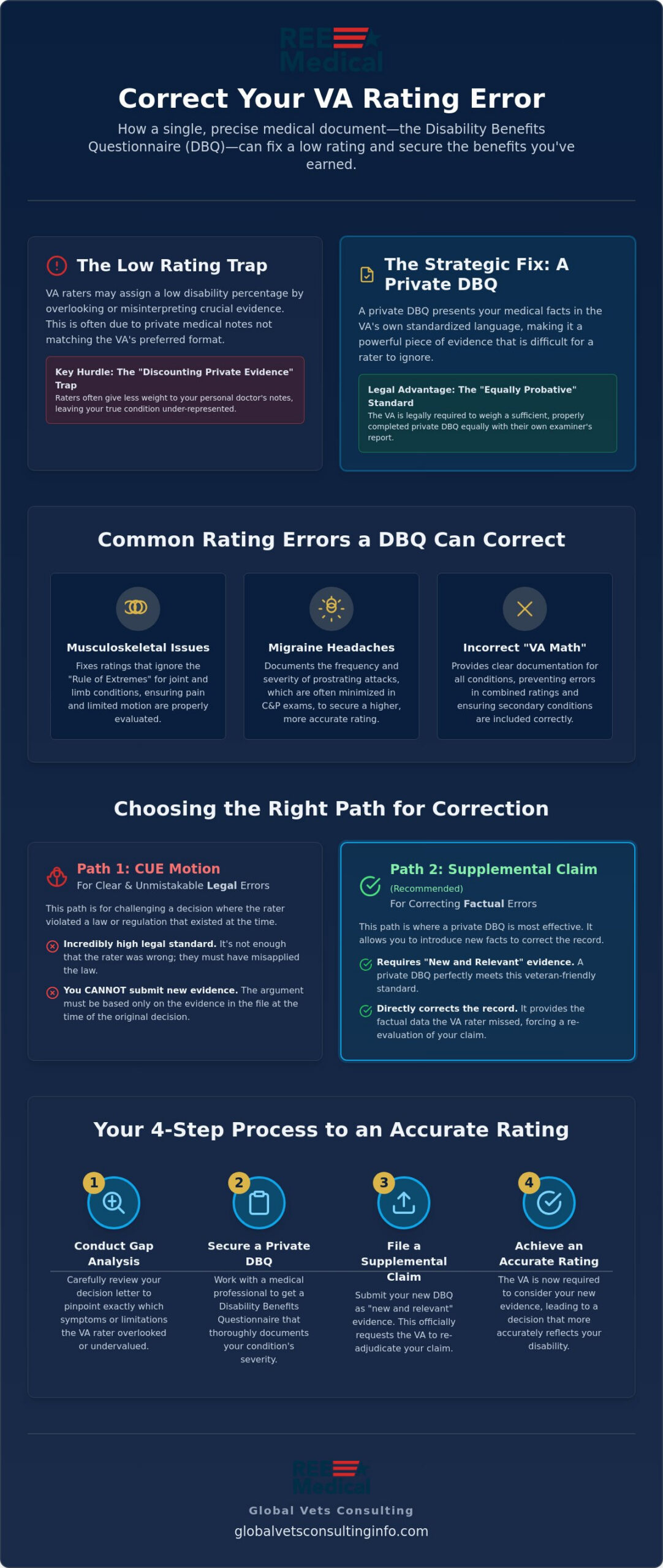
One of the biggest hurdles veterans face is the “Discounting Private Evidence” trap. Raters sometimes ignore your personal doctor’s notes because they aren’t formatted the way the VA prefers. Using a dbq to correct a va rating error solves this problem by presenting your medical facts in the VA’s own language. This standardized format makes it much harder for a rater to skip over critical details about your health. It acts as a corrective lens, bringing symptoms that were previously overlooked into sharp focus for the decision-maker.
You also have legal protections that many veterans don’t realize exist. Under 38 C.F.R. § 3.655, the VA can issue a rating based on the evidence already in your file. If your private DBQ is thorough and accurate, it can serve as the primary evidence for your claim. This is vital if a C&P exam was poorly conducted, rushed, or missed entirely. You don’t have to rely solely on a single VA exam when you have professional documentation on your side.
The Most Frequent Errors a DBQ Can Correct
- Failure to consider the “Rule of Extremes” in musculoskeletal ratings, which can result in a lower percentage for joint or limb issues than the law allows.
- Ignoring the frequency and duration of prostrating attacks in migraine claims, leading to a low rating when your symptoms warrant a much higher percentage.
- Incorrectly applying “VA Math” to combined ratings, where the total disability percentage is calculated using the wrong formulas or missing secondary conditions.
Why the VA is Legally Required to Weigh Your Private DBQ
The VA must follow the “Equally Probative” standard. This means they can’t automatically give more weight to a VA examiner’s opinion over your private medical evidence just because the examiner works for the government. For your documentation to hold this weight, it must be “sufficient for rating purposes” to be legally valid. Using a dbq to correct a va rating error ensures your evidence meets this high bar of documentation and compliance, forcing the VA to reconcile their decision with the facts.
CUE vs. Supplemental Claims: Choosing the Right Path for Correction
When you realize the VA made a mistake, choosing the correct administrative “lane” is the most important decision you’ll make. Most veterans feel overwhelmed by the options, but the choice usually comes down to whether the error was legal or factual. Understanding the VA disability claims process step by step allows you to pick the path that offers the highest chance of success without waiting years for a Board appeal.
A Clear and Unmistakable Error (CUE) is a specific legal challenge. It applies only when a rater makes a blunder so obvious that it would have changed the outcome of the claim based solely on the evidence that was already in the file. You cannot submit new medical evidence for a CUE. If you’ve recently secured a private medical opinion to prove your symptoms are worse than the VA stated, using a dbq to correct a va rating error through the Supplemental Claim lane is almost always the better strategy.
How to File a CUE Claim When the Error is Legal
The legal standard for a CUE is incredibly high. It isn’t enough to say the rater was wrong; you must prove they violated a law or regulation that existed at the time of the decision. For example, if a rater completely ignored a service-connected diagnosis already in your records, that might be a CUE. However, if the error is that the VA examiner didn’t listen to you during a C&P exam, a DBQ is not the answer for a CUE. You’d need a different approach for legal misinterpretations.
Using a DBQ for a Supplemental Claim (The Factual Fix)
The Supplemental Claim lane is where most veterans find relief. This path requires “new and relevant” evidence, which is a low and veteran-friendly bar in 2026. By submitting Public Disability Benefits Questionnaires (DBQs) completed by a private provider, you provide the factual data the VA missed. This documentation forces the VA to re-evaluate your rating based on current, objective medical facts.
This method is particularly effective for correcting “inadequate” C&P exams. If an examiner spent five minutes with you and missed your range-of-motion limitations, a comprehensive private DBQ fills that gap. It provides the detailed evidence needed to overturn a factual omission. If you need help understanding how to document your symptoms correctly, our team can provide the medical evidence education you need to move forward with confidence.
Step-by-Step Guide: Using a Private DBQ to Correct the Record
Correcting a VA mistake requires more than just submitting more paperwork. It requires a methodical strategy to show the rater exactly where the previous decision fell short. By following a structured process, using a dbq to correct a va rating error becomes a targeted strike against inaccuracy rather than a shot in the dark. 🇺🇸
Reviewing Your Decision Letter for Clues
Your journey begins with a “Gap Analysis” of your rating letter. Look closely at the “Reasons for Decision” section. This is where the VA explains why they didn’t grant a higher percentage. You should also identify “Favorable Findings.” These are facts the VA has already conceded, such as your service connection. While a Clear and Unmistakable Error is a high legal bar to meet, finding factual omissions in this letter provides the roadmap for your new DBQ.
Ensuring Your DBQ is “Rater-Ready”
A private DBQ is only as good as the detail it contains. It must specifically address the severity markers the VA claimed were missing in your denial. Ensure your provider includes a clear “Nexus” statement if service connection is being challenged. Every checkbox on the DBQ must be supported by the “Remarks” section for maximum impact. If a doctor checks a box for “prostrating attacks” but doesn’t describe them in the notes, a rater may dismiss the evidence as insufficient.
Once your evidence is ready, draft a Statement in Support of Claim (VA Form 21-4138). Use this form to point the rater directly to the new findings in your DBQ. Finally, submit everything via the Supplemental Claim lane using VA Form 20-0995. This path allows the VA to review the “new and relevant” evidence without the years of waiting required for a Board appeal. By following these steps, using a dbq to correct a va rating error ensures your file is complete and accurate. If you’re ready to take the next step, get started with our medical evidence education to ensure your documentation is built to win.
Securing Accurate Ratings with Global Vets Consulting
Global Vets Consulting streamlines the evidence-gathering process by focusing on the specific documentation raters need to see. Many veterans struggle because their medical records are disorganized or fail to speak the VA’s technical language. We bridge that gap through Independent Medical Evidence Education, ensuring your file is built on a foundation of professional, standardized documentation. Understanding what is a DBQ and how it functions is the first step in taking control of your claim. 🇺🇸
The importance of standardized medical documentation cannot be overstated when you are challenging a previous mistake. By using a dbq to correct a va rating error, you provide a clear, objective roadmap that forces the rater to look at your symptoms through the lens of the law. This methodical approach reduces the risk of further delays and helps you secure a rating that matches your actual level of impairment. We provide the educational resources you need to substantiate your claim with confidence and precision.
Veterans Helping Veterans: Our Mission-Driven Approach
Our organization is veteran-owned and operated, which means our peer-to-peer community voice is built on shared experience and mutual respect. We understand the frustration of a low rating because we’ve seen the system from both sides. To ensure you never feel lost in the process, we leverage modern technology like our 24/7 AI Veteran Intake Specialist. This tool provides immediate guidance and helps you identify the next actionable steps in your journey toward a fair rating. 🌐
Ready to Correct Your Rating Error?
If you’re tired of waiting for the benefits you earned, it’s time to take a proactive approach to your medical evidence. Our team is dedicated to simplifying the complexities of the VA system so you can focus on your health and your family. 📞
- Call our 24/7 National Client Services Hotline for immediate support and guidance.
- Visit GlobalVetsConsultingInfo.com to start your comprehensive evidence review today.
Don’t let a rater’s oversight define your future. Using a dbq to correct a va rating error is a proven strategy to get your claim back on track. We are ready to serve as your knowledgeable advocate and steady guide until your record is corrected. 🇺🇸
Take Control of Your VA Rating Today
Fixing a low disability percentage requires moving beyond the frustration of a flawed decision and taking decisive action with your medical evidence. You now understand that a private DBQ provides the standardized data raters need to see, allowing you to bypass the long wait times of a Board appeal. By choosing the Supplemental Claim lane, you can present new and relevant facts that directly address the gaps in your previous rating letter. 🇺🇸
Using a dbq to correct a va rating error is a strategic move that puts the power back in your hands. At Global Vets Consulting, we are a veteran-owned and operated team specializing in DBQ preparation education. We are dedicated to ensuring your medical status is accurately reflected so you can secure the benefits you earned through your service. Our 24/7 National Client Services Hotline is always available to provide the steady guidance you need. 🌐
🇺🇸 Contact Global Vets Consulting Today to Correct Your Rating Error
You don’t have to navigate this complex bureaucratic system alone. We’re ready to stand with you as a reliable ally until your rating matches your sacrifice. It’s time to get the record right.
Frequently Asked Questions
Can I use a private DBQ to appeal a VA decision from years ago?
Yes, you can file a Supplemental Claim at any time by submitting a private DBQ as new and relevant evidence. While you must file within one year of a decision to preserve your original effective date for back pay, a new medical evaluation can still be used to fix a long-standing mistake. Using a dbq to correct a va rating error allows you to update your file with current medical facts and secure the correct monthly compensation moving forward.
What happens if the VA ignores my private DBQ and schedules a C&P exam anyway?
You must attend any VA-scheduled Compensation and Pension (C&P) exam even if you have already submitted a private DBQ. Skipping a scheduled exam often leads to an immediate denial of your claim. Your private evidence remains a vital part of your file, and it forces the rater to compare your doctor’s findings against the VA examiner’s report. This comparison is often what highlights the original error in your rating.
How long does it take to correct a rating error using a Supplemental Claim?
The average timeline for a Supplemental Claim in 2026 is currently between 3 to 5 months. This path is significantly faster than a Board of Veterans’ Appeals (BVA) hearing, which can still take several years to resolve. Using a dbq to correct a va rating error through the Supplemental Claim lane is the most efficient strategy for veterans who need their benefits updated quickly without a prolonged legal battle.
Is a CUE claim faster than a Supplemental Claim for fixing errors?
No, a Supplemental Claim is generally faster and has a higher success rate for most factual errors. A Clear and Unmistakable Error (CUE) claim requires you to meet an incredibly high legal standard using only the evidence that was in your file at the time of the decision. Most veterans find it much simpler to submit a new, detailed DBQ as new evidence rather than trying to prove a rare legal blunder.
What is the difference between a DBQ and a Nexus Letter for error correction?
A DBQ documents the current severity and functional limitations of your condition, while a Nexus Letter establishes the medical link between your condition and your military service. If the VA already service-connected your disability but gave you a rating that is too low, a DBQ is the correct tool to fix the error. It provides the specific symptoms and severity markers the rater needs to assign a higher percentage.

Article by
Willie Daniel
Willie Daniel is the Founder and Chief Executive Officer (CEO) of Global Vets Consulting (GVC) – National Veterans Disability Services, a veteran-led educational and medical evidence support organization dedicated to helping veterans better understand VA disability rating increases, DBQ medical evidence, secondary claims education, and C&P examination preparation.
He is a retired U.S. Army Medical Service Corps Officer with more than 27 years of honorable military service, a decorated Iraq combat veteran, and a retired federal official with the U.S. Department of Veterans Affairs. Throughout his military and federal career, Willie Daniel served in leadership, healthcare administration, operational, and veteran-support roles focused on improving services and support systems for servicemembers, veterans, and their families.
Drawing from decades of military leadership, healthcare administration, veteran advocacy, and federal government experience, Willie Daniel brings a practical, veteran-centered perspective to Global Vets Consulting’s educational articles, AI-powered veteran resources, video education initiatives, and outreach programs. His experience navigating military systems, medical documentation processes, and veteran-related administrative operations provides valuable insight into many of the challenges veterans face when seeking to better understand VA disability rating criteria, medical evidence, documentation strategies, and secondary condition education.
Through GVC’s “Veterans Helping Veterans” mission, his focus is on delivering clear, educational, and easy-to-understand information designed to empower veterans with knowledge, resources, and educational tools that may help them make more informed decisions regarding their individual VA disability journeys.
The information provided through GVC is intended for educational and informational purposes only and should not be considered legal or medical advice.
Disclaimer
Disclaimer: Global Vets Consulting, LLC (“GVC”) is a veteran-led educational and medical evidence support organization. GVC is not a law firm, is not a Veterans Service Organization (VSO), and is not affiliated with the U.S. Department of Veterans Affairs (VA) or any government agency.
Global Vets Consulting does not provide legal advice, medical advice, medical treatment, or healthcare services. GVC does not prepare, file, or submit VA disability claims on behalf of veterans. All information provided through this website, blog articles, videos, educational materials, AI tools, dashboards, templates, and communications is intended solely for general educational and informational purposes.
Veterans are encouraged to consult with accredited representatives, licensed attorneys, qualified medical providers, or Veterans Service Organizations regarding their specific legal, medical, or VA-related matters. VA disability decisions, ratings, and outcomes are determined solely by the U.S. Department of Veterans Affairs based on applicable laws, regulations, medical evidence, and individual circumstances. Past results do not guarantee future outcomes.