

What if the most critical evidence for your 50% disability rating isn’t found in a medical lab, but in the nightly observations of your spouse or roommate? Many veterans face the frustration of a denied claim simply because a doctor didn’t witness their gasping or choking episodes during a clinical sleep study. It’s exhausting to feel like your daily struggle isn’t official enough for the rating you’ve earned. You know your symptoms are real. Yet, the gap between medical records and your actual life can feel impossible to close.
This guide will teach you how to craft a powerful va buddy letter for sleep apnea that provides the lay evidence needed to support your claim. You’ll learn how to translate nighttime distress into the specific language the VA looks for in 2026. We’ll walk through a clear structure for VA Form 21-10210, identify the key symptoms that trigger a higher rating, and show you how to present a witness statement that reinforces your medical evidence. By the end of this article, you’ll have the tools to submit a comprehensive package that finally gives the VA the full picture of your condition.
Key Takeaways
- Understand how lay evidence serves as a critical bridge between your daily symptoms and the medical evidence required for a successful rating.
- Learn the specific structure of a va buddy letter for sleep apnea to ensure witnesses focus on observable events like gasping or choking.
- Identify the two most common errors that lead to claim denials, including the danger of using vague language or attempting to provide a medical opinion.
- Discover how to correctly utilize VA Form 21-10210 to document the frequency and severity of your nighttime distress for the Rater’s review.
- Explore how combining detailed witness statements with professional Disability Benefits Questionnaire (DBQ) resources creates a more comprehensive evidence package.
What is a VA Buddy Letter for Sleep Apnea? 🌐
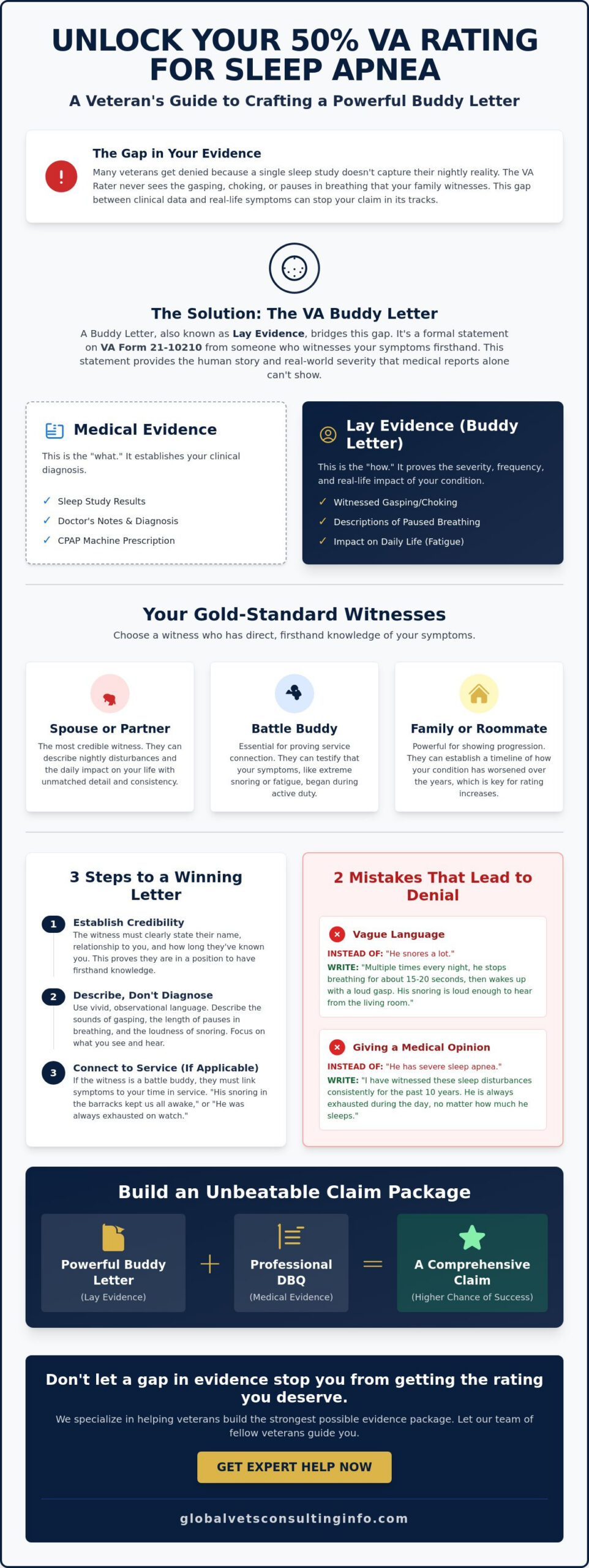
A va buddy letter for sleep apnea is a formal statement written by someone who has firsthand knowledge of your condition. In the world of VA claims, this is known as “lay evidence.” While a doctor provides the clinical diagnosis, a buddy letter provides the human story of your nightly struggles. As we move through June 2026, the VA continues to use VA Form 21-10210 (Statement in Support of Claim) as the primary way for witnesses to document these observations. This form is vital because Sleep apnea often presents symptoms that you cannot witness yourself, such as gasping for air or long pauses in breathing during the night.
Witnessed testimony is often the missing piece in a successful claim. A C&P exam or a sleep study only captures a snapshot of your health in a controlled environment. A buddy letter fills the gaps by describing how you stop breathing multiple times an hour or how your snoring is loud enough to be heard in other rooms. This evidence doesn’t replace a medical diagnosis; it complements it by proving the real world severity of your condition to the Rater.
Lay Evidence vs. Medical Evidence
It’s vital to understand that lay evidence is not a replacement for a medical diagnosis. Instead, it serves as a bridge. Medical evidence consists of sleep study results and doctor’s notes. Lay evidence consists of competent statements about what a witness sees, hears, or experiences alongside you. Under federal law, the VA is required to consider credible statements from friends and family as part of your total evidence package. These statements can prove the severity and frequency of symptoms that a one night sleep study might underreport. This is especially true in 2026 as the VA maintains the 50% rating for CPAP use, making detailed testimony about your need for the device even more valuable.
Who Should Write Your Sleep Apnea Buddy Letter?
- Spouses or domestic partners: They’re the gold standard for evidence because they witness your breathing disturbances every night and can speak to the daily impact on your sleep quality.
- Battle buddies: These witnesses are essential for proving that your symptoms began during your active duty service, which helps establish the required service connection.
- Roommates or family members: These individuals can establish a clear timeline of how your condition has progressed over the years, which is critical for veterans seeking a rating increase.
How to Write a Winning Sleep Apnea Buddy Letter 📞
Creating a successful va buddy letter for sleep apnea requires moving beyond generalities. A winning statement provides a vivid, chronological account of the veteran’s condition that a clinical sleep study might not fully capture. You must provide the Rater with a clear picture of what happens when the lights go out. This involves identifying the veteran, explaining your relationship, and describing the physical symptoms you witness with your own eyes and ears.
Step 1: Establishing Credibility and Relationship
The witness must begin by stating their relationship to the veteran with absolute clarity. A spouse might write, “I have been the veteran’s wife for fifteen years and have observed his sleep patterns every night during that time.” This establishes that the witness is in a unique, consistent position to provide lay evidence. Always include contact information at the end of the statement. This shows the VA that the witness is real and willing to stand by their testimony if a recruiter or Rater needs to verify the details.
Step 2: Describing ‘Gasping and Choking’ Episodes
Avoid the temptation to use medical jargon. Instead of saying the veteran has “apneic events,” use descriptive language that illustrates the struggle. You might say, “He sounds like he is fighting for air,” or “He stops breathing for twenty seconds until he suddenly gasps so loudly it wakes me up.” This type of reporting is what the VA considers “competent lay evidence.” As noted by this authoritative government source, these interruptions are primary indicators of the condition. Be specific about frequency. Does this happen every night? Does it occur multiple times every hour?
Step 3: Connecting Symptoms to Service
For battle buddies, the focus should be on the earliest onset of symptoms. If you shared a tent or barracks, describe the environment. Did the veteran’s snoring keep the entire unit awake? Did they struggle with extreme daytime fatigue during long shifts? Establishing that these issues existed during active duty is vital for proving a service connection. If you need help organizing these details to support your case, sleep apnea claims education can provide the structure you need to move forward with confidence.
Finally, don’t ignore the daytime impact. A strong letter describes the “hangover” effect of poor sleep, such as morning headaches, irritability, or falling asleep during meetings. These details demonstrate the functional impairment required for a fair VA rating increase.
Common Mistakes That Lead to VA Claim Denials 🇺🇸
Even the most sincere witness statement can fail if it doesn’t meet the VA’s specific evidentiary standards. Many veterans submit a va buddy letter for sleep apnea only to find their claim denied because the letter attempted to do too much or provided too little detail. Understanding these pitfalls is the first step toward building a resilient case. When a witness tries to step into the role of a medical professional, it often triggers a red flag for the Rater.
The ‘Diagnosis’ Trap: What NOT to Say
The most frequent error is a layperson attempting to “diagnose” the veteran. A spouse might write, “My husband has Obstructive Sleep Apnea.” While this may be true, a layperson isn’t qualified to make that determination. The VA may view this as an attempt to provide medical evidence rather than lay testimony, which can lead them to disregard the entire statement. Instead, the witness should describe the physical symptoms they see and hear, such as the gasping and snoring patterns identified by a leading medical institution. Stick to describing the “struggle for air” rather than naming the disease.
Vagueness is another significant claim killer. Stating that a veteran “sleeps poorly” or “is always tired” doesn’t provide the Rater with actionable data. You need to be specific about the frequency of the events. Does the veteran stop breathing every single night? Does the snoring happen several times an hour? Concrete numbers and specific examples carry much more weight than general observations.
Consistency Across All VA Documentation
Your evidence must tell a single, coherent story. If the buddy letter contradicts the veteran’s personal statement or existing medical records, the VA may find the evidence non-credible. It’s essential to ensure the letter aligns with the va disability claims process step by step. Every piece of paperwork should reinforce the others to create a clear timeline of the condition’s progression.
If you’ve had your va claim denied for lack of evidence in the past, it’s often because the lay testimony didn’t effectively bridge the gap between your symptoms and your service. You can correct this by focusing on specific, observable events in your next submission. If you’re feeling overwhelmed by the technical requirements, our sleep apnea claims education can help you organize your evidence for a stronger presentation.
Strengthening Your Claim with Professional DBQs 🌐
A va buddy letter for sleep apnea is a powerful tool, but it shouldn’t stand alone. Think of it as the bridge between your daily lived experience and the technical requirements of the VA. While your spouse or battle buddy can describe your gasping for air, they cannot provide the clinical measurements the Rater needs to assign a percentage. Combining lay evidence with a professional Disability Benefits Questionnaire (DBQ) creates a comprehensive evidence package that is much harder for the VA to ignore.
The Winning Evidence Trifecta
To secure the rating you’ve earned in 2026, your claim should ideally consist of three distinct layers of evidence. Missing any of these elements can create a “gap” that leads to a denial or an underrated claim.
- The Sleep Study (Diagnosis): This provides the clinical proof that the condition exists.
- The Buddy Letter (Lay Evidence): This documents the “human” side, proving the frequency and severity of symptoms in a real-world setting.
- The DBQ (Severity and Rating): This translates your symptoms into the specific medical language the VA uses to determine your disability percentage.
As of June 2026, the 50% rating for veterans requiring a CPAP machine remains in effect. However, the VA has proposed changes that could shift focus toward treatment effectiveness. This makes it vital to use a va buddy letter for sleep apnea to document your consistent need for and use of the device alongside medical evidence.
Next Steps for Your VA Disability Claim
Start gathering your witness statements as early as possible. These letters provide the foundation for your medical provider to understand the full scope of your condition. If you are seeking a higher rating because your symptoms have worsened, a buddy letter can effectively support a dbq for va disability rating increase by showing a clear timeline of progression.
If you’re still wondering what is a dbq or how it fits into your specific case, education is your best defense. We provide the resources you need to navigate these complex forms with confidence. Don’t leave your 2026 benefits to chance; ensure your lay evidence and medical documentation are working in perfect sync.
🇺🇸 Global Vets Consulting
📞 24/7 National Client Services Hotline
🌐 GlobalVetsConsultingInfo.com
Secure Your Earned Benefits with Stronger Evidence 🇺🇸
You now have the framework to transform simple observations into powerful lay evidence. A well-constructed va buddy letter for sleep apnea provides the Rater with a window into your nightly struggle that a clinical study might miss. By avoiding common pitfalls like medical diagnosing and ensuring consistency across your documentation, you significantly strengthen your case under the current 2026 rating schedule. The path to a successful claim is built on accuracy and the right combination of evidence.
We are a veteran-owned and operated consulting service dedicated to providing high-quality medical evidence education. Our team understands the intricacies of the system and is ready to act as your reliable ally. Whether you’re navigating a new claim or seeking a rating increase, we offer the professional support you need to move forward with confidence. Our 24/7 National Client Services Hotline is available whenever you’re ready to take the next step.
Get the Professional DBQ Documentation You Need for Your VA Claim
📞 24/7 National Client Services Hotline
🌐 GlobalVetsConsultingInfo.com
You’ve served your country with honor; now it’s time to ensure you receive the benefits you’ve rightfully earned.
Frequently Asked Questions
Can a spouse write a buddy letter for sleep apnea?
Yes, a spouse is often the most effective witness for a va buddy letter for sleep apnea because they observe your nighttime breathing patterns every single night. They can provide specific, firsthand details about gasping, choking, or long pauses in your breath that you cannot see yourself. Their testimony helps the VA understand the daily severity of your condition beyond what a one night clinical sleep study might capture.
How many buddy letters should I submit for my VA claim?
You should aim to submit between one and three high quality buddy letters that offer unique perspectives on your condition. For example, one letter from a spouse can cover current symptoms and the need for a CPAP machine, while another from a battle buddy can establish when the snoring first began during active duty. focus on clear, distinct observations that reinforce your medical evidence rather than submitting multiple repetitive statements.
Does the VA actually read buddy letters?
Yes, VA Raters are legally required to consider all credible lay evidence, including buddy statements, when evaluating your disability claim. These letters are particularly important for sleep apnea because they fill in the gaps regarding the frequency and intensity of your symptoms. While medical evidence provides the diagnosis, your witness statements provide the necessary context that helps the VA determine the appropriate disability rating.
What if I don’t have a spouse or roommate to witness my sleep apnea?
If you live alone, you can still submit a va buddy letter for sleep apnea from family members or friends who have observed you during vacations, deployments, or visits. They can describe what they heard through the walls or observed while you were sleeping in a shared space. Additionally, you should focus on your own personal statement describing observable daytime impacts like morning headaches and extreme fatigue to support your case.
Should a buddy letter be notarized for the VA?
No, the VA does not require buddy letters to be notarized to be considered valid evidence. When using the official VA Form 21-10210, the witness signs a declaration stating the information is true to the best of their knowledge under penalty of perjury. This official certification carries the necessary legal weight for the Rater without the need for a notary’s seal, simplifying the process for your witnesses.

Article by
Willie Daniel
Willie Daniel is the Founder and Chief Executive Officer (CEO) of Global Vets Consulting (GVC) – National Veterans Disability Services, a veteran-led educational and medical evidence support organization dedicated to helping veterans better understand VA disability rating increases, DBQ medical evidence, secondary claims education, and C&P examination preparation.
He is a retired U.S. Army Medical Service Corps Officer with more than 27 years of honorable military service, a decorated Iraq combat veteran, and a retired federal official with the U.S. Department of Veterans Affairs. Throughout his military and federal career, Willie Daniel served in leadership, healthcare administration, operational, and veteran-support roles focused on improving services and support systems for servicemembers, veterans, and their families.
Drawing from decades of military leadership, healthcare administration, veteran advocacy, and federal government experience, Willie Daniel brings a practical, veteran-centered perspective to Global Vets Consulting’s educational articles, AI-powered veteran resources, video education initiatives, and outreach programs. His experience navigating military systems, medical documentation processes, and veteran-related administrative operations provides valuable insight into many of the challenges veterans face when seeking to better understand VA disability rating criteria, medical evidence, documentation strategies, and secondary condition education.
Through GVC’s “Veterans Helping Veterans” mission, his focus is on delivering clear, educational, and easy-to-understand information designed to empower veterans with knowledge, resources, and educational tools that may help them make more informed decisions regarding their individual VA disability journeys.
The information provided through GVC is intended for educational and informational purposes only and should not be considered legal or medical advice.
Disclaimer
Disclaimer: Global Vets Consulting, LLC (“GVC”) is a veteran-led educational and medical evidence support organization. GVC is not a law firm, is not a Veterans Service Organization (VSO), and is not affiliated with the U.S. Department of Veterans Affairs (VA) or any government agency.
Global Vets Consulting does not provide legal advice, medical advice, medical treatment, or healthcare services. GVC does not prepare, file, or submit VA disability claims on behalf of veterans. All information provided through this website, blog articles, videos, educational materials, AI tools, dashboards, templates, and communications is intended solely for general educational and informational purposes.
Veterans are encouraged to consult with accredited representatives, licensed attorneys, qualified medical providers, or Veterans Service Organizations regarding their specific legal, medical, or VA-related matters. VA disability decisions, ratings, and outcomes are determined solely by the U.S. Department of Veterans Affairs based on applicable laws, regulations, medical evidence, and individual circumstances. Past results do not guarantee future outcomes.

