
Why does it feel like the VA often uses “adjustment disorder” as a catch-all label when your symptoms feel every bit as debilitating as PTSD? It’s a common experience for many of us in the veteran community to walk out of a C&P exam feeling dismissed or misunderstood. You’ve served your country, and now you just want the system to acknowledge the reality of your mental health challenges without the confusion of complex administrative jargon.
We understand the anxiety that comes with looking at the 38 CFR rating schedule and wondering where you fit in. Filing a va claim for adjustment disorder shouldn’t feel like a gamble with your future. This guide is designed to give you a clear, predictable path forward by revealing the exact criteria the VA uses to determine your rating. You’ll learn how to bridge the gap between your diagnosis and the compensation you’ve earned through your service.
We will provide a detailed breakdown of the 0 to 100 percent rating scale for 2026 and explain how to use a Disability Benefits Questionnaire (DBQ) to document your functional impairment. By the end of this article, you’ll have the knowledge and confidence to secure the medical evidence necessary to win your claim or successfully file for a rating increase.
Key Takeaways
- Understand how a va claim for adjustment disorder transitions from a temporary civilian diagnosis into a chronic, service-connected disability.
- Learn the specific criteria within the General Rating Formula for Mental Disorders that determines your 0% to 100% rating.
- Master the three pillars of evidence, including the current diagnosis and medical nexus, necessary to win your claim.
- Discover why a comprehensive Disability Benefits Questionnaire (DBQ) is critical for documenting the full extent of your symptoms.
- Gain the confidence to pursue a rating increase by understanding exactly how the VA measures social and occupational impairment.
What is an Adjustment Disorder VA Claim? 🇺🇸
An Adjustment Disorder is formally defined as an emotional or behavioral reaction to a specific, identifiable stressor. In the civilian healthcare system, providers often view this as a temporary condition that resolves once the stressor passes. However, for those of us in the veteran community, these symptoms frequently persist long after we hang up the uniform. When symptoms last longer than six months, the VA classifies the condition as chronic. This distinction is vital because a chronic va claim for adjustment disorder is a ratable disability that qualifies you for monthly compensation.
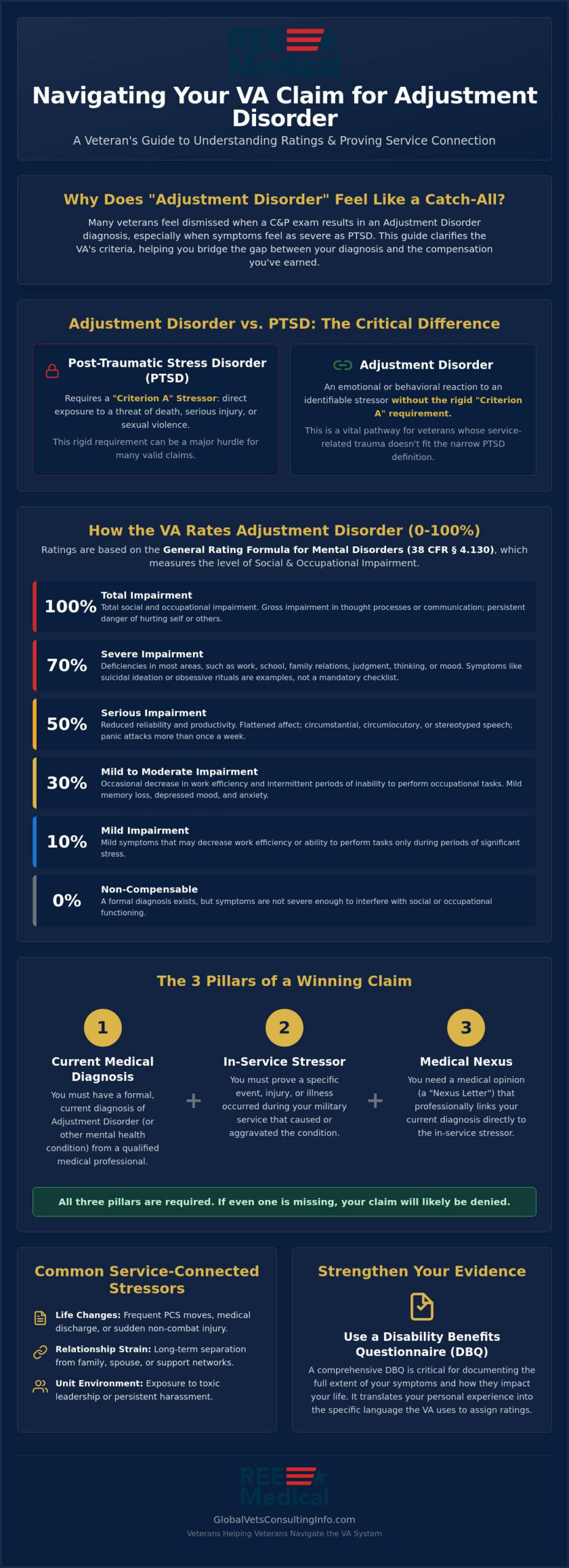
The VA does not use a unique set of rules to evaluate this condition. Instead, they utilize the same General Rating Formula for Mental Disorders found in 38 CFR § 4.130 that they use for PTSD or depression. The primary measuring stick for your rating is “Social and Industrial Impairment.” This term refers to how your symptoms interfere with your ability to hold a job, maintain healthy relationships, and manage your daily responsibilities. The more your condition disrupts your life, the higher your potential rating will be.
Adjustment Disorder vs. PTSD: Knowing the Difference
The biggest hurdle in a PTSD claim is the “Criterion A” stressor requirement. To qualify for PTSD, you must prove you experienced a threat of death, serious injury, or sexual violence. Many veterans struggle with debilitating anxiety or depression caused by events that don’t meet that narrow definition. This is why a va claim for adjustment disorder is such an important tool. It allows you to receive benefits for mental health challenges without the rigid stressor requirements of PTSD. You can follow the VA disability claims process step by step to establish this connection regardless of which mental health diagnosis you carry.
Common Service-Connected Stressors for Adjustment Disorder
Your stressor doesn’t need to be a combat event to be valid for service connection. The VA recognizes several military-specific experiences that can trigger chronic symptoms:
- Frequent PCS moves that lead to social isolation or family strain.
- Long-term separation from your spouse, children, or support networks.
- Exposure to toxic leadership or persistent harassment in your unit.
- The sudden life change following a non-combat injury or medical discharge.
Success depends on documenting these events in your military records and showing they directly caused your symptoms. Establishing this link is the foundation of a winning claim.
The VA Rating Schedule for Adjustment Disorder (0%–100%)
The VA evaluates a va claim for adjustment disorder using 38 CFR § 4.130, the General Rating Formula for Mental Disorders. This schedule doesn’t just look at your symptoms; it looks at how those symptoms disrupt your life. While the Diagnosis of adjustment disorders involves identifying a specific stressor, the rating depends entirely on your functional impairment. The VA assigns percentages based on the following levels of severity:
- 0% Rating: A formal diagnosis exists, but your symptoms don’t interfere with your job or social life. This is often called a “non-compensable” rating.
- 30% Rating: You experience occasional inefficiency and periods where you simply can’t perform tasks. You might have mild symptoms that generally don’t stop you from working but cause noticeable friction.
- 70% Rating: Your impairment is evident in most areas, including work, school, and family. It’s vital to remember that symptoms like suicidal ideation or obsessive rituals listed in the 70% tier are examples, not a mandatory checklist. If your mood and social life are falling apart, you deserve an evaluation that reflects that reality.
- Pillar 1: A Current Medical Diagnosis. You must have a formal diagnosis of adjustment disorder from a qualified mental health professional. It isn’t enough to feel “stressed” or “anxious.” The diagnosis must be documented in your current medical records.
- Pillar 2: An In-Service Event or Stressor. You need to identify a specific event, injury, or period of service that triggered your symptoms. This could be a toxic command climate, a traumatic deployment, or even the cumulative strain of multiple PCS moves.
- Pillar 3: The Medical Nexus. This is the bridge. A medical professional must provide a “nexus” letter or statement confirming that your current diagnosis is “at least as likely as not” caused by the in-service event.
Proving Service Connection: The Three Pillars of Your Claim
Winning a va claim for adjustment disorder requires more than just telling your story. The VA looks for three specific elements, often called the Three Pillars of Service Connection. If one is missing, your claim will likely be denied. These pillars ensure your condition is both real and related to your military service.
Establishing the nexus is often the hardest part, especially when C&P examiners are rushed. The VA evaluates these links using the VA’s General Rating Formula for Mental Disorders. If you feel your service records don’t tell the whole story, lay evidence becomes vital. “Buddy Letters” from fellow service members, spouses, or friends can provide the missing context about how your behavior changed during or after service.
Direct vs. Secondary Service Connection
Direct service connection applies if your mental health symptoms began while you were on active duty. However, many veterans find that their mental health struggles are actually a result of physical injuries. This is a secondary service connection. For example, living with chronic back pain or severe tinnitus can lead to depression and adjustment issues. If you are pursuing this path, educating yourself on a DBQ for mental health conditions is a smart move to ensure your secondary connection is properly documented.
The Critical Role of the Stressor Statement
Your statement in support of the claim (VA Form 21-4138) is your chance to speak directly to the rater. Don’t just list symptoms. Instead, focus on the “before and after.” Describe who you were before the stressor and how your mental health state shifted afterward. Be concise but detailed. Highlighting specific instances where your condition affected your duty performance or social life provides the concrete evidence the VA needs to see. If you need help organizing your medical evidence to support these statements, explore our educational resources to learn how to build a stronger case.
Strengthening Your Evidence with Professional DBQ Support
The success of a va claim for adjustment disorder often comes down to how well your symptoms are translated into the VA’s specific regulatory language. A Disability Benefits Questionnaire (DBQ) is the primary tool used to bridge this gap. While the VA uses these forms to standardize evaluations, the quality of the information recorded is what determines your final rating. Without a thorough document that captures the full scope of your social and occupational impairment, the person reviewing your file may not see the true impact of your condition.
Many veterans rely solely on the Compensation and Pension (C&P) exam, but these appointments can be problematic. It’s common for a contractor to spend only 15 or 20 minutes reviewing a life’s worth of challenges. This rushed environment rarely allows for a deep dive into the nuances of your mental health. Global Vets Consulting focuses on educating veterans on how to gather medical evidence that accurately reflects their daily struggle. We operate with a “Veterans Helping Veterans” mission, ensuring you have the knowledge to secure the paperwork needed to fight for the benefits you’ve earned.
Why Private DBQs Can Prevent Denials
A VA claim denied for lack of evidence is frequently the result of an incomplete or poorly conducted C&P exam. If the examiner doesn’t ask the right questions, your “bad days” might never make it into the record. A private DBQ, completed by a provider who takes the time to understand your history, ensures that every symptom is recorded using VA-standard terminology. This proactive approach creates a more comprehensive medical trail, making it much harder for the VA to overlook the severity of your adjustment disorder.
Preparing for Your C&P Examination
If you are scheduled for a C&P exam, your preparation is vital. You should be honest and transparent about your symptoms. Many of us were trained to “tough it out,” but this is the one time you must do the opposite. Describe your worst days, not how you feel at the exact moment of the exam. We recommend bringing a copy of your completed private DBQ to the appointment. Use it as a reference to ensure you don’t forget to mention critical details like sleep disturbances, panic attacks, or workplace friction. Taking control of your evidence is the most effective way to reduce anxiety and increase your chances of a favorable outcome.
Secure the VA Rating You’ve Earned in 2026 🇺🇸
Navigating the complexities of a va claim for adjustment disorder requires a strategic approach to medical evidence. We’ve explored how the VA uses the General Rating Formula to evaluate your level of impairment and why the Three Pillars of service connection are essential for a successful outcome. By prioritizing a thorough Disability Benefits Questionnaire (DBQ), you can ensure your symptoms are documented with the precision the system demands.
Global Vets Consulting has been veteran-owned and operated since 2021. We specialize in educating veterans on Disability Benefits Questionnaires (DBQ) and the importance of independent medical evidence. With our 24/7 AI Veteran Intake Specialist and a commitment to the “Veterans Helping Veterans” ethos, we provide the resources you need to move forward with confidence. Don’t let a brief C&P exam dictate your future.
📞 Contact our 24/7 National Client Services Hotline at 833-428-3871 to learn more about how we can support your journey. You dedicated your life to service, and now we’re here to help you secure the benefits you deserve. We’re ready to stand by your side through every step of this process.
Frequently Asked Questions
Can I get a 100% VA rating for adjustment disorder?
Yes, you can receive a 100% rating for adjustment disorder if your condition results in total occupational and social impairment. This level is reserved for veterans experiencing symptoms like gross impairment in communication, persistent delusions, or an inability to perform daily living activities. The VA uses the same criteria for adjustment disorder as it does for other mental health conditions like PTSD or depression to ensure consistent compensation across all mental health claims.
What is the difference between PTSD and adjustment disorder for VA claims?
The primary difference lies in the stressor requirement. PTSD requires proof of a “Criterion A” event, such as a threat of death or serious injury. A va claim for adjustment disorder only requires an identifiable stressor, such as a difficult PCS or a toxic command climate. Because both conditions are rated under the same 38 CFR formula, the monthly compensation for a 70% adjustment disorder rating is identical to a 70% PTSD rating.
Can adjustment disorder be claimed as a secondary condition?
You can claim adjustment disorder as a secondary condition if it is caused or aggravated by a service-connected physical disability. For example, veterans living with chronic musculoskeletal pain or severe tinnitus often develop secondary mental health symptoms. Establishing this link requires a medical nexus that explains how your physical limitations have directly impacted your mental well-being and social functioning, often leading to a higher combined disability rating.
What happens if my adjustment disorder claim is denied?
If your claim is denied, you have several options, including filing a Supplemental Claim with new medical evidence or requesting a Higher-Level Review. Denials are frequently caused by a lack of a clear medical nexus or an incomplete C&P exam. Strengthening your file with a private Disability Benefits Questionnaire (DBQ) can provide the specific clinical details needed to overturn a previous denial and secure your earned benefits through a structured appeal process.
How long does a VA claim for adjustment disorder take in 2026?
While processing times vary, most veterans can expect their va claim for adjustment disorder to take several months to complete in 2026. Factors such as the complexity of your medical history and the availability of C&P examiners in your region will influence the speed of the decision. Submitting a “Fully Developed Claim” with a private DBQ already included can sometimes help streamline the process by reducing the need for additional VA evidence gathering.

Article by
Willie Daniel
Willie Daniel is the Founder and Chief Executive Officer (CEO) of Global Vets Consulting (GVC) – National Veterans Disability Services, a veteran-led educational and medical evidence support organization dedicated to helping veterans better understand VA disability rating increases, DBQ medical evidence, secondary claims education, and C&P examination preparation.
He is a retired U.S. Army Medical Service Corps Officer with more than 27 years of honorable military service, a decorated Iraq combat veteran, and a retired federal official with the U.S. Department of Veterans Affairs. Throughout his military and federal career, Willie Daniel served in leadership, healthcare administration, operational, and veteran-support roles focused on improving services and support systems for servicemembers, veterans, and their families.
Drawing from decades of military leadership, healthcare administration, veteran advocacy, and federal government experience, Willie Daniel brings a practical, veteran-centered perspective to Global Vets Consulting’s educational articles, AI-powered veteran resources, video education initiatives, and outreach programs. His experience navigating military systems, medical documentation processes, and veteran-related administrative operations provides valuable insight into many of the challenges veterans face when seeking to better understand VA disability rating criteria, medical evidence, documentation strategies, and secondary condition education.
Through GVC’s “Veterans Helping Veterans” mission, his focus is on delivering clear, educational, and easy-to-understand information designed to empower veterans with knowledge, resources, and educational tools that may help them make more informed decisions regarding their individual VA disability journeys.
The information provided through GVC is intended for educational and informational purposes only and should not be considered legal or medical advice.
Disclaimer
Disclaimer: Global Vets Consulting, LLC (“GVC”) is a veteran-led educational and medical evidence support organization. GVC is not a law firm, is not a Veterans Service Organization (VSO), and is not affiliated with the U.S. Department of Veterans Affairs (VA) or any government agency.
Global Vets Consulting does not provide legal advice, medical advice, medical treatment, or healthcare services. GVC does not prepare, file, or submit VA disability claims on behalf of veterans. All information provided through this website, blog articles, videos, educational materials, AI tools, dashboards, templates, and communications is intended solely for general educational and informational purposes.
Veterans are encouraged to consult with accredited representatives, licensed attorneys, qualified medical providers, or Veterans Service Organizations regarding their specific legal, medical, or VA-related matters. VA disability decisions, ratings, and outcomes are determined solely by the U.S. Department of Veterans Affairs based on applicable laws, regulations, medical evidence, and individual circumstances. Past results do not guarantee future outcomes.