

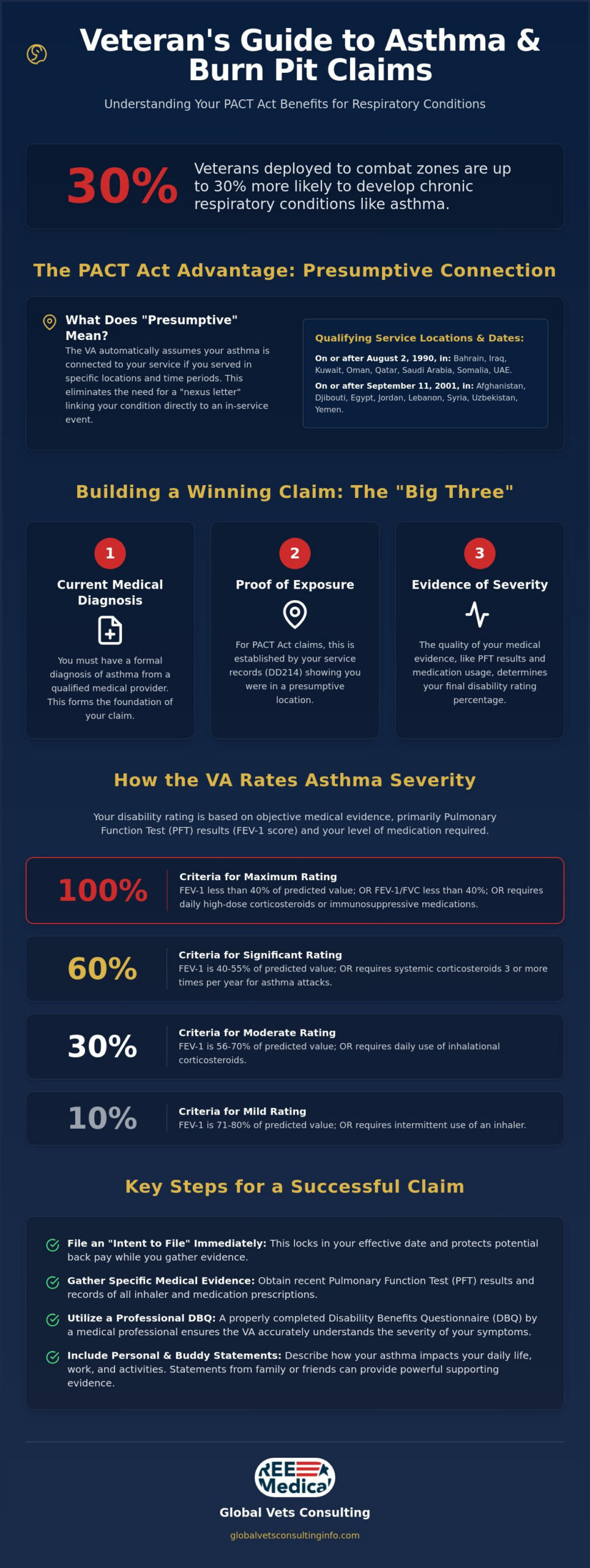
Did you know that veterans deployed to combat zones are up to 30% more likely to develop chronic respiratory conditions than those who served elsewhere? If you are struggling with shortness of breath or persistent wheezing, filing a va claim for asthma secondary to burn pits shouldn’t feel like another mission impossible. It’s exhausting when your health impacts your ability to work or enjoy time with family, and it’s even worse when you’re confused by changing PACT Act regulations. You’ve served your country, and you’ve earned the right to breathe easier without worrying about a “lack of evidence” denial. 🇺🇸
We recognize that the VA system can feel like a maze, but you don’t have to walk this path alone. This guide provides a clear roadmap to help you document your toxic exposure and secure the maximum VA disability rating allowed under the law. You’ll learn the specific medical evidence required for a successful claim, how to interpret the 2026 rating percentages, and how professional DBQ support can bridge the gap between a service connection and a fair monthly payment. We’re here to provide the education and resources you need to turn your eligibility into a winning result. 📞
Key Takeaways
- Understand how the PACT Act designates asthma as a presumptive condition, eliminating the requirement to prove a direct service connection for qualifying veterans.
- Learn why submitting an “Intent to File” immediately is the first step to locking in your 2026 effective date and protecting your potential backpay.
- Discover the specific medical evidence needed, including Pulmonary Function Test (PFT) results, to build a successful va claim for asthma secondary to burn pits.
- Identify how a professionally completed Disability Benefits Questionnaire (DBQ) ensures the VA accurately rates the severity of your respiratory symptoms.
- Explore the “Big Three” evidence requirements that bridge the gap between a medical diagnosis and receiving the maximum disability compensation you earned.
Understanding the Link Between Asthma and Burn Pit Exposure
Many veterans returning from deployment find that the air they breathed years ago is still impacting their health today. When you file a va claim for asthma secondary to burn pits, you’re addressing the long-term damage caused by inhaling microscopic toxins. During operations in the Middle East and Southwest Asia, military waste was often disposed of in large, open-air sites. To fully grasp what a burn pit is, you must consider the toxic cocktail of jet fuel, plastics, and chemicals that were incinerated around the clock. These particulates cause permanent inflammation in the airways, leading to the chronic wheezing and shortness of breath many of our brothers and sisters experience now.
While the VA classifies this as a direct presumptive condition under the PACT Act, many veterans still refer to it as a va claim for asthma secondary to burn pits because the toxic exposure is the clear secondary cause of their respiratory decline. Whether you call it direct or secondary, the goal is the same: getting the VA to acknowledge that your service environment caused your current breathing struggles. Identifying your symptoms, such as a persistent dry cough or chest tightness, is the first step toward building a solid case for compensation.
Presumptive Locations and Service Dates
The 2026 PACT Act regulations simplify the process for those who served in specific “presumptive” zones. If you were boots-on-the-ground in Iraq, Afghanistan, Kuwait, Saudi Arabia, or the UAE, the VA assumes your exposure happened. This applies to Gulf War veterans serving on or after August 2, 1990, and those deployed during the post-9/11 era. You don’t have to prove you stood next to a specific pit; your presence in the theater of operations is enough to establish the exposure element of your claim.
Why the VA Presumes Your Asthma is Service-Connected
The science behind this presumption is clear. Fine particulate matter from burn pits is small enough to bypass the body’s natural filters and lodge deep in the lungs. This creates a state of chronic respiratory inflammation. Because studies show that combat veterans are up to 30% more likely to develop asthma than non-deployed peers, the VA removed the difficult “nexus” requirement. This means you no longer need a doctor to write a complex letter linking your asthma to a specific event. Instead, a current diagnosis and proof of service in a qualifying location are the primary keys to securing your rating.
Evidence Requirements for a Successful Asthma Claim
Winning a va claim for asthma secondary to burn pits requires more than just telling the VA you have trouble breathing. You need a rock-solid evidence file that covers the “Big Three” of VA disability claims. First, you must have a current medical diagnosis of asthma from a qualified provider. Second, you need proof of exposure, which is simplified for those serving in qualifying locations listed under PACT Act presumptive conditions. Finally, while the medical link is presumed for many, the quality of your evidence determines your actual percentage. By following these evidence requirements, your va claim for asthma secondary to burn pits stands a much better chance of approval.
Your medical records should clearly document your symptoms and the frequency of your attacks. Personal statements, or buddy letters, are equally vital. These letters allow you to describe how asthma prevents you from exercising, playing with your kids, or performing your job duties. Don’t underestimate the power of a spouse or coworker describing your gasping for air after a flight of stairs; this qualitative data fills the gaps that clinical numbers sometimes miss. The Pulmonary Function Test (PFT) is the gold standard for VA asthma ratings in 2026. If you’re unsure if your current records are sufficient, we can provide Respiratory System Claims Education to help you prepare.
The Role of Pulmonary Function Tests (PFTs)
The VA relies heavily on your FEV-1 and FVC scores to assign a rating. These numbers measure how much air you can exhale and how quickly you can do it. For example, an FEV-1 of 40-55% of predicted value can result in a 60% rating. It’s critical that your PFT results are recent, ideally within the last 12 months, to reflect your current respiratory health. If your tests are outdated, the VA may schedule a new exam that doesn’t fully capture your worst days.
Documenting Inhaler and Medication Usage
Medication history is often the deciding factor between rating tiers. If you use a daily inhaler or require intermittent courses of systemic corticosteroids, your medical records must show this clearly. A 30% rating often hinges on the daily use of an inhaler. If you’re using your bronchodilator every morning but it’s not documented in your VA health profile, your claim might stall. Make sure your doctor’s notes specifically mention how often you use your rescue inhaler and any anti-inflammatory medications you’ve been prescribed.
How to File Your VA Claim for Asthma: Step-by-Step 🇺🇸
Submitting your va claim for asthma secondary to burn pits requires a tactical approach to ensure you don’t leave earned compensation on the table. The process starts long before you hit “submit” on your application. By following a methodical path, you reduce the risk of delays and denials caused by incomplete files. 🇺🇸
- Step 1: Submit an “Intent to File” immediately. This simple action locks in your effective date for 2026 benefits. It ensures that once your claim is approved, your backpay is calculated from this date rather than the day you finish your paperwork.
- Step 2: Gather all service and medical records. You’ll need your DD-214 to prove service in presumptive locations and recent PFT results to prove the severity of your condition. Participating in the Airborne Hazards and Open Burn Pit Registry can also serve as supporting evidence of your exposure.
- Step 3: Complete VA Form 21-526EZ. This is the official application for disability compensation. Accuracy here is vital to avoid administrative hang-ups.
- Step 4: Attach a professional Disability Benefits Questionnaire (DBQ). Including a high-quality DBQ ensures that your symptoms are captured using the specific medical terminology the VA requires for an accurate rating.
Standard vs. Fully Developed Claims (FDC)
A Fully Developed Claim is the fastest route to a 2026 VA decision. When you file an FDC, you certify that you’ve submitted all necessary evidence up front. This allows you to skip the “evidence gathering” phase where the VA spends months requesting records from your private doctors. Using a private DBQ is a strategic way to bypass this bottleneck and move your file straight to the rating board.
Preparing for the C&P Examination
The Compensation and Pension (C&P) exam is a common pitfall for many veterans. Examiners often spend very little time reviewing your history, which can lead to an “underrated” condition. You should use your private medical documentation to ensure the examiner doesn’t overlook critical symptoms like the frequency of your inhaler use. For a broader look at the timeline, see our guide on the VA Disability Claims Process Step by Step: A 2026 Veteran’s Guide. If you’re worried about your upcoming exam, we offer C&P Examination Preparation Education to help you walk in with confidence. 📞
Maximizing Your Rating with a Professional DBQ
Assigning a fair rating to your va claim for asthma secondary to burn pits often comes down to the quality of the medical evidence you present. While the VA’s internal C&P examinations are meant to evaluate your condition, they frequently result in “underrating” because the examiners may not have the time to review your full history of inhaler usage or exacerbations. A private Disability Benefits Questionnaire (DBQ) serves as a powerful tool for accuracy. It provides a thorough assessment that reflects your worst days, not just how you feel during a 15-minute appointment. Global Vets Consulting streamlines this process by providing the education you need to gather medical evidence that speaks the VA’s language.
Understanding the 2026 Asthma Rating Schedule
The VA uses specific lung function results and medication requirements to determine your monthly compensation. For 2026, a 10% rating is typically assigned for an FEV-1 of 71-80% or the intermittent need for an inhaler. You may qualify for a 30% rating if you require daily inhaler use. Higher ratings of 60% or 100% are reserved for those with lower lung function scores or who require systemic corticosteroids and frequent physician visits for attacks. If your current rating doesn’t match your symptoms, a professional assessment can help you seek a VA rating increase. To learn more about how these forms work, read our guide: What is a DBQ? A Veteran’s Guide to Disability Benefits Questionnaires in 2026.
The Global Vets Difference: Veterans Helping Veterans 🇺🇸
Our mission-driven focus ensures that your documentation accurately reflects your true medical status. As a veteran-owned and operated consulting service, we understand the stakes of your va claim for asthma secondary to burn pits because we’ve been in your boots. We provide expert Respiratory System Claims Education to help you substantiate your claim with high-quality evidence. You can leverage our 24/7 National Client Services Hotline for immediate assistance at any stage of your journey. Start your claim journey with Global Vets Consulting today and secure the benefits you’ve earned through your service. 📞
Take Control of Your Respiratory Claim Today
Securing the benefits you deserve for your service-connected asthma shouldn’t be a solo mission. While the PACT Act has opened the door for many, the quality of your documentation determines whether you receive a 10% or a 60% rating. Remember that locking in your effective date with an Intent to File and substantiating your symptoms with a professional DBQ are the most critical steps you can take in 2026. A successful va claim for asthma secondary to burn pits relies on precise medical evidence that clearly shows the severity of your breathing struggles. 🇺🇸
Global Vets Consulting is a veteran-owned and operated business dedicated to ensuring no veteran is left behind by a complex system. We specialize in Respiratory System Claims Education and offer a 24/7 AI Veteran Intake Specialist to assist you at any hour. You’ve fought for your country; now let us help you fight for the rating you’ve earned. Secure Your Medical Evidence with Global Vets Consulting and take the first step toward the compensation you deserve. You’ve got this, and we’re ready to stand with you. 📞
Frequently Asked Questions
Is asthma a presumptive condition for burn pit exposure in 2026?
Yes, asthma is a presumptive condition under the PACT Act for veterans who served in qualifying locations during specified timeframes. This means the VA assumes your respiratory condition was caused by your service environment, which simplifies the path for your va claim for asthma secondary to burn pits. You don’t need to prove a specific event caused the illness; you only need to show you were in a covered location and have a current diagnosis.
What VA rating can I get for asthma secondary to burn pits?
VA disability ratings for asthma are assigned at 10%, 30%, 60%, or 100% based on the severity of your symptoms and your required medical treatment. A 30% rating is often granted for those who require daily inhaler use or anti-inflammatory medication. Higher ratings, such as 60%, are typically assigned if you have lower lung function test results or require multiple courses of systemic corticosteroids throughout the year to manage exacerbations.
Do I need a nexus letter if asthma is a presumptive condition?
You do not need a formal nexus letter if your service meets the PACT Act presumptive criteria for toxic exposure. The VA automatically acknowledges the medical link between your deployment and your asthma diagnosis. However, you must still provide a current clinical diagnosis and proof of service in a qualifying theater of operations to successfully establish your va claim for asthma secondary to burn pits. High-quality medical evidence remains the key to a fair rating.
Can I file for asthma if I was a smoker during my service?
Yes, your history as a smoker does not disqualify you from receiving VA disability benefits for asthma related to burn pit exposure. The VA recognizes that toxic particulates from burn pits cause unique respiratory damage that is separate from the effects of tobacco use. As long as you meet the service requirements in presumptive locations and have a medical diagnosis, the VA will evaluate your claim based on the current severity of your condition.
What happens if my VA claim for asthma is denied for lack of evidence?
If your claim is denied due to a lack of evidence, you have the right to submit a supplemental claim featuring new and relevant medical documentation. Denials often occur because the VA records don’t sufficiently capture the frequency of your attacks or the specific medications you use. Submitting a private Disability Benefits Questionnaire (DBQ) or updated Pulmonary Function Test (PFT) results can provide the clinical detail necessary to overturn a denial and secure your benefits.

Article by
Willie Daniel
Willie Daniel is the Founder and Chief Executive Officer (CEO) of Global Vets Consulting (GVC) – National Veterans Disability Services, a veteran-led educational and medical evidence support organization dedicated to helping veterans better understand VA disability rating increases, DBQ medical evidence, secondary claims education, and C&P examination preparation.
He is a retired U.S. Army Medical Service Corps Officer with more than 27 years of honorable military service, a decorated Iraq combat veteran, and a retired federal official with the U.S. Department of Veterans Affairs. Throughout his military and federal career, Willie Daniel served in leadership, healthcare administration, operational, and veteran-support roles focused on improving services and support systems for servicemembers, veterans, and their families.
Drawing from decades of military leadership, healthcare administration, veteran advocacy, and federal government experience, Willie Daniel brings a practical, veteran-centered perspective to Global Vets Consulting’s educational articles, AI-powered veteran resources, video education initiatives, and outreach programs. His experience navigating military systems, medical documentation processes, and veteran-related administrative operations provides valuable insight into many of the challenges veterans face when seeking to better understand VA disability rating criteria, medical evidence, documentation strategies, and secondary condition education.
Through GVC’s “Veterans Helping Veterans” mission, his focus is on delivering clear, educational, and easy-to-understand information designed to empower veterans with knowledge, resources, and educational tools that may help them make more informed decisions regarding their individual VA disability journeys.
The information provided through GVC is intended for educational and informational purposes only and should not be considered legal or medical advice.
Disclaimer
Disclaimer: Global Vets Consulting, LLC (“GVC”) is a veteran-led educational and medical evidence support organization. GVC is not a law firm, is not a Veterans Service Organization (VSO), and is not affiliated with the U.S. Department of Veterans Affairs (VA) or any government agency.
Global Vets Consulting does not provide legal advice, medical advice, medical treatment, or healthcare services. GVC does not prepare, file, or submit VA disability claims on behalf of veterans. All information provided through this website, blog articles, videos, educational materials, AI tools, dashboards, templates, and communications is intended solely for general educational and informational purposes.
Veterans are encouraged to consult with accredited representatives, licensed attorneys, qualified medical providers, or Veterans Service Organizations regarding their specific legal, medical, or VA-related matters. VA disability decisions, ratings, and outcomes are determined solely by the U.S. Department of Veterans Affairs based on applicable laws, regulations, medical evidence, and individual circumstances. Past results do not guarantee future outcomes.

