
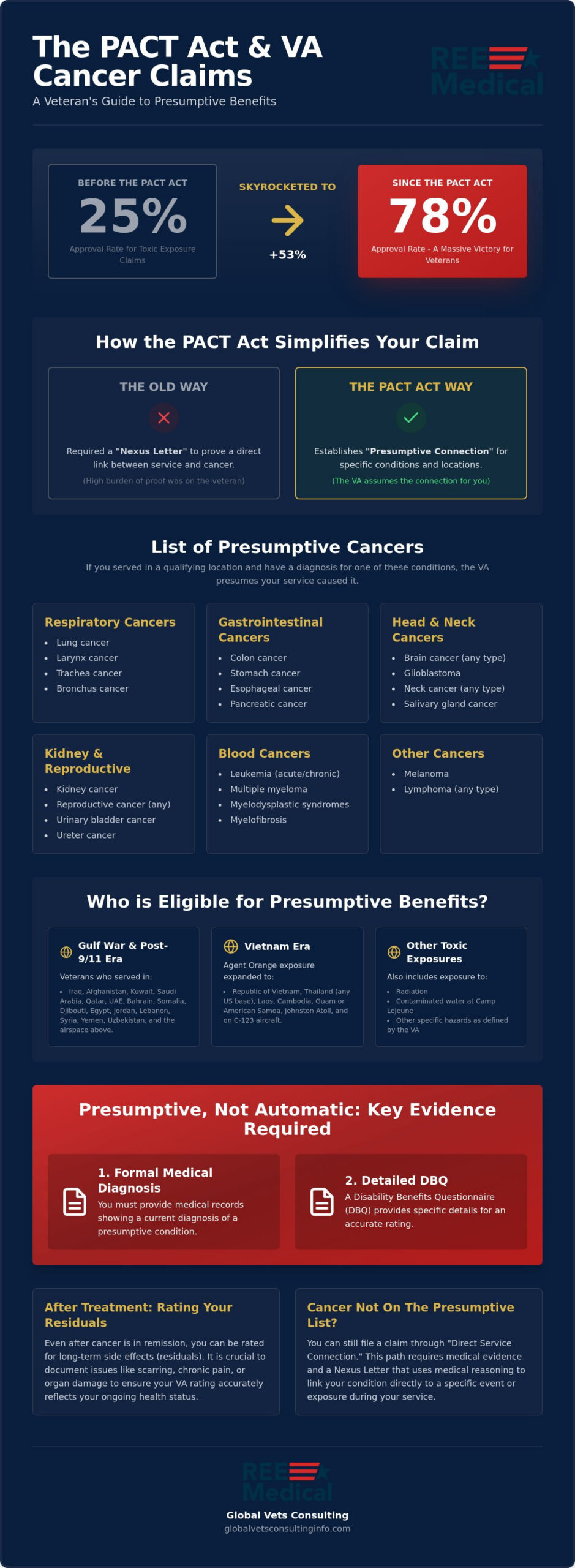
Did you know that the approval rate for toxic exposure claims has skyrocketed from 25% to 78% since the PACT Act became law? While this is a massive victory for our community, filing a va claim for cancer pact act still feels like a battle against a bureaucratic machine. You’ve served your country with honor; you shouldn’t have to fight this hard for the benefits you’ve earned.
It’s natural to feel overwhelmed by the technical difference between presumptive and direct service connection, especially when you’re managing a health crisis. You might also worry that your rating will plummet once your cancer goes into remission, leaving you without support for lasting residuals. We understand these frustrations because we’ve seen how easily the system can overlook the true impact of your service.
This guide will show you how to navigate the 2026 requirements to confirm your presumptive status and secure the medical evidence needed for a successful outcome. We’ll preview the 100% rating criteria for active conditions and explain how a detailed Disability Benefits Questionnaire (DBQ) ensures your paperwork accurately reflects your physical reality.
Key Takeaways
- Understand how the PACT Act eliminates the need for a medical nexus letter by establishing presumptive service connection for specific cancers.
- Identify which respiratory and gastrointestinal conditions are currently covered under the 2026 guidelines for toxic exposure.
- Learn the essential evidence requirements to streamline your va claim for cancer pact act and avoid common processing delays.
- Discover how to document medical residuals after cancer treatment to ensure your VA rating accurately reflects your long-term health status.
- Explore how professional Disability Benefits Questionnaires (DBQs) can provide the detailed medical evidence necessary for a successful rating increase.
Understanding the PACT Act and VA Cancer Claims in 2026 🇺🇸
The Honoring our PACT Act of 2022 represents a monumental shift in how the VA handles toxic exposure. For years, veterans struggled to prove that their illness was directly caused by military service. This burden of proof, known as the medical nexus, often led to denied claims for life-threatening conditions. By 2026, the PACT Act has matured into a reliable framework that removes this barrier for many. If you are filing a va claim for cancer pact act, you no longer have to explain why the cancer happened; you only need to prove you were there and that you have a current diagnosis.
This legislation is a game-changer because it recognizes the long-term health impacts of burn pits and Agent Orange. However, establishing a service connection is only half the battle. You still need to demonstrate the severity of your condition to receive the correct rating. This is where a detailed Disability Benefits Questionnaire (DBQ) becomes essential. It provides the VA with the specific medical evidence required to evaluate your symptoms and functional limitations accurately.
Who is Eligible for PACT Act Cancer Benefits?
Eligibility depends on your service location and dates. This includes Gulf War era and post-9/11 veterans who served in countries like Iraq or Afghanistan. It also covers Vietnam era veterans, expanding recognized Agent Orange exposure locations to include Thailand, Guam, and American Samoa. Additionally, those exposed to radiation or deployed to various Global War on Terror zones are now within the scope of these expanded benefits.
The 2026 Presumptive Standard
Under the presumptive standard, the VA assumes your cancer is service-connected if you meet the deployment criteria. You don’t need a nexus letter. However, you must provide a formal diagnosis from a medical professional. The VA won’t assume you are sick just because you served in a toxic zone; you must have the medical documentation to back up your va claim for cancer pact act. This standard simplifies the path to benefits, but meticulous paperwork remains your strongest ally.
List of Presumptive Cancers Under the PACT Act
The PACT Act covers a wide range of malignancies, offering a clearer path to benefits for those exposed to environmental hazards. If you’re filing a va claim for cancer pact act, knowing exactly which conditions are on the list is the first step toward your rating. The VA now recognizes several broad categories as presumptive, meaning you don’t need to prove your military service caused the illness. You only need to show you served in a qualifying location and have a current diagnosis.
Key categories include:
- Respiratory cancers: This includes lung, larynx, and trachea cancers.
- Gastrointestinal cancers: Any type, such as colon, stomach, or esophageal cancer.
- Head and neck cancers: Any type, including brain cancer (like glioblastoma) and pancreatic cancer.
- Reproductive and kidney cancers: These were crucial additions that cover a significant portion of the veteran population.
The official VA PACT Act benefits page provides the full statutory list, but recent regulatory changes have expanded these protections even further to include more specific blood and urinary conditions.
Recent 2025-2026 Additions to the Presumptive List
As of 2026, the VA has officially integrated several conditions that were previously difficult to claim. This expansion includes acute and chronic leukemias, multiple myelomas, and myelodysplastic syndromes. Veterans diagnosed with myelofibrosis or cancers of the urinary bladder and ureter are also now eligible for presumptive service connection. These additions close a significant gap for those exposed to toxic chemicals during their service.
Non-Presumptive Cancers: What if Mine Isn’t Listed?
If your specific diagnosis isn’t on the presumptive list, you can still win your claim through direct service connection. This typically requires a Nexus Letter that links your condition to your military service through medical reasoning. You might also pursue a secondary service connection if your cancer was caused by another service-connected illness. If you’re unsure where your condition fits, educational resources for disability evaluations can help you understand the evidence needed for a successful filing.
How to File a VA Claim for Cancer: Evidence Requirements 📞
Establishing a service connection is a significant milestone, but it’s only the start of the process. To successfully file a va claim for cancer pact act, you must provide a clear medical and service-related roadmap for the VA rater. While the law assumes your condition is related to your service, it doesn’t assume the severity of your illness or its impact on your daily life. You’ll need specific documentation to ensure your claim moves through the system without hitches.
Follow these four essential steps to build a strong case:
- Step 1: Secure a formal medical diagnosis. You need a current, definitive diagnosis of the specific cancer type from a qualified medical professional.
- Step 2: Gather your service records. Proving you served in recognized toxic exposure zones is non-negotiable. Review the official guide on the PACT Act and Your VA Benefits to confirm your location qualifies.
- Step 3: Complete a detailed DBQ. A Disability Benefits Questionnaire (DBQ) should outline your functional loss, symptoms, and the specific ways the cancer affects your ability to work or care for yourself.
- Step 4: Submit as a Fully Developed Claim (FDC). By providing all evidence upfront, you reduce the need for the VA to request more information, which typically speeds up the decision process.
The Role of Private Medical Evidence
Relying solely on a standard C&P exam can be risky. Private medical evidence, specifically a private DBQ, often provides a more thorough look at your condition than a brief VA-contracted exam. This level of detail is vital to avoid common denials for lack of evidence. If the rater can’t see the full scope of your symptoms, they can’t assign an accurate rating. Our team can help you understand how to secure the medical evidence education needed to support your filing.
Documenting Severity for the 100% Rating
The VA typically assigns a temporary 100% disability rating while you are undergoing active treatment for a service-connected cancer. This includes periods of chemotherapy, radiation, or surgical intervention. To secure this, you must submit evidence of your treatment schedule and the expected duration of the therapy. Once active treatment ends, the VA will re-evaluate your condition based on residuals, so keeping meticulous records of every medical appointment is crucial for your long-term va claim for cancer pact act strategy. Accurate documentation ensures that your rating reflects the lasting impact the disease has on your health.
Residuals and VA Rating Increases: Life After Cancer
Entering remission is a milestone worth celebrating, but it also triggers a critical transition in your VA benefits. The VA typically schedules a re-evaluation six months after your active treatment stops. If the cancer is no longer active, the rater will shift focus to your “residuals,” which are the permanent side effects caused by the disease or the treatments you endured. Failing to document these issues can result in a significant drop in your compensation, making a long-term strategy for your va claim for cancer pact act essential.
Common residuals include peripheral neuropathy, chronic organ dysfunction, and persistent respiratory damage. These conditions often qualify for independent ratings that can keep your overall disability percentage high. Global Vets Consulting serves as your partner in this phase, showing you how to use a DBQ for a VA disability rating increase in 2026 based on these lasting health impacts.
Secondary Conditions Related to Cancer
Your va claim for cancer pact act should also account for conditions that develop as a direct result of your diagnosis. Mental health struggles, such as anxiety and depression, are frequently linked to the trauma of a cancer battle. Additionally, the physical toll of aggressive therapies can lead to secondary musculoskeletal or neurological impairments. Properly linking these to your service-connected cancer ensures your rating reflects the full scope of your health challenges.
Securing Your Future Benefits
Meticulous documentation today is the only way to prevent an underrated decision tomorrow. The VA rater can only compensate what is clearly recorded in your medical evidence. Use this checklist to protect your earned benefits:
- Maintain a detailed log of all treatment dates, including chemotherapy and radiation.
- Document daily functional losses, such as chronic fatigue or limited range of motion.
- Utilize a private DBQ to capture the specific severity of residuals.
- Identify and file for secondary conditions immediately upon diagnosis.
For immediate assistance, our 24/7 National Client Services Hotline and 24/7 AI Veteran Intake Specialist are available to guide you through the documentation process. 🇺🇸
Secure Your Rating and Protect Your Future 🇺🇸
The PACT Act has opened doors for millions, but walking through them requires more than just service history. As we’ve discussed, the key to a successful va claim for cancer pact act in 2026 is bridging the gap between a presumptive diagnosis and the precise medical evidence that defines its severity. By securing technical documentation that mirrors the VA’s own standards, you protect your rating from the common pitfalls of the re-evaluation process and ensure your compensation reflects your true physical reality.
At Global Vets Consulting, we operate with a mission-driven focus to ensure no veteran is left behind by a complex system. We are veteran-owned and dedicated to providing the expert DBQ preparation necessary for accurate disability evaluations. Our tech-forward approach ensures you have the resources needed to navigate these administrative hurdles with steady confidence.
🌐 Global Vets Consulting — Worldwide
📞 24/7 National Client Services Hotline: (866) 203-0801
🤖 24/7 AI Veteran Intake Specialist
Get the Professional DBQ Documentation You Need at Global Vets Consulting
Take control of your benefits today. We are ready to stand as your ally in securing the compensation you have rightfully earned. You’ve done your part for our country; now let us help you secure your future.
Frequently Asked Questions
Is cancer automatically 100% VA disability under the PACT Act?
Yes, the VA grants a temporary 100% disability rating for any service-connected cancer while it is active or during a course of treatment. This includes periods of chemotherapy, radiation, or surgical intervention. This 100% rating typically stays in place for the duration of your treatment and continues for six months after your final treatment session concludes.
What happens to my VA rating if my cancer goes into remission?
Your rating is subject to a mandatory re-evaluation six months after your treatment ends. The VA will assess your “residuals,” which are the lasting side effects of the disease or the treatment itself, such as organ damage or neuropathy. To protect your va claim for cancer pact act, you must document these long-term limitations to ensure your rating doesn’t drop to 0% once you are in remission.
Can I file a PACT Act claim for a deceased family member?
Yes, surviving spouses, children, or parents can file for survivors’ benefits if a veteran’s death was caused by a PACT Act-related cancer. This is usually done through a claim for Dependency and Indemnity Compensation (DIC). If the veteran had a pending claim at the time of their death, the family might also be eligible to receive accrued benefits that were owed to the veteran.
How long does a VA claim for cancer under the PACT Act take?
Processing times vary depending on the complexity of the case and the current VA backlog. In 2026, the VA continues to prioritize claims for veterans with terminal illnesses or those facing extreme financial hardship. Filing a va claim for cancer pact act as a Fully Developed Claim (FDC) with all medical evidence included at the start is the most effective way to reduce processing delays.
Do I need a C&P exam if I have a private DBQ for my cancer claim?
The VA may still schedule a C&P exam even if you provide a private DBQ, but your private documentation serves as a vital piece of medical evidence. A thorough private DBQ ensures that your symptoms and functional losses are accurately recorded by a professional who understands your history. This provides the VA rater with a clear, detailed picture of your condition, regardless of the findings of a brief C&P examination.

Article by
Willie Daniel
Willie Daniel is the Founder and Chief Executive Officer (CEO) of Global Vets Consulting (GVC) – National Veterans Disability Services, a veteran-led educational and medical evidence support organization dedicated to helping veterans better understand VA disability rating increases, DBQ medical evidence, secondary claims education, and C&P examination preparation.
He is a retired U.S. Army Medical Service Corps Officer with more than 27 years of honorable military service, a decorated Iraq combat veteran, and a retired federal official with the U.S. Department of Veterans Affairs. Throughout his military and federal career, Willie Daniel served in leadership, healthcare administration, operational, and veteran-support roles focused on improving services and support systems for servicemembers, veterans, and their families.
Drawing from decades of military leadership, healthcare administration, veteran advocacy, and federal government experience, Willie Daniel brings a practical, veteran-centered perspective to Global Vets Consulting’s educational articles, AI-powered veteran resources, video education initiatives, and outreach programs. His experience navigating military systems, medical documentation processes, and veteran-related administrative operations provides valuable insight into many of the challenges veterans face when seeking to better understand VA disability rating criteria, medical evidence, documentation strategies, and secondary condition education.
Through GVC’s “Veterans Helping Veterans” mission, his focus is on delivering clear, educational, and easy-to-understand information designed to empower veterans with knowledge, resources, and educational tools that may help them make more informed decisions regarding their individual VA disability journeys.
The information provided through GVC is intended for educational and informational purposes only and should not be considered legal or medical advice.
Disclaimer
Disclaimer: Global Vets Consulting, LLC (“GVC”) is a veteran-led educational and medical evidence support organization. GVC is not a law firm, is not a Veterans Service Organization (VSO), and is not affiliated with the U.S. Department of Veterans Affairs (VA) or any government agency.
Global Vets Consulting does not provide legal advice, medical advice, medical treatment, or healthcare services. GVC does not prepare, file, or submit VA disability claims on behalf of veterans. All information provided through this website, blog articles, videos, educational materials, AI tools, dashboards, templates, and communications is intended solely for general educational and informational purposes.
Veterans are encouraged to consult with accredited representatives, licensed attorneys, qualified medical providers, or Veterans Service Organizations regarding their specific legal, medical, or VA-related matters. VA disability decisions, ratings, and outcomes are determined solely by the U.S. Department of Veterans Affairs based on applicable laws, regulations, medical evidence, and individual circumstances. Past results do not guarantee future outcomes.