

What if the reason your claim keeps hitting a wall isn’t a lack of evidence, but because the VA doesn’t actually have a standalone diagnostic code for memory loss? It’s incredibly frustrating to deal with “VA math” and the fear that a single C&P exam won’t capture how cognitive fog disrupts your daily life. You’ve likely felt the stress of wondering whether to file under Traumatic Brain Injury (TBI) or a mental health condition like PTSD, especially when your symptoms seem to overlap both categories. 🇺🇸
This guide will show you how to navigate the system to secure the va disability for memory loss rating you’ve earned by correctly linking your symptoms to the right medical framework. With the 2.8% COLA increase for 2026 now in effect, ensuring your rating reflects your true level of impairment is more important than ever for your financial stability. We’ll break down the current rating criteria, explain how to use a Disability Benefits Questionnaire (DBQ) as bulletproof evidence, and help you identify the diagnostic path that provides the most accurate path toward an increase.
Key Takeaways
- Understand why there’s no standalone diagnostic code for memory loss and how the VA rates it as a symptom of an underlying condition.
- Learn to distinguish between TBI and mental health rating frameworks to ensure your cognitive symptoms are evaluated under the most favorable criteria.
- Discover how to use a professional DBQ to provide the bulletproof evidence required for a successful va disability for memory loss claim.
- Contrast the benefits of private medical documentation against a standard C&P exam to capture a more accurate picture of your daily challenges.
- Follow a structured, two-step plan to gather your records and secure the medical evidence needed for a rating increase in 2026.
Understanding the VA Rating for Memory Loss: Why There Is No Single Code
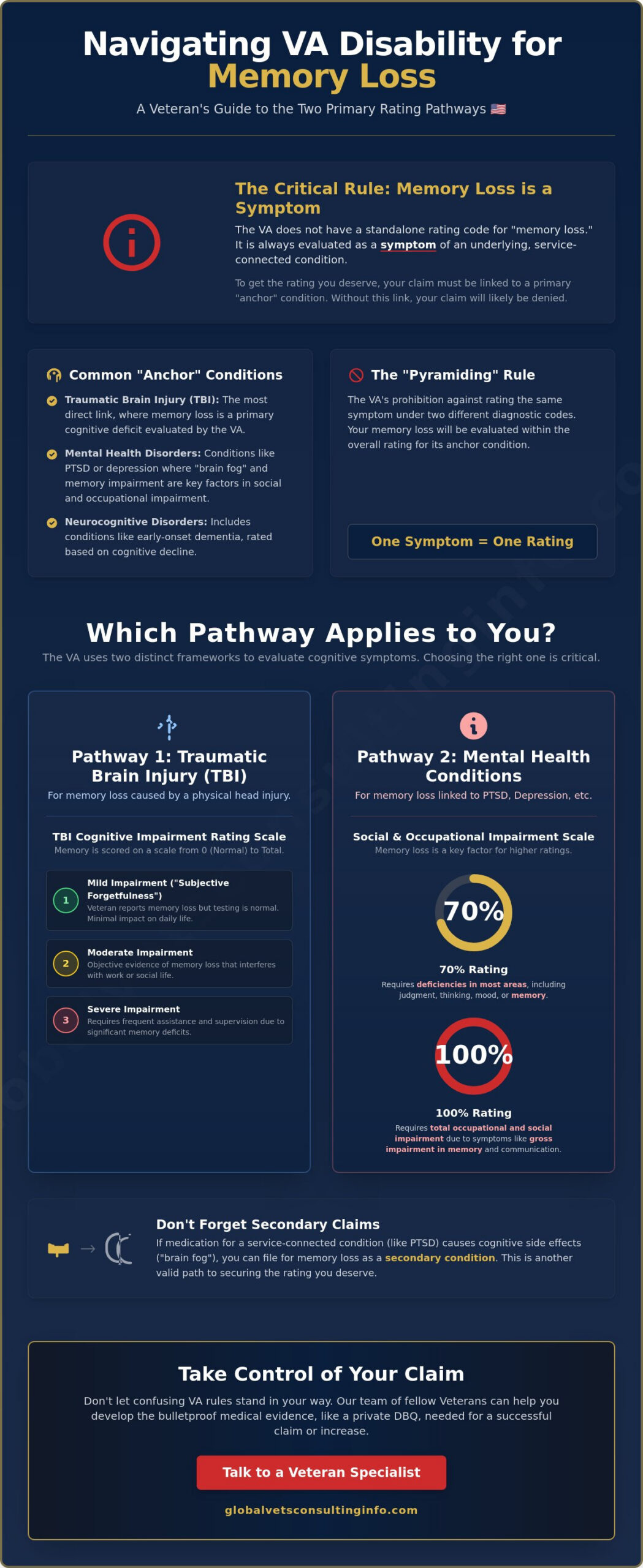
It’s a common point of confusion for many veterans; you look through the VA’s Schedule for Rating Disabilities (VASRD) and find no specific diagnostic code for “memory loss.” This is because the VA views memory loss as a symptom rather than a standalone disability. To secure a va disability for memory loss rating, you must identify a primary “anchor” condition that is already service-connected or can be proven as the cause of your cognitive issues. Think of your claim as a tree. The memory loss is a branch, but the trunk is the underlying medical diagnosis. If you try to file for memory loss without this anchor, the VA will likely deny the claim because there is no diagnostic framework to apply.
Common Primary Conditions Linked to Memory Loss
- Traumatic Brain Injury (TBI): This is often the most direct link. The VA evaluates TBI by looking at several facets of cognitive impairment, including memory, attention, and executive function.
- Mental Health Disorders: Conditions such as depression or chronic anxiety often manifest as “brain fog.” Understanding VA disability benefits for PTSD is crucial here, as memory impairment is a core symptom used to determine the severity of social and occupational impairment.
- Neurocognitive Disorders: This includes conditions like early-onset Alzheimer’s or dementia. The VA rates these based on the level of assistance you need for daily living and the progression of the cognitive decline.
The Pyramiding Rule and Your Rating
The VA uses a “totality of symptoms” approach to prevent what they call “pyramiding.” This means you won’t receive two separate ratings for the same symptom. For example, if your memory loss is caused by PTSD, the VA will include that cognitive impairment within your overall mental health rating rather than giving you a second check for the memory issues. Pyramiding is the VA’s prohibition against rating the same symptom under two different codes. Success depends on ensuring your medical evidence clearly shows how these symptoms impact your ability to work and maintain relationships. By identifying the correct anchor condition, you ensure the VA evaluates the full scope of your cognitive challenges.
How the VA Evaluates Cognitive Impairment: TBI vs. Mental Health
The VA uses two distinct paths to evaluate cognitive issues. If your memory loss stems from a physical head injury, the VA applies the Traumatic Brain Injury (TBI) criteria. If it’s a result of PTSD or depression, they use the general mental health formula. Understanding the VA disability claims process step by step is vital. Choosing the wrong path often leads to an underrated claim. Precision matters here. 🇺🇸
TBI Ratings and the Facets of Cognitive Impairment
Examiners rate TBI based on three main facets: cognitive, emotional/behavioral, and physical. When looking at your va disability for memory loss through the lens of TBI, the VA scores your memory, attention, and executive functions on a scale of 0, 1, 2, 3, or Total. A score of 1 represents subjective forgetfulness, while a score of 3 indicates severe impairment requiring frequent supervision. VA research on Traumatic Brain Injury shows that these cognitive deficits are often the most debilitating part of the condition for veterans.
Memory Loss as a Factor in Mental Health Ratings
If your memory loss isn’t from a TBI, the VA considers it under the social and occupational impairment scale. Within this framework, memory deficits are major factors for the higher rating tiers when filing for va disability for memory loss. For a 70% rating, the VA looks for deficiencies in most areas, such as judgment, thinking, or mood. By the time you reach the 100% tier, the criteria include total impairment due to symptoms like gross impairment in communication and memory. As of May 2026, the VA still uses these traditional criteria while proposed updates remain under review.
Sometimes the memory issues aren’t from the condition itself. They might be side effects from the medications used to treat it. If your service-connected PTSD meds cause “brain fog,” you can file for this as a secondary claim. If you’re struggling to connect these dots, exploring neurological conditions and TBI educational resources can help you build a stronger case for the rating you deserve.
The Strategic Advantage of Private DBQs for Memory Loss Claims
Many veterans walk out of a Compensation and Pension (C&P) exam feeling unheard. A standard VA exam for a va disability for memory loss claim often lasts only 15 minutes. This brief window is rarely enough to document the subtle, yet debilitating, ways cognitive decline impacts your life. By contrast, a private Disability Benefits Questionnaire (DBQ) allows a medical professional to review your full history and provide a comprehensive assessment that the VA’s contract examiners might overlook. This detailed documentation ensures your symptoms are evaluated based on their actual impact rather than a rushed snapshot.
C&P Exam vs. Private Medical Evidence
C&P examiners typically focus on snapshot evaluations. They see you on one day, which might be a “good day” where your symptoms are less apparent. This leads to ratings that don’t reflect the true frequency of your memory lapses. Obtaining Independent Medical Evidence helps level the playing field. It ensures that the record includes a longitudinal view of your condition. This thoroughness is essential when presenting scientific Traumatic Brain Injury information to support your claim. Private evidence acts as a necessary counterweight to the often impersonal nature of the standard VA exam process.
What a Professional DBQ Must Include for Memory Loss
A bulletproof va disability for memory loss claim requires more than just a statement that you’re forgetful. A professional DBQ for mental health conditions or cognitive impairment must include objective clinical findings. This often involves standardized testing like the Mini-Mental State Examination (MMSE) or Montreal Cognitive Assessment (MoCA). Additionally, the provider must establish a clear medical nexus. This connects your cognitive symptoms directly to your service or an existing service-connected condition. If you’re ready to strengthen your evidence, you can secure a professional Disability Benefits Questionnaire (DBQ) to provide the medical documentation required for a rating increase.
Securing Your Rating: Steps to File or Increase Your Claim in 2026
Filing for a va disability for memory loss increase requires a methodical approach to ensure the VA recognizes the full extent of your impairment. You’ve already identified your anchor condition and understood the rating criteria; now, it’s time to assemble a package that leaves no room for doubt. Following a structured plan reduces the risk of a denial and helps you move through the system with confidence. 🇺🇸
- Step 1: Gather all service treatment records and private medical files to establish a clear timeline of your cognitive decline.
- Step 2: Obtain a professional DBQ that accurately reflects your current cognitive limitations and provides objective clinical evidence.
- Step 3: Draft a “Statement in Support of Claim” (VA Form 21-4138) detailing exactly how memory loss affects your daily life and work.
- Step 4: Submit your evidence via the Fully Developed Claim (FDC) program to encourage faster processing by providing all evidence upfront.
Documenting the Impact on Social and Occupational Life
Buddy letters from family members or coworkers are critical for memory loss claims because they provide the context that medical charts often miss. These statements should highlight specific life impacts, such as forgetting stove burners, missing important medical appointments, or an inability to follow complex instructions at work. When an eyewitness describes how you struggle to manage daily tasks, it provides a vivid picture of your “Social and Occupational Impairment” that clinical scores alone cannot always convey.
How Global Vets Consulting Supports Your Journey
Our “Veterans Helping Veterans” approach is built on the belief that no veteran should have to navigate this complex system alone. We specialize in independent medical evidence education and help you understand how to use a DBQ for a VA disability rating increase to secure the benefits you earned. By focusing on meticulous documentation and technical accuracy, we aim to provide you with the steady guidance needed for a successful va disability for memory loss claim. 🌍
Contact our 24/7 National Client Services Hotline for immediate assistance 📞. We’re ready to help you take the next step toward the rating increase you deserve.
Take Control of Your Cognitive Health Rating Today
Securing a fair va disability for memory loss rating in 2026 requires moving beyond the standard VA exam. You’ve learned that memory impairment must be anchored to a primary condition like TBI or a mental health disorder. You also understand that private medical documentation is the most effective tool to capture the daily reality of your cognitive challenges. By following the structured steps to gather evidence and buddy letters, you can present a claim that the VA cannot easily overlook.
Since 2021, Global Vets Consulting has operated as a veteran-owned and operated resource dedicated to this mission. We specialize in Neurological and Mental Health DBQ education, providing you with the technical accuracy needed for a successful increase. Our 24/7 AI Veteran Intake Specialist is ready to help you begin the process right now. Don’t let your symptoms be minimized by a 15-minute evaluation.
Get the Professional DBQ Support You Deserve: Start Your Intake Here
You earned these benefits through your service; it’s time your rating reflected that sacrifice. We’re here to stand with you as you navigate this process.
Frequently Asked Questions
Can I get a 100% VA rating for memory loss?
Yes, you can receive a 100% rating, but it is typically granted as part of a primary mental health or TBI diagnosis. For mental health, a 100% rating requires total occupational and social impairment, often involving gross impairment in communication and memory. If your va disability for memory loss is evaluated under TBI, you must show a Total score in the cognitive facets, meaning you require constant supervision for your safety.
What is the VA memory loss test called?
The VA frequently uses the Mini-Mental State Examination (MMSE) or the Montreal Cognitive Assessment (MoCA) to screen for cognitive issues during a C&P exam. These standardized tests measure your orientation, attention, and recall through a series of verbal and written tasks. While these scores are important, they are only one part of the medical evidence. A private examiner may use more comprehensive neuropsychological testing to provide a deeper look at your limitations.
Is memory loss a secondary condition to PTSD?
Memory loss is generally viewed as a core symptom of PTSD rather than a distinct secondary condition. Because of the VA’s rule against pyramiding, you cannot receive two separate ratings for the same symptom. However, if your service-connected PTSD medications cause brain fog or cognitive decline, you might pursue that as a secondary claim. This approach requires clear medical evidence linking the medication side effects to your worsening memory symptoms.
How does the VA rate memory loss caused by a TBI?
Memory impairment from a TBI is evaluated under the Facets of Cognitive Impairment within the VA’s rating schedule. The examiner assigns a score of 0, 1, 2, 3, or Total based on how often you forget information or require assistance. A score of 2 indicates you have memory lapses that interfere with daily activities, while a score of 3 means you frequently forget essential information and need regular supervision to function safely.
What happens if my VA claim for memory loss is denied?
If your va disability for memory loss claim is denied, you have several options for recourse. You can file a Supplemental Claim if you have new and relevant evidence, such as a private DBQ or a more detailed nexus letter. Alternatively, a Higher-Level Review allows a senior examiner to check for errors in the original decision. Most denials happen because the medical evidence failed to link the memory loss to a service-connected anchor condition.

Article by
Willie Daniel
Willie Daniel is the Founder and Chief Executive Officer (CEO) of Global Vets Consulting (GVC) – National Veterans Disability Services, a veteran-led educational and medical evidence support organization dedicated to helping veterans better understand VA disability rating increases, DBQ medical evidence, secondary claims education, and C&P examination preparation.
He is a retired U.S. Army Medical Service Corps Officer with more than 27 years of honorable military service, a decorated Iraq combat veteran, and a retired federal official with the U.S. Department of Veterans Affairs. Throughout his military and federal career, Willie Daniel served in leadership, healthcare administration, operational, and veteran-support roles focused on improving services and support systems for servicemembers, veterans, and their families.
Drawing from decades of military leadership, healthcare administration, veteran advocacy, and federal government experience, Willie Daniel brings a practical, veteran-centered perspective to Global Vets Consulting’s educational articles, AI-powered veteran resources, video education initiatives, and outreach programs. His experience navigating military systems, medical documentation processes, and veteran-related administrative operations provides valuable insight into many of the challenges veterans face when seeking to better understand VA disability rating criteria, medical evidence, documentation strategies, and secondary condition education.
Through GVC’s “Veterans Helping Veterans” mission, his focus is on delivering clear, educational, and easy-to-understand information designed to empower veterans with knowledge, resources, and educational tools that may help them make more informed decisions regarding their individual VA disability journeys.
The information provided through GVC is intended for educational and informational purposes only and should not be considered legal or medical advice.
Disclaimer
Disclaimer: Global Vets Consulting, LLC (“GVC”) is a veteran-led educational and medical evidence support organization. GVC is not a law firm, is not a Veterans Service Organization (VSO), and is not affiliated with the U.S. Department of Veterans Affairs (VA) or any government agency.
Global Vets Consulting does not provide legal advice, medical advice, medical treatment, or healthcare services. GVC does not prepare, file, or submit VA disability claims on behalf of veterans. All information provided through this website, blog articles, videos, educational materials, AI tools, dashboards, templates, and communications is intended solely for general educational and informational purposes.
Veterans are encouraged to consult with accredited representatives, licensed attorneys, qualified medical providers, or Veterans Service Organizations regarding their specific legal, medical, or VA-related matters. VA disability decisions, ratings, and outcomes are determined solely by the U.S. Department of Veterans Affairs based on applicable laws, regulations, medical evidence, and individual circumstances. Past results do not guarantee future outcomes.

