
Your MRI might show a bulging disc, but it can’t tell the VA about the Tuesday morning you couldn’t get out of bed to go to work. Most veterans realize that a five-minute range of motion test during a C&P exam rarely captures the full reality of living with chronic spinal issues. It’s frustrating when medical records miss the flare-ups that happen at home or the way your pain makes holding a steady job feel like an uphill battle. Writing a detailed va lay statement for back condition is your best opportunity to bridge the gap between clinical data and your daily reality.
You deserve a claim that reflects the true impact of your service-connected injuries. We’ll show you exactly how to document your functional limitations and pain to turn your back condition claim into a success. This guide provides a clear template for your statement and explains how to use 2026 standards to work toward a higher disability rating and the service connection you’ve earned. By translating your clinical symptoms into a clear narrative, you can ensure the VA understands the full scope of your condition.
Key Takeaways
- Learn how a va lay statement for back condition bridges the gap between a static MRI and the daily reality of your functional limitations.
- Identify the exact details needed to document flare-ups so the VA understands what happens when your back pain makes it impossible to work.
- Follow our 2026 guide to establishing a clear nexus between your current pain and your military service records.
- See why combining your personal story with a professional Disability Benefits Questionnaire (DBQ) creates a more comprehensive and persuasive evidence package.
What is a VA Lay Statement and Why Your Back Claim Needs One
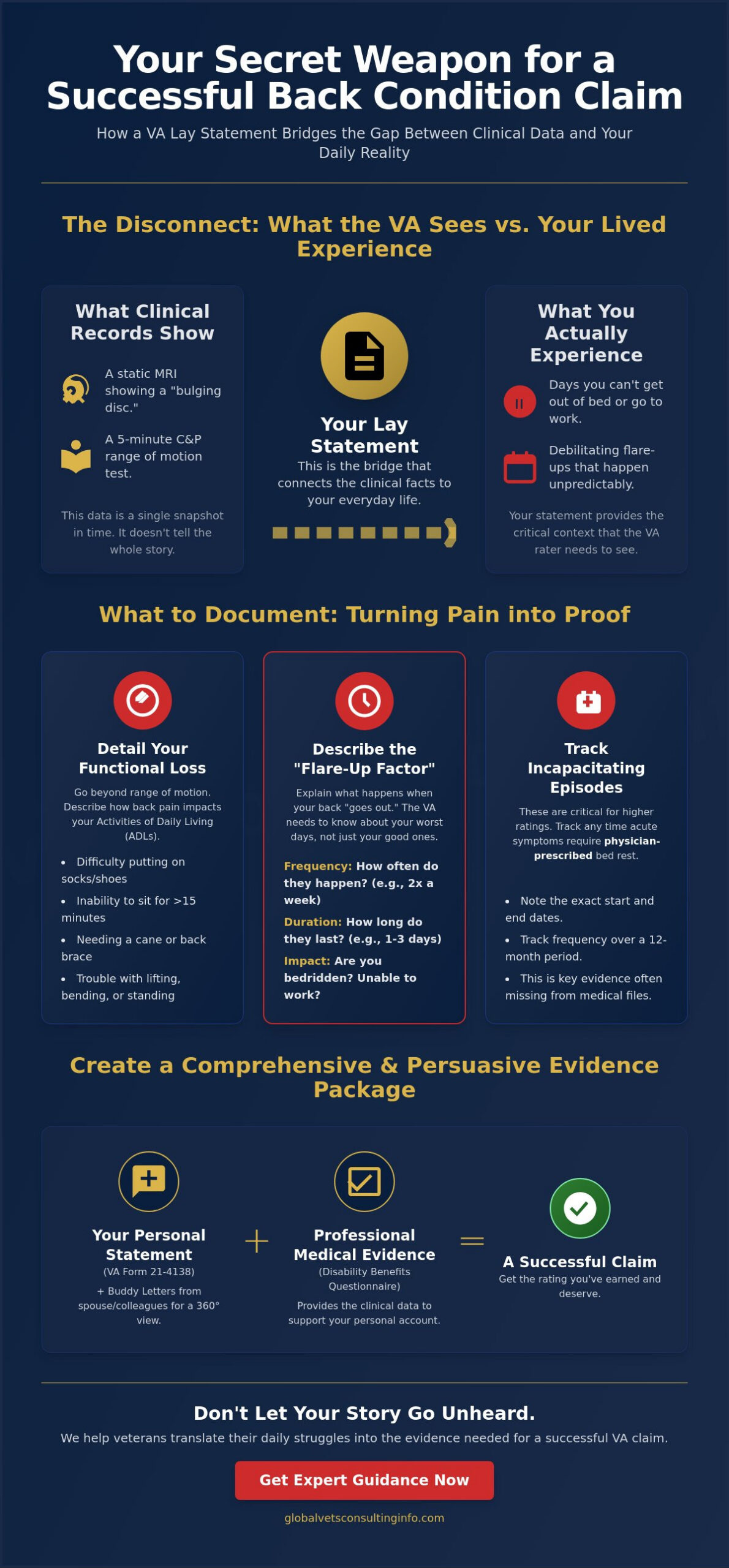
A VA lay statement, officially submitted on VA Form 21-4138, is a written document that provides your personal perspective on your disability. While the Veterans Benefits Administration (VBA) relies heavily on medical records, those files often fail to capture the nuances of a musculoskeletal condition. A va lay statement for back condition serves as the narrative bridge between a static MRI and your actual functional limitations. An image might show degenerative disc disease, but it doesn’t show the days you can’t tie your own shoes or the way you have to roll out of bed because your spine is locked. Your statement provides the context that clinical data lacks.
This document is vital because back pain is rarely a constant, unchanging baseline. You might feel relatively mobile during a 15-minute C&P exam, yet suffer from debilitating flare-ups twice a week that leave you bedridden. By documenting these episodes, you establish a “chronicity of care.” This helps the rater understand the progression of your pain from the initial in-service event to your current daily struggles. It transforms clinical data into a human story of earned benefits. Without this perspective, the VA might only see a snapshot of your health rather than the full picture of your disability.
Direct vs. Buddy Statements for Back Issues
Your personal statement is your primary voice, but adding a “buddy letter” on VA Form 21-10210 provides objective third-party verification. When a spouse describes your visible limp after a long day or a co-worker mentions your inability to sit through a brief meeting without standing to stretch, it adds immense weight to your va lay statement for back condition. These observers see the functional loss that a doctor might miss during a single office visit. This peer-to-peer evidence reinforces the legitimacy of your claim and provides the rater with a 360-degree view of your spinal health.
Documenting Functional Loss and Flare-ups for a Back Condition
The core of a successful va lay statement for back condition lies in detailing functional loss rather than just clinical range of motion. During a C&P exam, a provider might ask you to bend forward until you feel pain. However, being able to touch your toes once in a sterile office doesn’t mean you can perform that motion repeatedly during a workday. You must explain how your back prevents you from performing normal daily tasks. If you’re filing a supplemental claim, your statement can serve as new and relevant evidence to show how your condition has worsened or was initially misunderstood by the rater.
The “Painful Motion Principle” is a critical concept for your claim. Under VA regulations, if it hurts to move a joint, the examiner should record that as a limitation of motion at the point where the pain begins. Your statement should clearly identify where that “stop point” occurs in your daily life. Don’t leave it to the examiner to guess. You need to describe the “Flare-up Factor” by explaining what happens when your back “goes out.” Detail how often these episodes occur, how long they last, and the total loss of function you experience during these periods.
Specific Examples of Daily Limitations
Focus on your Activities of Daily Living (ADLs). Be specific about the tasks that have become difficult or impossible.
- Difficulty putting on socks, shoes, or pants without physical assistance.
- Inability to sit in a standard chair for more than 15 minutes without radiating leg pain.
- Regular use of assistive devices like back braces, canes, or TENS units that may not be explicitly listed in your primary medical records.
These details provide a vivid picture of your reality. If you’re unsure how to organize these details, seeking medical evidence education can help you align your personal experience with specific VA rating criteria.
Describing Incapacitating Episodes
For certain conditions, the VA looks for “incapacitating episodes.” These are periods of acute symptoms that require bed rest prescribed by a physician. You should track these episodes over a 12-month period. Note the frequency and the exact duration of each event. Your va lay statement for back condition should explicitly state how many times your back required doctor-ordered rest to recover. This data is often missing from standard medical charts but is essential for achieving a higher disability rating.
How to Write Your Statement: A Step-by-Step Guide for 2026
Staring at a blank VA Form 21-4138 is often the most difficult part of the process. To create a winning va lay statement for back condition, you need a structured approach that leaves no room for ambiguity. Following a logical progression helps the rater understand the history and current impact of your injury without getting lost in clinical jargon.
- Step 1: The In-Service Event. Clearly state the specific injury or the onset of your pain during service. Mention the date, your unit, and exactly what happened, such as a fall during a jump or chronic strain from heavy lifting.
- Step 2: The Nexus. Explain how your current back condition is directly linked to that service event. If the pain has been continuous since you transitioned to civilian life, you must document that “bridge” of symptoms.
- Step 3: Current Severity. Detail your symptoms as they exist today. While the VA uses official Disability Benefits Questionnaires (DBQs) for medical evaluations, your statement is where you describe the daily reality of your pain.
- Step 4: Employment Impact. Describe how your back pain affects your ability to work. Be specific about your inability to stand, sit, or lift, as these factors are vital for determining your rating.
The ‘Day in the Life’ Approach
Write a narrative that walks the rater through your day from the moment you wake up. Instead of saying “my back hurts,” use specific details. Explain that you cannot sit for more than 20 minutes without experiencing numbness in your legs. Mention if you have to use the wall for balance when getting out of bed. This level of detail makes your va lay statement for back condition much more persuasive than a general complaint of pain.
Common Pitfalls to Avoid
Avoid trying to use “VA Math” or suggesting a specific rating for yourself. Stick to the facts of your physical limitations. Another common mistake is the military habit of “toughing it out.” Don’t downplay your symptoms. You must describe your worst days accurately so the rater understands the full scope of your disability. If you need help organizing your evidence, explore our veteran benefits education resources to ensure your claim is as strong as possible.
Strengthening Your Evidence with a Professional DBQ
A personal narrative is powerful, but it rarely wins a claim on its own. While your va lay statement for back condition provides the subjective context of your daily struggles, the VA requires objective medical evidence to assign a rating. This is where a Disability Benefits Questionnaire (DBQ) becomes essential. It translates your lived experience into the clinical language the rater uses to decide your case. By combining your personal story with objective data, you create a comprehensive evidence package that is difficult to ignore.
Many veterans rely solely on a C&P examination, which can be hit or miss. These exams are often conducted by contractors who may only spend a few minutes reviewing your file or testing your range of motion. In contrast, a DBQ completed by a private medical provider often carries significant weight because it allows for a more detailed assessment of your spinal health. A private provider can take the time to document the pain points you’ve already described in your va lay statement for back condition, ensuring the medical record matches your reality.
Consistency is the key to a successful claim. Your medical records, your DBQ, and your personal statement must all tell the same story. If your statement describes severe flare-ups while your medical evidence suggests only minor stiffness, the rater will likely find a discrepancy. Aligning these documents is the best way to prevent VA claim denials. Global Vets Consulting is dedicated to musculoskeletal claims education, helping you secure the professional medical documentation your back claim deserves.
The Role of a Nexus Letter
Back conditions often lead to secondary issues like radiculopathy, which causes shooting pain or numbness in the legs. A professional medical opinion or nexus letter can link these secondary conditions to your primary back injury. This comprehensive approach ensures that every symptom mentioned in your lay statement is supported by a professional medical opinion. When your personal testimony and professional medical evidence work in tandem, you build a much stronger case for a higher disability rating.
🇺🇸 Global Vets Consulting
🌐 GlobalVetsConsultingInfo.com
📞 24/7 National Client Services Hotline
🤖 24/7 AI Veteran Intake Specialist
Secure Your Earned Benefits with Stronger Evidence
Success in the VA claims process requires more than just submitting forms. It demands a strategic approach that combines your personal truth with ironclad medical evidence. By focusing on functional loss and accurately documenting those debilitating flare-ups, you provide the rater with a roadmap to your actual physical limitations. A well-crafted va lay statement for back condition turns clinical observations into a compelling human narrative that medical records alone cannot convey.
You don’t have to navigate this complex system alone. Global Vets Consulting is a veteran-owned and operated team of specialists dedicated to musculoskeletal DBQ documentation. We understand the high stakes of your claim and offer a 24/7 National Client Services Hotline to support you at every turn. Ensuring your evidence is consistent and thorough is the most effective way to secure the rating you’ve earned through your service.
Get the Professional DBQ Evidence You Need for Your Back Claim 🇺🇸
Your journey toward a fair disability rating is a mission we take seriously. With the right documentation and a clear voice, you can move forward with confidence and peace of mind. We’re ready to help you turn your claim into a success.
Frequently Asked Questions
Can a lay statement win a VA back claim without medical records?
A lay statement cannot replace medical records but serves as vital supporting evidence to bridge gaps in your history. The VA requires a formal medical diagnosis and a nexus to grant service connection. Your statement provides the human context that a clinical record might miss, such as the specific frequency of flare-ups or how your pain prevents you from completing a full workday.
Which form should I use for a personal statement for a back condition?
You should use VA Form 21-4138, Statement in Support of Claim, for your personal narrative. This form allows you to explain the onset of your injury and your current physical limitations in your own words. If you have a friend or family member who wants to provide testimony, they should use VA Form 21-10210, the Lay/Witness Statement, to support your case.
Should I mention my leg pain (radiculopathy) in my back lay statement?
You should definitely include leg pain or radiculopathy because these symptoms often qualify for separate secondary ratings. Chronic back issues frequently cause nerve compression that leads to numbness, tingling, or weakness in the lower extremities. Detailing these issues in your va lay statement for back condition ensures the VA rater understands the full neurological impact of your spinal condition.
How long should my statement in support of claim be?
Aim for a concise statement that covers all necessary details in one to two pages. While you want to be thorough, a rater is more likely to digest a focused narrative that highlights specific functional losses. Use clear, direct language to describe your worst days and avoid including irrelevant personal history that doesn’t directly relate to your back condition or its impact on your life.
Can my spouse write a buddy statement for my back pain?
Your spouse is an excellent source for a buddy statement because they witness your functional limitations every day. They can provide objective observations about your struggle to get out of bed or your need for assistance with basic chores. Their testimony adds a layer of credibility to your va lay statement for back condition by verifying the symptoms you experience outside of a doctor’s office.

Article by
Willie Daniel
Willie Daniel is the Founder and Chief Executive Officer (CEO) of Global Vets Consulting (GVC) – National Veterans Disability Services, a veteran-led educational and medical evidence support organization dedicated to helping veterans better understand VA disability rating increases, DBQ medical evidence, secondary claims education, and C&P examination preparation.
He is a retired U.S. Army Medical Service Corps Officer with more than 27 years of honorable military service, a decorated Iraq combat veteran, and a retired federal official with the U.S. Department of Veterans Affairs. Throughout his military and federal career, Willie Daniel served in leadership, healthcare administration, operational, and veteran-support roles focused on improving services and support systems for servicemembers, veterans, and their families.
Drawing from decades of military leadership, healthcare administration, veteran advocacy, and federal government experience, Willie Daniel brings a practical, veteran-centered perspective to Global Vets Consulting’s educational articles, AI-powered veteran resources, video education initiatives, and outreach programs. His experience navigating military systems, medical documentation processes, and veteran-related administrative operations provides valuable insight into many of the challenges veterans face when seeking to better understand VA disability rating criteria, medical evidence, documentation strategies, and secondary condition education.
Through GVC’s “Veterans Helping Veterans” mission, his focus is on delivering clear, educational, and easy-to-understand information designed to empower veterans with knowledge, resources, and educational tools that may help them make more informed decisions regarding their individual VA disability journeys.
The information provided through GVC is intended for educational and informational purposes only and should not be considered legal or medical advice.
Disclaimer
Disclaimer: Global Vets Consulting, LLC (“GVC”) is a veteran-led educational and medical evidence support organization. GVC is not a law firm, is not a Veterans Service Organization (VSO), and is not affiliated with the U.S. Department of Veterans Affairs (VA) or any government agency.
Global Vets Consulting does not provide legal advice, medical advice, medical treatment, or healthcare services. GVC does not prepare, file, or submit VA disability claims on behalf of veterans. All information provided through this website, blog articles, videos, educational materials, AI tools, dashboards, templates, and communications is intended solely for general educational and informational purposes.
Veterans are encouraged to consult with accredited representatives, licensed attorneys, qualified medical providers, or Veterans Service Organizations regarding their specific legal, medical, or VA-related matters. VA disability decisions, ratings, and outcomes are determined solely by the U.S. Department of Veterans Affairs based on applicable laws, regulations, medical evidence, and individual circumstances. Past results do not guarantee future outcomes.