
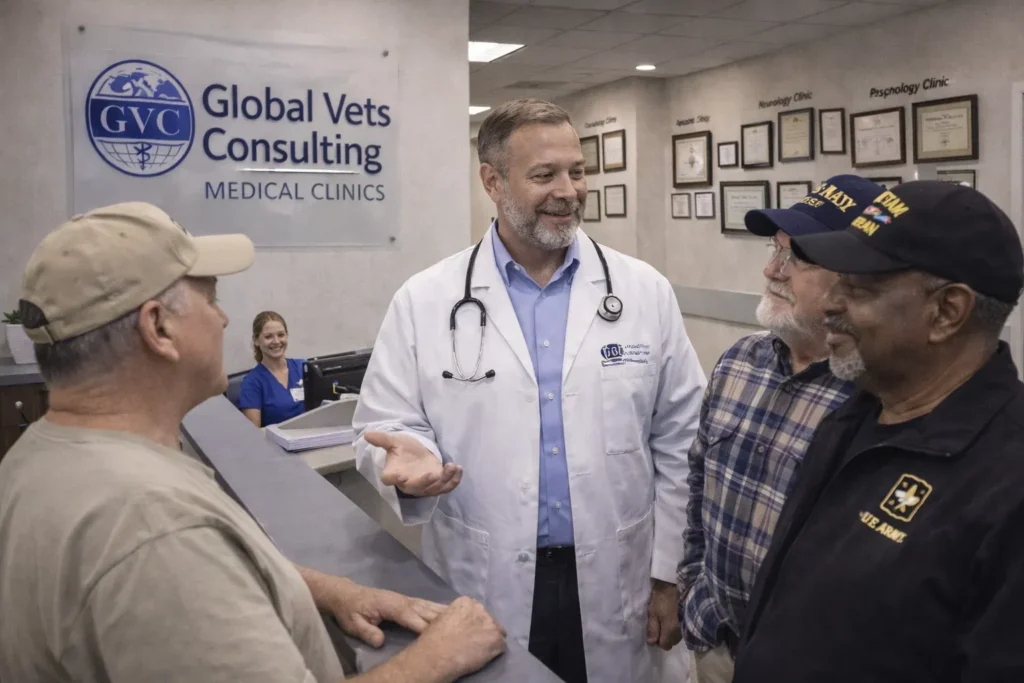
What if the reason your claim keeps getting denied isn't that your pain isn't real, but simply that you haven't "spoken the language" of the VA rater?
For many veterans, the battle doesn't end when the first rating decision arrives. You might have a 10% rating for a service-connected knee injury, but now your back is giving out from an altered gait, or the medication for your service-connected PTSD is causing chronic migraines. This is where the strategy shifts from direct service connection to VA secondary claims. To win this mission, you need more than just a diagnosis; you need a VA nexus letter: the tactical blueprint that bridges the gap between your primary disability and your secondary condition.
Table of Contents
- The Strategic Blueprint: Understanding 38 CFR § 3.310
- Key Components of a Bulletproof VA Nexus Letter
- Causation vs. Aggravation: Knowing Your Target
- Mastering the VA Disability Increase
- The Language of the Rater: Technical Requirements
- Pre-Submission Checklist
- Frequently Asked Questions
Key Takeaways
- A nexus is a link: It is the medical evidence that proves your secondary condition was "proximately due to" your primary service-connected disability.
- Legal standard matters: Use specific phrasing like "at least as likely as not" (50% probability or greater) to satisfy VA requirements.
- Precision beats volume: A single, well-reasoned VA nexus letter from a specialist is worth more than a dozen generic treatment notes.
- Secondary claims are path to 100%: Many veterans achieve a VA disability increase by identifying conditions that are secondary to their primary ratings.
The Strategic Blueprint: Understanding 38 CFR § 3.310
In the world of VA claims, you are operating under a specific set of rules. For secondary service connection, the governing regulation is 38 CFR § 3.310. This regulation dictates that any disability which is proximately due to or the result of a service-connected disease or injury shall be service-connected.
Think of your primary service-connected condition as the "anchor." A secondary claim is any condition that was either caused by that anchor or was "aggravated" by it. For example, if you have service-connected sciatica, and the constant nerve pain leads to depression, that depression can be filed as a VA secondary claim.

Key Components of a Bulletproof VA Nexus Letter
A VA nexus letter is an independent medical opinion (IMO) written by a licensed healthcare provider. It is not a simple doctor's note. It is a formal, evidence-based document that must meet high-level technical standards to be effective.
To ensure your VA nexus letter stands up to the scrutiny of a C&P examiner, verify that it includes these four pillars:
- Credentials & Expertise: The provider must be qualified. A nexus for a foot condition like pes planus carries more weight coming from an orthopedist than a general practitioner.
- Review of the C-File: The letter must explicitly state that the doctor reviewed your entire medical history (your "Claims File" or C-File). Without this, the VA may dismiss the opinion as "uninformed."
- Formal Diagnosis: The secondary condition must be identified by its clinical name and, ideally, its diagnostic code from 38 CFR Part 4.
- Medical Rationale: This is the "why." The doctor must explain the physiological or psychological mechanism: such as biomechanical stress or medication side effects: that links the two conditions.
Causation vs. Aggravation: Knowing Your Target
When filing for VA secondary claims, you must identify which tactical path you are taking: Causation or Aggravation.
Direct Causation
This is when your service-connected condition created a new problem.
- Example: Service-connected diabetes type 2 causing diabetic retinopathy (vision loss).
Aggravation (38 CFR § 3.310(b))
This is when you already had a condition, but your service-connected disability made it permanently worse.
- Example: You had mild back pain before service, but your service-connected degenerative disc disease has aggravated it to the point of functional loss.
| Feature | Direct Secondary | Aggravation |
|---|---|---|
| Origin | Caused entirely by primary condition | Pre-existing condition made worse |
| Requirement | New diagnosis | Evidence of "baseline" severity |
| Nexus Language | "Proximately due to…" | "Aggravated beyond natural progression…" |
Mastering the VA Disability Increase
If your condition has worsened since your last rating, you aren't just looking for service connection: you are looking for a VA disability increase. To win an increase, you must move from "subjective" pain to "objective" evidence that meets a higher percentage threshold in the 38 CFR Part 4 Schedule for Rating Disabilities.
For instance, if you are filing for an increase in knee flexion limitation, the VA isn't looking at how much it hurts; they are looking at the exact degrees of range of motion. Your VA nexus letter and accompanying Disability Benefits Questionnaire (DBQ) must use this "language of the rater" to be successful.

The Language of the Rater: Technical Requirements
Do not let your provider use "maybe" or "possibly." The VA operates on a "more likely than not" standard. Use these specific phrases to ensure your medical evidence is actionable:
- "At least as likely as not": This means there is a 50% or greater probability that the conditions are linked. This is the minimum requirement for a grant of service connection.
- "More likely than not": Greater than 50% probability. This is a very strong stance.
- "Proximately due to": The legal term for causation.
- "Functional Loss": Don't just say it hurts; describe how the condition prevents you from working or performing daily tasks. Use terms like "calcaneal eversion" for foot claims or "effusion" for joint claims to provide the technical precision the VA requires.
Pre-Submission Checklist
Before you hit "submit" on your next claim, run through this mission-ready checklist:
- Verify Diagnosis: Do you have a formal medical diagnosis for the secondary condition?
- Confirm Connection: Does your VA nexus letter explicitly link the secondary condition to a currently service-connected "anchor" disability?
- Check Phrasing: Does the letter use the phrase "at least as likely as not"?
- Identify Baseline: If claiming aggravation, do you have medical records showing how severe the condition was before it got worse?
- Review DBQ: Is there a completed independent medical evaluation or DBQ that captures your current symptoms according to 38 CFR Part 4?
Frequently Asked Questions
Do I need a nexus letter if I have a DBQ?
While not always legally required, a VA nexus letter provides the "medical rationale" that a DBQ often lacks. A DBQ shows what your symptoms are; a nexus letter explains why they are related to your service.
Can I get a VA disability increase for a secondary condition?
Yes. Once a secondary condition is service-connected, it is rated just like a primary condition. If it worsens over time, you can file for a VA disability increase for that secondary rating.
What are the most common secondary claims?
Common links include depression secondary to chronic pain, hypertension secondary to PTSD, and sleep apnea secondary to respiratory issues or weight gain caused by a service-connected physical injury.
How do I find a doctor who understands VA nexus letters?
Most primary care physicians are not trained in the nuances of 38 CFR. It is often necessary to work with a network of independent medical providers who specialize in veteran-specific documentation and understand the "language of the rater."
The VA claims process is a marathon, not a sprint. By utilizing a strategic approach, technical medical evidence, and a clear VA nexus letter, you can bridge the gap from a denied claim to the benefits you rightfully earned. Don't leave your rating to chance( build your blueprint today.)