
What if your va rating for degenerative arthritis of the spine had more to do with your worst flare-ups than the ten minutes you spent in a C&P exam? It’s a common frustration for veterans who feel their chronic pain is dismissed because they can still move “enough” during a clinical test. You’ve likely felt the confusion of VA math when a rating comes back lower than your actual physical limitations suggest it should be.
We understand that your condition affects every aspect of your life, from your ability to work to your time with family. This guide is designed to help you bridge the gap between clinical measurements and your real-world experience. You’ll learn exactly how the VA evaluates spinal conditions under the 2026 standards and how to use a DBQ to document functional loss for the highest possible rating.
We’re going to break down the 10% to 100% rating criteria, explain the critical importance of the “painful motion” rule, and show you how to capture the impact of your worst days on paper. By the end of this article, you’ll have a clear, step-by-step plan to secure the benefits that reflect the true severity of your service-connected condition.
Key Takeaways
- Understand how spinal arthritis is classified as wear-and-tear damage and why establishing a clear service connection is the first step toward your benefits.
- Learn the specific Range of Motion (ROM) measurements the VA uses to determine your va rating for degenerative arthritis of the spine under the 2026 schedule.
- Discover how to apply the DeLuca Criteria to document functional loss from pain and flare-ups that a standard C&P exam might miss.
- Identify how a private Disability Benefits Questionnaire (DBQ) can provide the technical accuracy needed to reflect your true level of physical impairment.
- Gain actionable strategies to ensure your medical evidence captures your worst days, leading to a more favorable and accurate rating outcome.
What is Degenerative Arthritis of the Spine? 🦴
Degenerative arthritis is essentially the “wear and tear” of the spinal column. In medical terms, it is often called Spondylosis (Degenerative Arthritis of the Spine). This condition occurs when the protective cartilage between your joints wears down and the spinal discs begin to lose their cushioning ability. For many veterans, this isn’t just a natural part of aging. The physical demands of military service, such as airborne operations, heavy lifting, and repetitive stress from long patrols, significantly accelerate this damage.
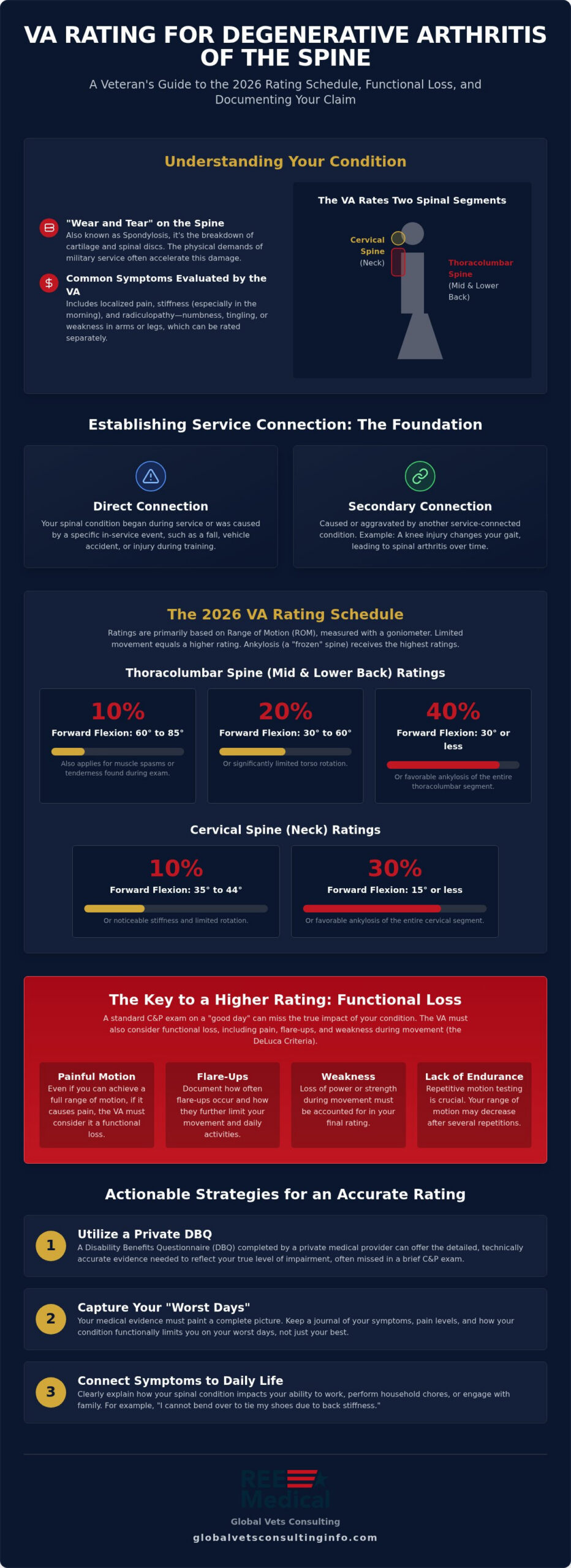
When you seek a va rating for degenerative arthritis of the spine, you should know that the VA groups most spinal conditions together. Whether you have arthritis, Degenerative Disc Disease (DDD), or a chronic strain, the VA uses the same “General Rating Formula for Diseases and Injuries of the Spine.” They divide your back into two rating segments: the cervical spine (your neck) and the thoracolumbar spine (your mid and lower back). Each segment is evaluated based on how much it limits your movement.
Direct vs. Secondary Service Connection
Establishing service connection is the foundation of your VA disability claim. A direct connection is straightforward; you must show that your spinal condition began during service or was caused by a specific event, like a vehicle accident or a fall during training. However, many veterans qualify through a secondary service connection. For example, if a service-connected knee or hip injury caused you to change your gait, that uneven walking pattern often leads to spinal arthritis over time. This makes the back condition secondary to your lower extremity disability.
Common Symptoms the VA Evaluates
The VA focuses on how your symptoms limit your daily life. You may experience localized pain, stiffness that is worse in the morning, or tenderness along the vertebrae. It is also common to experience “referred pain” known as radiculopathy. If your spinal arthritis causes numbness, tingling, or weakness in your arms or legs, you may be eligible for a va rating for degenerative arthritis of the spine along with separate ratings for nerve damage. Documenting these flare-ups is vital for an accurate claim.
The 2026 VA Rating Schedule for Spinal Arthritis 📊
The VA doesn’t just look at an X-ray to determine your compensation. Instead, they focus on how much you can actually move. This process is governed by the VA’s Schedule of Ratings for the Musculoskeletal System. For most claims involving a va rating for degenerative arthritis of the spine, the primary factor is your Range of Motion (ROM).
If your spine is completely “frozen” or fixed in place, the VA calls this ankylosis. This condition triggers the highest possible ratings, ranging from 60% to 100% depending on how much of the spine is affected. Favorable ankylosis means the spine is fixed in a neutral position at 0 degrees.
It’s vital to remember that the neck and back are treated as two distinct segments. You can receive a separate va rating for degenerative arthritis of the spine for both the cervical and thoracolumbar regions if they are distinct service-connected issues. During your exam, the provider must use a tool called a goniometer to get objective measurements. If they just eyeball your movement, the results are often inaccurate.
Thoracolumbar Spine (Back) Ratings
- 10% Rating: Forward flexion between 60° and 85°, or the presence of muscle spasms and tenderness during the exam.
- 20% Rating: Forward flexion between 30° and 60°, or a significantly limited rotation of the torso.
- 40% Rating: Forward flexion of 30° or less, or favorable ankylosis of the entire thoracolumbar segment.
Cervical Spine (Neck) Ratings
- 10% Rating: Forward flexion between 35° and 44°, or noticeable stiffness and limited rotation.
- 30% Rating: Forward flexion of 15° or less, or favorable ankylosis of the entire cervical segment.
If you’re unsure if your current measurements reflect your daily reality, reviewing musculoskeletal claims education can help you prepare for your next evaluation. Accuracy in these degrees is the difference between a 10% and a 40% rating.
Functional Loss and the DeLuca Criteria: The Key to a Higher Rating
Many veterans receive a lower va rating for degenerative arthritis of the spine than they deserve because their C&P exam happened on a “good day.” If you push through the pain to show the examiner how far you can bend, the VA often records that as your standard ability. However, the landmark court case DeLuca v. Brown changed the rules. It requires the VA to consider functional loss caused by pain, fatigue, lack of endurance, and even incoordination.
This means your rating shouldn’t just be based on a single measurement. If pain makes it impossible to repeat a movement, or if you lose strength after several repetitions, the VA must rate you based on those limitations. Even if you aren’t physically “frozen,” functional impairment can justify a higher percentage. You’re entitled to a rating that reflects your actual physical capacity during your worst flare-ups, not just your best ten minutes in a clinic.
Documenting Flare-Ups and Weakness
When speaking with an examiner, you must describe your worst days. Detail the frequency, duration, and severity of your flare-ups. If your spinal arthritis causes periods of “incapacity” where a doctor prescribes bed rest, this evidence is critical. The VA defines incapacity as a period of extreme pain requiring medical intervention and rest. Documenting these episodes helps ensure your va rating for degenerative arthritis of the spine accurately reflects your level of disability.
Functional Loss vs. Static Motion
Static motion is what you can do once in a doctor’s office. Functional loss is how your spine performs during a full workday or while performing daily tasks. A professional Disability Benefits Questionnaire (DBQ) is the best tool to capture this distinction. It allows a provider to document how your condition affects your ability to sit, stand, and function in the real world. If you need help documenting these critical details, our VA rating increase education can guide you through the process.
Winning Your Claim with a Private DBQ 📑
A Disability Benefits Questionnaire (DBQ) is the standardized form the VA uses to evaluate the severity of your medical conditions. It serves as the primary tool for translating your physical pain into a numerical disability percentage. While the VA often relies on its own contracted examiners, you have the right to submit a DBQ completed by a private healthcare provider. This is a critical distinction for anyone seeking a va rating for degenerative arthritis of the spine, as it allows for a more comprehensive review of your medical history.
Private DBQs are often more accurate than a one-time C&P exam because your own provider understands the long-term progression of your condition. A standard VA exam might only last fifteen minutes, which is rarely enough time to capture how your arthritis limits your movement during a flare-up. By submitting a private DBQ as part of a Fully Developed Claim (FDC), you provide the VA with all the necessary evidence upfront. This proactive approach often leads to faster decisions and reduces the likelihood of the VA requesting additional, redundant examinations. You can find more details on how to submit a dbq to the va in our step-by-step submission guide.
The Advantage of Global Vets Consulting
Our focus is on technical accuracy and thoroughness. We specialize in musculoskeletal claims education to ensure that every measurement, from your forward flexion to your lateral rotation, is documented according to VA standards. We help you understand how to present your medical evidence so that your functional loss isn’t ignored. If you’ve struggled with previous filings, you might find our resource on VA Claim Denied for Lack of Evidence: How to Recover in 2026 particularly useful for your next steps.
Next Steps for Your VA Rating Increase
Securing a va rating for degenerative arthritis of the spine that reflects your reality requires preparation. Start by reviewing your current rating and identifying specific ways your condition has worsened since your last evaluation. Gather all relevant treatment records, including recent X-rays or MRIs that show the progression of your spinal aging. This objective evidence supports the findings in your DBQ and strengthens your overall claim.
Don’t leave your compensation to chance. Ready to secure the rating you’ve earned? Contact Global Vets Consulting today for a DBQ consultation.
Secure Your Earned Benefits for Spinal Arthritis 🇺🇸
You’ve learned that securing a va rating for degenerative arthritis of the spine depends on more than just an X-ray result. It’s about documenting your true Range of Motion and ensuring the VA applies the DeLuca criteria to account for your functional loss. Whether your condition affects your cervical or thoracolumbar spine, your medical evidence must capture your worst flare-ups to reflect the daily reality of your service-connected condition.
Don’t let a rushed C&P exam determine your financial future. Using a private DBQ ensures that every degree of movement and every instance of pain is meticulously recorded by a provider who understands your history. At Global Vets Consulting, we provide the veteran-owned expertise and meticulous DBQ documentation needed to strengthen your claim. We prioritize technical accuracy so that your physical limitations are never overlooked by the rating board.
Our 24/7 National Client Services Hotline is ready to support you as you navigate this complex system. You’ve served your country; now it’s time to ensure the system serves you. Start Your DBQ Consultation with Global Vets Consulting today and take the final step toward the benefits you’ve earned. You’ve got a dedicated partner in this mission.
Frequently Asked Questions
Can I get a 100% VA rating for degenerative arthritis of the spine?
Yes, you can receive a 100% rating, but it requires unfavorable ankylosis of the entire spine. This means your entire spinal column is fixed in a non-neutral position, making movement impossible. Most veterans find that a 100% rating is difficult to achieve through arthritis alone. Instead, many reach higher combined ratings by documenting secondary conditions like radiculopathy or mental health issues stemming from chronic spinal pain.
What is the average VA disability rating for spinal arthritis?
The average va rating for degenerative arthritis of the spine typically falls between 10% and 20%. A 10% rating is frequently assigned under the “painful motion” rule. This rule applies if you experience pain during movement even if you have a normal range of motion. Higher ratings of 40% or more are less common and usually require significant evidence of limited flexion or a frozen spine segment.
How does the VA rate back pain if my X-rays don’t show severe arthritis?
The VA rates your condition based on physical limitation rather than the severity of your imaging. Even if your X-rays show mild wear, your rating is determined by your Range of Motion (ROM) and functional loss. Under 38 C.F.R. § 4.59, you are entitled to at least a 10% rating if you have “painful motion” during your exam, regardless of what the X-ray shows.
Do I need an MRI to prove I have degenerative arthritis for my VA claim?
You don’t strictly need an MRI to prove arthritis; a standard X-ray is often enough to show joint space narrowing or bone spurs. However, an MRI is highly beneficial if you’re experiencing nerve pain or numbness. These images can help establish a secondary va rating for degenerative arthritis of the spine by proving that your spinal issues are causing radiculopathy in your arms or legs.
What happens if my C&P examiner doesn’t use a goniometer?
If your examiner fails to use a goniometer to measure your Range of Motion, the exam is technically insufficient. VA regulations require the use of this tool to ensure objective and accurate measurements. If this happens, you should immediately document the error in a Statement in Support of Claim. This helps you challenge an unfair rating and provides grounds for requesting a new, more accurate examination.

Article by
Willie Daniel
Willie Daniel is the Founder and Chief Executive Officer (CEO) of Global Vets Consulting (GVC) – National Veterans Disability Services, a veteran-led educational and medical evidence support organization dedicated to helping veterans better understand VA disability rating increases, DBQ medical evidence, secondary claims education, and C&P examination preparation.
He is a retired U.S. Army Medical Service Corps Officer with more than 27 years of honorable military service, a decorated Iraq combat veteran, and a retired federal official with the U.S. Department of Veterans Affairs. Throughout his military and federal career, Willie Daniel served in leadership, healthcare administration, operational, and veteran-support roles focused on improving services and support systems for servicemembers, veterans, and their families.
Drawing from decades of military leadership, healthcare administration, veteran advocacy, and federal government experience, Willie Daniel brings a practical, veteran-centered perspective to Global Vets Consulting’s educational articles, AI-powered veteran resources, video education initiatives, and outreach programs. His experience navigating military systems, medical documentation processes, and veteran-related administrative operations provides valuable insight into many of the challenges veterans face when seeking to better understand VA disability rating criteria, medical evidence, documentation strategies, and secondary condition education.
Through GVC’s “Veterans Helping Veterans” mission, his focus is on delivering clear, educational, and easy-to-understand information designed to empower veterans with knowledge, resources, and educational tools that may help them make more informed decisions regarding their individual VA disability journeys.
The information provided through GVC is intended for educational and informational purposes only and should not be considered legal or medical advice.
Disclaimer
Disclaimer: Global Vets Consulting, LLC (“GVC”) is a veteran-led educational and medical evidence support organization. GVC is not a law firm, is not a Veterans Service Organization (VSO), and is not affiliated with the U.S. Department of Veterans Affairs (VA) or any government agency.
Global Vets Consulting does not provide legal advice, medical advice, medical treatment, or healthcare services. GVC does not prepare, file, or submit VA disability claims on behalf of veterans. All information provided through this website, blog articles, videos, educational materials, AI tools, dashboards, templates, and communications is intended solely for general educational and informational purposes.
Veterans are encouraged to consult with accredited representatives, licensed attorneys, qualified medical providers, or Veterans Service Organizations regarding their specific legal, medical, or VA-related matters. VA disability decisions, ratings, and outcomes are determined solely by the U.S. Department of Veterans Affairs based on applicable laws, regulations, medical evidence, and individual circumstances. Past results do not guarantee future outcomes.