Did you know that back and spine conditions were among the most frequently claimed disabilities in 2026, yet initial approval rates for Degenerative Disc Disease VA claims sit at approximately 47%? It’s incredibly frustrating when your chronic pain limits every daily activity, yet the VA “math” and range of motion tests don’t seem to reflect your reality. You’ve earned your benefits, but navigating the system feels like an uphill battle. We understand these challenges because we’re a veteran-owned organization dedicated to serving our community with integrity and respect. 🇺🇸
This guide will show you exactly how to secure a rating that accurately reflects your symptoms, from 10% up to 100%. We’ll break down the 2026 rating criteria, explain how to document flare-ups, and show you how a Disability Benefits Questionnaire (DBQ) provides the medical evidence needed for a successful claim. For immediate assistance, our 24/7 AI Veteran Intake Specialist and National Client Services Hotline are available at (727) 350-8387, or you can visit https://www.GlobalVetsConsultingInfo.com.
Key Takeaways
- Learn how the VA utilizes 38 CFR § 4.71a to evaluate spinal wear and tear, ensuring you understand the framework behind your evaluation.
- Discover the specific Range of Motion (ROM) thresholds for forward flexion that the VA uses to assign disability ratings between 10% and 100%.
- See why a private Disability Benefits Questionnaire (DBQ) is the most effective way to document the severity of your Degenerative Disc Disease VA symptoms.
- Find out how to leverage 24/7 veteran-to-veteran resources and medical evidence education to streamline your path toward an accurate rating increase. 🇺🇸
Understanding Degenerative Disc Disease (DDD) in the VA System 🇺🇸
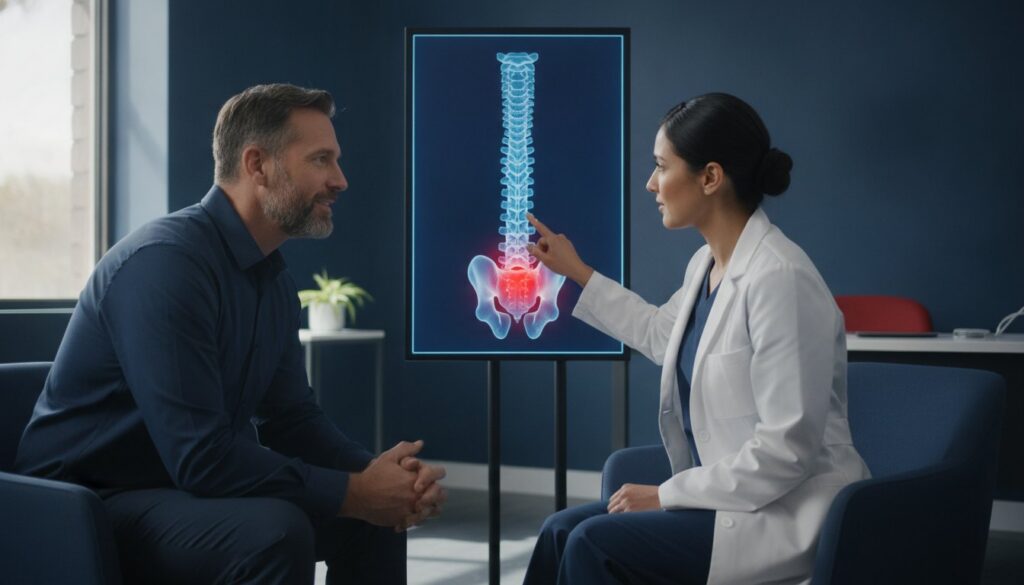
Understanding Degenerative Disc Disease starts with recognizing that it isn’t actually a disease, but rather the structural wear and tear of the intervertebral discs. These discs serve as the spine’s hydraulic shock absorbers. For a Degenerative Disc Disease VA claim, the Department evaluates this condition as part of the musculoskeletal system under 38 CFR § 4.71a. It’s vital to remember that a clinical diagnosis on your MRI is just the baseline. The real challenge is establishing a clear connection to your military service.
The VA classifies the spine into two distinct regions for rating purposes. You can receive separate evaluations for the cervical spine (the neck) and the thoracolumbar spine (the mid and lower back). If your service history resulted in degenerative changes in both areas, documenting them as separate claims is essential for an accurate cumulative disability rating.
Direct vs. Secondary Service Connection for DDD
Establishing service connection often follows two distinct paths. Direct service connection requires proving a specific event, such as a heavy fall or a vehicle accident during active duty, caused your disc degeneration. Many veterans also find success through secondary service connection. This involves linking your DDD to an existing service-connected issue. For example, a chronic knee injury that alters your gait can put abnormal stress on your spine, leading to degenerative changes over time.
The Importance of Medical Evidence in 2026
In 2026, the VA’s emphasis on objective clinical data is higher than ever. While your personal statement regarding daily pain is valuable, it isn’t enough to secure a high rating. You need robust clinical documentation. High-quality imaging, like MRIs or X-rays, is necessary to confirm structural changes for a Degenerative Disc Disease VA claim. For support, our 24/7 National Client Services Hotline and 24/7 AI Veteran Intake Specialist at Global Vets Consulting (GVC4Vets) are available at (727) 350-8387, or visit https://www.GlobalVetsConsultingInfo.com. 🇺🇸
How the VA Rates Degenerative Disc Disease: Range of Motion (ROM) 🇺🇸
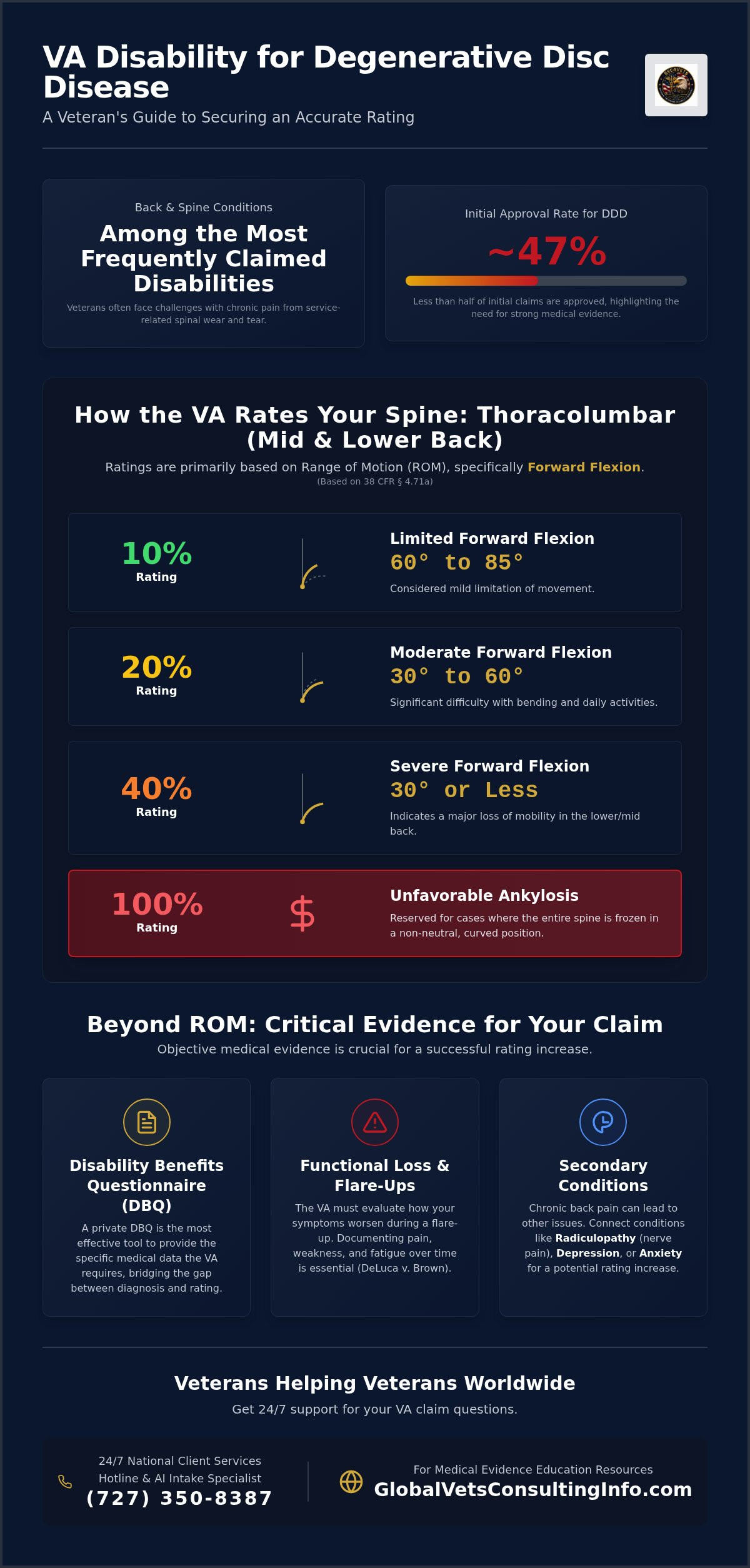
The VA applies a General Rating Formula for the Spine to determine your level of disability. This evaluation relies primarily on forward flexion, which is the degree to which you can bend toward your toes. According to Johns Hopkins Medicine on DDD, chronic stiffness often limits this movement significantly. For the thoracolumbar spine, a 10% rating is assigned for flexion between 60 and 85 degrees. You may qualify for a 20% rating if your flexion is limited to between 30 and 60 degrees. A 40% rating is reserved for flexion of 30 degrees or less. It’s important to realize that pain alone rarely exceeds a 10% rating unless there is a documented loss of mobility. A 100% rating is only granted for unfavorable ankylosis, where the entire spine is essentially frozen in a curved or non-neutral position.
Documenting Functional Loss and Flare-ups
The DeLuca v. Brown rule is a critical protection for veterans. It requires the VA to evaluate how your symptoms worsen during a flare-up, not just how you perform on a good day. When describing functional loss, you must explain how pain, weakness, or fatigue prevents you from maintaining a full range of motion over time. This level of detail ensures your Degenerative Disc Disease VA rating reflects your actual physical limitations. If you’re unsure how to document these episodes, exploring accurate medical evidence education through Global Vets Consulting (GVC4Vets) can provide a clearer path forward. 🇺🇸
Common Secondary Conditions to DDD
Living with Degenerative Disc Disease VA often leads to secondary issues like radiculopathy, which causes numbness or shooting pain in the legs. Additionally, the psychological toll of chronic back pain can be severe. You may use a dbq for mental health conditions to support a secondary claim for depression or anxiety related to your spinal injury. Our 24/7 AI Veteran Intake Specialist and National Client Services Hotline at (727) 350-8387 are available to help you understand the evidence needed for these complex claims.
The Role of the DBQ in Proving Your DDD Severity 🇺🇸
A Disability Benefits Questionnaire (DBQ) acts as the essential bridge between your clinical diagnosis and your final disability rating. For a Degenerative Disc Disease VA claim, this standardized form ensures that a medical examiner captures the exact data points the VA requires for an accurate evaluation. Resources like the Arthritis Foundation emphasize that detailed documentation is vital for managing degenerative conditions. By providing standardized evidence, you remove the guesswork from the rating process and ensure your physical limitations are recorded in a way the VA can’t ignore.
Key Sections of the Musculoskeletal DBQ
The Back (Thoracolumbar Spine) DBQ focuses on objective measurements rather than vague descriptions of pain. A physician uses a goniometer to record your range of motion, documenting exactly where your movement stops or where pain begins. The form also tracks muscle atrophy and sensory changes that indicate nerve involvement, which often supports secondary ratings. Most importantly, it includes specific remarks on how your condition affects your daily work capacity. You can learn how to submit a dbq to the va to ensure your medical evidence is front and center during a Fully Developed Claim.
Why a Private DBQ Can Be More Accurate Than a C&P Exam
Relying solely on a C&P exam can be risky because these appointments are often rushed and performed by examiners who don’t know your medical history. An examiner might miss the severity of your worst symptoms or fail to document functional loss properly. A private DBQ allows you to work with a doctor who understands veteran-specific spinal issues and takes the time to follow VA guidelines to the letter. This thoroughness provides a reliable path toward the rating you’ve earned. If you’re ready to strengthen your evidence, start your education with Global Vets Consulting (GVC4Vets) today. 🇺🇸 Our 24/7 AI Veteran Intake Specialist and National Client Services Hotline are available at (727) 350-8387 to help you begin the process.
Securing Your VA Evidence with Global Vets Consulting 🇺🇸
Global Vets Consulting operates as a mission-driven, veteran-owned resource dedicated to the worldwide veteran community. We understand that a Degenerative Disc Disease VA claim requires more than just a history of pain. It requires meticulous documentation that speaks the VA’s language. Our peer-to-peer support model focuses on educating you on how to gather high-quality medical evidence that accurately reflects your service-connected conditions.
Many veterans face the frustration of a va claim denied for lack of evidence because their records didn’t clearly define functional loss or range of motion limitations. We bridge this gap by providing the resources needed to document your symptoms correctly the first time. Our “Veterans Helping Veterans” approach ensures you’re never tackling this bureaucratic maze alone. We prioritize thoroughness and accuracy to help you secure the benefits you’ve earned through your service.
24/7 Support for Your Disability Claim Evidence
Immediate guidance is always available, regardless of your location. Our 24/7 National Client Services Hotline and 24/7 AI Veteran Intake Specialist at (727) 350-8387 provide a reliable starting point for any veteran seeking to understand their evidence requirements. You can also explore a wealth of educational materials and digital resources at learn more. We’re here to reduce your anxiety by offering a clear, predictable path forward.
Next Steps: How to Get Started Today
- Step 1: Contact our 24/7 hotline at (727) 350-8387 to speak with a specialist.
- Step 2: Learn about the specific DBQ process for your spinal condition and how to document flare-ups.
- Step 3: Submit your medical evidence with confidence, knowing it meets the VA’s rigorous standards.
Take Control of Your Disability Rating Today 🇺🇸
Securing an accurate rating for your spinal condition requires more than just describing your pain. It demands a thorough understanding of how the VA evaluates range of motion and functional loss. By utilizing a private Disability Benefits Questionnaire (DBQ), you ensure that your medical evidence meets the specific criteria for a Degenerative Disc Disease VA claim. This proactive approach prevents common pitfalls like claim denials due to insufficient documentation.
At Global Vets Consulting, we’ve been veteran-owned and operated since 2021, specializing in the medical evidence education you need to succeed. Our 24/7 AI Veteran Intake Specialist and National Client Services Hotline are always ready to support your journey. Contact our 24/7 National Client Services Hotline at (727) 350-8387 or visit Global Vets Consulting to secure the medical evidence you need for your VA claim. 🇺🇸 You’ve served your country with honor, and now it’s time to ensure you receive every benefit you deserve.
Frequently Asked Questions
Can I get VA disability for DDD if I am still working?
Yes, you can receive a disability rating for Degenerative Disc Disease VA while maintaining full-time employment. The VA compensates you for the functional loss and physical limitations caused by your service, not your total inability to work. Unless you’re seeking Total Disability based on Individual Unemployability (TDIU), your current job or income level doesn’t disqualify you from receiving the standard musculoskeletal benefits you’ve earned through your military service.
What happens during a C&P exam for Degenerative Disc Disease?
During the exam, an examiner will use a goniometer to measure your range of motion and evaluate your pain levels. They’ll assess how your condition impacts your daily activities and look for evidence of functional loss. It’s important to be honest about your symptoms and stop moving the moment pain begins. For comprehensive preparation resources, visit https://www.GlobalVetsConsultingInfo.com to learn how to approach these critical medical evaluations with confidence.
Is a DBQ required for a VA back pain claim?
While the VA doesn’t strictly require a DBQ, submitting one is a highly effective strategy for securing an accurate rating. A private DBQ allows your physician to document your symptoms using the VA’s exact standardized criteria. This level of detail ensures your claim is fully developed and reduces the risk of errors during a rushed C&P exam. You can contact our 24/7 National Client Services Hotline for guidance on this process.

Article by
Willie Daniel
Willie Daniel is the Founder and Chief Executive Officer (CEO) of Global Vets Consulting (GVC4Vets) – National Veterans Disability Services, a veteran-led educational and medical evidence support organization dedicated to helping veterans better understand VA disability rating increases, DBQ medical evidence, secondary claims education, and C&P examination preparation.
He is a retired U.S. Army Medical Service Corps Officer with more than 27 years of honorable military service, a decorated Iraq combat veteran, and a retired federal official with the U.S. Department of Veterans Affairs. Throughout his military and federal career, Willie Daniel served in leadership, healthcare administration, operational, and veteran-support roles focused on improving services and support systems for servicemembers, veterans, and their families.
Drawing from decades of military leadership, healthcare administration, veteran advocacy, and federal government experience, Willie Daniel brings a practical, veteran-centered perspective to Global Vets Consulting’s educational articles, AI-powered veteran resources, video education initiatives, and outreach programs. His experience navigating military systems, medical documentation processes, and veteran-related administrative operations provides valuable insight into many of the challenges veterans face when seeking to better understand VA disability rating criteria, medical evidence, documentation strategies, and secondary condition education.
Through GVC’s “Veterans Helping Veterans” mission, his focus is on delivering clear, educational, and easy-to-understand information designed to empower veterans with knowledge, resources, and educational tools that may help them make more informed decisions regarding their individual VA disability journeys.
The information provided through GVC is intended for educational and informational purposes only and should not be considered legal or medical advice.
Disclaimer
Disclaimer: Global Vets Consulting, LLC (“GVC”) is a veteran-led educational and medical evidence support organization. GVC is not a law firm, is not a Veterans Service Organization (VSO), and is not affiliated with the U.S. Department of Veterans Affairs (VA) or any government agency.
Global Vets Consulting does not provide legal advice, medical advice, medical treatment, or healthcare services. GVC does not prepare, file, or submit VA disability claims on behalf of veterans. All information provided through this website, blog articles, videos, educational materials, AI tools, dashboards, templates, and communications is intended solely for general educational and informational purposes.
Veterans are encouraged to consult with accredited representatives, licensed attorneys, qualified medical providers, or Veterans Service Organizations regarding their specific legal, medical, or VA-related matters. VA disability decisions, ratings, and outcomes are determined solely by the U.S. Department of Veterans Affairs based on applicable laws, regulations, medical evidence, and individual circumstances. Past results do not guarantee future outcomes.