
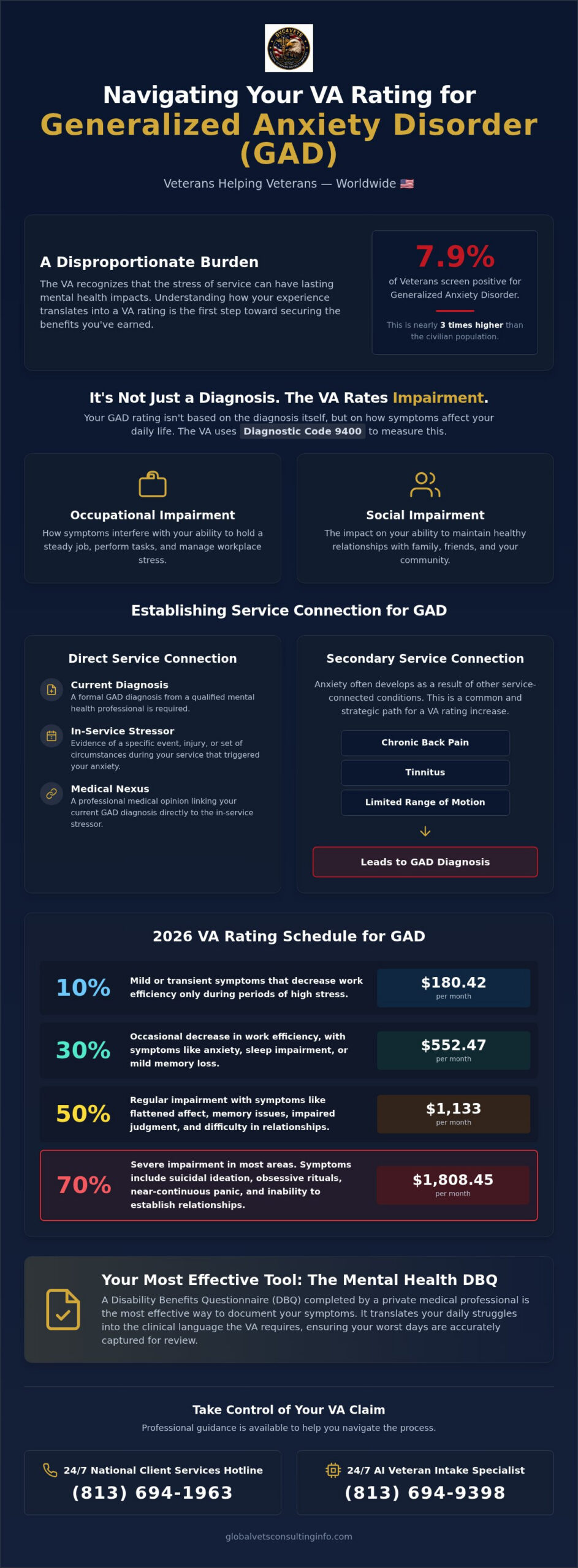
Did you know that 7.9% of veterans screen positive for Generalized Anxiety Disorder, a rate nearly three times higher than the civilian population? If you’re currently seeking a va rating for generalized anxiety disorder, you’ve likely realized that a simple diagnosis isn’t enough to secure the benefits you’ve earned. It’s frustrating to walk out of a C&P exam feeling unheard or to struggle with explaining how constant worry interferes with your work and family life. You shouldn’t have to feel like your mental health is being ignored by a complex system.
We understand that navigating the VA’s requirements can feel like an uphill battle against confusing math and bureaucratic red tape. This guide provides a clear roadmap to help you document your symptoms with precision, focusing on the functional impairment that determines your rating. You’ll learn about the 2026 COLA increases, including the $1,133 monthly rate for a 50% rating, and how to prepare professional documentation that reflects your worst days. We’ll walk through the specific criteria the VA uses to evaluate GAD so you can move forward with confidence and secure the financial stability you deserve. 🇺🇸
Key Takeaways
- Understand that a va rating for generalized anxiety disorder is determined by your level of occupational and social impairment under Diagnostic Code 9400.
- Identify how the 2026 COLA adjustments increase your monthly compensation and what specific symptoms are required for higher rating tiers.
- Learn why a Mental Health Disability Benefits Questionnaire (DBQ) is the most effective tool for documenting your symptoms with clinical accuracy.
- Discover the advantages of using private medical evidence to ensure your worst days are fully captured for the VA’s review.
- Follow a structured roadmap to move past the confusion of VA math and secure the disability benefits you’ve rightfully earned.
What is the VA Rating for Generalized Anxiety Disorder (GAD)?
The VA evaluates mental health conditions using a specific set of criteria known as the General Rating Formula for Mental Disorders. While many veterans are familiar with PTSD, a va rating for generalized anxiety disorder is one of the most common claims processed under Diagnostic Code 9400. It’s vital to understand that the VA doesn’t just look for a medical label. Instead, they measure the “total occupational and social impairment” your condition causes. This means your rating depends on how your symptoms interfere with your ability to hold a steady job or maintain healthy relationships.
Ratings are assigned in increments of 0%, 10%, 30%, 50%, 70%, or 100%. Most veterans diagnosed with GAD find themselves in the 30% to 70% range, depending on the severity of their daily struggles. To get a better clinical understanding of the condition itself, you can review What is Generalized Anxiety Disorder (GAD)? which outlines the persistent worry and physical symptoms that define this struggle. Whether you’re just starting your claim or seeking a higher va rating for generalized anxiety disorder, the focus must remain on functional impairment.
Direct Service Connection for GAD
To establish a direct connection, you need three specific pieces of evidence. First, you must have a current diagnosis from a qualified mental health professional. Second, you need to document a specific in-service stressor or event that triggered your anxiety. Finally, you need a medical nexus, which is a formal link connecting your current diagnosis to your military service. Without this bridge, the VA often denies claims even when the symptoms are severe and clearly documented.
GAD as a Secondary Condition
Many veterans don’t realize that anxiety often stems from other service-connected disabilities. If you suffer from chronic back pain, limited range of motion, or constant tinnitus, the resulting stress and lack of sleep can lead to a formal GAD diagnosis. Filing for anxiety as a secondary condition is a strategic path toward a VA rating increase because it acknowledges how physical injuries degrade your mental health. When your physical service-connected conditions cause your anxiety to flare, the VA is required to compensate you for that combined impact.
The 2026 VA Rating Schedule for Mental Health Disorders
Securing a fair va rating for generalized anxiety disorder requires a deep dive into the specific language the VA uses to evaluate your claim. The VA doesn’t grant ratings based on your level of distress alone; they use a rigid framework to determine how much your condition disrupts your life. To understand how your specific symptoms translate into a monthly benefit, you should reference The 2026 VA Rating Schedule for Mental Health Disorders. This legal standard ensures that every veteran is measured against the same criteria for social and occupational impairment.
- 0% Rating: You have a formal GAD diagnosis, but your symptoms don’t currently interfere with your social or work life. This is a “service-connected” placeholder that allows for future increases.
- 10% Rating: You experience mild or transient symptoms that cause occasional occupational impairment. You might use medication to control symptoms, but you’re generally able to perform your duties. For 2026, this rating provides $180.42 per month.
- 30% Rating: This is the threshold for “occasional” impairment. You likely deal with social isolation, weekly panic attacks, or difficulty sleeping. This rating pays $552.47 monthly for a veteran alone.
- 50% Rating: Your impairment is regular. Symptoms include a “flattened affect” (feeling emotionally numb), speech impairment, or significant memory issues. This results in a monthly payment of $1,133.
The 70% Rating: Severe Social and Occupational Impairment
At the 70% level, your anxiety is nearly constant. The VA looks for symptoms like suicidal ideation, obsessive rituals, and near-continuous panic. You likely struggle to maintain effective relationships and find workplace stability almost impossible. Documenting these “worst days” is critical for a successful va rating for generalized anxiety disorder at this high level, as it pays $1,808.45 per month. If you feel your current rating doesn’t reflect this severity, seeking professional education on your claim options is a logical next step.
The 100% Rating: Total Disability
A 100% rating represents total social and occupational impairment. This includes disorientation to time or place, persistent danger to yourself or others, or an inability to perform basic self-care. If your GAD symptoms prevent you from working but don’t quite reach the 100% criteria, you may qualify for Total Disability Individual Unemployability (TDIU). This allows the VA to pay you at the 100% rate of $3,938 even if your combined rating is lower.
How to Use a Mental Health DBQ to Prove Your GAD Claim
Your medical evidence is the most critical factor in determining your va rating for generalized anxiety disorder. A Disability Benefits Questionnaire (DBQ) serves as a standardized form that allows a healthcare provider to document your symptoms in a language the VA understands. If you aren’t familiar with this document, reviewing A Veteran’s Guide to Disability Benefits Questionnaires will help you understand how these forms bridge the gap between a clinical diagnosis and a disability rating.
Many veterans rely solely on the VA’s Compensation and Pension (C&P) exam, but these appointments are often rushed. A 15 minute conversation rarely captures the full scope of your condition. Private medical evidence is often more accurate because it allows for a thorough evaluation of your “worst days.” This is essential because the VA Schedule for Rating Disabilities requires specific evidence of how symptoms manifest over time, not just how you feel on the day of your appointment. You can reach out to our 24/7 National Client Services Hotline to start your intake for professional medical evidence education today.
Key Sections of the GAD DBQ
Section III of the DBQ is a symptoms checklist. You must ensure your doctor checks every box that applies to your daily life, from sleep disturbances to panic attacks. However, Section IV is the most vital for your va rating for generalized anxiety disorder. This section covers Occupational and Social Impairment. The box checked here directly correlates to your percentage, so it must accurately reflect your inability to function in a high stress work environment or maintain family stability.
Common Mistakes in GAD Documentation
The most frequent error veterans make is downplaying their symptoms due to a “tough it out” military culture. If you tell an examiner you’re “doing okay,” they’ll record that as a lack of impairment. You must provide specific examples of workplace conflict, social withdrawal, or times when anxiety prevented you from leaving the house. Detailed anecdotes transform a generic checklist into a compelling case for the benefits you’ve earned.
Securing Your VA Rating with Global Vets Consulting 🇺🇸
Global Vets Consulting operates with a mission-driven focus: Veterans Helping Veterans. We understand that securing a va rating for generalized anxiety disorder is more than just paperwork; it is about your livelihood and peace of mind. Our team provides the professional education needed to ensure your medical evidence is thorough, accurate, and ready for review. By streamlining the DBQ for mental health conditions, we help you prepare for the C&P exam with the confidence that comes from being fully prepared.
Our approach is built on partnership and transparency. We don’t just provide forms; we guide you through a predictable path forward. This process ensures that your “worst days” are professionally documented, preventing the VA from overlooking the true impact of your anxiety. We prioritize clinical accuracy to help you secure the maximum benefits you have rightfully earned through your service to our nation.
Why Professional DBQ Support Matters
Many veterans face a VA claim denied for lack of evidence because their documentation didn’t meet strict 2026 regulatory standards. Professional education helps you avoid these common pitfalls by ensuring every symptom is mapped correctly to the VA rating schedule. This meticulousness protects your va rating for generalized anxiety disorder from being undervalued. We focus on the functional “friction” in your life to ensure your rating reflects your actual level of social and occupational impairment.
Take the Next Step Toward Your Rating
We are ready to provide immediate assistance through our global support network. Use the contact points below to start your intake process today:
- 🌐 Worldwide Website: GlobalVetsConsultingInfo.com
- 📞 24/7 National Client Services Hotline: Call us anytime for support.
- 🤖 24/7 AI Veteran Intake Specialist: Available for immediate engagement on our website.
- 🇺🇸 Our Mission: Dedicated to helping veterans navigate the VA system with integrity.
Take Control of Your Disability Claim Journey
Securing a fair va rating for generalized anxiety disorder is about documenting the specific friction anxiety creates in your daily life. You’ve learned how the 2026 rating schedule evaluates impairment and why a professional DBQ is your strongest tool in the claims process. It’s time to bridge the gap between your symptoms and the financial stability you’ve earned. Our team is ready to stand with you as you navigate these complex requirements.
- 🌐 Worldwide Website: GlobalVetsConsultingInfo.com
- 📞 24/7 National Client Services Hotline: Connect with us anytime for immediate assistance.
- 🇺🇸 Veteran-Owned and Operated: Serving the veteran community since 2021.
- 📋 Professional DBQ Preparation: Specialized education to ensure clinical accuracy.
Get the medical evidence you need for your VA claim at Global Vets Consulting today. You served your country with honor and commitment; now let us help you secure the benefits you deserve. We are dedicated to your mission and your well-being.
Frequently Asked Questions
Can I get a 100% VA rating for Generalized Anxiety Disorder?
Yes, you can receive a 100% va rating for generalized anxiety disorder if you demonstrate total occupational and social impairment. This rating is reserved for the most severe cases where a veteran experiences persistent danger to themselves or others, or a complete inability to perform self-care. If your anxiety prevents you from maintaining employment but doesn’t meet these extreme criteria, you may qualify for TDIU instead.
What is the difference between GAD and PTSD ratings?
The VA rates GAD and PTSD using the exact same General Rating Formula for Mental Disorders found in 38 CFR § 4.130. While the underlying causes and symptoms may differ, the VA evaluates both conditions based on how much they interfere with your work and social life. You can’t receive separate ratings for both; the VA will combine the symptoms into a single mental health rating.
Do I need a Nexus Letter for a GAD claim?
A Nexus Letter is vital if your anxiety wasn’t diagnosed during your time in service. This medical document provides a formal link between your current GAD diagnosis and a specific in-service event or physical injury. Establishing this connection is the only way to prove your condition is service-connected. Professional medical evidence education can help you understand how to document this link with clinical accuracy.
How much does a 70% VA rating for anxiety pay in 2026?
A 70% va rating for generalized anxiety disorder pays $1,808.45 per month for a veteran alone in 2026. This rate includes the 2.8% COLA increase that became effective on December 1, 2025. If you have a spouse, children, or dependent parents, you’re eligible for additional monthly compensation. This financial support is intended to offset the significant social and occupational impairment that occurs at this rating level.
Can the VA reduce my anxiety rating after I’ve been awarded benefits?
The VA can reduce your benefits if a re-evaluation shows your condition has undergone “material improvement.” They can’t simply reduce your rating because of a single exam; they must show that your improvement is sustained and reflects your ability to function in a workplace. You have the right to a hearing and can submit updated medical evidence to prove your symptoms remain severe.

Article by
Willie Daniel
Willie Daniel is the Founder and Chief Executive Officer (CEO) of Global Vets Consulting (GVC4Vets) – National Veterans Disability Services, a veteran-led educational and medical evidence support organization dedicated to helping veterans better understand VA disability rating increases, DBQ medical evidence, secondary claims education, and C&P examination preparation.
He is a retired U.S. Army Medical Service Corps Officer with more than 27 years of honorable military service, a decorated Iraq combat veteran, and a retired federal official with the U.S. Department of Veterans Affairs. Throughout his military and federal career, Willie Daniel served in leadership, healthcare administration, operational, and veteran-support roles focused on improving services and support systems for servicemembers, veterans, and their families.
Drawing from decades of military leadership, healthcare administration, veteran advocacy, and federal government experience, Willie Daniel brings a practical, veteran-centered perspective to Global Vets Consulting’s educational articles, AI-powered veteran resources, video education initiatives, and outreach programs. His experience navigating military systems, medical documentation processes, and veteran-related administrative operations provides valuable insight into many of the challenges veterans face when seeking to better understand VA disability rating criteria, medical evidence, documentation strategies, and secondary condition education.
Through GVC’s “Veterans Helping Veterans” mission, his focus is on delivering clear, educational, and easy-to-understand information designed to empower veterans with knowledge, resources, and educational tools that may help them make more informed decisions regarding their individual VA disability journeys.
The information provided through GVC is intended for educational and informational purposes only and should not be considered legal or medical advice.
Disclaimer
Disclaimer: Global Vets Consulting, LLC (“GVC”) is a veteran-led educational and medical evidence support organization. GVC is not a law firm, is not a Veterans Service Organization (VSO), and is not affiliated with the U.S. Department of Veterans Affairs (VA) or any government agency.
Global Vets Consulting does not provide legal advice, medical advice, medical treatment, or healthcare services. GVC does not prepare, file, or submit VA disability claims on behalf of veterans. All information provided through this website, blog articles, videos, educational materials, AI tools, dashboards, templates, and communications is intended solely for general educational and informational purposes.
Veterans are encouraged to consult with accredited representatives, licensed attorneys, qualified medical providers, or Veterans Service Organizations regarding their specific legal, medical, or VA-related matters. VA disability decisions, ratings, and outcomes are determined solely by the U.S. Department of Veterans Affairs based on applicable laws, regulations, medical evidence, and individual circumstances. Past results do not guarantee future outcomes.