

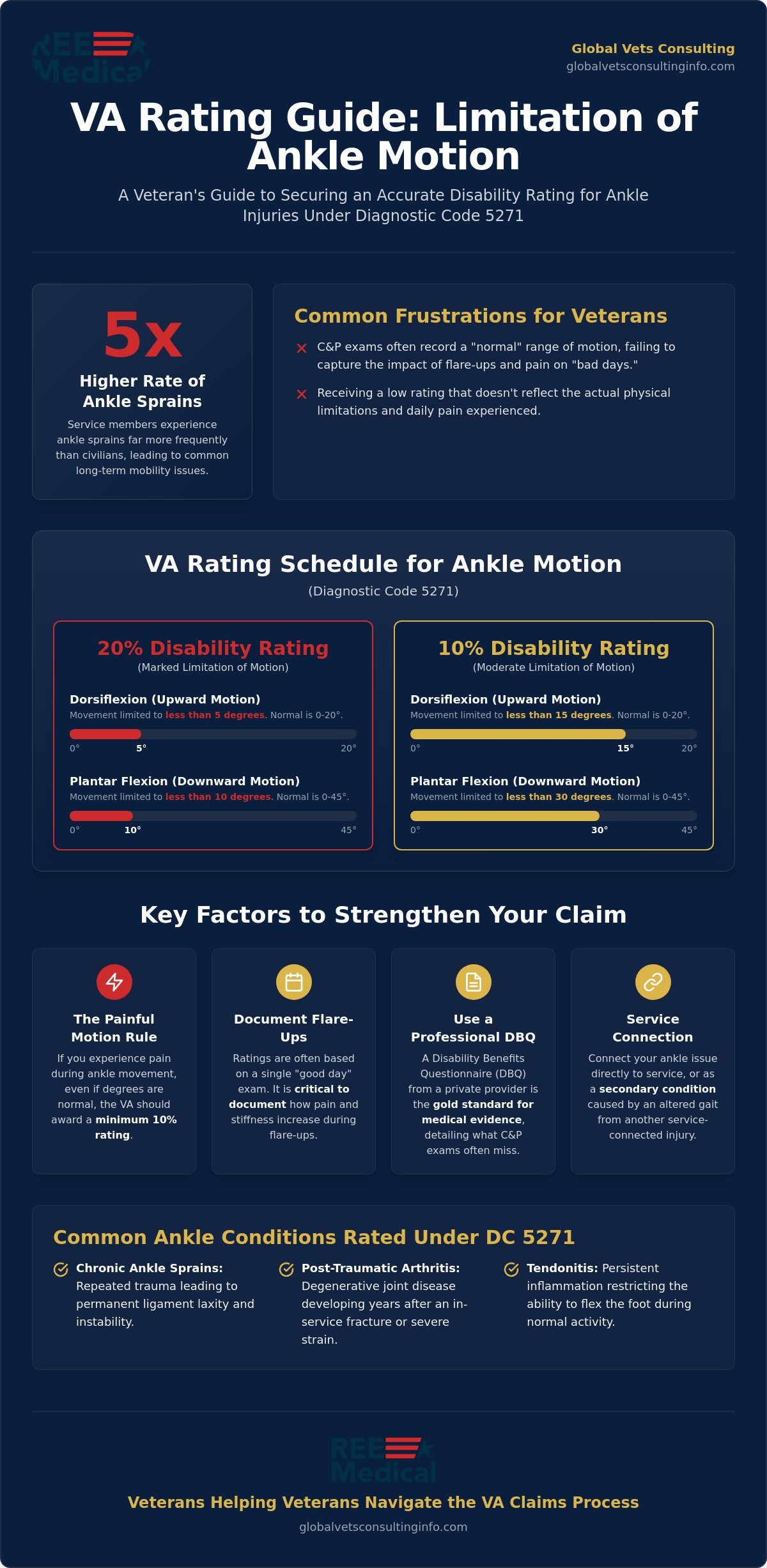
Did you know that service members experience ankle sprains at a rate five times higher than civilians? Despite this being such a common injury, securing an accurate va rating for limitation of motion of the ankle often feels like an uphill battle against a system that doesn’t see your daily struggle. You might walk into a C&P exam feeling stiff and unstable, yet the examiner records a “normal” range of motion because they didn’t catch you during a flare-up. It’s a common frustration to receive a low rating that doesn’t reflect your actual physical limitations or the pain you feel with every step.
You shouldn’t have to be a medical expert to understand how terms like “dorsiflexion” or “plantar flexion” affect your compensation. We’re here to help you master the specific VA rating criteria so you can document your functional loss with confidence. In this 2026 guide, we’ll break down the exact degrees of motion required for higher ratings, explain how a professional Disability Benefits Questionnaire (DBQ) serves as the gold standard for medical evidence, and provide a clear path to securing the rating you’ve earned through your service.
Key Takeaways
- Identify the specific degrees of dorsiflexion and plantar flexion required to qualify for 10% or 20% disability ratings under Diagnostic Code 5271.
- Learn how to apply the DeLuca criteria to document functional loss so your va rating for limitation of motion of the ankle accounts for weakness and fatigue.
- Differentiate between ankle ankylosis and limited motion to ensure your claim is filed under the most accurate and high-yielding diagnostic code.
- Master the use of a professional Disability Benefits Questionnaire (DBQ) as the gold standard for providing detailed medical evidence that standard exams often miss.
- Understand why documenting flare-ups is critical for moving beyond the static, “good day” measurements often recorded during standard C&P exams.
VA Rating Schedule for Ankle Limitation of Motion
The Department of Veterans Affairs utilizes Diagnostic Code (DC) 5271 to determine the va rating for limitation of motion of the ankle. This specific code evaluates the functional movement of the joint rather than just the presence of a diagnosis. It is vital to understand the difference between limited motion and ankylosis. While ankylosis involves a joint that is entirely frozen or fused, limitation of motion refers to a range of movement that is restricted but still exists. Distinguishing between these two is critical because they are rated under different codes with different percentage tiers.
Under the standards of 38 CFR Part 4, the VA prioritizes range of motion (ROM) measurements over subjective pain levels. During a C&P exam, a provider uses a goniometer to measure your degrees of movement. Gaining a basic understanding of Ankle joint anatomy can help you articulate exactly where your movement stops and where the pain begins. The VA looks for “marked” or “moderate” restriction to assign a percentage; therefore, precise documentation is essential. If your movement is limited by pain, the examiner must note the point at which that pain begins to interfere with your mobility.
Common Ankle Conditions Rated Under DC 5271
Many injuries sustained during service result in long-term mobility issues. Veterans often seek a va rating for limitation of motion of the ankle for several specific conditions that impact their daily lives:
- Chronic ankle sprains: Repeated trauma that leads to permanent ligament laxity and persistent instability.
- Post-traumatic arthritis: Degenerative joint disease that develops years after an initial in-service fracture or severe strain.
- Tendonitis: Persistent inflammation of the tendons that restricts the ability to push off or flex the foot during normal activity.
Direct vs. Secondary Service Connection
Establishing service connection is the foundation of your claim. Direct connection requires evidence of an event, injury, or disease in service that caused the current limitation. If your records don’t show a specific ankle injury, you might consider a secondary service connection. For example, a service-connected hip or knee condition can force you to change how you walk. This altered gait places undue stress on the ankle joint over time, leading to secondary physical impairment. Navigating these requirements is easier when you follow the VA disability claims process step by step to ensure every piece of medical evidence is in place for your filing.
Breaking Down Ankle ROM Percentages and VA Math
The VA uses specific measurements of movement to assign a va rating for limitation of motion of the ankle. These percentages are strictly governed by the VA’s Schedule of Ratings for the Musculoskeletal System. When you attend a C&P exam, the examiner isn’t just looking at whether it hurts; they are recording the exact degree where your joint stops functioning normally. This data directly translates into your disability percentage.
A 10% rating is typically awarded for moderate limitation of motion. According to the current schedule, this means you have less than 15 degrees of dorsiflexion or less than 30 degrees of plantar flexion. If your restriction is more severe, you may qualify for a 20% rating. This “marked” limitation is defined as having less than 5 degrees of dorsiflexion or less than 10 degrees of plantar flexion. These small differences in degrees can lead to significant differences in your monthly compensation.
Measuring Dorsiflexion and Plantar Flexion
Dorsiflexion refers to your ability to move your foot upward toward your shin. Plantar flexion is the opposite motion, similar to pushing down on a gas pedal. For a healthy veteran, the normal range of motion is 0 to 20 degrees for dorsiflexion and 0 to 45 degrees for plantar flexion. If your range is even one degree outside these windows, you should ensure it’s documented accurately.
The Role of Pain in Ankle Ratings
You don’t always need to meet the specific degree requirements to receive a rating. The “Painful Motion Rule” establishes that if you experience pain during movement, the VA should award a minimum 10% rating. This serves as a floor for your claim. Additionally, if you have been diagnosed with arthritis, Diagnostic Code 5003 may interact with your ROM ratings to provide a more accurate reflection of your condition.
It is also vital to understand how “VA Math” affects your total. The Amputation Rule states that a rating for a joint cannot exceed the rating for an actual amputation of that limb. Furthermore, your combined rating for the ankle and foot on a single leg is generally capped at 40%. This is a nuance many veterans miss when filing. If you’re struggling to understand how these caps impact your specific case, musculoskeletal claims education can help you navigate the complexities of the system.
Documenting Functional Loss and Flare-Ups
A single range of motion measurement taken during a brief C&P exam often fails to capture the true extent of your disability. If you’re having a “good day” when you see the examiner, the resulting va rating for limitation of motion of the ankle might be significantly lower than what you actually experience. The VA is legally required to consider functional loss under the DeLuca criteria. This means your rating shouldn’t just be a snapshot of one moment; it must account for factors like weakness, fatigability, and incoordination. If your ankle gives out after walking a block or becomes stiff after an hour of standing, that is functional loss that needs to be documented.
Examiners have a specific duty to “reasonably estimate” what your range of motion looks like during a flare-up. Since you likely won’t be at the clinic during your worst moments, you must be the primary source of that context. Explain how a flare-up restricts your ability to perform daily tasks or maintain steady employment. If you’re looking for guidance on how to present this evidence effectively, our C&P Examination Preparation Education can help you walk into your appointment with a clear strategy to communicate your reality.
Communicating with Your Examiner
One of the most important things to remember during your exam is the “Stop” rule. When the examiner asks you to move your ankle, stop the moment you feel pain or resistance. Don’t try to be a tough guy and push through it. If you move further than your pain-free limit, the examiner will record that as your functional range, which could lead to a lower rating. Be specific about the frequency and duration of your flare-ups. Tell them if a flare-up lasts for three days and leaves you unable to drive or walk without assistance.
The Power of Lay Statements
Medical records don’t always show the full picture of your life outside the clinic. This is where lay statements, often called “buddy letters,” become invaluable. A spouse, friend, or coworker can describe visible limitations, such as seeing your ankle swell after a shift or watching you struggle with stairs. Your own personal statement should bridge the gap between clinical measurements and your daily reality. This ensures the rater understands the total impact of your injury, which is essential for an accurate va rating for limitation of motion of the ankle.
Securing Your Rating with a Professional DBQ
A Disability Benefits Questionnaire (DBQ) is a standardized form created by the VA to ensure that medical evidence is captured in a way that aligns with their rating criteria. For ankle conditions, this document specifically records measurements like dorsiflexion, plantar flexion, and the presence of instability or pain. While the VA frequently uses its own C&P exams, a private DBQ offers a major advantage. It allows you to work with a medical professional who can spend the time necessary to document your history of flare-ups and functional loss in exhaustive detail. Learning What is a DBQ? is the first step toward building a claim that stands up to VA scrutiny.
The primary benefit of a private DBQ is the level of specificity it provides. Standard C&P exams are often rushed, and examiners may miss the nuances of how your injury impacts your gait or causes secondary pain in your knees or back. A doctor who understands veteran-specific musculoskeletal issues knows how to translate your daily physical limitations into the technical language the VA requires. This ensures your va rating for limitation of motion of the ankle is based on a complete medical picture rather than a brief, five-minute observation.
Why Accurate Documentation Prevents Denials
Many veterans find themselves stuck because their VA claim denied for lack of evidence. This often happens when medical records are vague or fail to mention the specific range of motion degrees found in the VA’s diagnostic codes. A professional DBQ solves this problem by clearly mapping your symptoms to the requirements of Diagnostic Code 5271. It provides the objective data points that raters need to approve a va rating increase without questioning the severity of your physical impairment.
Global Vets Consulting: Your Partner in Evidence Preparation
We operate with a mission-driven focus to simplify the bureaucratic system for those who served. Global Vets Consulting provides the education and resources you need to secure a rating that truly reflects your level of disability. We offer a clear, predictable path forward through expert evidence preparation. 🇺🇸
- Expert Education: Step-by-step musculoskeletal claims education to help you understand your rating potential.
- 24/7 Support: Access our AI Veteran Intake Specialist anytime for immediate guidance on your intake process.
- Direct Connection: 📞 Call our National Client Services Hotline to start your DBQ preparation education today.
Visit us at GlobalVetsConsultingInfo.com to join a partnership that values your well-being and respects your history of service.
Take Control of Your Ankle Disability Claim
Mastering the specific degrees of movement and the impact of flare-ups is the only way to move past a low rating. You now understand how the VA uses Diagnostic Code 5271 and why your “worst day” must be the standard for your medical evidence. By focusing on functional loss rather than just a snapshot of pain, you’re positioning yourself for a successful va rating for limitation of motion of the ankle. Proper documentation is the difference between a denied claim and the compensation you deserve.
Securing the medical evidence you need shouldn’t be a solo mission. Global Vets Consulting is a veteran-owned and operated firm dedicated to providing standardized DBQ education that bridges the gap between your injury and a fair rating. We’re here to ensure your service is respected and your physical limitations are accurately documented. You can secure the medical evidence you need with Global Vets Consulting right now. Our 24/7 National Client Services Hotline is always available to help you start the process of evidence preparation. You’ve earned these benefits through your service; don’t let a confusing system stand in your way. We’re ready to help you move forward with confidence.
Frequently Asked Questions
What is the highest VA disability rating for an ankle condition?
The highest schedular disability rating for a single ankle condition is typically 40% for severe ankylosis, which is a total fusion of the joint in an unfavorable position. If you are filing specifically for a va rating for limitation of motion of the ankle under Diagnostic Code 5271, the maximum rating is 20%. It’s important to note that ankle replacement surgery provides a temporary 100% rating for one year before the VA re-evaluates the joint based on residual symptoms.
Can I get a separate rating for ankle pain and limited motion?
No, you cannot receive two separate ratings for pain and limited motion in the same ankle joint. The VA has strict rules against “pyramiding,” which is the practice of rating the same symptom or functional loss under multiple codes. Your rating will be based on whichever diagnostic code provides the highest evaluation for your symptoms, whether that is through range of motion measurements or the presence of painful motion.
How do I prove my ankle condition is service-connected?
Proving service connection requires three specific elements often called the “Caluza Triangle.” You must have a current medical diagnosis, evidence of an injury or event that occurred during your military service, and a medical nexus linking the two. Seeking an evaluation from specialists like Local Foot Doc can help satisfy the diagnosis requirement, and providing a professional Disability Benefits Questionnaire (DBQ) remains the most effective way to establish this link and secure your va rating for limitation of motion of the ankle.
What happens if my ankle range of motion is normal but it still hurts?
If your range of motion is technically normal but movement causes pain, you should qualify for a minimum 10% rating under the Painful Motion Rule. 38 CFR 4.59 states that the VA must recognize pain as a functional limitation. You should clearly communicate to your C&P examiner exactly when pain begins during the exam. This ensures they record the pain as a functional loss even if you are physically capable of moving the joint through a full range.
Does the VA rate both ankles separately or combine them?
The VA evaluates each ankle as an individual disability and then combines the ratings using their standard “VA math” formula. If both of your ankles are service-connected, you are also entitled to the “bilateral factor.” This regulation adds an extra 10% to the combined rating of your bilateral disabilities to account for the increased level of impairment caused by having both lower limbs affected. This can often result in a higher overall combined rating for the veteran.

Article by
Willie Daniel
Willie Daniel is the Founder and Chief Executive Officer (CEO) of Global Vets Consulting (GVC) – National Veterans Disability Services, a veteran-led educational and medical evidence support organization dedicated to helping veterans better understand VA disability rating increases, DBQ medical evidence, secondary claims education, and C&P examination preparation.
He is a retired U.S. Army Medical Service Corps Officer with more than 27 years of honorable military service, a decorated Iraq combat veteran, and a retired federal official with the U.S. Department of Veterans Affairs. Throughout his military and federal career, Willie Daniel served in leadership, healthcare administration, operational, and veteran-support roles focused on improving services and support systems for servicemembers, veterans, and their families.
Drawing from decades of military leadership, healthcare administration, veteran advocacy, and federal government experience, Willie Daniel brings a practical, veteran-centered perspective to Global Vets Consulting’s educational articles, AI-powered veteran resources, video education initiatives, and outreach programs. His experience navigating military systems, medical documentation processes, and veteran-related administrative operations provides valuable insight into many of the challenges veterans face when seeking to better understand VA disability rating criteria, medical evidence, documentation strategies, and secondary condition education.
Through GVC’s “Veterans Helping Veterans” mission, his focus is on delivering clear, educational, and easy-to-understand information designed to empower veterans with knowledge, resources, and educational tools that may help them make more informed decisions regarding their individual VA disability journeys.
The information provided through GVC is intended for educational and informational purposes only and should not be considered legal or medical advice.
Disclaimer
Disclaimer: Global Vets Consulting, LLC (“GVC”) is a veteran-led educational and medical evidence support organization. GVC is not a law firm, is not a Veterans Service Organization (VSO), and is not affiliated with the U.S. Department of Veterans Affairs (VA) or any government agency.
Global Vets Consulting does not provide legal advice, medical advice, medical treatment, or healthcare services. GVC does not prepare, file, or submit VA disability claims on behalf of veterans. All information provided through this website, blog articles, videos, educational materials, AI tools, dashboards, templates, and communications is intended solely for general educational and informational purposes.
Veterans are encouraged to consult with accredited representatives, licensed attorneys, qualified medical providers, or Veterans Service Organizations regarding their specific legal, medical, or VA-related matters. VA disability decisions, ratings, and outcomes are determined solely by the U.S. Department of Veterans Affairs based on applicable laws, regulations, medical evidence, and individual circumstances. Past results do not guarantee future outcomes.