
What if the key to winning your VA claim didn’t involve another stressful trip to a doctor’s office? Many veterans feel exhausted by the cycle of repetitive medical evaluations, especially when their service records already contain the necessary proof. If you’re asking what is a va nexus letter without an exam, you’re likely searching for a way to let your existing medical history speak for itself. We understand the anxiety that comes with being poked and prodded for conditions that are already well-documented in your files.
This guide will show you how a records-based Independent Medical Opinion (IMO) can establish a rock-solid service connection for your disability without requiring a new physical examination. By focusing on the “at least as likely as not” evidentiary standard required in 2026, you can leverage your medical history to bridge the gap between your service and your current diagnosis. We’ll walk through the specific requirements for these documents, explain how they differ from a standard DBQ, and help you determine if your claim is a candidate for a records-only review that saves you time and stress.
Key Takeaways
- Understand how an Independent Medical Opinion (IMO) serves as a professional records review of your C-File to establish a clear service connection.
- Discover what is a va nexus letter without an exam and how it uses existing medical evidence to satisfy the VA’s “at least as likely as not” standard.
- Learn how to successfully link secondary conditions to your primary service-connected disabilities using a documented medical trail rather than new physical tests.
- Identify why pairing a records-based nexus letter with a Disability Benefits Questionnaire (DBQ) creates a comprehensive evidence package for your rating increase.
- Gain the confidence to navigate the claims process by prioritizing thorough documentation over redundant and stressful physical examinations.
What is a VA Nexus Letter Without an Exam? The IMO Explained
Many veterans are surprised to learn they don’t always need to sit on an exam table to prove their disability. If you’re asking what is a va nexus letter without an exam, you’re looking at a specific type of medical evidence known as an Independent Medical Opinion (IMO). This document is a professional synthesis of your existing medical evidence rather than a new clinical diagnosis.
Instead of a physical checkup, a qualified physician performs a comprehensive review of your C-File, private treatment records, and military service history. The goal is to establish a “nexus,” or a clear link, between your current condition and your time in uniform. This approach is essential for those seeking Veterans’ benefits because it relies on the strength of your established paper trail to prove service connection.
Records Review vs. Physical Examination
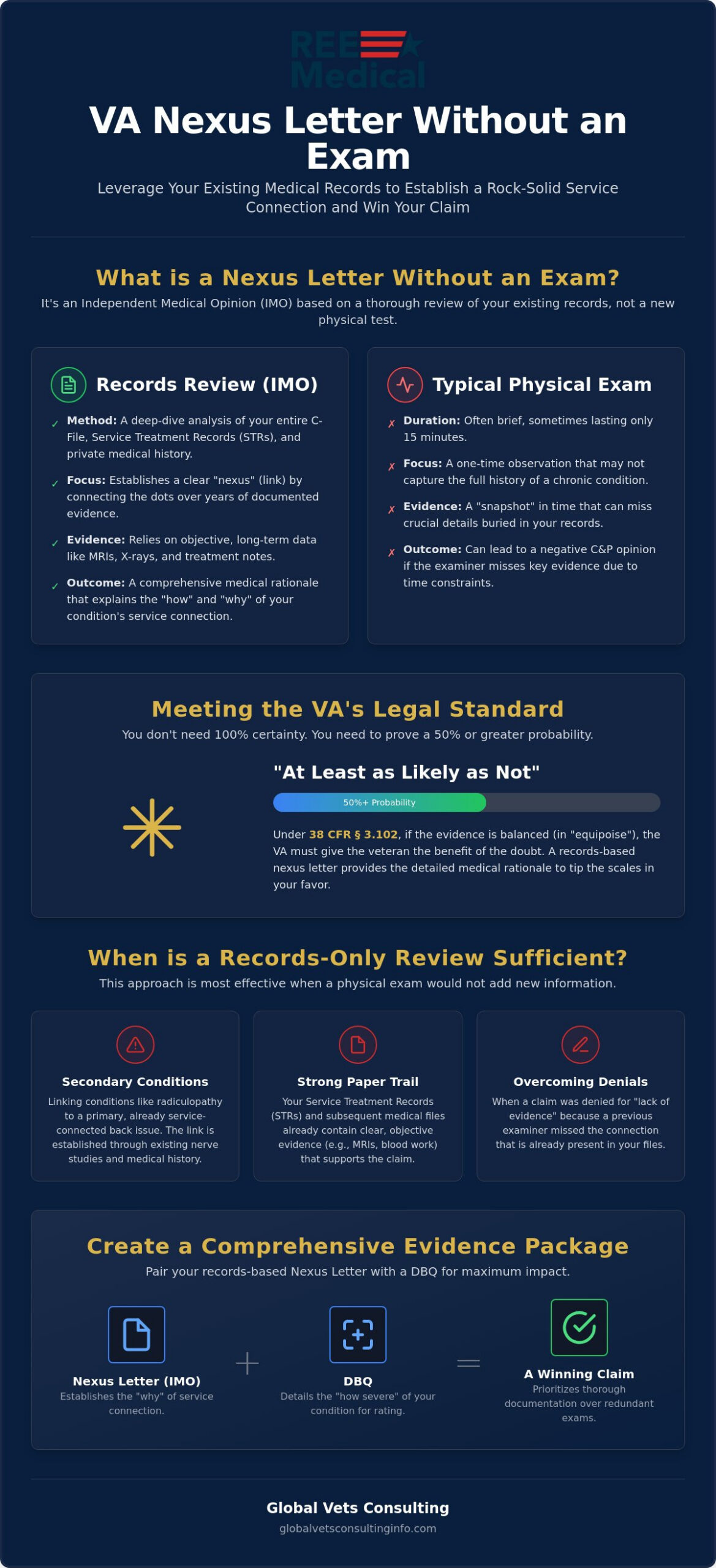
A physical exam often lasts only 15 minutes. That’s rarely enough time to capture the full history of a chronic condition or its progression over years. In contrast, existing diagnostics like MRIs, X-rays, and blood work provide objective, long-term data that carries significant weight in a VA disability claim. A records-based review allows a doctor to connect the dots across years of treatment records that a brief physical exam might miss.
The VA recognizes this efficiency through the Acceptable Clinical Evidence (ACE) process. This modern claims processing method allows examiners to complete a medical opinion based solely on the records in your file. When you understand what is a va nexus letter without an exam, you see it’s about accuracy and thoroughness. A physician uses your military service records to bridge the gap between your service-connected events and your current health status. This methodical approach ensures your claim is backed by a thorough medical rationale rather than a brief, one-time observation.
The Medical Standard: ‘At Least as Likely as Not’
To win a disability claim, you don’t have to prove 100% certainty that your condition began in service. The VA operates on a legal threshold known as “at least as likely as not.” This signifies a 50% or greater probability that your disability is connected to your military service. Under 38 CFR § 3.102, if the evidence for and against your claim is in “equipoise,” or balanced at 50/50, the veteran must receive the benefit of the doubt.
Understanding what is a va nexus letter without an exam helps you meet this specific legal bar. A records-based review is often more effective than a physical exam because it allows the physician to cite specific medical literature and peer-reviewed studies. This scientific backing provides the medical rationale the VA requires. It directly supports the Evidence Needed For Your Disability Claim by providing competent medical evidence that connects your current health to your service history through logical, data-driven arguments.
This standard is especially vital when a VA claim is denied for lack of evidence. Many denials happen because an initial examiner failed to find a clear link. A detailed nexus letter can fill that gap by explaining the medical “how” and “why” through a deep dive into your history that a 15-minute exam simply cannot replicate.
Why the Physician’s Rationale is King
A strong nexus letter doesn’t just state a conclusion; it builds a bridge using your Service Treatment Records (STRs). If a C&P examiner missed a key entry during a rushed appointment, a thorough records review can highlight that oversight and bring it to the VA’s attention. This methodical approach can overcome a negative C&P opinion by providing a more comprehensive analysis of your total medical history. If you’re ready to strengthen your documentation, exploring Independent Medical Evidence Education can provide the clarity you need to move forward with confidence.
When is a Nexus Letter Without an Exam Sufficient?
A records-based review is sufficient in several specific scenarios where a physical exam wouldn’t add new value. This is particularly true for secondary conditions where the primary disability is already service-connected. For instance, linking radiculopathy secondary to back condition often relies on nerve studies and imaging rather than a simple range-of-motion test. If you’re wondering what is a va nexus letter without an exam, it’s essentially the medical expert’s bridge between two documented conditions.
Presumptive conditions also benefit from this approach. While the VA assumes service connection for certain locations or eras, a professional opinion can clarify the onset or severity to ensure you get the correct rating. Similarly, aggravation claims use a detailed record comparison to prove that military service worsened a pre-existing condition. If your private medical history spans years, a new 15-minute exam is often redundant and less accurate than a comprehensive file review. Understanding what is a va nexus letter without an exam helps you identify if your specific claim qualifies for a records-only review.
Secondary Service Connection Case Studies
A records review is highly effective for complex secondary links. Physicians can use established medical literature to connect sleep apnea to service-connected PTSD or obesity. Another common scenario involves connecting GERD or digestive issues to the long-term use of NSAIDs for service-connected joint pain. In these cases, the paper trail of prescriptions and symptoms is far more persuasive than a physical observation.
The VA’s Acceptable Clinical Evidence (ACE) logic allows examiners to skip the physical appointment if the records are complete. This is a specific VA protocol designed to streamline claims when the medical file contains enough data to make a decision. By providing a high-quality IMO, you’re giving the VA the exact evidence they need to apply this logic to your file. If you need help understanding these connections, our Secondary VA Claims Education resources can guide you through the process.
Strengthening Your Claim: Combining Nexus Letters and DBQs
To secure the benefits you’ve earned, you need a strategy that covers both service connection and disability severity. While understanding what is a va nexus letter without an exam is the first step in proving the “why” behind your condition, the Disability Benefits Questionnaire (DBQ) proves the “how bad.” When you combine these two documents, you provide the VA with a complete medical narrative that leaves little room for interpretation. This partnership between a link and a severity report creates a much stronger foundation for your claim.
Submitting a professional DBQ alongside a records-only nexus letter creates a “bulletproof” evidence package. This approach ensures the rater has clear, clinical evidence of your symptoms and a logical medical link to your service events. For more details on this documentation, see the veteran’s guide to disability benefits questionnaires. Global Vets Consulting focuses on streamlining the educational process so you can navigate these requirements with confidence and clarity.
The Fully Developed Claim (FDC) Advantage
Providing your own medical evidence allows you to submit a Fully Developed Claim (FDC). This can significantly bypass the lengthy “evidence gathering” phase where many claims stall for months. By being proactive, you also reduce the risk of a “duty to assist” error. These errors often occur when the VA fails to identify the full scope of your condition during a standard review. With approximately 67% to 70% of claims facing initial denial, having a complete file is your best defense against a loss of benefits.
A denial for a 100% disability rating in 2026 results in a loss of $3,938.58 in monthly tax-free compensation. Don’t let a missing link or a vague exam result stand in your way. Understanding what is a va nexus letter without an exam gives you the tools to present a medically sound case from the start. This strategy puts the control back in your hands. 🇺🇸
Take control of your claim today. Contact Global Vets Consulting for expert education on DBQ preparation and medical evidence resources. Our 24/7 National Client Services Hotline is available to help you find the right path forward. 📞
Secure Your Earned Benefits with Precise Documentation
Proving service connection doesn’t have to mean enduring another redundant medical appointment. By understanding what is a va nexus letter without an exam, you can use your existing medical history and the “at least as likely as not” standard to bridge the gap between your service and your current diagnosis. A records-based review provides the scientific rationale the VA needs while respecting your time and health history. This approach ensures your claim is backed by objective facts rather than a rushed 15-minute observation.
Combining this professional medical opinion with a detailed DBQ gives the VA a complete picture of your condition and its severity. This proactive strategy minimizes the risk of common claim denials and helps you bypass lengthy evidence-gathering delays. We’re a veteran-owned and operated team with a national presence, and we’re dedicated to helping our brothers and sisters in arms navigate these complex systems with confidence. 🇺🇸
Our 24/7 AI Veteran Intake Specialist is available right now to help you start your journey toward a more accurate rating. You served your country with honor; now it’s time to ensure your benefits reflect that dedication. We’re here to guide you every step of the way.
📞 Get Expert Education on Your VA Documentation Today
Frequently Asked Questions
Can the VA ignore a nexus letter if the doctor didn’t perform an exam?
The VA cannot legally ignore a medical opinion simply because a physical examination did not occur. According to the VA’s own Acceptable Clinical Evidence (ACE) protocols, a physician can provide a valid opinion based solely on a review of your medical records. The key is ensuring the doctor explicitly states they have reviewed your complete C-file and medical history. This thorough review often carries more weight than a rushed physical exam because it covers your entire history.
Is an Independent Medical Opinion (IMO) the same as a nexus letter?
In most contexts, an Independent Medical Opinion (IMO) is the professional term for what veterans commonly call a nexus letter. While a nexus letter specifically focuses on the “link” to service, the IMO is the formal document provided by a non-VA physician to establish that connection. When you ask what is a va nexus letter without an exam, you are essentially looking for a records-based IMO. Both documents serve to satisfy the VA’s evidentiary requirements.
What should I do if my C&P examiner contradicts my records-only nexus letter?
If a C&P examiner provides a negative opinion that contradicts your nexus letter, the VA must weigh both pieces of evidence. This often triggers the “benefit of the doubt” rule if the evidence is in equipoise, meaning both sides are equally persuasive. You can challenge a negative C&P by highlighting specific medical records or peer-reviewed literature in your nexus letter that the examiner may have overlooked during their brief, often 15-minute evaluation.
How much does a private nexus letter cost for a VA claim in 2026?
Costs for private medical opinions vary significantly across the industry based on the complexity of your medical history and the number of conditions being reviewed. Many private providers in the 2026 market charge separate fees for the initial record review and the actual drafting of the letter. It is best to research multiple providers to find a service that offers a transparent process and a thorough review of your military service records to ensure accuracy.
Do I still need a DBQ if I have a strong nexus letter?
You generally still need a Disability Benefits Questionnaire (DBQ) even with a solid nexus letter because they serve two different purposes. While your nexus letter proves that your condition is “at least as likely as not” related to your service, the DBQ tells the VA how severe your symptoms are. Having both documents ensures that you not only establish a service connection but also receive the correct disability rating based on your current level of functional impairment.

Article by
Willie Daniel
Willie Daniel is the Founder and Chief Executive Officer (CEO) of Global Vets Consulting (GVC) – National Veterans Disability Services, a veteran-led educational and medical evidence support organization dedicated to helping veterans better understand VA disability rating increases, DBQ medical evidence, secondary claims education, and C&P examination preparation.
He is a retired U.S. Army Medical Service Corps Officer with more than 27 years of honorable military service, a decorated Iraq combat veteran, and a retired federal official with the U.S. Department of Veterans Affairs. Throughout his military and federal career, Willie Daniel served in leadership, healthcare administration, operational, and veteran-support roles focused on improving services and support systems for servicemembers, veterans, and their families.
Drawing from decades of military leadership, healthcare administration, veteran advocacy, and federal government experience, Willie Daniel brings a practical, veteran-centered perspective to Global Vets Consulting’s educational articles, AI-powered veteran resources, video education initiatives, and outreach programs. His experience navigating military systems, medical documentation processes, and veteran-related administrative operations provides valuable insight into many of the challenges veterans face when seeking to better understand VA disability rating criteria, medical evidence, documentation strategies, and secondary condition education.
Through GVC’s “Veterans Helping Veterans” mission, his focus is on delivering clear, educational, and easy-to-understand information designed to empower veterans with knowledge, resources, and educational tools that may help them make more informed decisions regarding their individual VA disability journeys.
The information provided through GVC is intended for educational and informational purposes only and should not be considered legal or medical advice.
Disclaimer
Disclaimer: Global Vets Consulting, LLC (“GVC”) is a veteran-led educational and medical evidence support organization. GVC is not a law firm, is not a Veterans Service Organization (VSO), and is not affiliated with the U.S. Department of Veterans Affairs (VA) or any government agency.
Global Vets Consulting does not provide legal advice, medical advice, medical treatment, or healthcare services. GVC does not prepare, file, or submit VA disability claims on behalf of veterans. All information provided through this website, blog articles, videos, educational materials, AI tools, dashboards, templates, and communications is intended solely for general educational and informational purposes.
Veterans are encouraged to consult with accredited representatives, licensed attorneys, qualified medical providers, or Veterans Service Organizations regarding their specific legal, medical, or VA-related matters. VA disability decisions, ratings, and outcomes are determined solely by the U.S. Department of Veterans Affairs based on applicable laws, regulations, medical evidence, and individual circumstances. Past results do not guarantee future outcomes.