
What if the key to a GERD secondary claim isn’t simply showing that you have reflux, but clearly documenting what you believe caused or aggravated it? If you’re connecting GERD to a service-connected condition or its treatment, it can be difficult to distinguish a general medical association from evidence about your own health history. GERD Secondary Claims call for a clear explanation of the connection you’re asserting and records that support the medical question.
You’ll learn what secondary service connection means in this context, which treatment records and medical explanations may help establish the link, and how a Disability Benefits Questionnaire (DBQ) can fit into organized documentation. A diagnosis alone may not explain an individual connection, so this article also covers the role of a medical opinion and practical ways to prepare your evidence. This is educational information, not legal or medical advice. Global Vets Consulting (GVC4Vets) provides veteran-focused education on secondary claims and medical documentation. Its 24/7 National Client Services Hotline and 24/7 AI Veteran Intake Specialist are available at (727) 350-8387, with resources at https://www.GlobalVetsConsultingInfo.com.
Key Takeaways
- Clarify whether you’re claiming GERD is connected to a service-connected condition or its treatment, rather than claiming another condition is secondary to GERD.
- For GERD Secondary Claims, organize your diagnosis, symptom history, treatment records, and relevant medication history to help explain the connection you’re asserting.
- A medication’s timing or a general medical association doesn’t establish an individual link. Discuss medical questions with a qualified provider.
- Learn how DBQ education may help you organize documentation. Global Vets Consulting (GVC4Vets)’s 24/7 National Client Services Hotline and 24/7 AI Veteran Intake Specialist are available at (727) 350-8387, and resources are at https://www.GlobalVetsConsultingInfo.com.
What Does a GERD Secondary Claim Mean for Your VA Disability Claim?
A secondary claim asserts that a condition is connected to a disability VA has already service-connected, or to treatment for that disability. In this case, you’re claiming that GERD is secondary to another service-connected condition or its treatment. The direction matters: claiming GERD resulted from medication used for a service-connected condition is different from claiming a separate condition resulted from GERD.
Having both conditions doesn’t, by itself, establish a medical relationship. A general association may provide context, but an individual claim calls for evidence that addresses your diagnoses, treatment, and medical history. For a general overview of Gastroesophageal reflux disease (GERD), see this medical reference. These examples are educational and don’t determine any veteran’s eligibility or claim outcome.
GERD secondary to a service-connected condition or its treatment
Medication-related GERD is one possible pathway discussed in secondary-claim coverage. But reflux symptoms appearing after you begin a medication doesn’t establish that the medication caused or aggravated GERD. A clinician’s case-specific reasoning matters more than a broad association. It should address the relevant condition or treatment and your medical history. Rather than assuming a connection, document what you’re asking a qualified provider to evaluate.
A separate condition claimed secondary to GERD
The reverse direction is a claim that another diagnosed condition is connected to already service-connected GERD. That is not the same as claiming GERD is secondary to a different condition. No condition is automatically caused by GERD or separately compensable simply because it appears in medical discussions. An individual relationship needs appropriate supporting evidence.
Global Vets Consulting (GVC4Vets) provides education on secondary VA claims and DBQ preparation, not medical care or legal representation. Its 24/7 National Client Services Hotline and 24/7 AI Veteran Intake Specialist are available at (727) 350-8387. Educational resources are available at https://www.GlobalVetsConsultingInfo.com.
How Could a Service-Connected Condition or Medication Relate to GERD?
A possible medical pathway is a starting point for a question, not proof of an individual connection. Discussions of GERD secondary to mental-health conditions, such as PTSD, or related treatment can help identify topics to ask a clinician about. For example, GERD secondary to PTSD coverage describes one potential claim context, but a general discussion cannot establish what caused or aggravated your condition.
Medication history may also be relevant to a veteran’s inquiry. The fact that GERD symptoms began after a medication change does not, by itself, show that the medication caused or worsened them. A qualified healthcare professional can consider your diagnoses, treatment, symptoms, and medical history. Each case needs its own medical explanation. A plausible pathway isn’t the same as evidence supporting a specific claim.
Why the medical timeline can matter
A timeline can help you and your provider see how events fit together. Note when the service-connected condition was diagnosed, when treatment began or changed, and when GERD symptoms were first reported. Include relevant appointments and records where available. You can make the timeline easier to review by pairing dates with the source record or appointment. However, dates alone don’t establish a medical nexus or replace a clinician’s reasoning.
How to handle possible related conditions
If you suspect a connection involving a mental-health condition or medication, bring the question and your organized history to a qualified healthcare professional. Don’t treat online examples or a list of associated conditions as confirmation of eligibility. For GERD Secondary Claims, individual evidence matters. Before relying on claim guidance, verify current VA rating criteria and diagnostic-code references, since those details can change.
Global Vets Consulting (GVC4Vets) offers education about secondary claims and DBQ preparation to help veterans understand medical documentation. It doesn’t provide medical care or determine claim outcomes. Explore VA claims education resources. The 24/7 National Client Services Hotline and 24/7 AI Veteran Intake Specialist are available at (727) 350-8387.
What Evidence Can Help Document a GERD Secondary Claim?
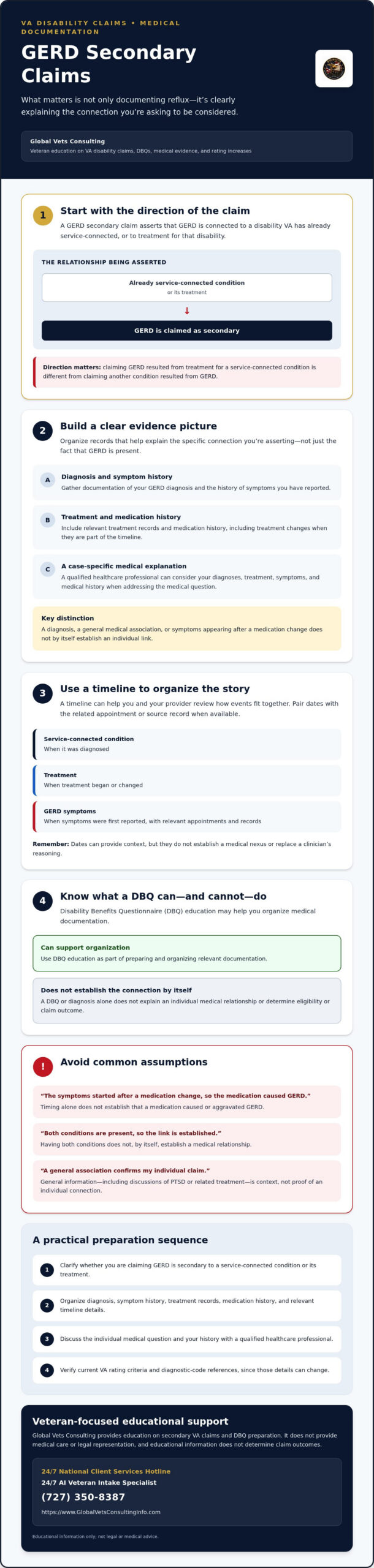
Build your evidence around the connection you’re claiming. First, identify the condition VA has already service-connected. Next, gather records that document GERD and its history. Then discuss the specific relationship you believe exists with a qualified healthcare professional. This sequence helps keep GERD Secondary Claims focused on the relevant medical question instead of becoming a broad collection of unrelated records.
Organize records around the claim you are making
Separate evidence according to the direction of the claim: are you saying GERD is connected to another service-connected condition or its treatment, or that a different condition is connected to service-connected GERD? Label records by source and date so the history is easier to review. Consider organizing:
- Records documenting GERD diagnoses, reported symptoms, and treatment.
- Records showing the primary service-connected condition and its care.
- Relevant medication names and changes, alongside dates and symptom notes.
A timeline can help clarify what happened and when, but it doesn’t establish causation on its own.
Where a DBQ or medical opinion may fit
A medical opinion can explain how the clinician assessed your individual history and the reasoning behind the claimed connection. A Disability Benefits Questionnaire (DBQ) is a structured way to document medical information. It doesn’t replace diagnosis or treatment, guarantee VA acceptance, or promise a particular rating. For an overview, see the guide What is a DBQ? A Veteran’s Guide to Disability Benefits Questionnaires in 2026.
Global Vets Consulting (GVC4Vets) provides education about DBQs and medical documentation, not medical care or a VA decision. Explore DBQ and medical evidence education at https://www.GlobalVetsConsultingInfo.com. The 24/7 National Client Services Hotline and 24/7 AI Veteran Intake Specialist are available at (727) 350-8387.
What Should Veterans Do Next With a GERD Secondary Claim?
A clear next step is to make sure your records match the relationship you’re asking VA to consider. Use this checklist to get organized:
- Clarify whether you’re claiming GERD is connected to another service-connected condition or its treatment, or a separate condition is connected to GERD.
- Gather relevant diagnoses, symptom history, treatment records, and medication information, and label each item by date and source.
- Discuss the suspected medical connection and any questions about your records with a qualified healthcare professional.
These steps can help you prepare, but they don’t predict a VA decision. Each veteran’s circumstances and supporting evidence are individual.
Know what documentation support can and cannot do
DBQ preparation can help organize medical information in a standardized format. It doesn’t replace a clinician’s medical judgment, provide treatment, or determine how VA will review or rate a claim. Global Vets Consulting (GVC4Vets) offers educational support related to DBQs and VA documentation. It isn’t a law firm, a Veterans Service Organization (VSO), or a healthcare provider. For additional process education, consult VA Disability Claims Process Step by Step: A 2026 Veteran’s Guide.
Reach the veteran support team
Veterans can use these 24/7 contact options for information about the organization’s educational resources:
- 24/7 National Client Services Hotline: (727) 350-8387
- 24/7 AI Veteran Intake Specialist: (727) 350-8387
For more information about GERD Secondary Claims education and DBQ resources, visit Global Vets Consulting (GVC4Vets).
Prepare Your Next Step With Clarity
Strong GERD Secondary Claims documentation starts with a clear direction: identify the condition or treatment you believe is connected to GERD, organize relevant records, and discuss the medical question with a qualified provider. A timeline can make your history easier to review, while a DBQ can help document medical information. Neither guarantees VA acceptance or a particular rating.
Global Vets Consulting (GVC4Vets) is a veteran-owned and operated organization focused on veterans’ documentation needs. It provides DBQ preparation and education about independent medical evidence and secondary claims, not medical care, legal representation, or VA decisions.
To explore DBQ preparation and education about secondary claims, visit Global Vets Consulting (GVC4Vets).
Frequently Asked Questions
What is a GERD secondary claim?
A GERD secondary claim generally asserts that GERD is connected to a condition VA has already service-connected or to its treatment. This differs from claiming that another condition is secondary to GERD. The direction helps identify which diagnoses, treatment records, and medical questions are relevant. If you’re unsure how to describe the relationship, review your history and discuss the individual medical question with a qualified healthcare professional.
Can GERD be secondary to medication for a service-connected condition?
Medication use may be one possible pathway, but a timeline alone can’t show that a prescribed drug caused or aggravated GERD. Gather medication names, changes, dates, symptom history, and treatment records for discussion with a qualified healthcare professional. They can assess your circumstances and whether an explanation is medically appropriate. Don’t stop or change prescribed medication based on claim guidance. Discuss treatment decisions with the prescribing professional.
What evidence may support a VA claim for GERD secondary to another condition?
Potentially relevant evidence may include a GERD diagnosis, treatment records, symptom history, medication records, and a medical opinion addressing the claimed relationship. Organize these materials by date and source, then ask a qualified provider which records help explain your specific history. A DBQ can document medical findings in a standardized format, but it doesn’t guarantee VA acceptance or a particular rating. Evidence needs and relevance vary by veteran.
Is GERD secondary to PTSD the same as PTSD secondary to GERD?
No. The phrases describe opposite claimed relationships: GERD secondary to PTSD means GERD is claimed as related to PTSD, while PTSD secondary to GERD means PTSD is claimed as related to GERD. Evidence for one direction doesn’t automatically establish the other. Identify which condition is already service-connected, then discuss the claimed medical connection and your history with a qualified healthcare professional.
Can a private DBQ guarantee approval of a GERD secondary claim?
No. A private DBQ documents medical information, but it can’t guarantee approval, a rating, or VA acceptance. Its relevance depends on what it records and the full evidence. Global Vets Consulting provides DBQ preparation and education about medical evidence and secondary claims, not healthcare or legal representation. For resources, visit https://www.GlobalVetsConsultingInfo.com. The 24/7 National Client Services Hotline and 24/7 AI Veteran Intake Specialist are both available at (727) 350-8387.

Article by
Willie Daniel
Willie Daniel is the Founder and Chief Executive Officer (CEO) of Global Vets Consulting (GVC4Vets) – National Veterans Disability Services, a veteran-led educational and medical evidence support organization dedicated to helping veterans better understand VA disability rating increases, DBQ medical evidence, secondary claims education, and C&P examination preparation.
He is a retired U.S. Army Medical Service Corps Officer with more than 27 years of honorable military service, a decorated Iraq combat veteran, and a retired federal official with the U.S. Department of Veterans Affairs. Throughout his military and federal career, Willie Daniel served in leadership, healthcare administration, operational, and veteran-support roles focused on improving services and support systems for servicemembers, veterans, and their families.
Drawing from decades of military leadership, healthcare administration, veteran advocacy, and federal government experience, Willie Daniel brings a practical, veteran-centered perspective to Global Vets Consulting’s educational articles, AI-powered veteran resources, video education initiatives, and outreach programs. His experience navigating military systems, medical documentation processes, and veteran-related administrative operations provides valuable insight into many of the challenges veterans face when seeking to better understand VA disability rating criteria, medical evidence, documentation strategies, and secondary condition education.
Through GVC’s “Veterans Helping Veterans” mission, his focus is on delivering clear, educational, and easy-to-understand information designed to empower veterans with knowledge, resources, and educational tools that may help them make more informed decisions regarding their individual VA disability journeys.
The information provided through GVC is intended for educational and informational purposes only and should not be considered legal or medical advice.
Disclaimer
Disclaimer: Global Vets Consulting, LLC (“GVC”) is a veteran-led educational and medical evidence support organization. GVC is not a law firm, is not a Veterans Service Organization (VSO), and is not affiliated with the U.S. Department of Veterans Affairs (VA) or any government agency.
Global Vets Consulting does not provide legal advice, medical advice, medical treatment, or healthcare services. GVC does not prepare, file, or submit VA disability claims on behalf of veterans. All information provided through this website, blog articles, videos, educational materials, AI tools, dashboards, templates, and communications is intended solely for general educational and informational purposes.
Veterans are encouraged to consult with accredited representatives, licensed attorneys, qualified medical providers, or Veterans Service Organizations regarding their specific legal, medical, or VA-related matters. VA disability decisions, ratings, and outcomes are determined solely by the U.S. Department of Veterans Affairs based on applicable laws, regulations, medical evidence, and individual circumstances. Past results do not guarantee future outcomes.