
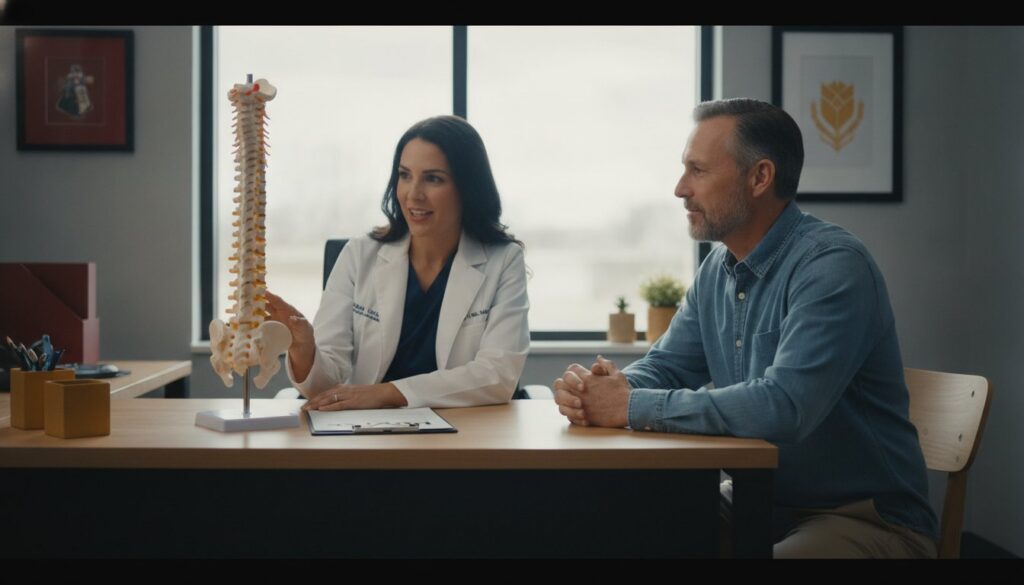
A five-minute C&P exam shouldn’t be the final word on a decade of chronic back pain. You’ve likely experienced the frustration of a medical evaluation that fails to capture your worst days, leaving you with a rating that doesn’t reflect your actual physical limitations. It’s common to feel like the system overlooks the flare-ups that stop you in your tracks. Utilizing a private dbq for rating increase for back pain is a strategic way to shift the narrative back to the medical facts. By documenting your functional loss with precision, you can move toward a rating of 30%, 40%, or higher.
This 2026 guide explains the exact steps to use a DBQ to capture the evidence the VA requires for an increase. We’ll explore how to record range of motion accurately and why private medical evidence is a game-changer for your claim. With the 2026 COLA increase setting the 40% rating at $795.84 per month, ensuring your documentation is meticulous is vital for the benefits you’ve earned. You deserve a rating that accounts for your daily reality, not just a snapshot in a clinic.
Key Takeaways
- Identify how the VA utilizes goniometer measurements to determine your spine rating under the General Rating Formula for Diseases and Injuries of the Spine.
- Learn how to leverage a private dbq for rating increase for back pain to ensure Section 4 accurately reflects your true range of motion and functional loss.
- Follow a proven five-step process to build a Fully Developed Claim (FDC) that provides the clear medical evidence required for a successful increase.
- Discover how to document secondary conditions like radiculopathy and sciatica to maximize your combined rating through the bilateral factor.
Understanding the VA Rating System for Back Pain in 2026
The Veterans Benefits Administration (VBA) evaluates spine conditions using a specific set of rules known as the General Rating Formula for Diseases and Injuries of the Spine, found in 38 CFR § 4.71a. It’s vital to understand that the VA views the thoracolumbar spine as a single functional unit. This means your rating isn’t based on individual vertebrae but on how the entire middle and lower back move together. Most veterans find that a dbq for rating increase for back pain is the most effective tool to show the VA exactly how their mobility has decreased since their last exam.
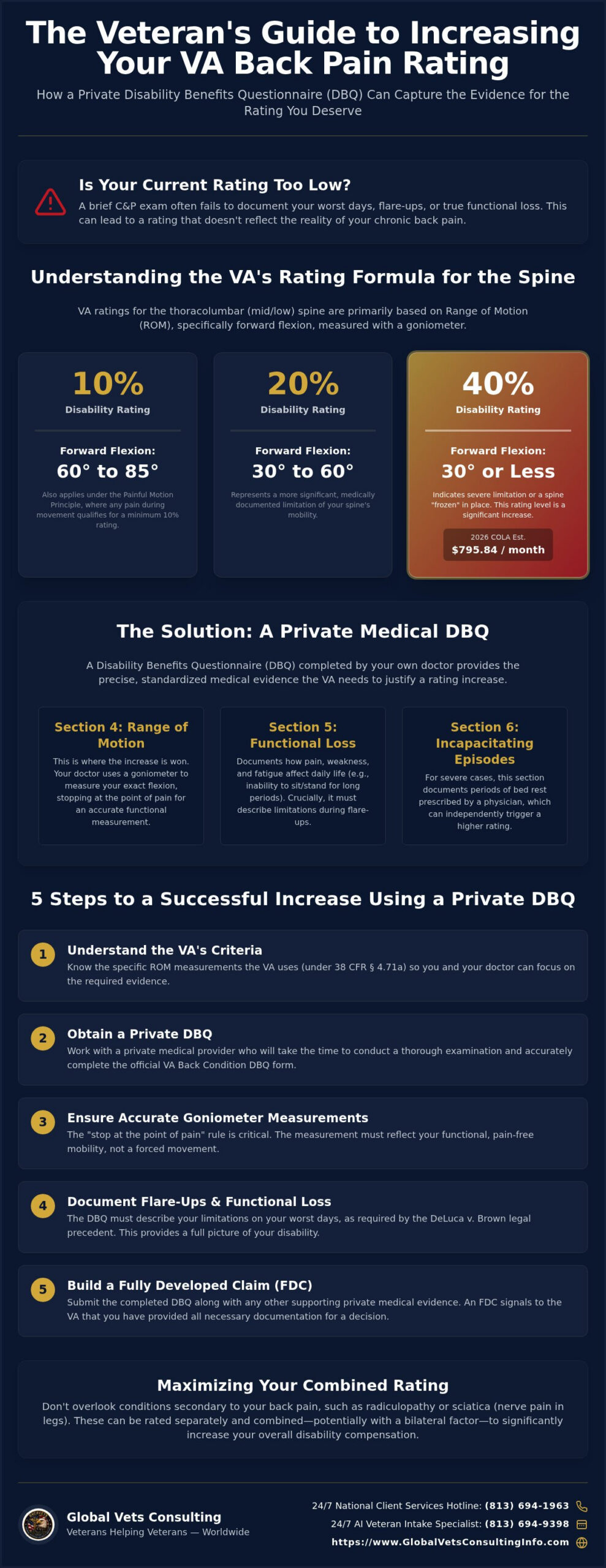
Ratings are strictly tied to Range of Motion (ROM) measurements taken with a goniometer. Under 38 CFR § 4.59, the Painful Motion Principle ensures that any pain documented during movement qualifies you for at least a 10% disability rating, regardless of how far you can actually bend. Beyond that baseline, the VA uses specific tiers:
- 10%: Forward flexion of the thoracolumbar spine between 60 and 85 degrees.
- 20%: Forward flexion between 30 and 60 degrees.
- 40%: Forward flexion of 30 degrees or less, or a spine that is functionally “frozen” in place.
Why Your Current Rating May Be Too Low
Many veterans are stuck at a low rating because VA-contracted examiners often rush through the physical test. They might push you to move further than you comfortably can or fail to document how your back feels during a flare-up. If the examiner fails to record functional loss, such as your inability to remain standing or sit for long periods, your rating will remain stagnant. A private dbq for rating increase for back pain allows your own doctor to document these limitations without the time pressure of a standard C&P exam.
The Role of the Thoracolumbar Spine DBQ
The Disability Benefits Questionnaire (DBQ) acts as the standardized scorecard for your claim. It ensures every necessary measurement is captured so the VA cannot ignore the evidence of a worsening condition. You can learn more about what is a dbq for va claims to see how this document carries significant weight in your medical file. By providing a clear, goniometer-backed report, you provide the VA with the exact data needed to justify a higher tier.
Decoding the Lumbar Spine DBQ for Rating Increases
The official VA Back Condition DBQ form serves as the primary roadmap for your evaluation. Sections 1 through 3 establish your diagnosis and medical history, ensuring your service connection is clearly stated. While these sections are foundational, the data required for a successful dbq for rating increase for back pain is largely contained in the technical measurements that follow.
Section 4 focuses on Range of Motion (ROM), which is where most increases are won or lost. Section 5 covers Functional Loss, documenting how pain, weakness, or fatigability affects your daily ability to function. For those with severe symptoms, Section 6 addresses Incapacitating Episodes. This is critical for veterans who require bed rest prescribed by a physician, as the frequency of these episodes can trigger a higher rating independently of your range of motion.
The Goniometer: The Most Important Tool in Your Exam
A goniometer is a specialized protractor that your doctor must use to measure flexion and extension precisely. You shouldn’t push through pain during these measurements. The “stop at the point of pain” rule is vital; once you feel discomfort, the movement should end. This ensures the VA captures your functional, pain-free mobility rather than a measurement achieved by forcing yourself through a flare-up. If you need help understanding these technical requirements, medical evidence education can provide the clarity you need.
Documenting Flare-Ups and Daily Variations
Your back pain doesn’t look the same every day. The landmark case DeLuca v. Brown requires the VA to consider functional limitations during flare-ups, meaning your rating shouldn’t be based solely on how you feel in a quiet exam room. A properly completed dbq for rating increase for back pain will reflect your condition during its worst periods. Your doctor should use the DBQ to describe how your mobility is limited by pain and fatigability during a typical flare-up, ensuring the VA sees the full picture of your disability.
5 Steps to Securing a Back Pain Increase with a Private DBQ
Securing the rating you’ve earned starts with meticulous preparation. You need to follow a structured path to ensure your dbq for rating increase for back pain stands up to VA scrutiny. By moving through these five steps, you can transform a complex process into a predictable victory that reflects your current physical reality.
- Step 1: Compare your current medical records with previous C&P results to highlight exactly how your symptoms and range of motion have worsened over time.
- Step 2: Partner with a medical professional who understands goniometric testing and the specific nuances of VA disability criteria.
- Step 3: Complete the Lumbar Spine DBQ with high specificity, referencing the VA’s Schedule of Ratings for the Musculoskeletal System to align your symptoms with the correct percentage.
- Step 4: Review the document for “VA-ready” language, ensuring no sections are left blank or contain contradictory statements that could trigger a delay.
- Step 5: Submit your evidence as a Fully Developed Claim (FDC) to help the VA reach a decision faster and potentially bypass unnecessary exams.
Working with a Private Doctor vs. VA Examiner
A private examination offers the time and detail that a rushed C&P exam lacks. While a VA examiner might only spend ten minutes with you, a private doctor can conduct a thorough evaluation of your functional loss. Your physician should provide a robust rationale that links your current severity back to your service-connected injury, providing the “why” behind your worsening pain. This expert perspective is often the difference between a stagnant rating and a 40% award.
Submitting Your Evidence Correctly
Don’t fall into the common trap of having your va claim denied for lack of evidence. Upload your completed DBQ directly through the VA.gov portal and track your claim status 🌎. This proactive approach keeps your file organized and moving through the system. If you’re ready to take control of your claim, start your medical evidence education today to build a stronger, more precise case for the benefits you deserve.
Maximizing Your Claim: Secondary Conditions and Expert Support
Chronic back pain rarely exists in a vacuum. As your condition progresses, it often triggers secondary disabilities that the VA must compensate. Identifying these issues is a critical step in using a dbq for rating increase for back pain to its full potential. By documenting these symptoms, you can trigger the bilateral factor. This provides a percentage boost when nerve issues affect both sides of your body, ensuring your combined rating reflects your total functional loss.
Common secondary conditions include:
- Radiculopathy: Sharp pain, numbness, or tingling in the legs.
- Sciatica: Chronic nerve compression following the sciatic path.
- Mental Health: Secondary depression or anxiety caused by chronic pain and loss of mobility.
Radiculopathy: The Most Common Secondary to Back Pain
Numbness or weakness in your extremities is often rated separately from the spine. While the back is rated on range of motion, nerve damage is evaluated based on sensory and motor loss. To capture this, a Neurological DBQ is typically required alongside your Lumbar Spine DBQ. Professional education ensures every symptom is categorized correctly for the rater, preventing the VA from overlooking the full scope of your disability.
The Global Vets Consulting Advantage 🇺🇸
We provide the professional medical evidence education needed for a successful dbq for va disability rating increase. Our mission is “Veterans Helping Veterans” – Worldwide. We speak your language and understand the meticulous documentation required to secure your earned benefits. Our team is ready to assist you immediately through our modern support channels:
- 24/7 National Client Services Hotline 📞
- 24/7 AI Veteran Intake Specialist for immediate starts
- Official Website: GlobalVetsConsultingInfo.com 🌎
Our goal is to reduce your anxiety by offering a clear, predictable path forward. We prioritize thoroughness and accuracy to ensure your dbq for rating increase for back pain is VA-ready from the moment you submit. You’ve served your country; now let us help you navigate the system to secure the outcome you’ve earned.
Take Control of Your VA Back Pain Rating in 2026
Securing a rating that reflects your true physical limitation is about technical precision. You’ve learned that the VA relies on specific range of motion degrees and functional loss documentation to determine your award. By moving beyond rushed exams and utilizing a private dbq for rating increase for back pain, you provide the rater with undeniable medical evidence. Don’t overlook secondary conditions like radiculopathy or mental health impacts; these are often the key to reaching a higher combined rating that accounts for the full impact on your life.
Global Vets Consulting is here to guide you through every step of this complex process. We are a Veteran-Owned and Operated team specialized in high-accuracy DBQ documentation education. Our mission is to ensure no veteran feels neglected by a bureaucratic system. Our 24/7 National Client Services Hotline is standing by to help you navigate your claim with steady confidence 📞. Get Started with Your DBQ Education Today at Global Vets Consulting. You’ve served your country with honor; now it’s time to secure the benefits you’ve earned.
Frequently Asked Questions
Can I use a private doctor for my back pain DBQ instead of a VA C&P exam?
Yes, you can partner with a private physician to complete your documentation. The VA is required to consider evidence from private providers as part of your medical file. Utilizing a private doctor often results in a more thorough evaluation than a standard C&P exam. This approach allows someone familiar with your long-term history to document your daily physical limitations and functional loss with high precision.
What is the highest VA disability rating for back pain in 2026?
The highest rating for back pain is 100% if the entire spine is frozen in an unfavorable position, known as ankylosis. Most veterans receive ratings between 10% and 40% based on their range of motion measurements. You can achieve a higher combined rating by documenting secondary conditions. These include nerve pain or mental health issues that stem directly from your service-connected back condition and its impact on your life.
How do I prove my back pain has worsened if my X-rays look the same?
You prove worsening through range of motion and functional loss rather than imaging results. X-rays often fail to show the daily pain and stiffness that limit your mobility. A dbq for rating increase for back pain focuses on how far you can bend before pain starts. This documentation is more influential than a static image because the VA rates you on how your condition affects your movement and daily activity.
Will the VA automatically increase my rating if I submit a private DBQ?
No, the VA does not grant an automatic increase upon submission. The rater must review the medical evidence to ensure it meets the legal requirements for a higher tier. However, submitting a private dbq for rating increase for back pain as part of a Fully Developed Claim makes the process more efficient. It provides the VA with clear, goniometer-backed data that is difficult for them to ignore or overlook during the review.
What is the difference between a Nexus Letter and a DBQ for back pain?
A Nexus Letter connects your condition to your military service, while a DBQ documents the current severity of your symptoms. Since you’re seeking an increase, your service connection is already established. Your focus should be on the DBQ to show the VA how your condition has progressed. The DBQ provides the specific range of motion measurements the rater needs to justify moving you to a higher percentage tier in 2026.

Article by
Willie Daniel
Willie Daniel is the Founder and Chief Executive Officer (CEO) of Global Vets Consulting (GVC4Vets) – National Veterans Disability Services, a veteran-led educational and medical evidence support organization dedicated to helping veterans better understand VA disability rating increases, DBQ medical evidence, secondary claims education, and C&P examination preparation.
He is a retired U.S. Army Medical Service Corps Officer with more than 27 years of honorable military service, a decorated Iraq combat veteran, and a retired federal official with the U.S. Department of Veterans Affairs. Throughout his military and federal career, Willie Daniel served in leadership, healthcare administration, operational, and veteran-support roles focused on improving services and support systems for servicemembers, veterans, and their families.
Drawing from decades of military leadership, healthcare administration, veteran advocacy, and federal government experience, Willie Daniel brings a practical, veteran-centered perspective to Global Vets Consulting’s educational articles, AI-powered veteran resources, video education initiatives, and outreach programs. His experience navigating military systems, medical documentation processes, and veteran-related administrative operations provides valuable insight into many of the challenges veterans face when seeking to better understand VA disability rating criteria, medical evidence, documentation strategies, and secondary condition education.
Through GVC’s “Veterans Helping Veterans” mission, his focus is on delivering clear, educational, and easy-to-understand information designed to empower veterans with knowledge, resources, and educational tools that may help them make more informed decisions regarding their individual VA disability journeys.
The information provided through GVC is intended for educational and informational purposes only and should not be considered legal or medical advice.
Disclaimer
Disclaimer: Global Vets Consulting, LLC (“GVC”) is a veteran-led educational and medical evidence support organization. GVC is not a law firm, is not a Veterans Service Organization (VSO), and is not affiliated with the U.S. Department of Veterans Affairs (VA) or any government agency.
Global Vets Consulting does not provide legal advice, medical advice, medical treatment, or healthcare services. GVC does not prepare, file, or submit VA disability claims on behalf of veterans. All information provided through this website, blog articles, videos, educational materials, AI tools, dashboards, templates, and communications is intended solely for general educational and informational purposes.
Veterans are encouraged to consult with accredited representatives, licensed attorneys, qualified medical providers, or Veterans Service Organizations regarding their specific legal, medical, or VA-related matters. VA disability decisions, ratings, and outcomes are determined solely by the U.S. Department of Veterans Affairs based on applicable laws, regulations, medical evidence, and individual circumstances. Past results do not guarantee future outcomes.