

The VA often treats your body like a collection of unrelated parts, yet you know that your service-connected back pain is exactly why you now struggle with depression or nerve damage. It’s exhausting to feel ignored when a new diagnosis is clearly tied to an old injury. Understanding how to prove a secondary condition is the key to moving past the confusion of “VA math” and securing a higher combined rating. You deserve a process that validates your health instead of causing more anxiety about upcoming C&P exams or the difficulty of finding a doctor to write a nexus letter.
This guide provides the exact step-by-step process to link your conditions using the latest 2026 standards, including how the Elizabeth Dole Act affects your medical evidence. We’ll show you how to document the medical bridge needed to turn a new diagnosis into the compensation you’ve earned. By following this methodical approach, you can navigate the system with confidence and work toward a faster claim approval in an environment where the average processing time is now approximately 80 days.
Key Takeaways
- Understand how secondary conditions carry the same weight as primary ratings to help you secure the maximum combined disability percentage you’ve earned.
- Master the three essential pillars of how to prove a secondary condition, focusing on the medical “bridge” between your new diagnosis and your anchor disability.
- Learn the specific steps to gather high-quality evidence, from specialized medical diagnoses to effective “Statements in Support of Claim” that document your daily functional impairment.
- Discover why utilizing a professional Disability Benefits Questionnaire (DBQ) provides the VA with the precise, technical documentation needed to validate your claim faster.
What is a Secondary Condition and Why Does it Matter? 🌐
Many veterans assume that if a health issue didn’t start during their time in uniform, they can’t claim it. That isn’t true. A secondary service-connected disability is any condition that’s caused or “permanently aggravated” by an existing service-connected rating. When you’re learning how to prove a secondary condition, you’re looking for the medical link between your current rating and a new diagnosis. These claims carry the same weight as primary ones, meaning they’re often the missing piece needed to reach a 100% P&T status.
You don’t need a specific “event” or injury from your service records to win these claims. This is a common point of confusion for those dealing with the United States Department of Veterans Affairs. As long as you can show that your primary condition made the new one worse or caused it to develop, the VA recognizes it as service-connected. This shift in perspective turns a partial rating into a comprehensive reflection of your actual health.
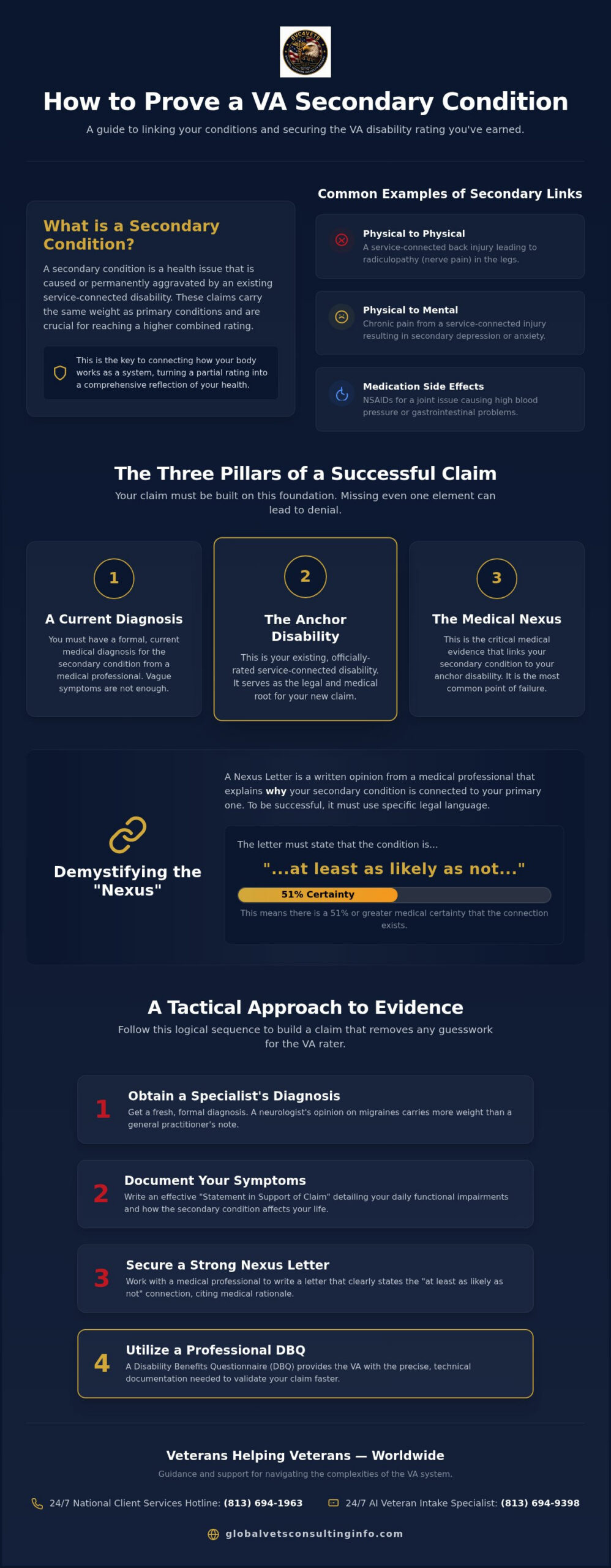
Common Examples of Secondary Links
Identifying these links is the first step in understanding how to prove a secondary condition effectively. Your body works as a system, so one injury often triggers a domino effect. Common connections include:
- Physical to Physical: A service-connected lower back injury often leads to radiculopathy (nerve pain) in the legs or compensatory issues in your knees and hips.
- Physical to Mental: Living with chronic, service-connected physical pain frequently results in secondary depression or anxiety.
- Medication Side Effects: If you take high doses of NSAIDs for a service-connected joint issue and develop high blood pressure or gastrointestinal problems, those are valid secondary conditions.
These connections aren’t just medical theories; they’re pathways to the benefits you’ve earned through your service. Recognizing how your conditions interact allows you to build a stronger, evidence-based claim.
The Three Pillars of Proving Your Secondary Claim 📞
Proving a secondary connection isn’t about luck; it’s about meticulous documentation. You need three specific components to satisfy the VA’s requirements. If you miss even one of these elements, the VA disability claims process step by step often results in a frustrating denial letter. Building your claim on a solid foundation ensures you aren’t just making an assertion, but presenting a logical medical case.
- Pillar 1: A Current Diagnosis. You must have a formal, current medical diagnosis for the secondary condition. Reporting symptoms like “leg numbness” isn’t enough; you need a clinical diagnosis such as “sciatic radiculopathy” to move forward.
- Pillar 2: The Anchor. This is your existing service-connected disability. It serves as the legal root for your new claim. You can’t claim a secondary condition if the primary one hasn’t been officially rated by the VA yet.
- Pillar 3: The Nexus. This is the medical evidence linking the two conditions together. It’s the most common point of failure for many veterans because it requires a specific type of medical language to be effective.
Demystifying the Medical Nexus
The Nexus is a medical professional’s written opinion explaining why your secondary condition is related to your primary one. While a “Direct” nexus links a condition to your time in service, a “Secondary” nexus focuses on the relationship between two current health issues. A strong nexus letter doesn’t just state a connection; it often cites medical journals to prove the biological link. To win, your doctor must state that the condition is “at least as likely as not” caused by your primary rating. This specific legal standard means there is a 51% certainty or greater that the connection exists.
Understanding how to prove a secondary condition starts with these pillars. If you feel stuck on the evidence gathering phase, looking into expert education in secondary claims can provide the clarity you need to move forward with confidence.
Step-by-Step Guide: How to Prove a Secondary Condition 🇺🇸
Winning a secondary claim requires a tactical approach to evidence gathering. To master how to prove a secondary condition, you must follow a logical sequence that removes any guesswork for the VA rater. First, obtain a fresh diagnosis from a specialist. A neurologist’s opinion on secondary migraines carries far more weight than a general practitioner’s note. Next, document your symptoms through a “Statement in Support of Claim.” This personal statement is where you explain the daily functional impact your condition has on your life.
The third step involves securing a high-quality DBQ that specifically addresses the secondary connection. This ensures your medical evidence is in the VA’s preferred format. Finally, submit your Fully Developed Claim (FDC) to speed up the decision process. If you want to ensure your evidence is complete before you file, explore our secondary VA claims education for expert guidance.
The Role of Lay Evidence
Personal statements and buddy letters “paint the picture” for the VA. While medical records provide clinical data, lay evidence provides the human context. A spouse can describe how your service-connected back pain leads to sleepless nights and secondary anxiety. Lay evidence is powerful for showing severity, but it supports medical evidence rather than replacing a formal diagnosis.
Gathering the Right Medical Records
Always include private treatment records alongside your VA files. This creates a broader view of your health history. The VA rater looks for “continuity of care,” which proves the secondary condition is a chronic issue. Highlighting consistent treatment across different providers strengthens the link between your primary and secondary disabilities. This consistency makes it much harder for the VA to claim your condition is unrelated to your service.
Strengthening Your Claim with Professional DBQs 🌐
The most effective tool in your tactical kit is the Disability Benefits Questionnaire. To understand what is a dbq for va claims, think of it as a standardized roadmap that guides a VA rater through your medical evidence. While a typical C&P exam might feel rushed or incomplete, a private DBQ ensures every symptom is documented with precision. This form is the VA’s preferred evidence format because it translates your health struggles into the specific language raters use to assign percentages.
Global Vets Consulting streamlines the process of gathering this critical medical documentation. We focus on ensuring your evidence includes the “at least as likely as not” language that is mandatory for success. When a specialist completes your DBQ, they provide the clinical depth that a general practitioner might miss. This level of detail is vital when you are documenting how to prove a secondary condition, as it establishes the undeniable link between your primary rating and your new diagnosis.
A private DBQ provides a level of thoroughness that a 15-minute C&P exam simply cannot match. In 2026, the VA has placed a higher emphasis on functional impairment; specifically how your condition limits your daily life and work. A specialist-led DBQ captures these nuances, ensuring the rater understands the full scope of your secondary disability. This meticulousness reinforces your claim’s legitimacy and protects you against the increased scrutiny the VA is currently applying to private medical evidence.
Why Professional Preparation Prevents Denials
The primary reason the VA denies secondary claims is a perceived lack of a clear medical link. A correctly filled-out DBQ pre-emptively answers the rater’s questions before they can find a reason to say “no.” It bridges the gap between your symptoms and the legal requirements of the law. By presenting a completed file, you reduce the rater’s workload and increase your chances of a favorable outcome. If you need support gathering your medical evidence, contact Global Vets Consulting for 24/7 assistance with your secondary claim evidence 🇺🇸.
- 📞 24/7 National Client Services Hotline
- 🌐 GlobalVetsConsultingInfo.com
Securing the Rating You’ve Earned 🇺🇸
Navigating the VA system shouldn’t feel like an uphill battle. By mastering the three pillars of evidence and utilizing professional DBQs, you’ve gained the tactical knowledge of how to prove a secondary condition effectively. Your medical documentation must speak the VA’s language, specifically by establishing that “at least as likely as not” connection between your primary and secondary disabilities. This methodical approach ensures your claim is grounded in clinical facts rather than just symptom reports.
As a veteran-owned and operated team, we understand the stakes of your claim. We maintain a 24/7 National Client Services Hotline and provide deep expertise in complex secondary claims to help you document your disabilities accurately. Don’t let a lack of evidence stand between you and your 100% P&T status. Get Started with Your Professional DBQ Preparation Today and take the next step toward the compensation you deserve. You’ve served your country with honor; now it’s time to ensure your benefits reflect the full reality of your health.
Frequently Asked Questions
What is a secondary condition in a VA disability claim?
A secondary condition is any health issue that’s caused or aggravated by an existing service-connected disability. For instance, if a service-connected knee injury alters your gait and eventually leads to a hip condition, the hip issue is secondary. The VA recognizes these as valid claims because your primary service-connected injury is the direct cause of the new medical complication.
Can I file a secondary condition claim years after my primary rating?
Yes, you can file for a secondary condition at any time as long as the primary disability is already service-connected. Many veterans develop new health problems decades after their service because of the long-term strain an original injury puts on their body. The timing doesn’t matter as much as the medical evidence linking the two conditions together.
Do I need a nexus letter if I have a DBQ for a secondary condition?
A DBQ can replace a standalone nexus letter if it includes the specific “at least as likely as not” medical opinion. This language is the core of how to prove a secondary condition successfully. If your specialist clearly explains the biological link within the DBQ, the VA generally has the evidence they need to establish service connection without additional letters.
What happens if the VA denies my secondary condition claim?
If your claim is denied, you can file a Supplemental Claim with new evidence or request a Higher-Level Review. Denials for secondary conditions usually happen because the rater didn’t see a clear medical “bridge” between your disabilities. Providing a more detailed DBQ or a stronger medical opinion from a specialist can often overturn these initial decisions.
How does the VA calculate the rating for secondary conditions?
The VA uses a combined rating table to integrate secondary ratings into your overall percentage. This “VA math” doesn’t just add numbers together; it calculates your total disability based on your remaining healthy capacity. Learning how to prove a secondary condition is vital because even a small secondary rating can push your combined total into a much higher payment bracket.

Article by
Willie Daniel
Willie Daniel is the Founder and Chief Executive Officer (CEO) of Global Vets Consulting (GVC4Vets) – National Veterans Disability Services, a veteran-led educational and medical evidence support organization dedicated to helping veterans better understand VA disability rating increases, DBQ medical evidence, secondary claims education, and C&P examination preparation.
He is a retired U.S. Army Medical Service Corps Officer with more than 27 years of honorable military service, a decorated Iraq combat veteran, and a retired federal official with the U.S. Department of Veterans Affairs. Throughout his military and federal career, Willie Daniel served in leadership, healthcare administration, operational, and veteran-support roles focused on improving services and support systems for servicemembers, veterans, and their families.
Drawing from decades of military leadership, healthcare administration, veteran advocacy, and federal government experience, Willie Daniel brings a practical, veteran-centered perspective to Global Vets Consulting’s educational articles, AI-powered veteran resources, video education initiatives, and outreach programs. His experience navigating military systems, medical documentation processes, and veteran-related administrative operations provides valuable insight into many of the challenges veterans face when seeking to better understand VA disability rating criteria, medical evidence, documentation strategies, and secondary condition education.
Through GVC’s “Veterans Helping Veterans” mission, his focus is on delivering clear, educational, and easy-to-understand information designed to empower veterans with knowledge, resources, and educational tools that may help them make more informed decisions regarding their individual VA disability journeys.
The information provided through GVC is intended for educational and informational purposes only and should not be considered legal or medical advice.
Disclaimer
Disclaimer: Global Vets Consulting, LLC (“GVC”) is a veteran-led educational and medical evidence support organization. GVC is not a law firm, is not a Veterans Service Organization (VSO), and is not affiliated with the U.S. Department of Veterans Affairs (VA) or any government agency.
Global Vets Consulting does not provide legal advice, medical advice, medical treatment, or healthcare services. GVC does not prepare, file, or submit VA disability claims on behalf of veterans. All information provided through this website, blog articles, videos, educational materials, AI tools, dashboards, templates, and communications is intended solely for general educational and informational purposes.
Veterans are encouraged to consult with accredited representatives, licensed attorneys, qualified medical providers, or Veterans Service Organizations regarding their specific legal, medical, or VA-related matters. VA disability decisions, ratings, and outcomes are determined solely by the U.S. Department of Veterans Affairs based on applicable laws, regulations, medical evidence, and individual circumstances. Past results do not guarantee future outcomes.

