

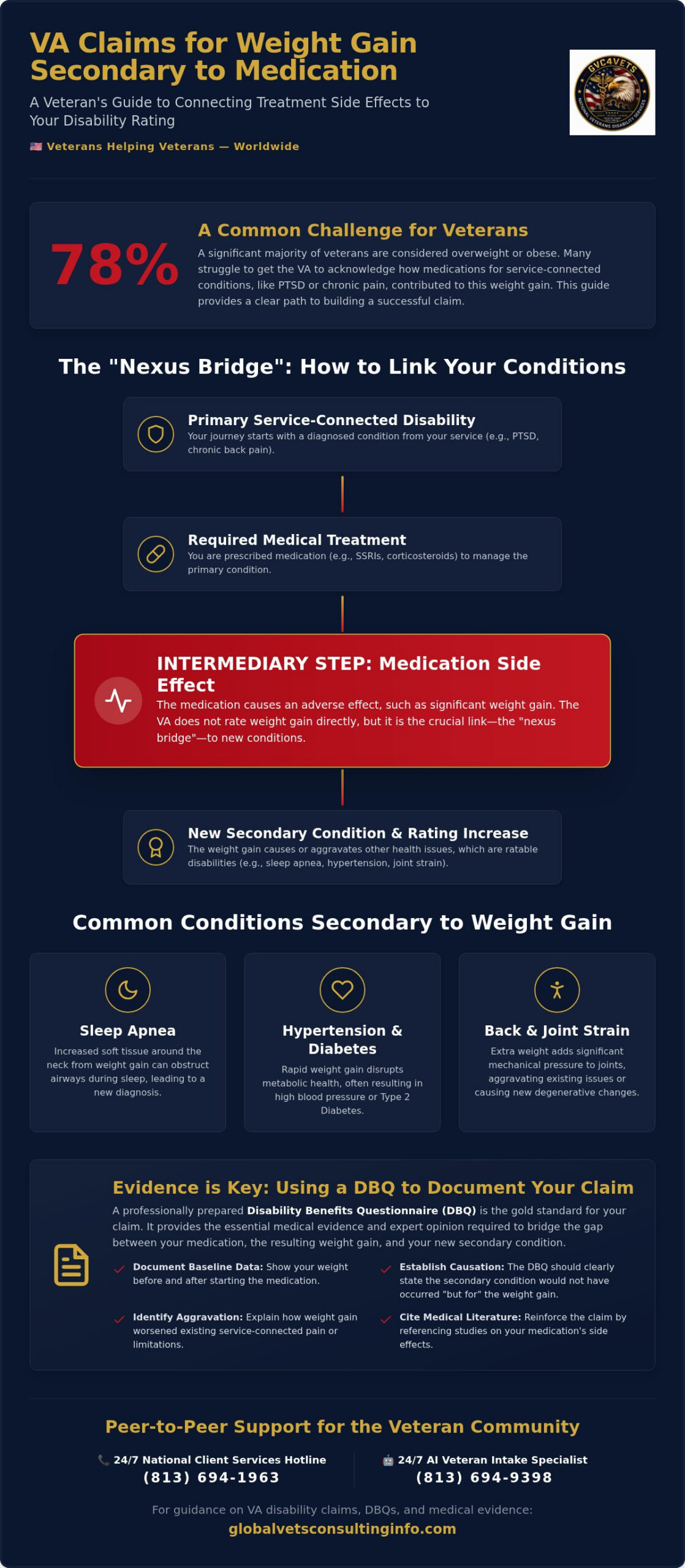
Did you know that 78% of veterans are currently considered overweight or obese, yet many struggle to get the VA to acknowledge how service-connected medications contributed to that increase? It’s a common frustration to find that the treatments managing your PTSD or chronic pain are simultaneously creating new health hurdles. You’ve likely felt the anxiety of a C&P exam where the provider doesn’t grasp how your primary condition led to this change. Filing a va claim for weight gain secondary to medication side effects is no longer the uphill battle it once was, especially following the 2025 Adams v. Collins ruling which clarified obesity’s role in secondary service connection.
We understand that navigating these hurdles feels overwhelming when you’re already managing your health. This guide promises to give you a clear path to linking your weight gain to your medications using professional medical evidence. You’ll learn how to use weight gain as a “nexus bridge” to secure rating increases for related conditions. We’ll break down the necessary documentation, the importance of DBQs, and how to present your case so the VA finally sees the full picture of your service-connected journey.
Key Takeaways
- Understand that weight gain acts as a critical “intermediary step” to link primary service-connected disabilities to new secondary conditions like hypertension or sleep apnea.
- Learn the precise steps to successfully file a va claim for weight gain secondary to medication side effects by identifying specific prescriptions that contributed to your metabolic shifts.
- Discover why a professionally prepared Disability Benefits Questionnaire (DBQ) provides the essential medical evidence required to bridge the gap between your medication and your current health status.
- Master the strategy for gathering weight baseline data and medical records to substantiate your claim and secure a well-earned VA rating increase.
Understanding Weight Gain as a Secondary VA Disability Claim
The Department of Veterans Affairs does not recognize obesity or weight gain as a standalone service-connected disability. You won’t find a specific rating percentage for a high BMI on your decision letter. Instead, the VA views weight gain as an “intermediary step” that either causes a new medical problem or makes an existing one worse. This distinction is vital for your va claim for weight gain secondary to medication side effects because it shifts the focus from the scale to the resulting clinical diagnosis.
Many common prescriptions used to treat service-connected conditions have metabolic consequences. For instance, SSRIs used for PTSD or depression and corticosteroids used for chronic joint inflammation are well-documented to cause weight changes. When these treatments lead to an adverse effect of medication such as significant weight gain, that gain becomes the bridge to secondary service connection. Secondary service connection is a legal framework where a new disability is granted because it was caused or aggravated by an existing service-connected condition or its required treatment.
Why Medication Side Effects Matter for Your Claim
Documenting the transition from your primary treatment to secondary symptoms is the key to a successful va claim for weight gain secondary to medication side effects. If you were prescribed a medication for a service-connected back injury and subsequently gained 40 pounds, that extra weight puts measurable strain on your musculoskeletal system. This often leads to a VA rating increase for your back or new ratings for your knees and hips.
- Document the Baseline: Show your weight before starting the medication versus your weight after six months of treatment.
- Identify the Aggravation: Explain how the weight gain has worsened existing service-connected pain or limited your range of motion.
- Bridge the Gap: Use professional medical evidence to show that the weight gain was a direct result of the pharmaceutical intervention, not lifestyle choices.
The Nexus Bridge: How to Link Weight Gain to Your Service
To secure a successful va claim for weight gain secondary to medication side effects, you must master the “Obesity as an Intermediary” framework. This legal structure allows you to use weight gain as a bridge between your primary service-connected disability and a new secondary condition. You aren’t claiming obesity itself as the disability; instead, you’re showing how the medication for your primary condition caused weight gain, which then caused a new, ratable health problem.
Proving “but for” causation is the standard you need to meet. Your medical evidence should clearly state that the secondary condition would not have occurred but for the weight gain triggered by your prescriptions. For example, if a veteran takes a specific antipsychotic for PTSD and gains 60 pounds, that weight increase often leads directly to obstructive sleep apnea or hypertension. Supporting your claim with peer-reviewed medical literature that confirms your medication’s side effect profile is a powerful way to establish this link. If you need help identifying these connections, secondary VA claims education can provide the clarity needed to strengthen your nexus.
Common Conditions Secondary to Weight Gain
Weight gain isn’t just a change in appearance; it’s a physiological shift that impacts multiple body systems. When filing your claim, focus on how the extra weight has created these specific medical issues:
- Sleep Apnea: Increased soft tissue around the neck often causes airway obstruction during sleep, which is a direct result of medication-induced weight gain.
- Hypertension and Type 2 Diabetes: Rapid weight gain can disrupt your metabolic health, leading to high blood pressure or insulin resistance that didn’t exist before your treatment.
- Back and Knee Strain: Every extra pound adds significant mechanical pressure to your joints, which can aggravate service-connected musculoskeletal conditions or cause new degenerative changes.
Evidence Requirements: Using a DBQ to Document Your Claim
A Disability Benefits Questionnaire (DBQ) is the gold standard for documenting the severity of your secondary conditions. When you rely solely on a VA-contracted C&P exam, you’re often gambling on a provider who has only minutes to review your history. Private medical evidence allows for a much more thorough evaluation. Your own doctor sees the day-to-day struggle. They can capture the nuance of how your metabolism shifted after starting service-connected medications, providing the detailed evidence a standard exam often overlooks.
The DBQ must clearly outline the functional limitations caused by the secondary condition. For example, if your weight gain led to respiratory distress or a significantly limited range of motion in your knees, these specifics must be recorded. It’s not enough to just be “heavier.” You must show the VA how that weight prevents you from working or performing daily tasks. This documentation is a critical component of the VA disability claims process, ensuring your file is “ready to rate” when it reaches a decision maker’s desk. Precise language here is the difference between a denial and a successful va claim for weight gain secondary to medication side effects.
The Role of the Nexus Letter
While the DBQ describes your current symptoms, a nexus letter serves to prove the medical connection. You need a professional medical opinion stating it’s “at least as likely as not” that the weight gain was caused by your service-connected treatment. This specific phrase is the VA’s legal threshold for service connection. To be effective, your medical provider must review your entire C-File. This review establishes a credible link that’s difficult for the VA to ignore. If you need assistance understanding how to present this evidence, independent medical evidence education from Global Vets Consulting can guide you through the process of substantiating your claim.
Strategies to Maximize Your VA Rating Increase in 2026
Securing a higher rating requires a methodical approach to your medical records. You don’t want to leave your compensation to chance by submitting an incomplete file. To successfully file a va claim for weight gain secondary to medication side effects, follow these specific steps to build a bulletproof case.
- Identify Every Medication: List all prescriptions you take for service-connected conditions. Focus on those known to cause metabolic changes, such as SSRIs for PTSD or steroids for chronic inflammation.
- Establish Your Weight Baseline: Gather medical records that show your weight before you started the medication. Compare this to your current weight to demonstrate the direct, chronological impact of the treatment.
- Document the Primary Trigger: Secure a DBQ for mental health conditions or your specific primary disability. This proves the underlying condition exists and that the medication is a medical necessity.
- Submit a Fully Developed Claim (FDC): By providing all evidence upfront, you bypass the VA’s lengthy evidence-gathering phase. This can help you stay within the 2026 average processing time of 71 to 81 days.
Avoiding the ‘Lack of Evidence’ Denial
A common pitfall is relying on anecdotal evidence. If your VA claim is denied for lack of evidence, it’s usually because the nexus between the medication and the weight gain wasn’t clinically established. While “buddy letters” from family can provide emotional context, they don’t replace professional medical documentation. Raters prioritize a private medical opinion and a completed DBQ over lay statements for complex secondary links. Professional documentation provides the clinical certainty the VA needs to grant your rating increase and ensure you receive the benefits you’ve earned.
Secure Your Earned Benefits with Medical Precision
Navigating the complexities of a va claim for weight gain secondary to medication side effects requires more than just a list of symptoms. It demands a strategic approach that uses weight gain as an intermediary bridge to your secondary conditions. By documenting your medication history and establishing a clear weight baseline, you provide the VA with the clinical evidence needed to substantiate your claim. A professionally prepared DBQ remains the most effective tool to ensure your functional limitations are accurately captured and understood by raters in 2026.
As a veteran-owned and operated team, we specialize in independent medical evidence education to help you bridge the gap between your service-connected treatment and your current health status. Our 24/7 National Client Services Hotline 📞 is always available to support you through the documentation process. Don’t let a lack of evidence stand between you and the compensation you’ve earned through your service.
Get Your Professional DBQ for Your Secondary Claim Today 🇺🇸
You’ve already done the hard work of serving our country. Now, it’s time to make sure the system works for you. You have the tools and the strategy; move forward with confidence.
Frequently Asked Questions
Can I get a VA rating for obesity by itself?
No, the VA does not provide a standalone disability rating for obesity or weight gain. Instead, you must use obesity as an “intermediary step” to link a service-connected condition to a new secondary disability. This means you receive compensation for the conditions caused or aggravated by weight gain, such as hypertension or sleep apnea, rather than for the weight gain itself.
Which medications are most commonly linked to VA weight gain claims?
Several medications used for service-connected conditions are notorious for metabolic side effects. Veterans often cite SSRIs and antipsychotics used for PTSD, as well as corticosteroids like prednisone used for chronic joint inflammation. These drugs can cause rapid weight changes that lead to secondary health issues. Identifying these specific prescriptions is a vital step when filing a va claim for weight gain secondary to medication side effects.
How do I prove my weight gain is secondary to my PTSD medication?
You prove this connection by documenting your weight baseline before starting the medication and comparing it to your current weight. A nexus letter from a medical professional is essential to state that your weight gain is “at least as likely as not” caused by the PTSD treatment. High-quality medical evidence and a completed DBQ provide the clinical proof needed to satisfy VA rater requirements and establish service connection.
What happens if the C&P examiner ignores my medication side effects?
If a C&P examiner overlooks your side effects, you should submit independent medical evidence to counter their findings. Providing a private Disability Benefits Questionnaire (DBQ) ensures that your functional limitations and medication-induced weight gain are properly documented. You can also submit peer-reviewed medical literature that confirms the weight gain risks associated with your specific service-connected prescriptions to strengthen your case and provide a clear path for the rater.
Is a nexus letter required for a weight gain secondary claim?
While the VA doesn’t strictly require a nexus letter for every claim, it is practically essential for a va claim for weight gain secondary to medication side effects. Without a professional medical opinion linking the weight gain to your service-connected treatment, raters often default to denying the claim for lack of evidence. A strong nexus letter bridges the gap between your primary disability and your secondary symptoms by providing the necessary medical rationale.

Article by
Willie Daniel
Willie Daniel is the Founder and Chief Executive Officer (CEO) of Global Vets Consulting (GVC4Vets) – National Veterans Disability Services, a veteran-led educational and medical evidence support organization dedicated to helping veterans better understand VA disability rating increases, DBQ medical evidence, secondary claims education, and C&P examination preparation.
He is a retired U.S. Army Medical Service Corps Officer with more than 27 years of honorable military service, a decorated Iraq combat veteran, and a retired federal official with the U.S. Department of Veterans Affairs. Throughout his military and federal career, Willie Daniel served in leadership, healthcare administration, operational, and veteran-support roles focused on improving services and support systems for servicemembers, veterans, and their families.
Drawing from decades of military leadership, healthcare administration, veteran advocacy, and federal government experience, Willie Daniel brings a practical, veteran-centered perspective to Global Vets Consulting’s educational articles, AI-powered veteran resources, video education initiatives, and outreach programs. His experience navigating military systems, medical documentation processes, and veteran-related administrative operations provides valuable insight into many of the challenges veterans face when seeking to better understand VA disability rating criteria, medical evidence, documentation strategies, and secondary condition education.
Through GVC’s “Veterans Helping Veterans” mission, his focus is on delivering clear, educational, and easy-to-understand information designed to empower veterans with knowledge, resources, and educational tools that may help them make more informed decisions regarding their individual VA disability journeys.
The information provided through GVC is intended for educational and informational purposes only and should not be considered legal or medical advice.
Disclaimer
Disclaimer: Global Vets Consulting, LLC (“GVC”) is a veteran-led educational and medical evidence support organization. GVC is not a law firm, is not a Veterans Service Organization (VSO), and is not affiliated with the U.S. Department of Veterans Affairs (VA) or any government agency.
Global Vets Consulting does not provide legal advice, medical advice, medical treatment, or healthcare services. GVC does not prepare, file, or submit VA disability claims on behalf of veterans. All information provided through this website, blog articles, videos, educational materials, AI tools, dashboards, templates, and communications is intended solely for general educational and informational purposes.
Veterans are encouraged to consult with accredited representatives, licensed attorneys, qualified medical providers, or Veterans Service Organizations regarding their specific legal, medical, or VA-related matters. VA disability decisions, ratings, and outcomes are determined solely by the U.S. Department of Veterans Affairs based on applicable laws, regulations, medical evidence, and individual circumstances. Past results do not guarantee future outcomes.

