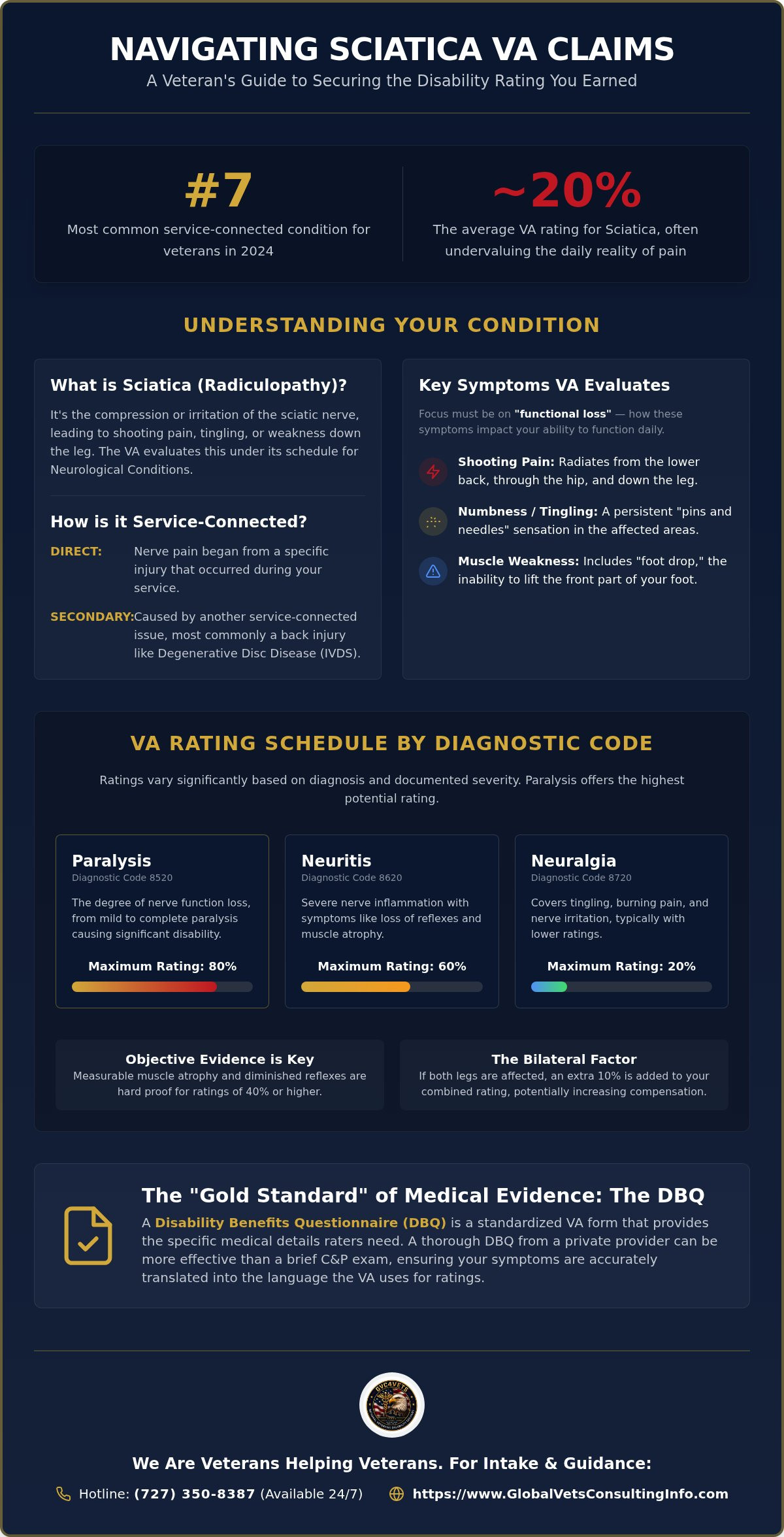
🇺🇸 Did you know that sciatic nerve paralysis was the seventh most common service-connected condition in 2024, yet the average rating for Sciatica VA Claims remains only about 20%? If you’re living with shooting pain that radiates down your legs, you know a “mild” rating doesn’t reflect your daily reality. It’s frustrating when inaccurate C&P exams downplay your symptoms or when you struggle to link leg pain to a service-connected back injury. At Global Vets Consulting (GVC4Vets), we understand that the VA’s complex system often feels like an uphill battle, but you aren’t alone in this fight.
This guide provides the clarity needed to secure the VA disability rating you truly earned through your service. You’ll learn how to accurately document your condition, understand the 10% to 80% rating scale, and use a DBQ to provide medical evidence the VA cannot ignore. For immediate assistance, our National Client Services Hotline and AI Veteran Intake Specialist are available 24/7 at 📞 (727) 350-8387. You can also visit 🌐 https://www.GlobalVetsConsultingInfo.com to explore our educational resources.
Key Takeaways
- Understand how the VA classifies sciatic nerve conditions under Diagnostic Codes 8520, 8620, and 8720 to identify your specific level of impairment.
- Learn why documenting functional loss instead of just pain is critical for maximizing Sciatica VA Claims and securing a rating between 10% and 80%.
- Discover how a Disability Benefits Questionnaire (DBQ) serves as the “Gold Standard” of medical evidence to counter inaccurate C&P exams.
- Follow a clear, step-by-step process to gather service records and obtain the precise documentation needed for a successful VA rating increase.
Understanding Sciatica VA Disability Ratings in 2026
Sciatica is a neurological condition clinically referred to as radiculopathy, involving the compression or irritation of the sciatic nerve. When you’re managing Sciatica VA Claims, the VA evaluates your condition under the Neurological Conditions and Convulsive Disorders schedule. Under Diagnostic Code 8520, the VA specifically defines sciatica as the paralysis of the sciatic nerve, which can range from mild tingling to complete functional loss. Understanding Sciatica is the first step toward ensuring your medical evidence reflects the true severity of your symptoms.
Direct vs. Secondary Service Connection 🇺🇸
You can establish service connection directly if your nerve pain began following a specific in-service injury. However, many veterans find success by claiming sciatica as a secondary condition. This often occurs when a service-connected back injury, such as degenerative disc disease or intervertebral disc syndrome (IVDS), causes nerve compression. If your back pain leads to radiating leg pain, you should follow the VA Disability Claims Process Step by Step to ensure every related symptom is properly rated.
Common Symptoms the VA Looks For
The VA focuses on how nerve damage impacts your ability to function. It’s not just about the pain; it’s about the “functional loss” you experience daily. Common symptoms include:
- Shooting pain that travels from the lower back through the hip and down the leg.
- Persistent numbness or a “pins and needles” sensation.
- Significant muscle weakness or “foot drop,” where you struggle to lift the front part of your foot while walking.
Documenting these specific limitations is vital for a VA rating increase. If you need help navigating your claim or medical evidence, our National Client Services Hotline is available 24/7 at 📞 (727) 350-8387 or visit 🌐 https://www.GlobalVetsConsultingInfo.com.
The VA Rating Schedule for Sciatic Nerve Conditions
The VA categorizes Sciatica VA Claims under three distinct diagnostic codes based on the nature of the nerve damage. Understanding the difference between paralysis, neuritis, and neuralgia is essential because the maximum ratings vary significantly. Paralysis (Diagnostic Code 8520) offers the highest potential rating, ranging from 10% for mild cases to 80% for complete paralysis. Neuritis (Diagnostic Code 8620) is rated between 10% and 60% and typically involves severe nerve inflammation. Neuralgia (Diagnostic Code 8720), which covers symptoms like tingling and burning pain, is generally capped at a 10% or 20% rating. Medical documentation of Sciatica symptoms and causes helps raters determine which code applies to your specific situation.
Mild, Moderate, and Severe Criteria
A “moderate” rating often involves constant pain and sensory changes, while a “severe” rating requires evidence of significant motor disability. If you experience symptoms in both legs, the VA applies the bilateral factor. This adds an extra 10% to your combined rating before rounding, which can push you into a higher compensation bracket. Ensuring your medical evidence accurately reflects these nuances is vital for a successful outcome. If you’re unsure where your symptoms fall, our team provides neurological conditions educational resources to guide your next steps.
The Role of Atrophy and Reflexes
Objective evidence is the key to a higher VA disability claim. Measurable muscle atrophy, or the wasting away of muscle tissue in the leg, serves as “hard” proof for 40% or 60% ratings. Raters also look for diminished deep tendon reflexes during examinations. These objective findings are much harder for the VA to ignore than subjective reports of pain alone. For immediate assistance with your intake, our National Client Services Hotline is available 24/7 at 📞 (727) 350-8387.
How a Disability Benefits Questionnaire (DBQ) Strengthens Your Claim
Do you feel like your C&P exam was too short to capture the reality of your leg pain? A Disability Benefits Questionnaire (DBQ) provides the standardized medical evidence the VA needs to assign an accurate rating percentage. While a standard C&P exam might only last 15 minutes, a private DBQ is often more thorough and ensures no symptom is missed. This documentation translates your physical suffering into the neurological language the VA rater uses to decide your monthly compensation. To learn more about the basics, see our guide on What is a DBQ? A Veteran’s Guide.
Key Sections of the Neurological DBQ
The Neurological DBQ tracks specific functional limitations that examiners often overlook. It requires the examiner to document motor gain or loss and sensory changes in your lower extremities. The “Functional Impact” section is the most critical area for your claim. Here, the examiner describes how radiculopathy affects your ability to work or perform daily tasks. This detail is essential because the VA’s Official Rating Schedule for Sciatica relies heavily on the degree of functional impairment.
Avoiding Common DBQ Mistakes
Many Sciatica VA Claims are underrated because veterans fail to distinguish between back pain and nerve pain during their exams. Ensure your examiner checks for “radicular pain” specifically rather than just general lumbar strain. If you’re filing for a secondary service connection, a clear Medical Nexus is necessary to bridge the gap between your back injury and your sciatica. Don’t leave your rating to chance. You can get started with our DBQ education services today. Our National Client Services Hotline is available 24/7 at 📞 (727) 350-8387.
Steps to File or Increase Your Sciatica VA Claim in 2026 🌐
Now that you understand the rating criteria and the power of a DBQ, it’s time to take action. Filing or increasing your Sciatica VA Claims requires a tactical approach to ensure the VA rater has everything needed for an accurate decision. By submitting a Fully Developed Claim (FDC), you can help the VA process your request more efficiently. Current 2026 data shows average processing times are between 68.4 and 80.7 days, making thorough preparation more important than ever.
- Step 1: Gather your service treatment records and any recent private medical documentation.
- Step 2: Obtain a detailed DBQ that captures your functional loss and neurological symptoms.
- Step 3: Submit your claim through the VA’s online portal or by mail as an FDC.
- Step 4: Review your evidence before your C&P exam and be prepared to describe your limitations on your worst days.
Using Global Vets Consulting (GVC4Vets) for Evidence Education
Navigating the bureaucracy alone is exhausting, but Global Vets Consulting (GVC4Vets) is here to act as your steady guide. Our educational resources specialize in helping you understand the requirements for a VA rating increase. You can connect with our 24/7 AI Veteran Intake Specialist at 📞 (727) 350-8387 to begin your documentation journey with confidence. We focus on empowering you with medical evidence education that standard exams often overlook.
What to Do if Your Claim is Denied
If the VA denies your claim, it’s usually due to a lack of evidence or a missing nexus. Don’t be discouraged; this is simply a signal to strengthen your file. You can submit a Supplemental Claim with updated medical evidence to address the VA’s concerns. For more details, see our resource on VA Claim Denied for Lack of Evidence: How to Recover. For additional support, visit 🌐 https://www.GlobalVetsConsultingInfo.com or call our 24/7 hotline at 📞 (727) 350-8387.
Secure Your Earned Benefits Today
Navigating the complex path of Sciatica VA Claims requires more than just showing up to an exam; it demands a strategy built on meticulous medical evidence. By understanding the rating schedules and the specific neurological criteria the VA uses, you’ve taken the first step toward a successful outcome. Remember that a properly completed DBQ is your strongest tool to ensure your functional limitations are fully recognized by the rater. Global Vets Consulting (GVC4Vets) is proud to stand as a reliable ally for those who served, offering the expertise needed to simplify this bureaucratic process. Our National Client Services Hotline and AI Veteran Intake Specialist are available 24/7 at 📞 (727) 350-8387 to assist with your documentation needs.
Ready to secure the medical evidence you deserve? Contact Global Vets Consulting (GVC4Vets) today for DBQ education. We are a veteran-owned and operated team dedicated to ensuring you receive the rating your service earned. Don’t let an inaccurate exam be the final word on your disability benefits. 🇺🇸
Frequently Asked Questions
What is the maximum VA rating for Sciatica?
The maximum VA rating for sciatica is 80% under Diagnostic Code 8520, which represents complete paralysis of the sciatic nerve. For neuritis under Code 8620, the cap is 60% for severe symptoms. Most veterans receive a 10% or 20% rating for mild to moderate symptoms. Securing a higher rating for Sciatica VA Claims requires clear medical evidence of functional loss or muscle atrophy documented during your examination.
Can I get a VA rating for Sciatica in both legs?
You can absolutely receive a rating for sciatica in both legs, which triggers the VA’s bilateral factor. The VA evaluates each leg independently and then combines the ratings. An additional 10% of the combined value is added before the final rounding. This often results in a significant increase in your overall disability compensation. Accurate DBQs for both legs are essential to ensure the VA rater applies this factor correctly to your claim.
How do I prove my Sciatica is secondary to my back pain?
Proving sciatica is secondary to back pain requires a medical nexus that connects your nerve symptoms to a service-connected lumbar condition. Common links include degenerative disc disease or a herniated disc compressing the sciatic nerve. You must provide medical evidence showing that your leg pain, numbness, or weakness is “at least as likely as not” caused by your back injury. Our educational resources help veterans document these secondary Sciatica VA Claims effectively.
Will the VA accept a DBQ from a private doctor for Sciatica?
The VA officially accepts DBQs from private medical providers, and these forms often provide more detailed evidence than a standard C&P exam. A private doctor can spend more time documenting your range of motion, muscle weakness, and sensory changes. This thoroughness makes the private DBQ the “Gold Standard” for substantiating a VA rating increase. Ensure your doctor uses the correct Peripheral Nerves DBQ to meet the VA’s specific neurological rating criteria.
What happens if my Sciatica C&P exam was too short or inaccurate?
If your C&P exam was inaccurate or failed to document your “worst days,” you can challenge the results by submitting a private DBQ as new medical evidence. You may also request a new exam through the VA’s formal process. Using our 24/7 AI Veteran Intake Specialist at (727) 350-8387 is a great way to start gathering the documentation needed for Sciatica VA Claims. Visit https://www.GlobalVetsConsultingInfo.com for more guidance on recovering from a bad exam.

Article by
Willie Daniel
Willie Daniel is the Founder and Chief Executive Officer (CEO) of Global Vets Consulting (GVC4Vets) – National Veterans Disability Services, a veteran-led educational and medical evidence support organization dedicated to helping veterans better understand VA disability rating increases, DBQ medical evidence, secondary claims education, and C&P examination preparation.
He is a retired U.S. Army Medical Service Corps Officer with more than 27 years of honorable military service, a decorated Iraq combat veteran, and a retired federal official with the U.S. Department of Veterans Affairs. Throughout his military and federal career, Willie Daniel served in leadership, healthcare administration, operational, and veteran-support roles focused on improving services and support systems for servicemembers, veterans, and their families.
Drawing from decades of military leadership, healthcare administration, veteran advocacy, and federal government experience, Willie Daniel brings a practical, veteran-centered perspective to Global Vets Consulting’s educational articles, AI-powered veteran resources, video education initiatives, and outreach programs. His experience navigating military systems, medical documentation processes, and veteran-related administrative operations provides valuable insight into many of the challenges veterans face when seeking to better understand VA disability rating criteria, medical evidence, documentation strategies, and secondary condition education.
Through GVC’s “Veterans Helping Veterans” mission, his focus is on delivering clear, educational, and easy-to-understand information designed to empower veterans with knowledge, resources, and educational tools that may help them make more informed decisions regarding their individual VA disability journeys.
The information provided through GVC is intended for educational and informational purposes only and should not be considered legal or medical advice.
Disclaimer
Disclaimer: Global Vets Consulting, LLC (“GVC”) is a veteran-led educational and medical evidence support organization. GVC is not a law firm, is not a Veterans Service Organization (VSO), and is not affiliated with the U.S. Department of Veterans Affairs (VA) or any government agency.
Global Vets Consulting does not provide legal advice, medical advice, medical treatment, or healthcare services. GVC does not prepare, file, or submit VA disability claims on behalf of veterans. All information provided through this website, blog articles, videos, educational materials, AI tools, dashboards, templates, and communications is intended solely for general educational and informational purposes.
Veterans are encouraged to consult with accredited representatives, licensed attorneys, qualified medical providers, or Veterans Service Organizations regarding their specific legal, medical, or VA-related matters. VA disability decisions, ratings, and outcomes are determined solely by the U.S. Department of Veterans Affairs based on applicable laws, regulations, medical evidence, and individual circumstances. Past results do not guarantee future outcomes.