

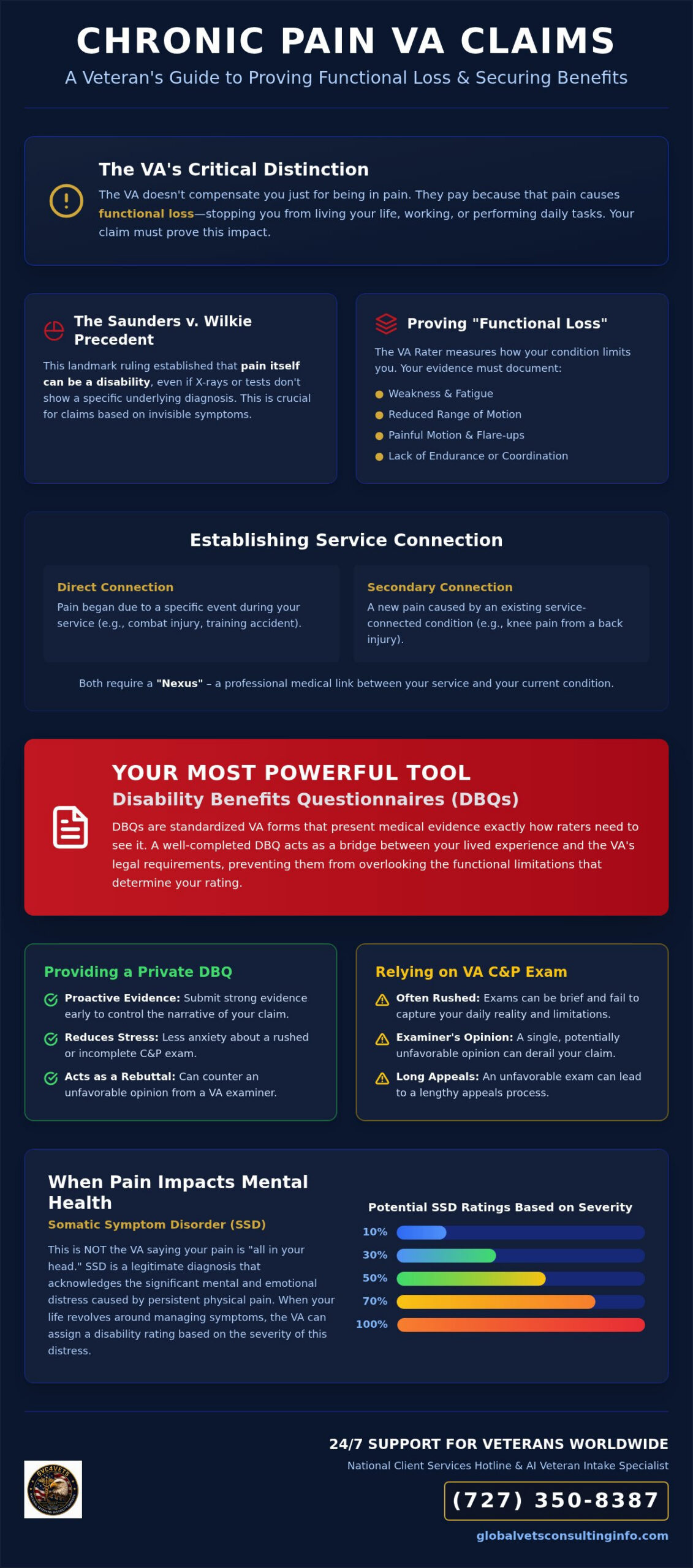
The VA doesn’t pay you because you’re in pain; they pay you because that pain stops you from living your life. It’s incredibly frustrating when an X-ray comes back clear while you’re struggling to tie your shoes or sit through a meal. You know your body is failing, but the system often treats invisible symptoms like they don’t exist. We understand the stress of a rushed C&P exam that fails to capture your daily reality. This guide will show you how to turn those struggles into a successful strategy for Chronic Pain VA Claims by focusing on functional loss and objective medical evidence.
As a veteran-owned organization, we provide worldwide support through our 24/7 National Client Services Hotline and 24/7 AI Veteran Intake Specialist at (727) 350-8387. You can also access educational resources at https://www.GlobalVetsConsultingInfo.com to learn how to secure a 10% to 100% rating based on functional loss. We’re going to break down the rating schedule and show you how to build a case the VA cannot easily dismiss. You deserve a clear, predictable path to the compensation you earned through your service.
Key Takeaways
- Learn how the Saunders v. Wilkie precedent allows for Chronic Pain VA Claims even without a specific diagnosis, provided there’s clear proof of functional loss.
- Use DBQs to stop raters from overlooking your medical evidence. These standardized forms are the most effective tools for documenting daily physical struggles.
- Discover how Somatic Symptom Disorder (SSD) allows for a mental health rating from 10% to 100% when persistent pain causes significant distress.
- Access our 24/7 National Client Services Hotline and 24/7 AI Veteran Intake Specialist at (727) 350-8387 or visit https://www.GlobalVetsConsultingInfo.com to learn how professional medical evidence strengthens your claim.
Understanding Chronic Pain VA Ratings & Eligibility in 2026 🇺🇸
The VA system historically ignored pain that couldn’t be pinned to a specific diagnosis. That changed with the landmark Saunders v. Wilkie ruling. This precedent established that pain itself can be a disability for Chronic Pain VA Claims, even if an X-ray shows nothing is wrong. In 2026, the rating schedule focuses on how musculoskeletal or neurological pain interferes with your ability to work and function. Common conditions like degenerative disc disease, arthritis, or nerve damage often trigger these claims, but the pain must be persistent and documented to qualify for compensation.
Direct vs. Secondary Service Connection for Pain
You can establish service connection in two ways. Direct connection means your pain started because of a specific event, like a fall during training or a combat injury. Secondary connection occurs when a service-connected condition, such as Tinnitus or a back injury, causes new pain elsewhere in the body. Both paths require a “Nexus,” which is a professional medical link between your service and your current state. We focus on educating veterans on how to secure the medical evidence needed for Chronic Pain VA Claims to prove these connections are legitimate and earned.
The “Functional Loss” Requirement
The VA rater isn’t just looking at your pain level on a scale of one to ten. They prioritize functional loss, which measures how your condition limits your range of motion, speed, or strength. Under the “De Luca” factors, you must document how flare-ups, fatigue, and weakness prevent you from performing daily tasks or maintaining employment. If you need assistance documenting these limitations, our 24/7 National Client Services Hotline and 24/7 AI Veteran Intake Specialist are available at (727) 350-8387. You can also find educational resources at learn more to help strengthen your claim and ensure your voice is heard.
The Critical Role of Disability Benefits Questionnaires (DBQs) in Chronic Pain Claims 🇺🇸
A Disability Benefits Questionnaire (DBQ) is often the most powerful asset in your claim file. It’s a standardized form designed to ensure that medical evidence is presented exactly how VA Raters need to see it. Understanding what is a dbq helps you realize that these forms prevent raters from “missing” the specific functional limitations that drive your rating. For Chronic Pain VA Claims, a well-completed DBQ acts as a bridge between your lived experience and the VA’s legal requirements.
Gathering Objective Medical Evidence
Professional medical documentation must go beyond just stating that you have pain. It needs to detail the severity of your limitations using standardized language. This means documenting exactly how much range of motion you’ve lost or how often flare-ups occur. Precise responses on these questionnaires leave little room for interpretation, which is vital when you’re seeking a rating increase. Taking control of your medical evidence education ensures your claim reflects the full scope of your service-connected conditions.
Private DBQs vs. VA C&P Examinations
Many veterans feel anxious about a VA-conducted C&P exam because it often feels rushed or incomplete. Providing your own private DBQ before the exam can significantly reduce this stress. It serves as a proactive piece of evidence and can even act as a rebuttal if the VA examiner’s opinion is unfavorable. You don’t have to wait for the VA to decide your future; submitting strong evidence early can help you avoid the long wait of the appeals process. Our 24/7 National Client Services Hotline and 24/7 AI Veteran Intake Specialist are available at (727) 350-8387 to provide the support you need as you navigate Chronic Pain VA Claims. You can find more resources at learn more.
Somatic Symptom Disorder vs. Physical Pain: Navigating Complex VA Criteria 🇺🇸
Many veterans feel dismissed when they’re told their symptoms are psychological. In reality, the VA recognizes Somatic Symptom Disorder (SSD) as a legitimate way to rate the mental toll of persistent physical agony. If your life revolves around your symptoms, the VA uses SSD to assign ratings of 10%, 30%, 50%, 70%, or 100%. This isn’t the VA saying your pain isn’t real; it’s an acknowledgment that the distress caused by that pain is a disability in itself. When filing Chronic Pain VA Claims, you must understand that the VA won’t “pyramid” ratings. This means you won’t get separate checks for the same functional loss, but an SSD rating can often capture a higher level of total impairment than a physical rating alone.
Documenting the Psychological Impact of Pain
Persistent pain rarely stays localized to the body; it often bleeds into your mental well-being. Chronic suffering frequently leads to secondary issues like severe depression, anxiety, and sleep disturbances. Utilizing a dbq for mental health conditions is essential here. This evidence proves to the rater that your physical condition has created a significant psychological burden that requires its own evaluation. It moves the conversation beyond just range of motion and into the reality of your mental health.
The Impact on Social and Industrial Impairment
The VA measures these claims by how much they interfere with your work and relationships. If your pain causes you to withdraw from family or makes it impossible to hold a steady job, these are the markers of “social and industrial impairment.” A thorough DBQ will highlight these specific struggles. If you need immediate guidance, our 24/7 AI Veteran Intake Specialist and 24/7 National Client Services Hotline are available at (727) 350-8387. You can also explore our educational resources at learn more to see how we support veterans worldwide. Our goal is to ensure your medical evidence accurately reflects the total impact of your service-connected conditions.
How to Strengthen Your Chronic Pain Claim with Professional Medical Evidence
Securing a rating for Chronic Pain VA Claims requires a methodical approach to evidence. First, you must comb through your service treatment records to identify every mention of pain or discomfort. These entries establish the initial event needed for service connection. Next, you need a professional Disability Benefits Questionnaire (DBQ) that captures your current functional loss. Instead of filing a standard claim, follow the va disability claims process step by step to submit a Fully Developed Claim (FDC). This allows the VA to make a decision based on the comprehensive evidence you provide upfront. Finally, use your private medical documentation as a study guide for your C&P exam so you can accurately describe your worst days to the examiner.
Winning the Evidence-Gathering Phase
Success depends on documentation. The VA rater often looks for a preponderance of evidence, so having multiple records of your limitations is always better than simply making new arguments without proof. Evidence is your leverage. If you’ve faced a va claim denied for lack of evidence, the solution is to fill those gaps with standardized medical forms. Providing objective data like range of motion measurements or frequency of flare-ups makes it much harder for the VA to justify a denial.
Partnering with Global Vets Consulting
We operate on a “Veterans Helping Veterans” model because we’ve been in your boots. Our goal is to simplify the administrative burden so you can focus on your health. You can access our 24/7 National Client Services Hotline or our 24/7 AI Veteran Intake Specialist at (727) 350-8387 for immediate support. Whether you’re just starting or trying to fix a past mistake, we provide the educational resources you need to succeed. Visit learn more to learn more about our worldwide support for Chronic Pain VA Claims. We’re here to help you secure the benefits you earned.
Take Control of Your Chronic Pain Claim Today 🇺🇸
You have the tools to change how the VA sees your condition. By focusing on functional loss and utilizing standardized DBQs, you move beyond subjective descriptions of pain into the objective medical evidence that raters require. Whether you’re navigating physical limitations or the psychological weight of Somatic Symptom Disorder, your path to a fair rating depends on the quality of your documentation. Chronic Pain VA Claims are won through meticulous preparation and the strategic use of professional medical evidence that clearly demonstrates your daily struggles to the rater.
We’re ready to stand by you as a mission-driven ally. As a veteran-owned and operated organization, we specialize in DBQ and medical evidence education designed to help you secure the benefits you earned. Ready to Secure the Evidence You Deserve? 🇺🇸 Visit Global Vets Consulting or call our 24/7 National Client Services Hotline and 24/7 AI Veteran Intake Specialist at (727) 350-8387 to get started worldwide. You don’t have to face this complex system alone; we’re here to help you move forward with confidence.
Frequently Asked Questions
Can I get a VA disability rating for chronic pain alone?
Yes, you can receive a rating for pain alone even if a doctor can’t find a specific diagnosis on an X-ray. The landmark Saunders v. Wilkie ruling established that pain is a disability when it causes functional loss. To succeed with Chronic Pain VA Claims, you must document how this pain limits your movement. Providing objective medical evidence is the most effective way to prove your case to a rater.
What is the maximum VA rating for chronic pain?
The maximum rating depends on how the VA classifies your condition and its impact on your life. While musculoskeletal pain often results in 10% or 20% ratings per joint, complex cases involving Somatic Symptom Disorder can reach 100%. Your rating is based on functional loss, range of motion, and frequency of flare-ups. We provide medical evidence education to help you document these limitations accurately for the best possible outcome.
How does the VA rate Somatic Symptom Disorder in 2026?
In 2026, the VA rates Somatic Symptom Disorder using the general formula for mental health conditions. Ratings are assigned at 10%, 30%, 50%, 70%, or 100% based on your level of social and industrial impairment. This rating captures the psychological distress caused by persistent pain. If you’re struggling with the mental impact of your condition, our 24/7 AI Veteran Intake Specialist at (727) 350-8387 can help you start the process.
Do I need a Nexus Letter for a chronic pain claim?
You must establish a “Nexus” or a medical link between your service and your current pain. While a formal letter is one option, a properly completed Disability Benefits Questionnaire (DBQ) often provides the necessary medical evidence to bridge this gap. This documentation proves your pain resulted from an in-service event or is secondary to another condition. You can find resources for establishing this connection at https://www.GlobalVetsConsultingInfo.com.
What should I do if my chronic pain claim was denied for lack of evidence?
If your claim was denied, don’t lose hope. Most denials occur because the veteran described how they felt instead of providing objective data. You should secure a private DBQ that details your functional loss for Chronic Pain VA Claims. Submitting a Fully Developed Claim with this new evidence is often faster than a traditional appeal. Call our 24/7 National Client Services Hotline at (727) 350-8387 for immediate support.

Article by
Willie Daniel
Willie Daniel is the Founder and Chief Executive Officer (CEO) of Global Vets Consulting (GVC4Vets) – National Veterans Disability Services, a veteran-led educational and medical evidence support organization dedicated to helping veterans better understand VA disability rating increases, DBQ medical evidence, secondary claims education, and C&P examination preparation.
He is a retired U.S. Army Medical Service Corps Officer with more than 27 years of honorable military service, a decorated Iraq combat veteran, and a retired federal official with the U.S. Department of Veterans Affairs. Throughout his military and federal career, Willie Daniel served in leadership, healthcare administration, operational, and veteran-support roles focused on improving services and support systems for servicemembers, veterans, and their families.
Drawing from decades of military leadership, healthcare administration, veteran advocacy, and federal government experience, Willie Daniel brings a practical, veteran-centered perspective to Global Vets Consulting’s educational articles, AI-powered veteran resources, video education initiatives, and outreach programs. His experience navigating military systems, medical documentation processes, and veteran-related administrative operations provides valuable insight into many of the challenges veterans face when seeking to better understand VA disability rating criteria, medical evidence, documentation strategies, and secondary condition education.
Through GVC’s “Veterans Helping Veterans” mission, his focus is on delivering clear, educational, and easy-to-understand information designed to empower veterans with knowledge, resources, and educational tools that may help them make more informed decisions regarding their individual VA disability journeys.
The information provided through GVC is intended for educational and informational purposes only and should not be considered legal or medical advice.
Disclaimer
Disclaimer: Global Vets Consulting, LLC (“GVC”) is a veteran-led educational and medical evidence support organization. GVC is not a law firm, is not a Veterans Service Organization (VSO), and is not affiliated with the U.S. Department of Veterans Affairs (VA) or any government agency.
Global Vets Consulting does not provide legal advice, medical advice, medical treatment, or healthcare services. GVC does not prepare, file, or submit VA disability claims on behalf of veterans. All information provided through this website, blog articles, videos, educational materials, AI tools, dashboards, templates, and communications is intended solely for general educational and informational purposes.
Veterans are encouraged to consult with accredited representatives, licensed attorneys, qualified medical providers, or Veterans Service Organizations regarding their specific legal, medical, or VA-related matters. VA disability decisions, ratings, and outcomes are determined solely by the U.S. Department of Veterans Affairs based on applicable laws, regulations, medical evidence, and individual circumstances. Past results do not guarantee future outcomes.