

A seizure diagnosis matters, but the documented pattern matters too. A Seizure Disorder VA Rating can depend on seizure type and frequency, so records that do not clearly describe episodes and their effects may leave important details out. If you are unsure how the VA classifies seizures or what evidence can clarify your history, start by reviewing the rating framework and the information your records contain.
This guide explains the general rating criteria and practical ways to document seizure frequency, treatment, and effects on daily life. It also explains how a Seizure Disorder DBQ may organize medical findings as supporting evidence. A DBQ cannot guarantee a particular rating or claim outcome. Global Vets Consulting is a veteran-owned, veteran-to-veteran resource that prepares Disability Benefits Questionnaires and provides medical evidence education. The 24/7 National Client Services Hotline and 24/7 AI Veteran Intake Specialist are both available at (727) 350-8387. Visit https://www.GlobalVetsConsultingInfo.com for guidance.
Key Takeaways
- The Seizure Disorder VA Rating depends on documented seizure patterns, not diagnosis wording alone.
- Compare the documented frequency of major and minor seizures with the VA’s general rating levels to understand the framework.
- Keep a consistent seizure log with episode details, recovery information, and witness accounts.
- A DBQ can organize clinical findings and functional effects as supporting evidence, but it cannot guarantee a rating or approval.
What Is the VA Seizure Disorder Rating Based On?
The Seizure Disorder VA Rating is evaluated under the neurological criteria in 38 CFR § 4.124a. The schedule considers seizure type and frequency. A diagnosis label by itself does not establish a percentage. The same condition name can describe different seizure patterns, so clear clinical documentation helps explain what is being evaluated.
The schedule includes Diagnostic Codes 8910-8914. These codes identify categories of seizure disorders, while the percentage is determined separately under the rating criteria. The applicable code depends on the documented condition. This overview is educational and cannot predict how the VA will decide an individual case.
How does the VA distinguish major and minor seizures?
In the schedule, major seizures generally refer to episodes involving generalized tonic-clonic convulsions with unconsciousness. Minor seizures cover other defined episodes, including brief interruptions in consciousness or conscious control and certain sudden movements. These are rating-schedule categories, not labels to assign based only on how an episode felt. Clinical documentation should describe the observed features and classification. For general background on epilepsy, see the Epilepsy Wikipedia article.
Which diagnostic codes cover seizure disorders?
Under 38 CFR § 4.124a, the schedule references:
- 8910: Epilepsy, grand mal.
- 8911: Epilepsy, petit mal.
- 8912: Jacksonian epilepsy.
- 8913: Diencephalic epilepsy.
- 8914: Psychomotor epilepsy.
These code descriptions identify the condition category, not the percentage. The rating level is determined separately under the schedule using the documented seizure pattern. Accurate medical records help connect the diagnosis and episode history to the relevant framework.
What Seizure Frequency Can Correspond to Each VA Rating?
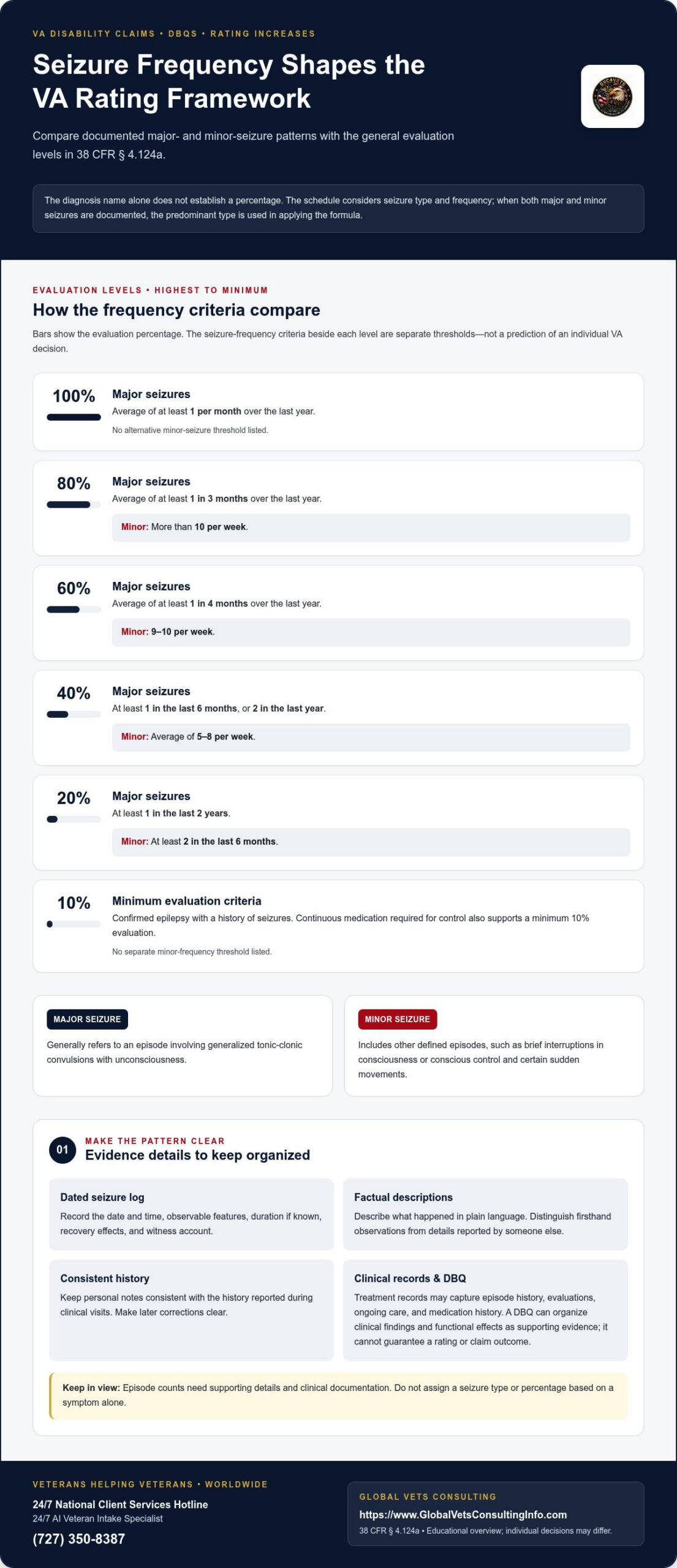
The general formula in 38 CFR § 4.124a compares seizure frequency over defined periods. The table summarizes the criteria, but it does not predict an individual VA decision. When both major and minor seizures are documented, the predominant seizure type is used in applying the formula.
How does the rating formula compare major and minor seizure frequency?
| Evaluation | Major-seizure pattern | Minor-seizure pattern |
|---|---|---|
| 100% | Average of at least one per month over the last year | No alternative minor-seizure threshold listed |
| 80% | Average of at least one in three months over the last year | More than 10 per week |
| 60% | Average of at least one in four months over the last year | 9-10 per week |
| 40% | At least one in the last six months, or two in the last year | Average of 5-8 per week |
| 20% | At least one in the last two years | At least two in the last six months |
| 10% | Confirmed epilepsy with a history of seizures; continuous medication required for control also supports a minimum 10% evaluation | No separate minor-frequency threshold listed |
Use dated records to show how the seizure history fits the schedule’s time windows. A timeline can make it easier to review when episodes occurred and how often they happened during each period.
Does the seizure rating depend only on the number of episodes?
Frequency is central to this formula, but episodes also need to be classified and documented. A number without supporting details may not show whether an episode meets a major- or minor-seizure category. Record what happened and when, then keep personal notes consistent with the history reported in clinical records. Do not assign a seizure type or percentage based on a symptom alone.
For VA epilepsy resources, visit the VA Epilepsy Centers of Excellence. Veterans seeking help understanding DBQs and medical evidence can explore VA claim evidence education.
How Can You Document Seizures and Their Impact Clearly?
A consistent record makes seizure patterns easier to review alongside medical evidence. Keep entries factual and chronological, and add details as soon as you can after an episode. If you did not witness the event yourself, identify who provided the information rather than presenting it as your own observation. Distinguishing firsthand observations from reported details helps keep the timeline clear.
What details belong in a seizure log?
Use the same fields for each entry. Record the date, observable episode details, duration if known, recovery effects, and any witness account. For example, describe what a witness saw and note whether the duration was timed or estimated. Avoid adding diagnostic labels or conclusions. Record the event rather than trying to classify it yourself.
- Date and time: Record when the episode occurred as precisely as you can.
- Observed features: Describe visible movements, awareness, and responsiveness in plain language.
- Duration and recovery: Note how long the episode lasted if known, and describe recovery afterward.
- Witness: Identify who observed the event and distinguish that person’s account from your own.
Keep personal notes consistent with the history you report during clinical visits. If you correct or clarify an entry later, make the change clear instead of silently altering the original details.
How can medical records and witness observations add context?
Treatment records may capture reported episode history, clinical evaluations, ongoing care, and medication history. Keep relevant records in date order so the timeline is easier to compare with your log. Do not change or stop medication based on claim documentation. Discuss treatment questions with your clinician.
A witness account can add context about observable events, but it does not replace a medical diagnosis or clinical assessment. Clear notes and clinical records together can help explain the pattern and its effects for a Seizure Disorder VA Rating. For help organizing medical evidence and DBQ information for a VA disability claim, explore VA claim evidence guidance.
How Can a DBQ Support Seizure Disorder Evidence?
A relevant Disability Benefits Questionnaire (DBQ) organizes medical findings in a consistent format for review. For a seizure-related claim, clinical documentation may describe the diagnosed condition, seizure classifications and frequency, treatment, and effects on daily functioning. Clear, accurate information can help show how the medical record relates to the rating criteria.
What can a DBQ clarify for a seizure-related claim?
A DBQ provides structured prompts for medical information. The appropriate documentation depends on the circumstances, and the findings should reflect the clinician’s assessment and available records, not assumptions or an effort to fit a particular rating level. A DBQ can be considered alongside treatment records, seizure logs, and other relevant evidence. It supports the record but does not replace it.
What should veterans understand before relying on a DBQ?
The VA reviews the full record and makes the rating determination. A DBQ does not guarantee approval or a particular Seizure Disorder VA Rating, and it cannot substitute for other relevant evidence. Its value depends on whether it accurately and clearly documents medical findings and functional information. Global Vets Consulting prepares DBQs and provides education about medical evidence to help veterans understand how these records fit together.
If you are organizing seizure-related documentation, learn more through DBQ and medical evidence guidance. The 24/7 National Client Services Hotline and 24/7 AI Veteran Intake Specialist are available at (727) 350-8387. Visit learn more for a veteran resource serving clients nationwide.
Take the Next Step With Clear Records
Start by reviewing the records you have gathered. Note questions about how they describe the condition, its history, or its effects. A focused review can help you identify details that may need clarification before you organize materials for a VA claim. Keep your account accurate and consistent, and direct medical questions to a qualified healthcare professional.
The VA determines a Seizure Disorder VA Rating, so no single document can promise a result. You can make sure the evidence you submit presents a clear, truthful picture and is organized for review. Before seeking guidance, write down the points you want to understand so the discussion can stay focused on your records and next steps.
🇺🇸 For veteran-to-veteran education on DBQs and medical evidence, visit Global Vets Consulting for DBQ and evidence guidance. Call the 24/7 National Client Services Hotline or connect with the 24/7 AI Veteran Intake Specialist at (727) 350-8387, or visit https://www.GlobalVetsConsultingInfo.com.
Frequently Asked Questions
What is the VA rating for a seizure disorder?
The VA’s general seizure rating levels range from 10% to 100%, depending on the documented seizure pattern and applicable criteria. For example, continuous medication required to control epilepsy may support a minimum 10% evaluation. The percentage is not determined by the diagnosis name alone. For a Seizure Disorder VA Rating, review whether the medical record clearly identifies the condition and describes the history relevant to the rating criteria.
Can a seizure disorder receive a 100% VA rating?
Yes. Under the general formula, a 100% evaluation corresponds to an average of at least one major seizure per month over the last year. The VA evaluates the evidence in the individual record, so this threshold is not an automatic award based on a count alone. The documented seizure classification and history must support the criteria, and the VA makes the final determination.
How does the VA count seizures for a disability rating?
The rating formula considers documented major- or minor-seizure frequency across specified periods, such as a month, several months, or a year. A dated timeline can help distinguish a cluster of episodes from a recurring pattern. Do not count uncertain events as confirmed seizures without appropriate documentation. Clearly identify reported estimates as estimates, and make any corrections to the timeline transparent.
Does a DBQ guarantee a higher seizure disorder VA rating?
No. A DBQ does not guarantee a higher evaluation or approval. It can present medical findings in an organized format, but the VA reviews the full record and decides the outcome. For example, if a DBQ describes a frequency that differs from treatment notes, the inconsistency may need clarification. The goal is accurate, consistent evidence, not wording designed to promise a particular percentage.
What evidence can help document a seizure disorder for a VA claim?
Relevant evidence may include clinical records describing evaluations and treatment, medication history, a contemporaneous seizure log, and accounts from people who observed episodes. Keep copies organized by date, and note which details are firsthand and which came from someone else. If records contain different descriptions or dates, identify the discrepancy and seek an accurate clarification for the record rather than guessing what happened.

Article by
Willie Daniel
Willie Daniel is the Founder and Chief Executive Officer (CEO) of Global Vets Consulting (GVC4Vets) – National Veterans Disability Services, a veteran-led educational and medical evidence support organization dedicated to helping veterans better understand VA disability rating increases, DBQ medical evidence, secondary claims education, and C&P examination preparation.
He is a retired U.S. Army Medical Service Corps Officer with more than 27 years of honorable military service, a decorated Iraq combat veteran, and a retired federal official with the U.S. Department of Veterans Affairs. Throughout his military and federal career, Willie Daniel served in leadership, healthcare administration, operational, and veteran-support roles focused on improving services and support systems for servicemembers, veterans, and their families.
Drawing from decades of military leadership, healthcare administration, veteran advocacy, and federal government experience, Willie Daniel brings a practical, veteran-centered perspective to Global Vets Consulting’s educational articles, AI-powered veteran resources, video education initiatives, and outreach programs. His experience navigating military systems, medical documentation processes, and veteran-related administrative operations provides valuable insight into many of the challenges veterans face when seeking to better understand VA disability rating criteria, medical evidence, documentation strategies, and secondary condition education.
Through GVC’s “Veterans Helping Veterans” mission, his focus is on delivering clear, educational, and easy-to-understand information designed to empower veterans with knowledge, resources, and educational tools that may help them make more informed decisions regarding their individual VA disability journeys.
The information provided through GVC is intended for educational and informational purposes only and should not be considered legal or medical advice.
Disclaimer
Disclaimer: Global Vets Consulting, LLC (“GVC”) is a veteran-led educational and medical evidence support organization. GVC is not a law firm, is not a Veterans Service Organization (VSO), and is not affiliated with the U.S. Department of Veterans Affairs (VA) or any government agency.
Global Vets Consulting does not provide legal advice, medical advice, medical treatment, or healthcare services. GVC does not prepare, file, or submit VA disability claims on behalf of veterans. All information provided through this website, blog articles, videos, educational materials, AI tools, dashboards, templates, and communications is intended solely for general educational and informational purposes.
Veterans are encouraged to consult with accredited representatives, licensed attorneys, qualified medical providers, or Veterans Service Organizations regarding their specific legal, medical, or VA-related matters. VA disability decisions, ratings, and outcomes are determined solely by the U.S. Department of Veterans Affairs based on applicable laws, regulations, medical evidence, and individual circumstances. Past results do not guarantee future outcomes.