
Submitting 500 pages of disorganized medical records won’t guarantee a win. In fact, burying a rater in a mountain of paperwork often leads to the very denial you’re trying to avoid. Most veterans believe that more is better, but the truth is that the VA rewards clarity over volume. You’ve likely felt the anxiety of wondering if you have enough medical evidence for va disability claim success or if a single missing document will result in a “lack of evidence” notification. It’s a common fear, especially when you’re navigating a system that processed over 1.5 million claims in the first half of fiscal year 2026 alone.
We understand the pressure of getting this right, and we’re here to help you cut through the confusion. You’re about to learn exactly which documents move the needle and how to present them so the VA can’t ignore your service connection. This guide provides a clear roadmap for 2026, covering everything from the updated VA Form 21-526EZ to the strategic use of Disability Benefits Questionnaires. By the end of this article, you’ll have a concrete plan to secure the VA rating increase you’ve earned and the peace of mind you deserve. 🇺🇸
Key Takeaways
- Identify the three essential pillars of a successful claim: a current diagnosis, a documented in-service event, and a clear medical nexus.
- Learn how to bridge the gap between your military service treatment records and civilian medical notes for a complete clinical picture.
- Discover how auditing your C-File helps you spot missing evidence before the VA uses it to justify a denial.
- Understand why submitting a private DBQ provides the most robust medical evidence for va disability claim success in the current 2026 landscape.
- Apply specific organization strategies to transform disorganized medical notes into a streamlined case for a rating increase.
Understanding Medical Evidence for VA Disability Claim Requirements
Medical evidence for va disability claim success is the clinical proof needed to turn your service history into a successful rating. It is not just a stack of papers; it is the objective data that substantiates your physical or mental limitations. You earned these benefits through your service. Meticulous documentation is how you ensure the VA recognizes that duty. 🇺🇸
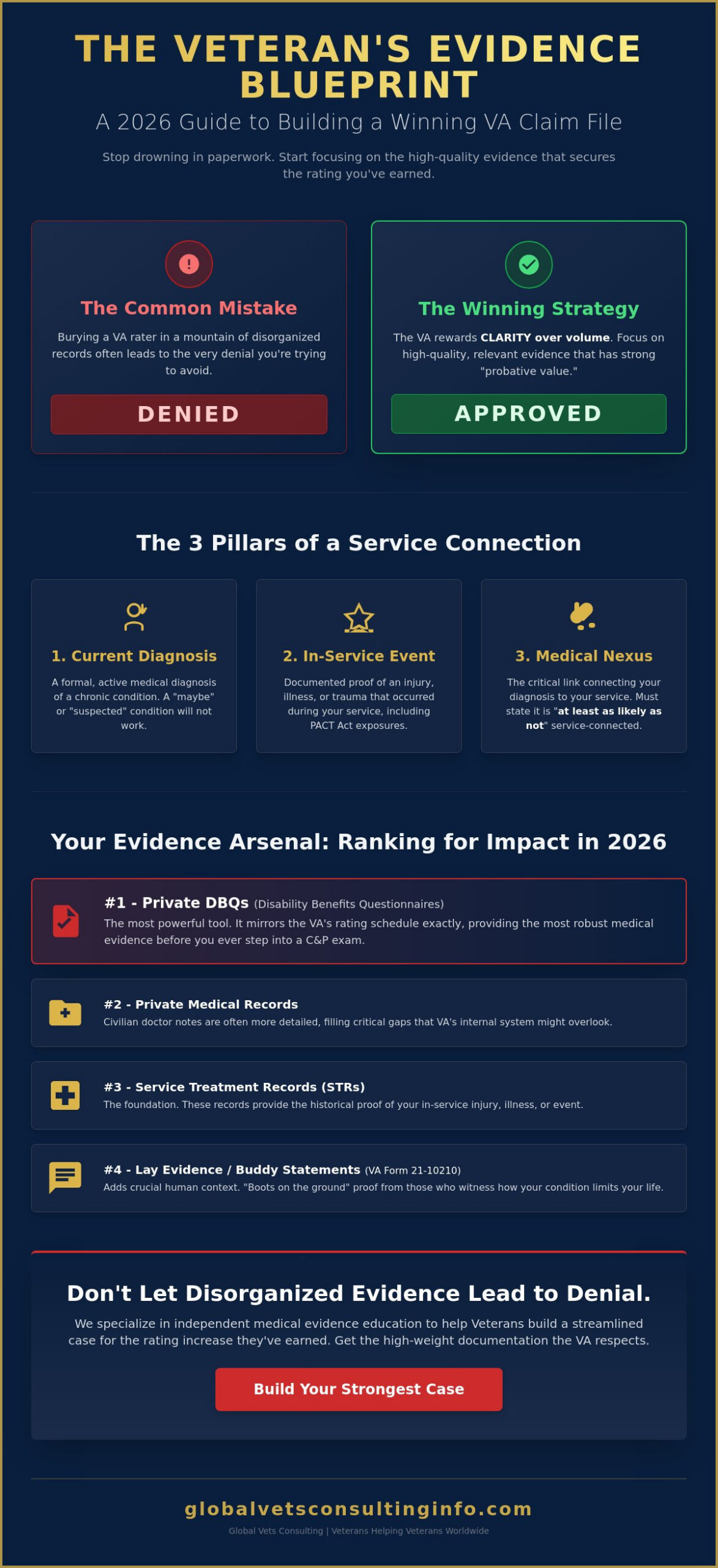
In 2026, the VA has shifted its focus. Raters now prioritize “probative value” over the sheer volume of pages. This means your evidence must be high-quality, relevant, and legally sufficient. To secure a service connection, your file must satisfy three specific requirements:
- Current Diagnosis: A formal medical finding of a chronic condition. A “maybe” or “suspected condition” will not work. You need a clear, active diagnosis supported by clinical findings.
- In-Service Event: Documentation of the specific injury, illness, or trauma that occurred during your service. This includes chronic exposure events now recognized under the PACT Act.
- The Medical Nexus: The clinical link connecting your current diagnosis to your time in uniform. This is the critical bridge that proves your disability didn’t start after you took off the uniform.
The Three Pillars of a Successful Service Connection
Your claim stands or falls on these three elements. Missing even one pillar usually leads to an immediate denial. For example, understanding the VA disability benefits process reveals how the VA evaluates specific conditions like PTSD using these exact criteria. 📄
A “maybe” from a doctor is not enough for the VA. You need precise, definitive language. The medical nexus must state your condition is “at least as likely as not” caused by your service. Using a structured approach to your evidence is the most effective way to provide a predictable path for the rater to follow. 🌎
By focusing on the probative value of your records, you reduce the risk of a “lack of evidence” denial. Every document in your packet should serve to strengthen one of these three pillars. This meticulousness is what separates a successful rating from a frustrating denial. 📞
Types of Evidence: From Service Records to Private DBQs
Not all documents carry the same weight in the eyes of a rater. To build a bulletproof file, you need a diverse range of medical evidence for va disability claim success. This isn’t just about showing you’re in pain; it’s about providing the specific evidence to support your claim that matches the VA’s legal criteria. Every document you submit should serve a specific purpose in proving your service connection or the severity of your symptoms.
Service Treatment Records (STRs) are your foundation. They provide the historical proof of your in-service event. If your STRs are missing a specific injury, you’ll need to work harder to establish service connection through other means. Private medical records are often more detailed than VA health notes. Civilian doctors typically have more time to document the nuances of your symptoms; these records fill the gaps that the VA’s internal system might overlook.
Lay evidence, or “buddy statements,” uses VA Form 21-10210 to add human context. While a doctor sees you for 15 minutes, your spouse or fellow service member sees you every day. Their testimony provides “boots on the ground” proof of how your condition limits your life. 📄
Disability Benefits Questionnaires (DBQs) are perhaps the most powerful tool in your arsenal. They’re designed to mirror the VA’s rating schedule exactly. If you’re new to this process and asking what is a DBQ for VA claims and how it can affect your rating, understanding this form is the first step toward taking control of your evaluation. Using a private DBQ ensures your condition is evaluated thoroughly before you ever step foot in a C&P exam. This proactive approach prevents the VA from relying solely on a potentially rushed government examination. Veterans with spinal injuries should also be aware that nerve damage may qualify as a separate ratable condition — understanding radiculopathy secondary to back condition can reveal additional benefits many veterans unknowingly leave on the table.
Medical Evidence vs. Lay Evidence: Knowing the Difference
Think of lay evidence as the “when and how” of your story. It sets the scene and provides the narrative. Medical evidence proves the “what and how bad” through clinical data and objective findings. Combining both creates a 360-degree view of your disability that is difficult for a rater to ignore. Global Vets Consulting specializes in independent medical evidence education to help you secure the high-weight documentation the VA respects. 🤝 🇺🇸
How to Gather and Organize Your Evidence Successfully
Success starts with taking full control of your records. While the VA offers to gather documents for you, this often leads to significant delays or missed files that can stall your progress for months. By collecting your own medical evidence for va disability claim, you ensure the rater sees exactly what you want them to see. This proactive approach turns a passive waiting game into a strategic mission to secure your rating. 🇺🇸
- Step 1: Obtain your C-File. Your Claims File is the master record of everything the VA knows about you. You can’t fix gaps in your history if you haven’t seen the current file.
- Step 2: Audit your Service Treatment Records. Review your STRs for specific in-service stressors. Ensure every injury or illness you’re claiming has a corresponding entry in your military history.
- Step 3: Secure an Independent Medical Opinion. A private assessment or DBQ provides a current, objective view of your health that mirrors the VA’s requirements.
- Step 4: Submit a Fully Developed Claim. Organizing your packet into an FDC tells the VA you have provided all Evidence Needed For Your Disability Claim, which can lead to a faster decision.
Avoiding the “Lack of Evidence” Denial
The most frequent error we see is submitting a claim without a formal, current diagnosis. If you tell the VA your back hurts but don’t have a doctor’s diagnosis for a specific condition, your claim is dead on arrival. “VA Math” also requires extreme precision. For musculoskeletal issues, the VA looks for specific measurements like range of motion. A properly completed DBQ captures these metrics, whereas a standard doctor’s note might just say you’re “sore.” This lack of detail is a primary reason for low ratings. Veterans with back conditions should also consider whether shooting pain or numbness in the extremities may qualify as radiculopathy secondary to back condition, a separately ratable neurological impairment that many veterans overlook. For more on high-stakes errors, read our guide on 7 Critical VA Disability Claim Mistakes to Avoid. 📄
Don’t leave your future to chance. If you’re ready to build a stronger case, explore our medical evidence education resources today to see how we can help you organize your claim for success. 📞 🌎
Why Private DBQs Are the Best Evidence for VA Claims in 2026
The current landscape of disability compensation rewards clarity and technical precision. While the VA has made progress in processing times, the quality of individual examinations can vary significantly. A private DBQ stands as the most effective form of medical evidence for va disability claim success because it guarantees a thorough clinical review. Unlike a standard C&P exam, which may be conducted by a contractor in a brief window, a private evaluation ensures that every symptom is captured according to the VA’s own rating schedule. 🇺🇸
Control is the primary advantage of this approach. When you utilize Disability Benefits Questionnaires from an independent source, you can review the clinical findings before they are submitted. This allows you to ensure that measurements like range of motion or the frequency of flare-ups are recorded accurately. This proactive step prevents the common “surprise” denial that occurs when a government examiner fails to document the full severity of your condition. 📄
Partnering with Global Vets Consulting — Worldwide — for Professional Documentation
Global Vets Consulting — Worldwide — operates with a “Veterans Helping Veterans” mission at its core. We understand that your rating is more than just a number; it is the support you earned through your service. Our streamlined process focuses on high-stakes medical evidence education to ensure your documentation meets the VA’s strict 2026 probative value standards. We provide specialized resources for complex secondary claims, such as migraines and sleep apnea, ensuring your paperwork is meticulous from the start. 🌎
Don’t leave your financial future to chance or a rushed examination. Secure the evidence required to substantiate your symptoms and protect your earned benefits. 📞
Contact Us 24/7:
National Client Services Hotline: [Insert Phone Number]
24/7 AI Veteran Intake Specialist: GlobalVetsConsultingInfo.com
Secure Your Rating with Meticulous Evidence
Securing your benefits requires more than just filling out forms; it demands a strategic assembly of the right facts. You now have the roadmap to identify the three pillars of service connection and the steps to audit your own records. By prioritizing high-quality medical evidence for va disability claim success, you eliminate the guesswork that often leads to years of appeals. Organizing your records into a Fully Developed Claim is the most direct path to overcoming current processing delays and securing the rating you deserve.
Global Vets Consulting — Worldwide — has been veteran-owned and operated since 2021. We provide the expertise and resources needed to navigate a complex system with confidence. Our commitment to your success includes:
- 24/7 National Client Services Hotline: Immediate support whenever you need it.
- DBQ Specialists: Technical accuracy focused on Disability Benefits Questionnaires.
- Tech-Forward Solutions: Modern intake tools to streamline your evidence gathering.
Don’t leave your financial future to a rushed government exam. Provide the VA with a clear, clinical roadmap of your condition that they cannot ignore. 🇺🇸
🇺🇸 Get the Medical Evidence You Need—Start Your DBQ with Global Vets Consulting Today
You served your country with honor. Now, it is time to secure the compensation you’ve earned. We are ready to stand with you as your steady guide and advocate. 🌎
Frequently Asked Questions
What is the most important medical evidence for a VA claim?
The medical nexus is the most critical piece of documentation because it legally links your current diagnosis to your military service. Without a clear statement from a medical professional confirming this connection, the VA will likely deny your claim as a non-service-connected issue. High-quality nexus letters or DBQs that use the specific “at least as likely as not” language provide the probative value raters require to approve your benefits. 📄
Can I use a private doctor for medical evidence instead of a VA doctor?
You absolutely can use a private doctor to gather medical evidence for va disability claim requirements. Civilian physicians often provide more comprehensive notes and specific measurements than what is found in standard VA treatment records. This is particularly useful when filing for a rating increase, as private doctors can take the time to complete a detailed DBQ that accurately reflects your daily functional limitations. 🇺🇸
What happens if the VA says there is “no medical evidence” for my claim?
Receiving a “no medical evidence” notification typically means the rater couldn’t find a formal diagnosis or a clear link to your service. To fix this, you should audit your C-File to see what is missing and then secure an Independent Medical Opinion. This new evidence can be submitted as a Supplemental Claim to restart the process with the facts the VA originally overlooked. 📞
Do buddy statements count as medical evidence?
Buddy statements are considered lay evidence rather than medical evidence. While they don’t provide a clinical diagnosis, they are essential for proving the “when and how” of an in-service stressor. Use VA Form 21-10210 to have friends or family describe your symptoms. This testimony supports your clinical records by showing how your condition affects your life outside of a 15-minute doctor’s appointment. 🤝
How far back should my medical evidence go for a secondary claim?
Your medical evidence for va disability claim success in a secondary filing should focus on the period when the new condition began as a result of your primary disability. You need to show a continuous timeline of treatment from the onset of the secondary issue to the present day. This helps establish that the new condition is a direct complication of your already rated service-connected disability. 🌎
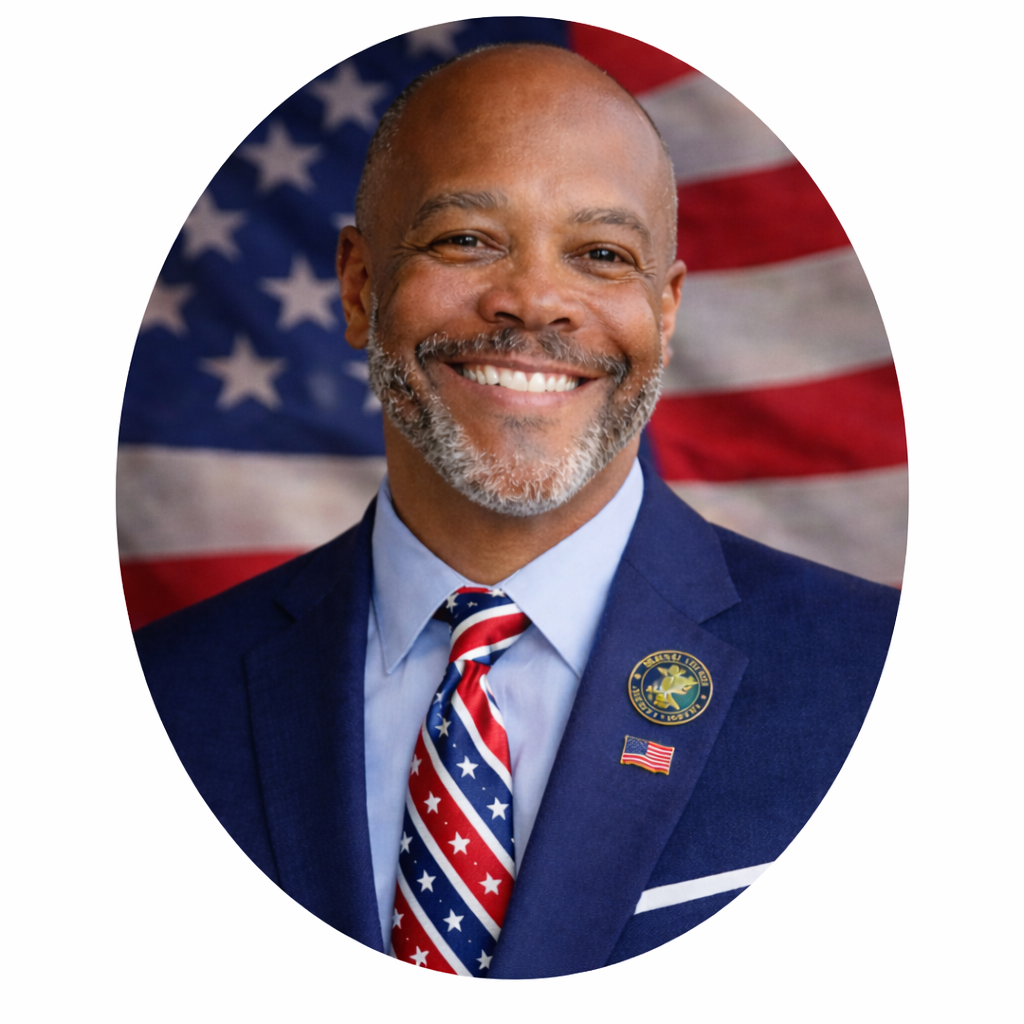
Article by
Willie Daniel
Willie Daniel is the Founder and Chief Executive Officer (CEO) of Global Vets Consulting (GVC) – National Veterans Disability Services, a veteran-led educational and medical evidence support organization dedicated to helping veterans better understand VA disability rating increases, DBQ medical evidence, secondary claims education, and C&P examination preparation.
He is a retired U.S. Army Medical Service Corps Officer with more than 27 years of honorable military service, a decorated Iraq combat veteran, and a retired federal official with the U.S. Department of Veterans Affairs. Throughout his military and federal career, Willie Daniel served in leadership, healthcare administration, operational, and veteran-support roles focused on improving services and support systems for servicemembers, veterans, and their families.
Drawing from decades of military leadership, healthcare administration, veteran advocacy, and federal government experience, Willie Daniel brings a practical, veteran-centered perspective to Global Vets Consulting’s educational articles, AI-powered veteran resources, video education initiatives, and outreach programs. His experience navigating military systems, medical documentation processes, and veteran-related administrative operations provides valuable insight into many of the challenges veterans face when seeking to better understand VA disability rating criteria, medical evidence, documentation strategies, and secondary condition education.
Through GVC’s “Veterans Helping Veterans” mission, his focus is on delivering clear, educational, and easy-to-understand information designed to empower veterans with knowledge, resources, and educational tools that may help them make more informed decisions regarding their individual VA disability journeys.
The information provided through GVC is intended for educational and informational purposes only and should not be considered legal or medical advice.
Disclaimer
Disclaimer: Global Vets Consulting, LLC (“GVC”) is a veteran-led educational and medical evidence support organization. GVC is not a law firm, is not a Veterans Service Organization (VSO), and is not affiliated with the U.S. Department of Veterans Affairs (VA) or any government agency.
Global Vets Consulting does not provide legal advice, medical advice, medical treatment, or healthcare services. GVC does not prepare, file, or submit VA disability claims on behalf of veterans. All information provided through this website, blog articles, videos, educational materials, AI tools, dashboards, templates, and communications is intended solely for general educational and informational purposes.
Veterans are encouraged to consult with accredited representatives, licensed attorneys, qualified medical providers, or Veterans Service Organizations regarding their specific legal, medical, or VA-related matters. VA disability decisions, ratings, and outcomes are determined solely by the U.S. Department of Veterans Affairs based on applicable laws, regulations, medical evidence, and individual circumstances. Past results do not guarantee future outcomes.