
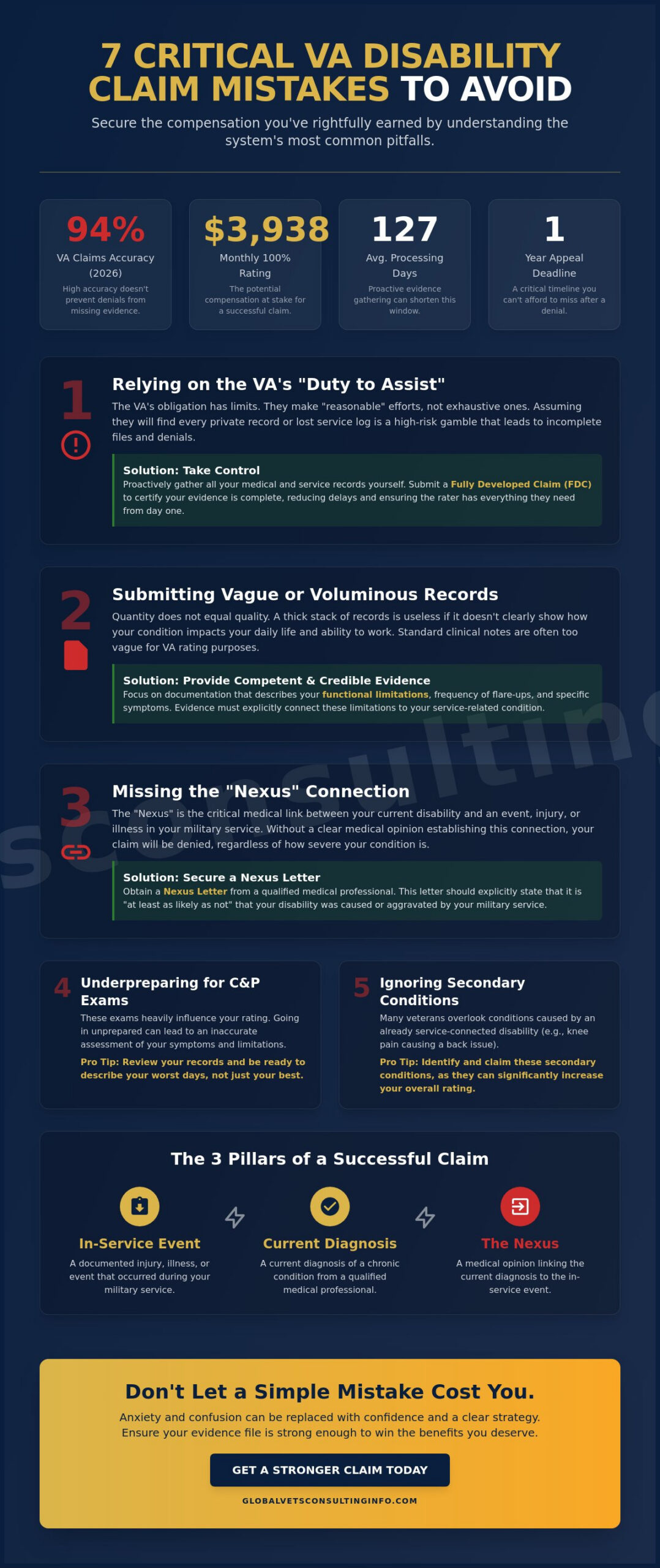
Did you know that even as the VA’s claims processing accuracy reaches 94.02% in 2026, thousands of veterans still receive a 0% rating or a flat denial because of a single missing link in their evidence? It’s a hard truth that success in the VA system isn’t about the sheer volume of records you submit, but the precision of the medical documentation provided. If you’re feeling overwhelmed by complex terminology or the pressure of a one-year appeal deadline, you aren’t alone. Understanding the specific va disability claim mistakes to avoid is the first step toward securing the $3,938 monthly compensation a 100% rating now provides.
We’re here to provide a steady guide through this bureaucratic maze. By learning to avoid these seven critical errors, you’ll gain a clear understanding of filing requirements and the knowledge needed to build a stronger evidence file. This guide outlines the specific steps to take so you can replace anxiety with confidence, ensuring you receive the compensation you have rightfully earned. We’ll preview how to navigate the 127-day average processing window and approach your C&P exam with the confidence of a veteran who is fully prepared for the road ahead.
Key Takeaways
- Learn why relying on the VA’s duty to assist often results in missing evidence and how you can take charge of your medical documentation.
- Discover the most critical va disability claim mistakes to avoid to ensure your symptoms are accurately reflected in your final rating.
- Understand the specific language required to meet the VA’s standards for competent and credible medical evidence.
- Find out how to identify secondary conditions and prepare for C&P examinations to secure the benefits you deserve.
- Follow a structured 5-step checklist to verify your evidence file and establish a clear service connection through a Nexus Letter.
Myth: The VA is Legally Required to Find Your Evidence
One of the most persistent misconceptions in the veteran community is that the VA acts as your personal researcher. While the Veterans Benefits Administration operates under a legal Duty to Assist, this obligation has practical boundaries that often surprise applicants. If you assume the VA will track down every missing private medical record or hunt for lost service logs, you risk significant delays or an outright denial. It’s your claim, and taking ownership of the evidence is the most reliable way to protect your outcome.
To better understand the common errors that can derail your progress, watch this helpful video:
The Reality of the Duty to Assist
The VA is required to make reasonable efforts to obtain records you identify, but “reasonable” doesn’t mean “exhaustive.” If a private provider doesn’t respond to a records request or a military archive is backlogged, the VA may move forward with the evidence they have on hand. This is one of the primary va disability claim mistakes to avoid. Relying on a third party to prove your case often backfires. When service records are missing or incomplete, your claim can stall for months while the system waits for a response that may never come. Taking a passive approach puts your effective date and your rating at risk.
Taking Control of Your Evidence File
Proactive evidence gathering is the most effective way to ensure a fast, accurate decision. By submitting a Fully Developed Claim (FDC), you certify that you’ve included all necessary evidence at the time of filing. This differs from a standard claim where you ask the VA to find records for you. Understanding the benefits of a fully developed claim can help you move the burden of proof into your own hands and avoid the “Evidence Gathering” loop that often leads to denials or lowballed ratings. Taking this initiative reduces the burden on the rater and minimizes the back-and-forth communication that causes frustration. You can learn more about organizing your submission by following the VA disability claims process step by step. Personally submitting your medical documentation ensures that nothing is left to chance and that your file is comprehensive from day one.
The Evidence Trap: Why Vague Medical Records Lead to Denials
Many veterans believe that submitting a thick stack of medical records is the best way to prove their case. However, quantity does not equal quality in the eyes of the VA. The system requires evidence to be “competent and credible,” meaning it must come from a qualified source and provide believable facts that support your diagnosis. One of the most frequent va disability claim mistakes to avoid is providing records that describe your treatment but fail to document your functional limitations. If the rater cannot see how your condition impacts your daily life or work, they cannot assign an accurate rating. To understand exactly how to organize and present the right documentation, review this comprehensive guide on medical evidence for va disability claim success in 2026.
A successful claim also requires a “nexus,” which is the formal medical link between your current disability and your military service. Without this bridge, even the most severe symptoms will result in a denial. The official VA guide on filing a claim outlines the basic requirements, but it often stops short of explaining how to translate clinical findings into the specific language used by raters. This gap is where many well-intentioned claims fall apart.
The Problem with Standard Clinical Notes
Doctors write notes to facilitate your healthcare, not to satisfy a bureaucratic rating schedule. They often use shorthand like “patient is stable” or “symptoms are well-managed” to indicate that a treatment plan is working. While these are positive signs for your health, a VA rater may interpret “stable” as an indication that your condition has improved enough to warrant a lower rating. Standard notes frequently omit critical details like your specific range of motion, the frequency of flare-ups, or how a condition prevents you from maintaining gainful employment.
The Solution: Standardized Medical Documentation
To ensure your records meet the necessary legal standards, you should consider using documentation designed specifically for the claims process. This is where understanding what is a dbq (Disability Benefits Questionnaire) becomes vital. These forms are structured to capture every data point the VA requires to make a decision. By utilizing educational resources for independent medical evidence, you can learn how to present your medical history with the precision needed to avoid vague assessments. This proactive approach ensures that your evidence file is both comprehensive and compliant with the VA’s strict rating criteria.
Procedural Pitfalls: C&P Exams, Deadlines, and Secondary Conditions
Missing a scheduled Compensation & Pension (C&P) examination is the single most common reason for an immediate claim denial. Even if you have submitted thorough documentation, the VA views a no-show as a lack of cooperation. In 2026, with the average claim taking approximately 127 days to process, a single missed appointment can set your progress back by months or force you to restart the entire application. These logistical errors are primary va disability claim mistakes to avoid if you want to maintain your place in the processing queue.
Timing is equally critical for preserving your effective date. You generally have exactly one year from the date of a VA decision to file an appeal. Missing this window means losing your original filing date and potentially thousands of dollars in back pay. Following the Official VA Claim Filing Guide ensures you use the correct forms for supplemental claims or higher-level reviews, which currently average 90 to 125 days for a decision. Utilizing an “Intent to File” form also provides a one-year buffer to gather evidence while locking in your start date for benefits.
Maximizing Your Claim with Secondary Conditions
Many veterans leave earned benefits on the table by only filing for primary conditions. A secondary condition is a disability caused or aggravated by an existing service-connected issue. For instance, chronic tinnitus often leads to severe migraines, while musculoskeletal injuries can cause digestive issues due to long-term medication use. If you don’t screen for these connections, you aren’t presenting the full scope of your disability to the rater. Identifying these links is a vital part of building a comprehensive file.
Navigating the C&P Exam Successfully
During the exam, you must be transparent about your limitations. Don’t downplay your symptoms or “tough it out.” Describe your “worst day” rather than how you feel at that specific moment. If an examiner ignores your private evidence or conducts a perfunctory review, document the experience immediately. You have the right to challenge an insufficient exam by submitting a statement for the record. To better prepare for these high-stakes appointments, explore our C&P examination preparation education to ensure you walk into the room with confidence and a clear plan.
Strategic Filing: How to Prevent Errors Before They Happen
The best way to handle a claim denial is to prevent it from happening in the first place. While the VA system is complex, most denials stem from preventable oversights in the initial evidence package. By adopting a proactive strategy, you shift from a reactive stance to one of steady confidence. Understanding the va disability claim mistakes to avoid allows you to submit a file that is so thorough it leaves little room for interpretation or error by the rater. Precision at the start of the process is the most effective way to secure a predictable path forward.
The Final Review Checklist
Before you hit submit, you must verify that your package is complete and compliant with 2026 standards. A single missing signature or an outdated form can result in an immediate administrative rejection. Use this five-step checklist to ensure your file is ready for review:
- Current Diagnosis: Confirm you have a formal medical diagnosis for every condition listed.
- Service Connection: Verify you’ve included records that place you at the scene of the event or injury during service.
- Symptom Severity: Ensure your medical notes describe your “worst days” and functional limitations.
- Correct Forms: Double-check that you are using the most current 2026 versions of all VA documentation.
- Nexus Letter: Include a formal medical opinion that links your current diagnosis to your military service.
Professional Support for Accurate Evaluations
A Nexus Letter acts as the “why” behind your claim, while a Disability Benefits Questionnaire (DBQ) provides the “how much” regarding your rating. These documents are the gold standard for evidence because they use the specific terminology raters look for. When you rely solely on standard clinical notes, you risk an examiner misinterpreting your condition. Standardized documentation bridges this gap by ensuring every symptom is recorded with meticulous accuracy.
At Global Vets Consulting, we specialize in helping veterans navigate these complexities through comprehensive education and resource awareness. We provide the tools you need to build a stronger evidence file, from independent medical evidence education to specialized resources for secondary conditions. By choosing to partner with Global Vets Consulting for professional DBQ support, you ensure your claim is supported by the high-quality documentation necessary for a successful outcome. Don’t leave your benefits to chance when you can move forward with a clear, evidence-based strategy.
Take Command of Your VA Claim Journey
Navigating the complex administrative landscape of the VA requires more than just persistence; it requires a strategic approach to your medical evidence. You’ve seen how relying solely on the VA’s duty to assist or submitting vague clinical notes can lead to unnecessary delays and lower ratings. By identifying the specific va disability claim mistakes to avoid, you position yourself to receive the compensation that accurately reflects your service-connected conditions. Success depends on the meticulousness of your documentation and your ability to bridge the gap between your military history and your current physical or mental health needs.
As a veteran-owned and operated team, Global Vets Consulting understands the weight of this process. We specialize in standardized medical documentation and maintain a proven track record in supporting complex VA claims with precision. Our focus is on providing the education and resources you need to present a clear, undeniable link to your service. Secure your earned benefits with professional DBQ documentation from Global Vets Consulting today.
You served your country with honor, and now it’s time to ensure the system respects that sacrifice. With the right evidence and a steady guide, you can move forward with the confidence that your future is secure and your contributions are recognized.
Frequently Asked Questions
What is the most common reason for a VA disability claim denial?
The most common reason for a VA disability claim denial is a lack of medical evidence linking your condition to your military service. This is one of the primary va disability claim mistakes to avoid during your initial submission. Many veterans fail to establish a clear “nexus” or medical bridge between their diagnosis and their time in uniform. Without this documentation, the VA cannot legally grant service connection. Ensuring your file contains precise medical language is essential.
Can I submit my own medical evidence to the VA instead of a C&P exam?
You can submit your own independent medical evidence, such as a completed Disability Benefits Questionnaire (DBQ), to support your claim. While this provides the rater with high-quality documentation, the VA still reserves the right to order a Compensation & Pension (C&P) examination. Submitting thorough evidence upfront through a Fully Developed Claim can sometimes reduce the need for additional exams, but you must attend any scheduled VA appointments to avoid an automatic claim denial.
How do I avoid missing critical deadlines in the VA claims process?
You can avoid missing critical deadlines by submitting an “Intent to File” form as soon as you decide to seek benefits. This action locks in your effective date and grants you a one-year window to gather evidence and complete your submission. Additionally, you must track the one-year appeal deadline that starts the day the VA issues a decision. Using a calendar to monitor these 365-day periods ensures you don’t lose your earned benefits or back pay.
What happens if I forget to list a secondary condition on my initial claim?
If you forget to list a secondary condition, you can file a new claim for that specific disability at any time. You don’t need to wait for your initial claim to finish, though it’s often more efficient to include them together. Identifying these related issues is one of the top va disability claim mistakes to avoid because secondary conditions often contribute significantly to your total rating. You should submit new medical evidence that establishes a clear connection between the conditions.
Is it a mistake to file for a VA rating increase without new evidence?
Filing for a VA rating increase without new medical evidence is a significant risk because it triggers a re-evaluation of your current condition. If your medical records don’t show that your symptoms have worsened since your last rating, the VA may decide your condition has improved and reduce your benefits. You should always ensure you have recent documentation, such as a new DBQ, that clearly demonstrates increased functional impairment before requesting a higher percentage from the rater.

Article by
Willie Daniel
Willie Daniel is the Founder and Chief Executive Officer (CEO) of Global Vets Consulting (GVC) – National Veterans Disability Services, a veteran-led educational and medical evidence support organization dedicated to helping veterans better understand VA disability rating increases, DBQ medical evidence, secondary claims education, and C&P examination preparation.
He is a retired U.S. Army Medical Service Corps Officer with more than 27 years of honorable military service, a decorated Iraq combat veteran, and a retired federal official with the U.S. Department of Veterans Affairs. Throughout his military and federal career, Willie Daniel served in leadership, healthcare administration, operational, and veteran-support roles focused on improving services and support systems for servicemembers, veterans, and their families.
Drawing from decades of military leadership, healthcare administration, veteran advocacy, and federal government experience, Willie Daniel brings a practical, veteran-centered perspective to Global Vets Consulting’s educational articles, AI-powered veteran resources, video education initiatives, and outreach programs. His experience navigating military systems, medical documentation processes, and veteran-related administrative operations provides valuable insight into many of the challenges veterans face when seeking to better understand VA disability rating criteria, medical evidence, documentation strategies, and secondary condition education.
Through GVC’s “Veterans Helping Veterans” mission, his focus is on delivering clear, educational, and easy-to-understand information designed to empower veterans with knowledge, resources, and educational tools that may help them make more informed decisions regarding their individual VA disability journeys.
The information provided through GVC is intended for educational and informational purposes only and should not be considered legal or medical advice.
Disclaimer
Disclaimer: Global Vets Consulting, LLC (“GVC”) is a veteran-led educational and medical evidence support organization. GVC is not a law firm, is not a Veterans Service Organization (VSO), and is not affiliated with the U.S. Department of Veterans Affairs (VA) or any government agency.
Global Vets Consulting does not provide legal advice, medical advice, medical treatment, or healthcare services. GVC does not prepare, file, or submit VA disability claims on behalf of veterans. All information provided through this website, blog articles, videos, educational materials, AI tools, dashboards, templates, and communications is intended solely for general educational and informational purposes.
Veterans are encouraged to consult with accredited representatives, licensed attorneys, qualified medical providers, or Veterans Service Organizations regarding their specific legal, medical, or VA-related matters. VA disability decisions, ratings, and outcomes are determined solely by the U.S. Department of Veterans Affairs based on applicable laws, regulations, medical evidence, and individual circumstances. Past results do not guarantee future outcomes.