

Your VA rating for eczema depends less on how your skin looks during a short exam and more on the intensity of the medical intervention you’ve required over the last twelve months. You’ve likely felt the frustration of a C&P examiner downplaying a severe flare-up because your skin happened to be clear on the day of your appointment. It’s common to feel that the system doesn’t account for the daily reality of living with chronic dermatitis or the confusion surrounding what qualifies as “systemic therapy” under current regulations. This guide will help you master the specific criteria for the va rating for eczema so you can secure the highest possible disability percentage based on your medical evidence. We’ll break down the requirements for the 30% and 60% ratings, including the 2026 COLA adjustments that now provide $1,435.02 per month for a veteran rated at 60%. You’ll learn how to calculate body surface area under Diagnostic Code 7806 and discover a strategy for documenting flare-ups that turns subjective symptoms into objective proof for your claim.
Key Takeaways
- Understand the specific requirements of Diagnostic Code 7806 to identify which rating tier aligns with your current medical evidence.
- Learn why transitioning from topical creams to systemic therapies like phototherapy or biologics is often the primary factor in securing a higher va rating for eczema.
- Master the “Palm Method” to accurately estimate your percentage of body coverage for both exposed areas and your entire body.
- Discover how a private Disability Benefits Questionnaire (DBQ) provides the longitudinal evidence needed to capture fluctuating symptoms that a single C&P exam might miss.
- Identify the critical documentation requirements for constant versus intermittent therapy to ensure your medical records reflect the true severity of your condition.
Understanding the VA Disability Rating for Eczema (Diagnostic Code 7806)
The Department of Veterans Affairs views skin conditions through a specific lens of severity and treatment intensity. When you apply for a va rating for eczema, the adjudicator evaluates your symptoms using the General Rating Formula for the Skin. Diagnostic Code 7806 serves as the governing criteria for all dermatitis-related claims; it ensures that your symptoms are measured against a standardized set of medical benchmarks. Understanding Eczema (Atopic Dermatitis) and its chronic, inflammatory nature is the first step in recognizing how the condition impacts your daily life and your eligibility for benefits.
To better understand how the VA evaluates these conditions, watch this helpful video:
The General Rating Formula for Skin Conditions
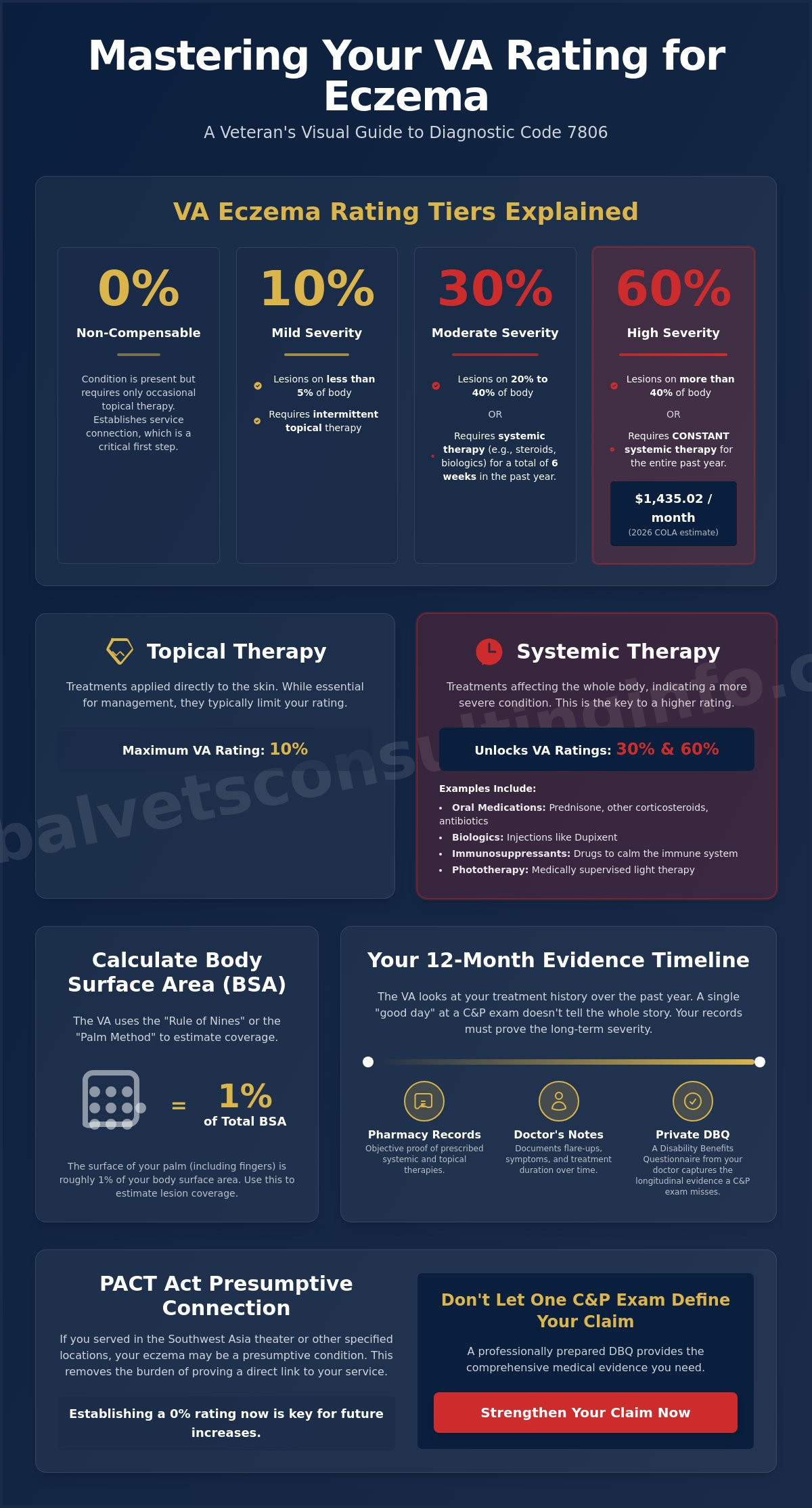
The VA groups eczema with other conditions like psoriasis because they share similar evaluation metrics. Ratings are assigned at 0%, 10%, 30%, or 60% based on two primary factors: the percentage of body coverage and the type of treatment required. A critical component of your medical evidence is the 12-month window. The VA specifically examines the frequency and duration of your treatments over the last year to determine if your condition is constant or intermittent. This longitudinal view prevents a single “good day” during a C&P exam from resulting in an unfairly low rating.
Presumptive Service Connection in 2026
In 2026, many veterans find a clearer path to service connection through the PACT Act. If you served in the Southwest Asia theater of operations or other specific locations, your eczema may be considered a presumptive condition related to burn pit or toxic exposure. This removes the burden of proving a direct link to a specific event in service. Even if your symptoms currently only require topical creams, securing a 0% non-compensatory rating is a vital first step. It establishes service connection, allowing you to seek an increase if your condition later requires systemic therapy or covers more of your body.
Systemic Therapy vs. Topical Treatment: The Key to a Higher Rating
The type of medication your doctor prescribes often dictates the ceiling of your disability compensation. If your treatment plan consists only of topical creams or ointments, the VA typically caps your va rating for eczema at 10%. This “rating ceiling” exists because the VA’s General Rating Formula for the Skin prioritizes the intensity of the medical intervention over the visual appearance of the rash. To move into the 30% or 60% tiers, your medical records must demonstrate the use of systemic therapy.
A common misconception involves the timing of your medication. You don’t need to be actively taking a pill or receiving an injection on the day of your C&P exam to qualify for a higher rating. The VA evaluates the total duration of systemic therapy required over the past 12 months. If you completed a six-week course of oral medication within the last year, you meet the threshold for a 30% rating, even if your skin is clear during the evaluation. Achieving a 60% rating requires constant systemic therapy, meaning your physician has kept you on these medications for the entire 12-month period preceding your claim.
What Qualifies as Systemic Therapy for VA Claims?
Systemic therapy includes any treatment that affects the entire body rather than just a localized patch of skin. This category encompasses oral antibiotics, systemic corticosteroids like Prednisone, and advanced biologics such as Dupixent. Phototherapy, or light therapy, also qualifies as a systemic intervention because of its impact on the immune system. If your eczema is severe enough to require immunosuppressive drugs, you are likely eligible for the higher rating tiers, provided the therapy duration is documented in your treatment history.
Documenting Treatment Frequency for the C&P Exam
Your pharmacy records are often more influential than the physical skin exam. Examiners can’t see a flare-up that happened four months ago, but they can see a filled prescription. Create a detailed treatment log that lists every medication, the dosage, and the exact dates of use. This log acts as a roadmap for the examiner, making it easier for them to check the boxes required for a rating increase. If you need help organizing your medical evidence, exploring educational resources for skin condition claims can provide the clarity you need to move forward with confidence.
How to Calculate Body Surface Area (BSA) and Lesion Coverage
Calculating the extent of your skin condition is a critical step in securing an accurate va rating for eczema. The VA doesn’t just look at the severity of your itching or redness; they use specific mathematical metrics to determine your disability percentage. Adjudicators evaluate your claim based on two primary measurements: the percentage of your “Entire Body” covered by lesions and the percentage of “Exposed Areas,” which include your head, face, neck, and hands. Understanding how these areas are measured helps you present a more compelling case during your C&P exam.
You can estimate your own coverage using the “Palm Method.” One veteran’s palm size, including the fingers, represents roughly 1% of their total body surface area. According to the VA Schedule of Ratings for Skin Conditions, a 10% rating requires lesions covering at least 5% but less than 20% of the entire body. To reach a 60% rating based on coverage alone, your lesions must affect more than 40% of your entire body. If you feel your current rating doesn’t reflect your actual symptoms, you may want to explore Skin Conditions & Dermatological Claims Education to better understand your options.
Exposed Areas vs. Total Body Coverage
The VA places a higher weight on lesions that appear on exposed areas because of their impact on social and industrial functioning. If your eczema is localized to your face or hands, you might qualify for a higher rating even if the total percentage of your body affected is relatively small. Additionally, if chronic scratching has led to permanent disfigurement or scars, those issues are often rated separately under Diagnostic Code 7800. This nuance is vital for veterans who experience severe symptoms in visible locations but have clear skin elsewhere.
The Rule of Nines in VA Medical Documentation
VA examiners often use the “Rule of Nines” to divide the body into sections for easier calculation. Under this system, each arm counts as 9%, each leg as 18%, and the torso as 36% (divided between the front and back). Before your appointment, take the time to map your own lesions using these percentages. Providing the examiner with a pre-calculated estimate based on your own observations ensures that no affected areas are overlooked during a brief physical examination. This proactive approach turns a subjective observation into a documented, objective measurement for your claim file.
Strengthening Your Claim with a Professional DBQ
Standard C&P examinations often fail to capture the reality of living with a chronic skin condition. Because eczema fluctuates, an examiner might see you on a “clear” day and conclude your symptoms are minimal. This snapshot approach frequently leads to a lower va rating for eczema than your medical history actually justifies. To overcome this, you can utilize a private Disability Benefits Questionnaire (DBQ) to provide a longitudinal view of your condition. A properly completed DBQ documents the frequency of your flare-ups and the duration of your treatments over the last year, ensuring the VA sees the full scope of your disability.
You can leverage the expertise of Global Vets Consulting to learn how to secure accurate medical documentation that meets the VA’s strict criteria. This educational support helps you identify the specific details, such as systemic medication dosages and the exact percentage of body coverage, that adjudicators require for a successful rating increase. This evidence-based approach is the most reliable way to secure a fair va rating for eczema that accounts for the total impact on your health and lifestyle.
Secondary Conditions Related to Chronic Eczema
Chronic skin irritation rarely exists in isolation. The intense itching and discomfort often lead to significant sleep disturbances, which can sometimes be linked to secondary sleep apnea or insomnia. The social and physical burden of severe eczema also frequently causes or worsens mental health conditions like depression and anxiety. If you are seeking an increase, understanding how to use a DBQ for a VA disability rating increase in 2026 can help you document these secondary links effectively. A Nexus Letter can further bridge the gap by explaining how your service-connected eczema is the primary driver of these additional health challenges.
The Final Step: Submitting Your Fully Developed Claim (FDC)
Submitting your evidence as a Fully Developed Claim (FDC) is the most efficient way to achieve a faster decision. When you provide a completed DBQ up front, the VA has all the information needed to make a decision without requesting additional records. This preparation significantly accelerates the VA disability claims process step by step. Before you hit “submit” on VA.gov, use this final checklist to ensure your evidence is complete:
- Verify that your DBQ includes the full 12-month treatment history for systemic therapy.
- Ensure all secondary conditions, like anxiety or sleep loss, are clearly linked via medical evidence.
- Double-check that your body surface area estimates match the clinical notes in your records.
- Confirm that your pharmacy records are attached to support your documented treatment log.
Secure the Rating Your Service Deserves
Achieving a fair va rating for eczema requires a shift in focus from the visible symptoms of today to the intensity of your medical treatment over the last year. You’ve learned that the transition from topical creams to systemic therapies, such as biologics or oral medications, is often the deciding factor between a 10% and a 60% rating. By accurately calculating your body surface area and documenting every flare-up, you turn a subjective process into a concrete, evidence-based claim. Global Vets Consulting has been veteran-owned and operated since 2021; we specialize in high-quality Disability Benefits Questionnaires designed to meet the VA’s rigorous standards. We offer streamlined medical evidence gathering for 2026 claims to ensure your documentation remains thorough and accurate from the start.
Get the Accurate DBQ Documentation You Need for Your Eczema Claim and take the next step toward a successful outcome. You’ve served your country with honor, and now it’s time to ensure the system works for you. With the right evidence in hand, you can move forward with confidence and peace of mind.
Frequently Asked Questions
Can I get a VA rating for eczema as a secondary condition?
Yes, you can establish a service connection for eczema as a secondary condition if it’s caused or aggravated by an existing service-connected disability. For example, some medications used to treat other service-connected issues can trigger chronic skin inflammation. Alternatively, you might claim mental health conditions like anxiety or sleep disturbances as secondary to your eczema due to the chronic pain and social impact of the condition.
What is the maximum VA disability rating for eczema?
The maximum va rating for eczema under Diagnostic Code 7806 is 60%. To qualify for this level, your medical records must show that lesions cover more than 40% of your entire body or that you’ve required constant systemic therapy for the past 12 months. Systemic therapy includes oral or injected medications, such as biologics or corticosteroids, that treat the immune system rather than just the skin’s surface.
Does the VA consider eczema a presumptive condition under the PACT Act?
Yes, the VA recognizes chronic dermatitis, which includes eczema, as a presumptive condition for veterans who served in specific locations. If you served in the Southwest Asia theater of operations or other areas designated under the PACT Act, you don’t need to prove a specific service event caused your condition. You only need to provide a medical diagnosis and evidence of your qualifying service dates and locations.
What happens if my eczema is clear on the day of my VA C&P exam?
Clear skin on the day of your examination won’t automatically result in a denial if you have provided longitudinal medical evidence. The VA’s rating criteria specifically look at your treatment requirements and flare-ups over a 12-month period. Using a private DBQ or a detailed treatment log helps ensure the examiner understands the frequency of your symptoms, even if your va rating for eczema is being decided during a period of remission.
What is the difference between eczema and dermatitis in the eyes of the VA?
The VA generally treats eczema and dermatitis as interchangeable terms under the General Rating Formula for the Skin. While your doctor might use specific terms like atopic dermatitis or contact dermatitis, the VA evaluates both under Diagnostic Code 7806. Your final disability percentage depends on the percentage of body coverage and the type of medication you use rather than the specific clinical label in your file.

Article by
Willie Daniel
Willie Daniel is the Founder and Chief Executive Officer (CEO) of Global Vets Consulting (GVC) – National Veterans Disability Services, a veteran-led educational and medical evidence support organization dedicated to helping veterans better understand VA disability rating increases, DBQ medical evidence, secondary claims education, and C&P examination preparation.
He is a retired U.S. Army Medical Service Corps Officer with more than 27 years of honorable military service, a decorated Iraq combat veteran, and a retired federal official with the U.S. Department of Veterans Affairs. Throughout his military and federal career, Willie Daniel served in leadership, healthcare administration, operational, and veteran-support roles focused on improving services and support systems for servicemembers, veterans, and their families.
Drawing from decades of military leadership, healthcare administration, veteran advocacy, and federal government experience, Willie Daniel brings a practical, veteran-centered perspective to Global Vets Consulting’s educational articles, AI-powered veteran resources, video education initiatives, and outreach programs. His experience navigating military systems, medical documentation processes, and veteran-related administrative operations provides valuable insight into many of the challenges veterans face when seeking to better understand VA disability rating criteria, medical evidence, documentation strategies, and secondary condition education.
Through GVC’s “Veterans Helping Veterans” mission, his focus is on delivering clear, educational, and easy-to-understand information designed to empower veterans with knowledge, resources, and educational tools that may help them make more informed decisions regarding their individual VA disability journeys.
The information provided through GVC is intended for educational and informational purposes only and should not be considered legal or medical advice.
Disclaimer
Disclaimer: Global Vets Consulting, LLC (“GVC”) is a veteran-led educational and medical evidence support organization. GVC is not a law firm, is not a Veterans Service Organization (VSO), and is not affiliated with the U.S. Department of Veterans Affairs (VA) or any government agency.
Global Vets Consulting does not provide legal advice, medical advice, medical treatment, or healthcare services. GVC does not prepare, file, or submit VA disability claims on behalf of veterans. All information provided through this website, blog articles, videos, educational materials, AI tools, dashboards, templates, and communications is intended solely for general educational and informational purposes.
Veterans are encouraged to consult with accredited representatives, licensed attorneys, qualified medical providers, or Veterans Service Organizations regarding their specific legal, medical, or VA-related matters. VA disability decisions, ratings, and outcomes are determined solely by the U.S. Department of Veterans Affairs based on applicable laws, regulations, medical evidence, and individual circumstances. Past results do not guarantee future outcomes.

