

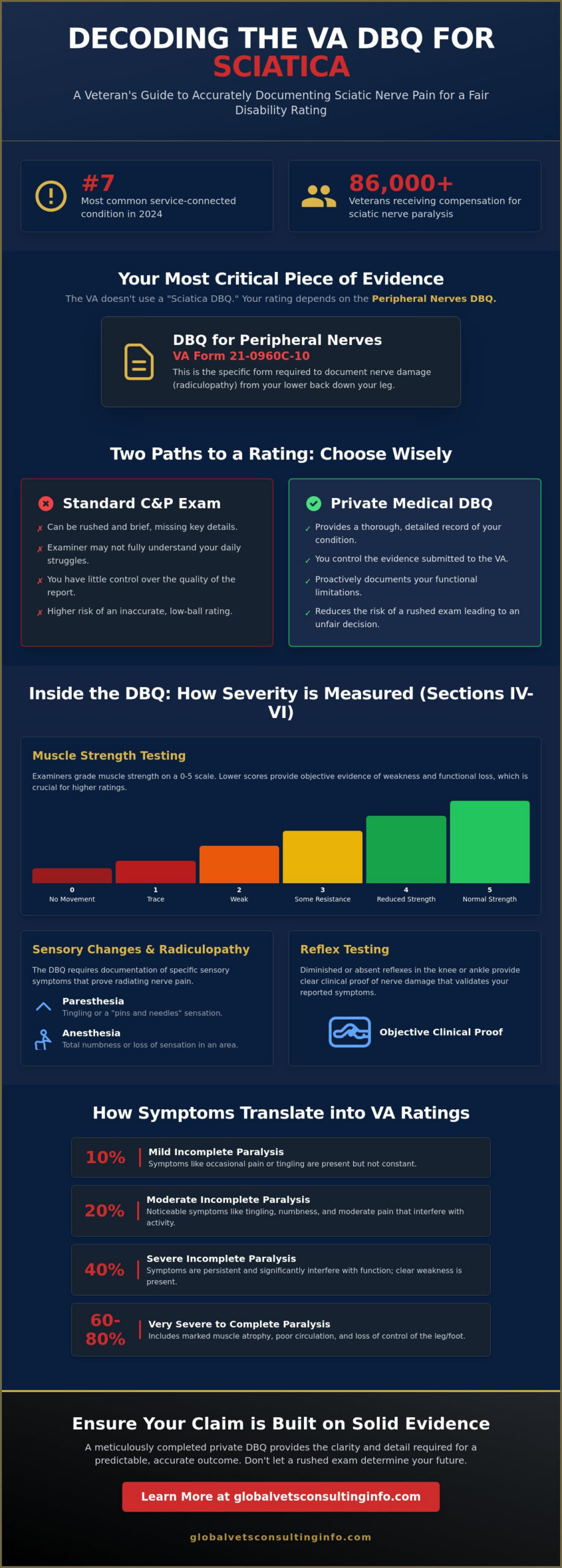
Did you know that sciatic nerve paralysis was the seventh most common service-connected condition in 2024, with over 86,000 veterans receiving compensation? Despite its prevalence, many veterans still struggle to receive a rating that reflects their actual physical limitations. The dbq for sciatica, officially known as the DBQ for Peripheral Nerves (VA Form 21-0960C-10), is the most critical document in your claim file. It’s frustrating to live with radiating pain that disrupts your work and family life, only to have a rushed examiner overlook the true severity of your symptoms during a brief appointment.
We understand that the fear of a low-ball rating is real, especially as the VA implements new data collection tools in 2026 to scrutinize medical evidence. This guide will show you exactly how the sciatica DBQ works and which sections determine whether you receive a 10% or an 80% rating. You’ll learn how a precise private medical opinion can strengthen your claim and provide the clear documentation the VA requires for an accurate decision. We’ll also break down the 2026 COLA increases and the specific criteria for paralysis, neuritis, and neuralgia to ensure you’re prepared for your next step.
Key Takeaways
- Identify why the Peripheral Nerves form is the specific dbq for sciatica required to document your nerve damage with medical precision.
- Learn how the VA uses muscle strength and sensory testing in Sections IV through VI to quantify the severity of your condition.
- Understand the “Incomplete Paralysis” terminology to better predict how your symptoms align with VA ratings from 10% to 80%.
- Discover how a detailed private medical opinion ensures your functional limitations are thoroughly recorded, protecting your claim from the risks of a rushed examination.
Understanding the DBQ for Sciatica: The Peripheral Nerves Form
The VA relies on structured documentation to translate your physical pain into a disability percentage. The Disability Benefits Questionnaire (DBQ) serves as this primary forensic tool. While you might seek treatment for lower back issues, the dbq for sciatica is actually found within the Peripheral Nerves form, specifically VA Form 21-0960C-10. The most recent version, v24_1, was updated on July 11, 2024. This distinction is vital. Filing the wrong paperwork can lead to a rating that only covers your spine, which ignores the radiating nerve damage that limits your daily mobility.
We view the process through a logical flow. Your problem is the persistent radiating pain. The action is the submission of a meticulous DBQ. The result is a fair disability rating. By treating the DBQ as a roadmap, you ensure the VA sees the full scope of your condition rather than just a brief summary of your last doctor’s visit. This methodical approach turns a complex administrative hurdle into a manageable, step-by-step process.
Why Sciatica Requires the Peripheral Nerves DBQ
Many veterans assume their sciatica should be part of their back claim. However, the VA views these as two distinct issues. Your back claim covers the range of motion in the spine. In contrast, What is Sciatica? It is a condition involving the compression or irritation of the sciatic nerve. This requires the Peripheral Nerves DBQ to track how the nerve travels from your lower spine down to your foot. This specific form quantifies radiculopathy, which ensures you receive credit for the nerve damage that a standard back exam might miss.
Private DBQ vs. VA C&P Exam: What’s the Difference?
You have two primary paths for medical documentation. A Compensation and Pension (C&P) exam is a meeting with a VA-contracted provider. These exams are often brief and may not capture the full extent of your daily struggles. A private DBQ is a piece of evidence you control. When you submit a privately completed dbq for sciatica, you provide the VA with a thorough record of your symptoms before they even schedule an exam. This proactive step ensures your medical history is presented clearly and professionally, which reduces the chance of a rushed examiner overlooking critical functional loss.
Crucial Sections of the Sciatica DBQ That Determine Your Rating
Your path to a fair rating depends on how accurately your symptoms are recorded in specific blocks of the dbq for sciatica. These sections serve as the evidence the VA rater uses to assign a percentage to your disability. Establishing a medical foundation begins in Sections I through III. Without a clear diagnosis and a documented history of when your pain started, the claim lacks the necessary clinical weight. While your primary issue is nerve-related, the VA often reviews the Disability Benefits Questionnaire for back conditions to determine if a spinal injury is the underlying cause of your nerve distress.
Functional loss in a sciatica claim refers to the inability of the sciatic nerve to perform its normal duties due to pain, weakness, or lack of coordination. You’ll find the “Functional Impact” section is where you bridge the gap between medical data and your daily reality. It’s vital to describe how your sciatica prevents you from standing at a workstation, walking through a grocery store, or maintaining a steady gait. Preparing your documentation in advance with a thoroughly completed DBQ provides the clarity needed for a predictable outcome.
Muscle Strength and Reflex Testing
Examiners use a 0 to 5 scale to grade muscle strength. A score of 5 is considered normal, while lower numbers indicate increasing levels of impairment. If you can’t resist the examiner’s pressure during the test, it’s recorded as objective weakness. Diminished knee or ankle reflexes also provide the clinical proof of nerve damage that the VA looks for when validating your self-reported pain levels.
Documenting Sensory Changes and Radiculopathy
Radiculopathy, or radiating pain, is a hallmark of sciatic issues that the VA tracks through specific markers. The dbq for sciatica requires the examiner to note “paresthesia,” which is the tingling or “pins and needles” sensation, and “anesthesia,” which refers to total numbness. Ensuring these markers are checked correctly can be the difference between a 10% rating for mild symptoms and a 40% rating for severe, constant interference with your leg’s function.
Sciatica VA Ratings: How the DBQ Translates to Compensation
The VA uses the clinical findings in your dbq for sciatica to assign a disability percentage under Diagnostic Code 8520. Ratings are tiered at 10%, 20%, 40%, 60%, and 80%, depending on the level of functional impairment documented by the examiner. With the 2026 COLA increase of 2.8%, a 10% rating now provides $180.42 per month, while an 80% rating for a veteran alone results in $2,102.15. These determinations are guided by the VA’s schedule of ratings for neurological conditions. If you experience symptoms in both legs, the VA applies the “Bilateral Factor.” This calculation adds 10% of your combined rating to the total, which often moves you into a higher compensation bracket.
Accuracy in your documentation is the only way to ensure the rater selects the correct tier. We focus on a problem-action-result approach. The problem is your radiating pain; the action is securing a precise dbq for sciatica; the result is a rating that reflects your true physical limitations. You can purchase a professionally completed DBQ to ensure that every clinical marker, from muscle strength to sensory loss, is captured with the meticulousness your claim deserves.
Understanding Incomplete vs. Complete Paralysis
The VA uses the term “incomplete paralysis” to categorize the severity of nerve damage. “Mild” cases usually involve sensory changes or occasional tingling. “Moderate” cases show frequent pain and measurable weakness during testing. “Severe” incomplete paralysis, which can lead to a 60% rating, is characterized by significant muscle wasting, also known as atrophy. Complete paralysis is an 80% rating. This is typically reserved for cases involving “foot drop,” where you have lost all functional control over the foot and toes.
Secondary Service Connection: Sciatica and the Lower Back
Sciatica is rarely a standalone issue. It’s often secondary to service-connected spinal conditions like Degenerative Disc Disease or a herniated disc. Your DBQ must clearly show how the spinal injury is causing the nerve compression. While the DBQ provides the clinical evidence of the nerve’s current state, you might also need a Nexus Letter to link the two conditions. This dual-layered evidence strategy prevents the VA from viewing your sciatica as a separate, non-service-connected ailment.
The Advantage of a Private DBQ for Sciatica Claims
A 15-minute C&P exam often feels like a race against the clock. When an examiner is rushed, they may fail to capture the nuances of your radiating pain or the specific ways your mobility is restricted. A private dbq for sciatica serves as a vital safeguard against these incomplete evaluations. It allows a medical professional to conduct a thorough review of your history and current symptoms without the pressure of a back-to-back schedule. Legally, the VA is mandated to accept and consider DBQs completed by private providers under the Johnny Isakson and David P. Roe, M.D. Veterans Health Care and Benefits Improvement Act of 2020. A properly completed private DBQ can lead to a Fully Developed Claim (FDC), which often results in faster decision times.
Working with providers who understand VA-specific terminology is essential for a successful outcome. The VA’s 2026 data collection tools are designed to flag boilerplate language or inconsistent data. By ensuring your documentation is precise and clinically sound, you reduce the risk of your claim being delayed or questioned. This proactive approach turns your medical evidence into a powerful tool for advocacy.
How Global Vets Consulting Supports Your Claim
Global Vets Consulting prioritizes meticulousness in every document we prepare. We understand that your disability rating is more than just a number; it represents the support you earned through your service. Our team acts as a steady guide, ensuring that your dbq for sciatica reflects the true severity of your condition. We focus on clinical accuracy to meet the VA’s rigorous 2026 standards, helping you move forward with confidence. Secure your private DBQ for sciatica with Global Vets Consulting today.
Filing Your DBQ: Ensuring a Fully Developed Claim
The path to a predictable result follows a logical, step-by-step progression. You can take control of your claim by following these essential actions:
- Step 1: Obtain your private medical records and imaging, such as an MRI or CT scan, to provide objective evidence of nerve compression.
- Step 2: Have a qualified provider complete the Peripheral Nerves DBQ, ensuring every section on muscle strength and sensory loss is detailed.
- Step 3: Submit the DBQ as part of a Fully Developed Claim to minimize administrative delays and reach a decision faster.
Taking Control of Your Sciatica Claim
Securing a fair disability rating requires more than just describing your pain. It demands forensic medical evidence that aligns with the VA’s strict 2026 criteria. By understanding that the correct dbq for sciatica is the Peripheral Nerves form and ensuring that specific markers like muscle atrophy and sensory loss are documented, you position your claim for a predictable result. You have the right to submit private medical evidence that truly reflects the daily challenges you face.
Global Vets Consulting has been veteran-owned and operated since 2021. We specialize in providing standardized medical evidence that meets the high bar set by VA raters. Our team focuses on accuracy and thoroughness to reduce the anxiety often associated with complex administrative processes. We’re here to act as your knowledgeable advocate and steady guide through every step of the documentation phase.
Get Expert Help with Your Sciatica DBQ Today
Your service earned these benefits. We’re ready to help you secure them with the meticulous documentation your claim deserves.
Frequently Asked Questions
Which DBQ is used for sciatica and radiculopathy?
The Peripheral Nerves DBQ, officially known as VA Form 21-0960C-10, is the correct document used to evaluate both sciatica and radiculopathy. This form is designed to capture neurological impairments, including sensory changes, muscle weakness, and reflex diminished capacity. Using this specific dbq for sciatica ensures your condition is rated as a nerve issue rather than being limited to a spinal range of motion test.
Can a private doctor fill out a DBQ for sciatica?
Yes, a private medical provider can legally complete a dbq for sciatica to support your disability claim. The Johnny Isakson and David P. Roe, M.D. Veterans Health Care and Benefits Improvement Act of 2020 mandates that the VA must accept and consider DBQs submitted by private doctors. This allows you to work with a physician who can take the necessary time to document your symptoms with the level of detail required for an accurate rating.
What is the maximum VA rating for sciatica?
The maximum disability rating for sciatica is 80% for each affected leg, which is assigned in cases of complete paralysis. This severe level of impairment typically involves “foot drop,” where the veteran has lost all functional control over the foot and toes. While most veterans fall within the 10% to 40% range for incomplete paralysis, the 80% rating remains the ceiling for the most debilitating nerve damage.
Is radiculopathy the same as sciatica for VA rating purposes?
Sciatica is a specific form of radiculopathy that affects the sciatic nerve, and the VA evaluates both conditions using the same neurological rating schedule. Radiculopathy is a general term for any nerve pain that radiates from the spine, whereas sciatica refers specifically to the nerve path from the lower back through the leg. Both conditions require the same Peripheral Nerves documentation to quantify functional loss for your claim.
Do I still have to go to a C&P exam if I submit a private DBQ for sciatica?
The VA may still schedule a Compensation and Pension (C&P) exam, but a thoroughly completed private DBQ can sometimes allow for a decision without an additional appointment. If your private evidence is sufficient, consistent, and follows all VA clinical standards, the rater may use it as the primary evidence for your award. If you are called for an exam, your private DBQ remains a critical part of your file that the examiner is required to review.

Article by
Willie Daniel
Willie Daniel is the Founder and Chief Executive Officer (CEO) of Global Vets Consulting (GVC) – National Veterans Disability Services, a veteran-led educational and medical evidence support organization dedicated to helping veterans better understand VA disability rating increases, DBQ medical evidence, secondary claims education, and C&P examination preparation.
He is a retired U.S. Army Medical Service Corps Officer with more than 27 years of honorable military service, a decorated Iraq combat veteran, and a retired federal official with the U.S. Department of Veterans Affairs. Throughout his military and federal career, Willie Daniel served in leadership, healthcare administration, operational, and veteran-support roles focused on improving services and support systems for servicemembers, veterans, and their families.
Drawing from decades of military leadership, healthcare administration, veteran advocacy, and federal government experience, Willie Daniel brings a practical, veteran-centered perspective to Global Vets Consulting’s educational articles, AI-powered veteran resources, video education initiatives, and outreach programs. His experience navigating military systems, medical documentation processes, and veteran-related administrative operations provides valuable insight into many of the challenges veterans face when seeking to better understand VA disability rating criteria, medical evidence, documentation strategies, and secondary condition education.
Through GVC’s “Veterans Helping Veterans” mission, his focus is on delivering clear, educational, and easy-to-understand information designed to empower veterans with knowledge, resources, and educational tools that may help them make more informed decisions regarding their individual VA disability journeys.
The information provided through GVC is intended for educational and informational purposes only and should not be considered legal or medical advice.
Disclaimer
Disclaimer: Global Vets Consulting, LLC (“GVC”) is a veteran-led educational and medical evidence support organization. GVC is not a law firm, is not a Veterans Service Organization (VSO), and is not affiliated with the U.S. Department of Veterans Affairs (VA) or any government agency.
Global Vets Consulting does not provide legal advice, medical advice, medical treatment, or healthcare services. GVC does not prepare, file, or submit VA disability claims on behalf of veterans. All information provided through this website, blog articles, videos, educational materials, AI tools, dashboards, templates, and communications is intended solely for general educational and informational purposes.
Veterans are encouraged to consult with accredited representatives, licensed attorneys, qualified medical providers, or Veterans Service Organizations regarding their specific legal, medical, or VA-related matters. VA disability decisions, ratings, and outcomes are determined solely by the U.S. Department of Veterans Affairs based on applicable laws, regulations, medical evidence, and individual circumstances. Past results do not guarantee future outcomes.

