
Most veterans believe a 100% rating is the finish line, but without the “permanent” designation, your benefits remain vulnerable to the VA’s next round of re-evaluations. You’ve likely felt the anxiety of waiting for a surprise C&P exam notice, wondering if a single medical review could jeopardize your family’s financial stability. It’s exhausting to navigate complex terminology while trying to secure the healthcare and education benefits your dependents deserve. You deserve a predictable path forward that replaces confusion with steady confidence.
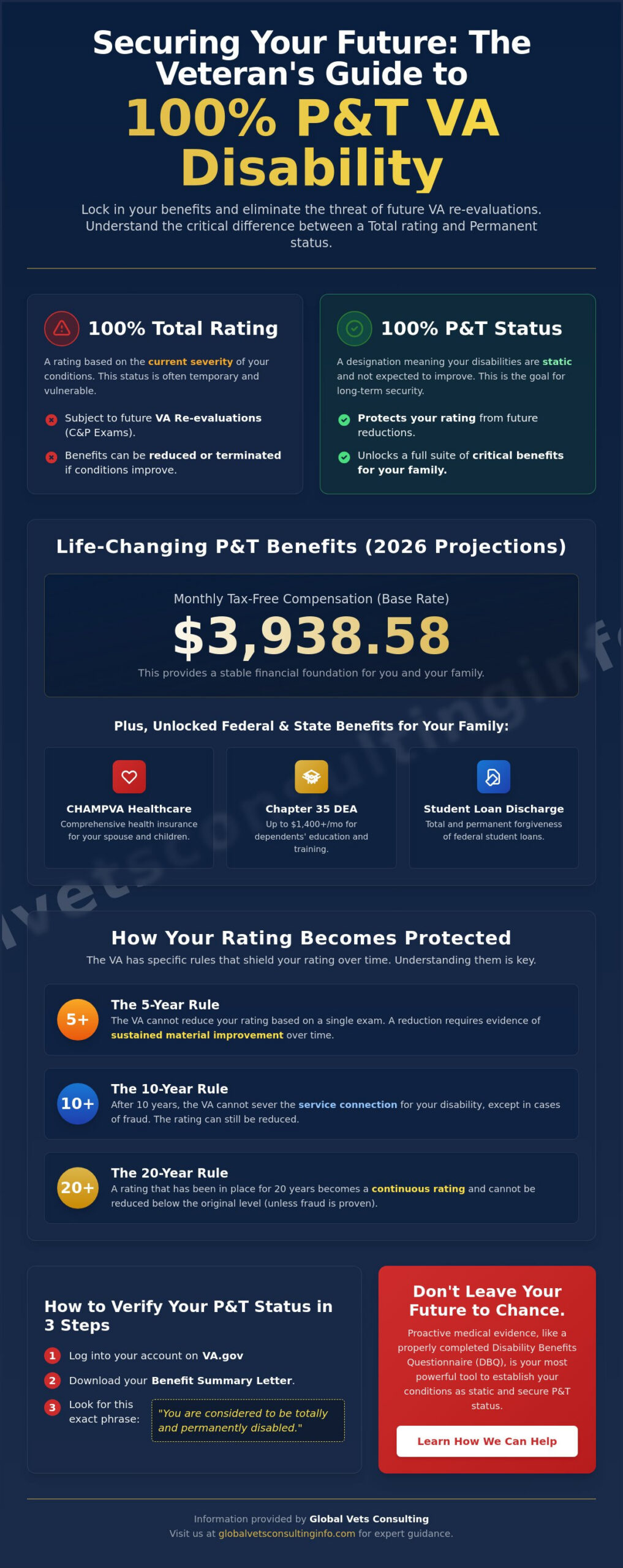
Understanding the nuances of 100 percent p&t va disability is the key to locking in your status and eliminating the threat of future reductions. By achieving “static” status, you protect your hard earned compensation and open doors to critical protections like CHAMPVA and federal student loan discharge. This guide details the 2026 benefit increases, including the $3,938.58 monthly base rate, and explains how proactive medical evidence can secure your future. We’ll walk through the specific criteria for permanent status and how a Disability Benefits Questionnaire (DBQ) serves as a vital tool in documenting the stability of your conditions.
Key Takeaways
- Distinguish between total and permanent ratings to confirm your 100 percent p&t va disability status is correctly documented.
- Identify the full range of family benefits available, including CHAMPVA healthcare and Chapter 35 educational assistance for dependents.
- Learn how to use Disability Benefits Questionnaires (DBQs) to provide the medical evidence needed to establish your conditions as static.
- Understand the 5, 10, and 20-year rules that protect your rating from future VA re-evaluations and surprise exams.
Understanding 100% P&T: What ‘Permanent and Total’ Really Means in 2026
Many veterans assume that reaching a 100% rating is the final step in their journey with the VA. However, a “Total” rating refers only to the current severity of your symptoms, while “Permanent” refers to the long-term medical stability of those conditions. You might have a 100% rating today, but if the VA believes your condition could improve, they’ll likely schedule a re-evaluation in the future. Securing 100 percent p&t va disability status means the VA has determined your disabilities are “static,” which indicates they aren’t expected to show significant improvement during your lifetime.
The Veterans Benefits Administration uses modernized data systems in 2026 to track medical progress more closely than ever before. If your medical records show a consistent pattern of improvement, the system may trigger a review of your file. This is why a 100% schedular rating doesn’t automatically grant P&T status. Your medical evidence must specifically demonstrate that your functional loss is permanent and not just a temporary spike in symptom severity. It’s about proving that your condition has reached its maximum medical improvement.
Total Disability vs. Permanent Status
Total disability means you’re being paid at the highest level, either through a 100% schedular rating or Total Disability Individual Unemployability (TDIU). Permanent status is an additional layer of protection that requires the medical evidence to show your condition is “reasonably certain to continue” without improvement. When a condition is labeled static, the VA removes the requirement for future Compensation and Pension (C&P) exams. This distinction is vital for your long-term financial security and peace of mind.
How to Check Your P&T Status
You don’t have to guess about your current status. Log into VA.gov and download your “Benefit Summary Letter” to see your current designation. Look specifically for a line that says, “You are considered to be totally and permanently disabled.” If that language isn’t present, check your original rating decision for any mention of “future exams scheduled.” If no future exams are listed, your conditions are likely considered static, which is a foundational step toward 100 percent p&t va disability protections.
The Life-Changing Benefits of 100% P&T for Veterans and Families
Securing a 100 percent p&t va disability rating transforms your financial reality by unlocking a massive suite of auxiliary benefits. While the monthly compensation of $3,938.58 provides a solid foundation, the true value lies in the long term protections for your dependents. These benefits ensure that your service-connected conditions don’t hinder your family’s access to quality healthcare or higher education. Before you can access these programs, you must meet the fundamental VA disability eligibility requirements and demonstrate that your conditions are static.
Family Healthcare and Education Security
CHAMPVA stands as one of the most significant advantages for families. It provides comprehensive health insurance for your spouse and children, covering most medically necessary services and supplies. It differs from TRICARE, which is reserved for military retirees; CHAMPVA is specifically designed for the dependents of veterans with P&T status. Additionally, the Chapter 35 Survivors’ and Dependents’ Educational Assistance (DEA) program offers monthly stipends to help cover tuition costs. In 2026, these payments often exceed $1,400 per month, helping your children pursue degrees without the burden of excessive student debt. Generally, children can use this benefit between the ages of 18 and 26, providing a stable window for academic achievement.
Federal and State-Level Perks
Your P&T status also grants access to Class IV dental benefits, meaning the VA covers your dental care needs. Beyond medical support, you’re eligible for a Uniformed Services ID (USID) card. This card facilitates base access and allows your family to use Morale, Welfare, and Recreation (MWR) facilities. High property taxes often place a heavy burden on fixed incomes, but many states offer full exemptions for your primary residence once you’re rated P&T. This result keeps thousands of dollars in your pocket annually. You can also receive a National Park Service Lifetime Access Pass, granting free entry to hundreds of federal recreation sites. If you need to document the stability of your conditions to reach this tier, professional Disability Benefits Questionnaire documentation can help clarify your medical status for the VA.
How to Secure P&T Status: The Power of Medical Evidence and DBQs
The VA often designates ratings as temporary because they anticipate medical improvement over time. This keeps your file “open” for future reviews and surprise exams. To close this loop, you must provide evidence that your condition is static. Securing a 100 percent p&t va disability rating often requires a proactive approach rather than waiting for the VA to grant it voluntarily. Beyond the financial peace of mind, this status allows for expedited processing of Social Security benefits for 100% P&T veterans, making the documentation process even more critical. Veterans who haven’t yet reached the 100% threshold should also explore how using secondary conditions to increase their VA rating can help them reach the compensation level their functional impairment truly warrants.
Documenting Stability with DBQs
To achieve a static designation, your medical records must contain specific language. A physician should clearly state that your condition is “permanent” and “not expected to improve.” Standard C&P exams are often brief and may miss the long-term nuances of your health. In contrast, a private Disability Benefits Questionnaire (DBQ) offers a comprehensive view of your medical history. Learn how our DBQ preparation service helps veterans secure their ratings by ensuring every functional limitation is documented accurately.
Proving Permanent Functional Loss
Proving permanence is often difficult for conditions like mental health or certain cancers, where the VA assumes recovery is possible. You must connect your current symptoms to a long-term prognosis. If you’ve been in treatment for years without significant change, your evidence should reflect that lack of progress. Highlighting a “static” clinical picture helps you lock in 100 percent p&t va disability status and prevents the VA from scheduling future medical reviews. If you’re ready to solidify your rating and stop the cycle of re-evaluations, investing in high quality Disability Benefits Questionnaires is a strategic step toward permanent protection.
Protection of Ratings: Are You Safe from VA Re-evaluations?
Achieving 100 percent p&t va disability status provides a level of security that few other ratings offer, yet many veterans still worry about a surprise letter in the mail. This anxiety often stems from a misunderstanding of how the VA’s protection rules function. While P&T status generally triggers the ‘No Future Exams’ rule, it’s vital to understand the legal framework that keeps your benefits secure. These protections aren’t just administrative suggestions; they’re codified rules that require the VA to meet a high burden of proof before altering your status.
The 5/10/20 Year Protection Framework
- 5-Year Rule: If your rating has been in place for five years or more, the VA cannot reduce it based on a single exam. They must prove sustained improvement through a series of medical records over time.
- 10-Year Rule: Once you’ve held a service connection for ten years, the VA cannot terminate that connection unless they prove the original grant was based on fraud.
- 20-Year Rule: This is the gold standard of protection. After twenty years at a specific rating level, that percentage is locked in for life. The VA can’t lower it even if your condition improves, provided there’s no evidence of fraud.
Mitigating Risk of Rating Reductions
Even with 100 percent p&t va disability, you should remain proactive about your healthcare. Continuing to seek medical treatment creates a consistent paper trail that confirms your condition hasn’t improved. Be cautious about filing new, unrelated claims after you’ve reached P&T status. Opening a new claim can sometimes invite a reviewer to look at your entire file, which may lead to an unintended re-evaluation of your existing ratings. P&T status is a shield, but not an excuse to stop documenting your medical journey. If you’re still working toward a higher combined rating, understanding how secondary conditions can increase your VA disability percentage is a critical strategy before locking in your permanent status.
If you ever receive a surprise re-evaluation notice, respond immediately with updated medical evidence. You have the right to contest any proposed reduction by showing that your symptoms remain severe and static. High quality Disability Benefits Questionnaires can serve as a powerful defense during these times. They provide current, objective data that reinforces the stability of your disabilities and helps maintain the peace of mind you’ve earned through your service.
Securing Your Family’s Future with Permanent Status
Achieving a 100 percent p&t va disability rating is about more than just a monthly check; it’s about establishing a permanent safety net for those you love. By documenting your conditions as static, you eliminate the threat of surprise re-evaluations and unlock the full spectrum of family healthcare and education benefits. The VA’s protection framework is strongest when it’s backed by consistent, high quality medical evidence that proves your functional loss is unlikely to improve over your lifetime. You’ve earned the right to stop worrying about the next exam notice and start focusing on your family’s long term security. To ensure your monthly compensation accurately reflects your condition, reviewing the 2026 VA disability rates and monthly compensation pay charts can help you confirm you’re receiving every dollar you’re entitled to.
Global Vets Consulting has been veteran-owned and operated since 2021, specializing in the medical evidence required for complex VA claims. Our team understands the intricacies of the system and provides a streamlined process for accurate documentation. Secure your rating with professional DBQ preparation from Global Vets Consulting and gain the steady confidence that comes with a protected status. You’ve already done the hard work of serving your country; now it’s time to ensure your benefits are locked in for good. Stay proactive, stay informed, and enjoy the peace of mind you deserve.
Frequently Asked Questions
Can the VA take away 100% P&T disability status?
Yes, the VA can only revoke this status if they prove fraud or a “clear and unmistakable error” occurred during the initial rating process. Because 100 percent p&t va disability status is meant to be permanent, you’re protected from the routine medical re-evaluations that other veterans face. As long as your claims were filed honestly and accurately, your benefits remain secure for life.
Is 100% P&T the same as being ‘Total Disability Individual Unemployability’ (TDIU)?
No, these are distinct designations, though you can hold both simultaneously. TDIU allows you to be paid at the 100% rate because your service-connected disabilities prevent you from maintaining gainful employment. P&T status refers to the medical stability of your conditions. You can have a 100% schedular rating that is permanent, or a TDIU rating that is permanent, but they serve different administrative purposes.
Do I get free dental care with a 100% P&T rating?
Yes, you are eligible for full VA dental benefits once you receive your permanent and total rating. This falls under Class IV eligibility, which covers everything from routine cleanings to major restorative work. Veterans with 100 percent p&t va disability simply need to contact their local VA dental clinic to schedule an initial exam and begin using this benefit.
What happens to my P&T benefits if I start working again?
If your 100% rating is schedular, you can work as much as you want without any impact on your compensation. This is one of the most significant differences between a schedular rating and TDIU. Because your schedular P&T status is based on the clinical severity of your symptoms rather than your job status, your income won’t trigger a reduction in your monthly pay.
How do I apply for CHAMPVA once I am rated 100% P&T?
You must apply manually by submitting VA Form 10-10d to the CHAMPVA office in Denver. Enrollment isn’t automatic after you receive your rating decision. You’ll need to include copies of your Benefit Summary Letter, marriage certificate, and birth certificates for any children. The process can take several months, so it’s best to apply as soon as you receive your P&T notification. You can also reference the updated 2026 VA disability rates pay charts to understand how dependent additions may affect your total monthly compensation once your CHAMPVA enrollment is confirmed.

Article by
Willie Daniel
Willie Daniel is the Founder and Chief Executive Officer (CEO) of Global Vets Consulting (GVC) – National Veterans Disability Services, a veteran-led educational and medical evidence support organization dedicated to helping veterans better understand VA disability rating increases, DBQ medical evidence, secondary claims education, and C&P examination preparation.
He is a retired U.S. Army Medical Service Corps Officer with more than 27 years of honorable military service, a decorated Iraq combat veteran, and a retired federal official with the U.S. Department of Veterans Affairs. Throughout his military and federal career, Willie Daniel served in leadership, healthcare administration, operational, and veteran-support roles focused on improving services and support systems for servicemembers, veterans, and their families.
Drawing from decades of military leadership, healthcare administration, veteran advocacy, and federal government experience, Willie Daniel brings a practical, veteran-centered perspective to Global Vets Consulting’s educational articles, AI-powered veteran resources, video education initiatives, and outreach programs. His experience navigating military systems, medical documentation processes, and veteran-related administrative operations provides valuable insight into many of the challenges veterans face when seeking to better understand VA disability rating criteria, medical evidence, documentation strategies, and secondary condition education.
Through GVC’s “Veterans Helping Veterans” mission, his focus is on delivering clear, educational, and easy-to-understand information designed to empower veterans with knowledge, resources, and educational tools that may help them make more informed decisions regarding their individual VA disability journeys.
The information provided through GVC is intended for educational and informational purposes only and should not be considered legal or medical advice.
Disclaimer
Disclaimer: Global Vets Consulting, LLC (“GVC”) is a veteran-led educational and medical evidence support organization. GVC is not a law firm, is not a Veterans Service Organization (VSO), and is not affiliated with the U.S. Department of Veterans Affairs (VA) or any government agency.
Global Vets Consulting does not provide legal advice, medical advice, medical treatment, or healthcare services. GVC does not prepare, file, or submit VA disability claims on behalf of veterans. All information provided through this website, blog articles, videos, educational materials, AI tools, dashboards, templates, and communications is intended solely for general educational and informational purposes.
Veterans are encouraged to consult with accredited representatives, licensed attorneys, qualified medical providers, or Veterans Service Organizations regarding their specific legal, medical, or VA-related matters. VA disability decisions, ratings, and outcomes are determined solely by the U.S. Department of Veterans Affairs based on applicable laws, regulations, medical evidence, and individual circumstances. Past results do not guarantee future outcomes.