

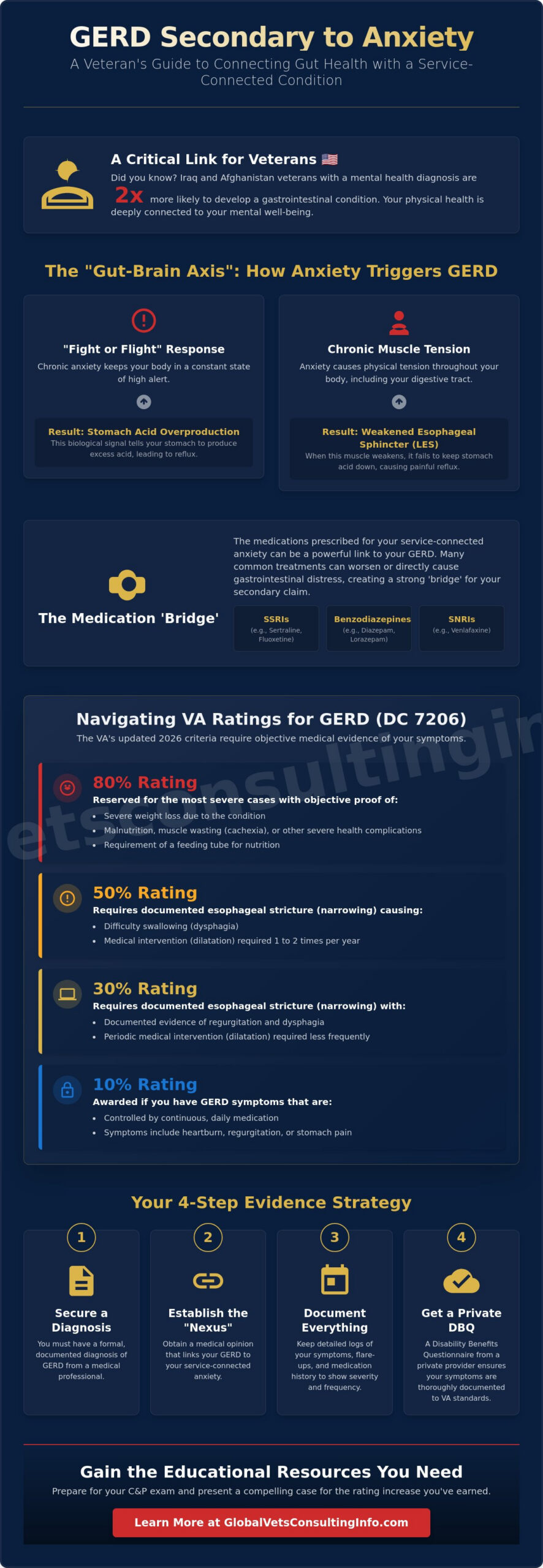
Did you know that Iraq and Afghanistan veterans with a mental health diagnosis are twice as likely to develop a gastrointestinal condition? 🇺🇸 This statistic highlights a reality many of us face: your physical health is deeply tied to your mental well-being. If you’re struggling with persistent acid reflux and stomach pain, you might be eligible for a VA claim for gerd secondary to anxiety.
It’s frustrating when painful physical symptoms interfere with your daily life, especially when the VA’s “secondary connection” rules feel like a maze. You might even feel anxious that a C&P exam won’t capture the full extent of your symptoms or the way your mental health triggers your digestive distress. We understand that this process is about more than just paperwork; it’s about getting the support and recognition you’ve earned through your service.
In this guide, you’ll discover how to link your digestive issues to your mental health and secure a fair VA disability rating. We’ll explain the “gut-brain axis” in simple terms, break down the 2026 rating criteria under Diagnostic Code 7206, and show you how to build a strategy for medical documentation and DBQs. 🌐
Key Takeaways
- Master the “gut-brain axis” concept to explain how chronic stress and muscle tension directly impact your digestive health.
- Navigate the significant changes to Diagnostic Code 7206 and identify where your symptoms fall on the 0% to 80% rating scale.
- Develop a clear strategy to secure a medical nexus that links your gerd secondary to anxiety to your service-connected mental health condition.
- Learn how a private Disability Benefits Questionnaire (DBQ) ensures your symptoms are documented thoroughly to meet 2026 VA criteria.
- Gain the educational resources needed to prepare for your C&P exam and present a compelling case for the rating increase you’ve earned.
The Biological Link: How Anxiety Triggers GERD
The connection between your mental health and your digestive system isn’t just in your head; it’s a biological reality known as the “gut-brain axis.” When you experience chronic anxiety, your body stays in a “fight or flight” state, which signals your stomach to overproduce acid. This biological response is why many veterans develop gerd secondary to anxiety, as the excess acid leads to Gastroesophageal Reflux Disease (GERD) and chronic discomfort.
Anxiety also causes physical muscle tension throughout the body. This tension often affects the Lower Esophageal Sphincter (LES), which is the muscle responsible for keeping stomach acid where it belongs. When the LES is weakened or fails to close properly due to stress, acid escapes into the esophagus, causing painful reflux. A secondary service connection is a disability that is caused or aggravated by an existing service-connected condition.
Anxiety Medications as a ‘Bridge’ to GERD
Many veterans find that the very treatments meant to help their anxiety actually worsen their digestive health. Certain medications can relax the LES or irritate the stomach lining, making reflux more frequent and severe. Common medications that list gastrointestinal distress as a side effect include:
- SSRIs (such as Sertraline or Fluoxetine)
- Benzodiazepines (such as Diazepam or Lorazepam)
- SNRIs (such as Venlafaxine)
Documenting your medication history is a powerful way to establish gerd secondary to anxiety. If your doctor prescribed these medications for a service-connected mental health condition, and those meds led to or aggravated your reflux, you’ve built a strong foundation for your medical evidence. This connection creates a clear “bridge” for the VA rater to see how your conditions are linked, moving you closer to the rating you’ve earned. 🇺🇸
VA Ratings for GERD in 2026: Understanding DC 7206
The VA updated the VA Schedule of Ratings for GERD to implement a more objective approach to digestive disorders. This change, which took effect on May 19, 2024, moved GERD away from being rated analogous to a hiatal hernia. It now sits under Diagnostic Code 7206. This shift is critical for veterans pursuing a claim for gerd secondary to anxiety because it requires evidence centered on physical complications rather than just general discomfort.
The 2026 rating scale offers percentages at 0, 10, 30, 50, and 80. A 10% rating usually applies if you need daily medication to control your reflux. Higher ratings of 30% or 50% require documented esophageal strictures that make swallowing difficult. The highest rating of 80% is reserved for extreme cases involving severe weight loss or the need for a feeding tube. You should also be aware of the “pyramiding” rule. The VA won’t grant separate ratings for GERD and a hiatal hernia since they overlap in symptoms. Mastering these details is a vital part of the VA disability claims process step by step.
What the VA Looks for in a 30% or 50% Rating
Winning a higher rating depends on how your medical evidence defines “regurgitation” and “dysphagia.” Regurgitation is the involuntary backflow of stomach contents. Dysphagia means you have trouble swallowing. You must document the frequency and duration of these episodes in your medical records. The VA looks for proof of how often you experience these flare-ups and whether they require medical procedures like dilatation. If you’re feeling overwhelmed by the technical requirements, our digestive system claims education resources can help you focus on the right documentation for your claim.
Evidence Strategy: Proving Your Secondary Connection
To secure the rating you deserve, you must move from understanding the rules to building a documented case. Proving a claim for gerd secondary to anxiety requires a methodical approach that leaves no room for ambiguity or guesswork by the VA rater. You are building a bridge between your service-connected mental health and your current digestive struggles.
- Step 1: Secure a formal diagnosis. You cannot claim a condition the VA hasn’t officially recognized. See a specialist to confirm you have GERD and ensure it’s documented in your medical records.
- Step 2: Establish the Nexus. This is the medical link. You need a professional opinion that shows your anxiety either caused or significantly worsened your digestive issues.
- Step 3: Document Functional Loss. Explain how the combination of anxiety and GERD limits your daily life. If your reflux flare-ups are triggered by panic attacks and keep you from focusing at work, that’s critical evidence.
- Step 4: Use a Disability Benefits Questionnaire (DBQ). A DBQ standardizes your medical evidence. It ensures your doctor addresses the specific 2026 rating criteria the VA uses to decide your claim.
The Power of a Strong Nexus Statement
The “Nexus” is the most vital part of your gerd secondary to anxiety claim. The gold standard for medical evidence is a statement from a doctor stating your GERD is “more likely than not” caused by your anxiety. This specific phrasing tells the VA there is a high probability the two conditions are linked. Your doctor should use your treatment records to show a clear timeline. For example, if your anxiety worsened during a specific period and your GERD symptoms appeared shortly after, that timeline reinforces the connection.
Building this evidence on your own can feel overwhelming, but you don’t have to do it alone. If you’re ready to take the next step in your claim, explore our Secondary VA Claims Education resources to learn how to strengthen your medical documentation today. 🇺🇸
Why a Private DBQ is Critical for Secondary Claims
Many veterans walk into a C&P exam feeling like their entire claim depends on a ten-minute conversation. These government-contracted exams are often rushed; examiners might overlook the subtle ways your mental health triggers physical reflux. A private Disability Benefits Questionnaire (DBQ) offers a thorough alternative. It ensures that the specific medical link for gerd secondary to anxiety is documented with the precision required by the 2026 VA rating schedule.
If you’re asking what is a DBQ?, it’s the standardized form the VA uses to evaluate the severity of your condition. By choosing a private session, you’re providing the rater with independent medical evidence that addresses every symptom, from medication side effects to esophageal strictures, before your file is even reviewed.
Taking Control of Your Medical Documentation
Accuracy is your best defense against a “low-ball” rating. When a VA examiner misses the frequency of your flare-ups, your rating won’t reflect your actual functional loss. Taking a proactive approach ensures your gerd secondary to anxiety is fully understood. At Global Vets Consulting, we provide the education you need to navigate these complex secondary connections with steady confidence. 🇺🇸
- 🌎 Worldwide Mission: Supporting veterans wherever they are.
- 📞 24/7 National Client Services Hotline: Immediate engagement for your claim needs.
- 💻 24/7 AI Veteran Intake Specialist: Modern technology to streamline your process.
- 🌐 Website: GlobalVetsConsultingInfo.com
Start your DBQ process with Global Vets Consulting today.
Take the Next Step Toward Your Earned Rating
Connecting your digestive health to your mental well-being is a critical step for your VA disability claim. We’ve explored the biological reality of the gut-brain axis and how the 2026 rating schedule under DC 7206 prioritizes objective evidence like esophageal strictures. Winning a claim for gerd secondary to anxiety requires a strategic approach to medical evidence that a standard C&P exam often fails to provide.
Global Vets Consulting, Worldwide, is veteran-owned and operated since 2021. We specialize in 2026 VA rating schedule compliance and complex secondary service connections. Our team is dedicated to providing the education and resources you need to secure the rating you’ve earned.
- 🇺🇸 Mission-Driven Support: Veterans Helping Veterans
- 📞 24/7 National Client Services Hotline: Immediate assistance for your claim
- 🌐 Website: GlobalVetsConsultingInfo.com
Secure your earned benefits with a professional DBQ from Global Vets Consulting. You’ve served your country with honor; now it’s time to ensure your benefits reflect your service. Keep moving forward; we’ve got your back.
Frequently Asked Questions
Can the VA deny GERD if I didn’t have it during service?
The VA cannot deny your claim simply because GERD didn’t start during your time in uniform. Since you’re filing for a secondary service connection, the focus is on how your service-connected anxiety causes or worsens your reflux today. You need a current diagnosis and a medical nexus letter to bridge the gap. This allows you to claim conditions that appeared years after you separated from the military.
How much of a rating increase can I get for GERD secondary to anxiety?
You can receive a rating of 10%, 30%, 50%, or 80% for GERD based on the 2026 Diagnostic Code 7206 criteria. A 10% rating is common for those requiring daily medication. If your condition involves esophageal strictures or difficulty swallowing, you may qualify for the 30% or 50% levels. These percentages are added to your overall combined rating using the VA’s specific math formula.
What medications for anxiety are known to cause or worsen GERD?
SSRIs like Sertraline and benzodiazepines such as Valium or Xanax are frequently linked to increased acid reflux. These medications can relax the muscles in your esophagus, making it easier for acid to rise. If you’ve noticed your digestive issues worsened after starting mental health treatment, your pharmacy records can serve as vital evidence. Documenting these side effects helps prove the link between your conditions.
Do I need a new C&P exam if I submit a private DBQ for GERD?
The VA might still schedule a C&P exam, but your private DBQ serves as a powerful piece of evidence they must consider. If your private medical evidence is thorough and meets all VA requirements, it can sometimes override a less detailed C&P exam. Providing a private DBQ ensures that a specialist who understands your history has documented your symptoms accurately before the rater sees your file.
Is it easier to claim GERD secondary to PTSD or anxiety?
Neither condition is technically easier, as the VA uses the same “more likely than not” standard for both. PTSD and anxiety both trigger the body’s stress response, which leads to the overproduction of stomach acid. The success of a claim for gerd secondary to anxiety depends entirely on the quality of your medical nexus and how well your doctor explains the biological connection between your mind and your gut.

Article by
Willie Daniel
Willie Daniel is the Founder and Chief Executive Officer (CEO) of Global Vets Consulting (GVC) – National Veterans Disability Services, a veteran-led educational and medical evidence support organization dedicated to helping veterans better understand VA disability rating increases, DBQ medical evidence, secondary claims education, and C&P examination preparation.
He is a retired U.S. Army Medical Service Corps Officer with more than 27 years of honorable military service, a decorated Iraq combat veteran, and a retired federal official with the U.S. Department of Veterans Affairs. Throughout his military and federal career, Willie Daniel served in leadership, healthcare administration, operational, and veteran-support roles focused on improving services and support systems for servicemembers, veterans, and their families.
Drawing from decades of military leadership, healthcare administration, veteran advocacy, and federal government experience, Willie Daniel brings a practical, veteran-centered perspective to Global Vets Consulting’s educational articles, AI-powered veteran resources, video education initiatives, and outreach programs. His experience navigating military systems, medical documentation processes, and veteran-related administrative operations provides valuable insight into many of the challenges veterans face when seeking to better understand VA disability rating criteria, medical evidence, documentation strategies, and secondary condition education.
Through GVC’s “Veterans Helping Veterans” mission, his focus is on delivering clear, educational, and easy-to-understand information designed to empower veterans with knowledge, resources, and educational tools that may help them make more informed decisions regarding their individual VA disability journeys.
The information provided through GVC is intended for educational and informational purposes only and should not be considered legal or medical advice.
Disclaimer
Disclaimer: Global Vets Consulting, LLC (“GVC”) is a veteran-led educational and medical evidence support organization. GVC is not a law firm, is not a Veterans Service Organization (VSO), and is not affiliated with the U.S. Department of Veterans Affairs (VA) or any government agency.
Global Vets Consulting does not provide legal advice, medical advice, medical treatment, or healthcare services. GVC does not prepare, file, or submit VA disability claims on behalf of veterans. All information provided through this website, blog articles, videos, educational materials, AI tools, dashboards, templates, and communications is intended solely for general educational and informational purposes.
Veterans are encouraged to consult with accredited representatives, licensed attorneys, qualified medical providers, or Veterans Service Organizations regarding their specific legal, medical, or VA-related matters. VA disability decisions, ratings, and outcomes are determined solely by the U.S. Department of Veterans Affairs based on applicable laws, regulations, medical evidence, and individual circumstances. Past results do not guarantee future outcomes.