
What if a fifteen minute medical exam determines the next decade of your financial security? The dbq for ptsd isn’t just another piece of VA paperwork; it’s the clinical translation of your most difficult days into the specific legal language the VA requires to grant benefits. It’s frustrating when an examiner rushes through your appointment, often resulting in a rating that fails to capture the reality of your daily struggle with service-connected symptoms. You deserve a process that acknowledges your experience rather than one that feels like a series of technical hurdles and confusing “VA math.”
We’re here to help you navigate these complexities with steady confidence and professional clarity. This guide will teach you how to master the PTSD Disability Benefits Questionnaire, including the updated VA Form 21-0960P-3 released in October 2025. You’ll gain a clear understanding of the current rating criteria and learn how to submit private medical evidence that stands up to scrutiny. We’ll walk through the specific steps to pursue a 70% or 100% rating, ensuring your compensation accurately reflects your level of impairment in 2026.
Key Takeaways
- Learn why the VA reopened public access to private medical forms and how this shift empowers you to take control of your evidence.
- Identify the specific checkboxes in Section 4 that dictate whether you receive a 70% or 100% rating based on occupational and social impairment.
- Understand how to leverage the “Equipose rule” to ensure that conflicting medical evidence is resolved in your favor during the ratings process.
- Master the preparation process for your dbq for ptsd by gathering the right service records and learning how to describe your symptoms without masking.
- Discover how a professionally prepared DBQ reduces the risk of technical denials by ensuring every clinical detail aligns with VA documentation standards.
Understanding the PTSD Disability Benefits Questionnaire (DBQ)
The Disability Benefits Questionnaire (DBQ) serves as the primary bridge between your medical reality and the VA’s rating system. It’s a standardized document designed to capture the specific symptoms, frequency, and severity of your condition in a format that VA raters can process efficiently. While the VA previously restricted public access to these forms, they reopened them to private physicians in 2021 to help address the growing backlog of claims. By submitting a private dbq for ptsd, you provide the VA with a comprehensive view of your mental health that a standard Compensation and Pension (C&P) exam might overlook due to time constraints. This document is essential for both proving that your condition is service-connected and determining the exact percentage of your monthly compensation. Understanding PTSD involves recognizing that symptoms fluctuate, and the DBQ is the tool that records these variations for the rater’s review.
Initial vs. Review PTSD DBQs: Which Do You Need?
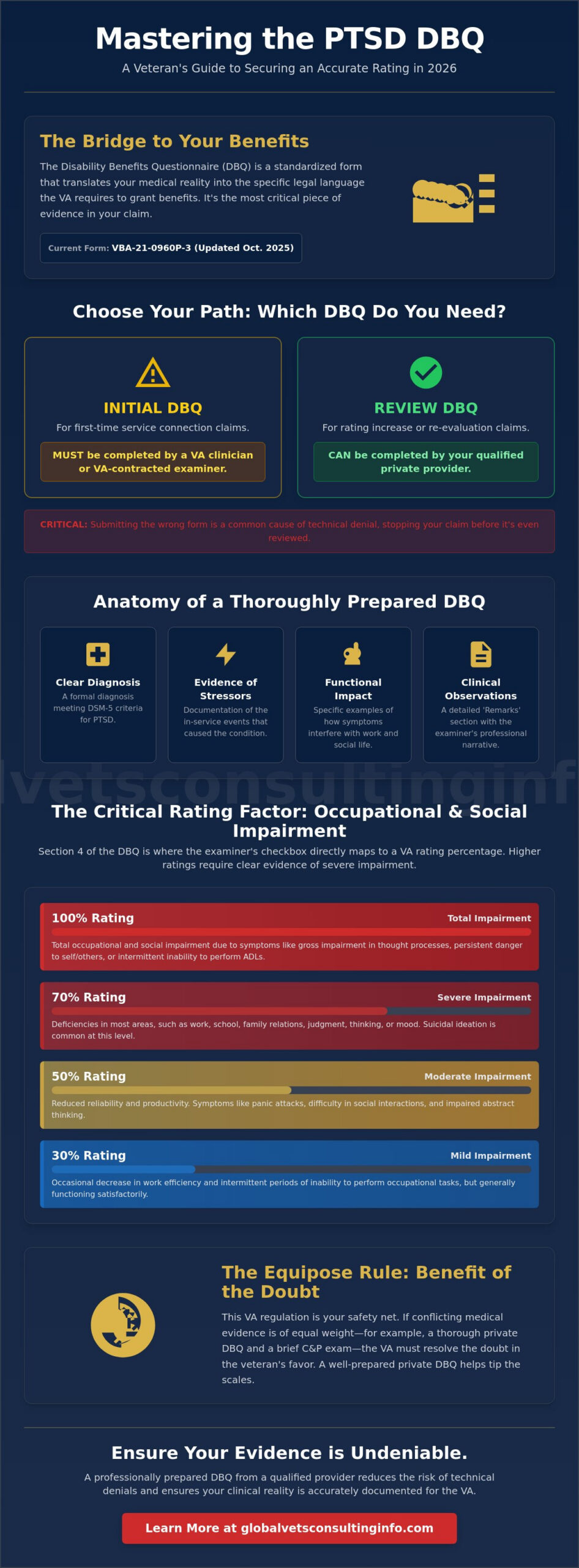
One of the most common reasons for a technical denial is submitting the wrong version of the dbq for ptsd. The VA maintains a strict distinction between an Initial and a Review DBQ. If you’re filing for service connection for the first time, you require an Initial PTSD DBQ. However, per current VA regulations in 2026, initial evaluations for PTSD must be completed by a VA clinician or a VA-contracted examiner. Private providers cannot complete the initial version for you. Conversely, if you’re already service-connected and seeking an increase because your symptoms have worsened, you need a Review PTSD DBQ. Submitting a review form for an initial claim, or vice versa, often leads to an immediate administrative rejection without the VA even looking at your medical evidence.
VBA-21-0960P-3: Navigating the Official Form
The specific form you’ll likely encounter for an increase or re-evaluation is VA Form 21-0960P-3. The VA released an updated version of this form on October 3, 2025, to better align with evolving clinical standards. This document is divided into critical sections, including your formal diagnosis, clinical findings, and levels of functional impairment. It’s not enough for a doctor to simply check a box. Every selection in the “Occupational and Social Impairment” section must be supported by a detailed clinical narrative in the ‘Remarks’ section. Without this narrative, the VA may find the evidence insufficient and trigger a mandatory C&P exam, potentially disregarding your private medical record. A thorough DBQ should include:
- Clear Diagnosis: A formal diagnosis that meets DSM-5 criteria.
- Evidence of Stressors: Documentation of the events that caused the condition.
- Functional Impact: Specific examples of how symptoms interfere with work and social life.
- Clinical Observations: The examiner’s professional opinion on the severity of your symptoms.
Choosing the correct form and ensuring it is filled out with meticulous detail is the first step toward a successful claim. This proactive approach reduces the likelihood of the VA relying solely on a rushed internal exam, giving you more control over the evidence used to determine your rating. Veterans dealing with co-occurring conditions should also explore how a dbq for mental health conditions can help document the full spectrum of service-connected psychiatric symptoms alongside PTSD.
The Critical Rating Factor: Occupational and Social Impairment
Section 4 of the dbq for ptsd is the most influential portion of your claim. This is where the examiner selects a single checkbox that summarizes your entire level of functioning. The VA uses these checkboxes to map your condition directly to the General Formula for Mental Disorders. While symptoms like nightmares or hypervigilance are important, the VA prioritizes how those symptoms disrupt your ability to work and maintain a stable social life. If the checkbox selected doesn’t reflect the true depth of your struggle, you’ll likely find yourself stuck in the “middle ground” trap of a 30% or 50% rating, which often fails to cover the financial reality of your impairment.
To qualify for higher compensation levels, your medical evidence must clearly demonstrate a high degree of disruption. You can review the basic VA eligibility for PTSD disability to see how the government frames these requirements. Many veterans feel their symptoms are severe, yet their ratings stay low because the examiner didn’t see enough evidence of “impairment” during the brief exam window. It’s also worth noting that mental health conditions rarely exist in isolation — veterans with service-connected tinnitus, for example, may also be dealing with depression that compounds their overall impairment, making it important to understand how to file a va claim for depression secondary to tinnitus to capture the full scope of your service-connected challenges. Ensuring your clinical narrative is robust and accurate is essential for a fair outcome. For those who need assistance, seeking expert preparation of your medical documentation can help bridge the gap between your lived experience and the VA’s technical requirements.
The 70% vs. 100% Threshold: What the DBQ Must Show
The jump from 70% to 100% is significant, both in terms of clinical criteria and monthly compensation. For a 100% rating, the dbq for ptsd must indicate “total occupational and social impairment.” This usually involves showing that you’re unable to function in almost any environment. Key indicators include near-continuous panic, profound memory loss, or a total inability to maintain relationships. A 70% rating is generally assigned when there is occupational and social impairment with deficiencies in most areas, such as work, school, family relations, judgment, thinking, or mood. Documenting suicidal ideation or frequent, unprovoked outbursts is often the clinical evidence needed to reach this threshold.
Documenting Symptoms in Section 5
Section 5 is where the examiner lists your specific symptoms, but these notes must serve as the “proof” for the impairment level chosen in Section 4. If your doctor notes frequent flashbacks and hypervigilance, these should be explicitly linked to why you can’t stay in a crowded office or maintain a steady job. The frequency and severity of these episodes are vital. If you experience panic attacks weekly rather than monthly, that distinction must be clear in the clinical notes. It’s also important to ensure that “occupational impairment” isn’t just about your job; it includes your ability to navigate social settings, interact with family members, and manage daily tasks without significant assistance.
Private PTSD DBQs vs. VA C&P Exams: Making the Choice
Choosing between a VA-contracted Compensation and Pension (C&P) exam and a private medical evaluation is a pivotal decision for your claim. While the VA often defaults to its own examiners, these appointments can be notoriously brief, sometimes lasting only 15 minutes. This limited window rarely provides enough time to capture the full scope of your service-connected symptoms. By contrast, a private dbq for ptsd allows for a more exhaustive review of your history. If the evidence from a private provider and a VA examiner is in conflict, the “Equipose” rule states that the VA should decide in favor of the veteran. This legal safeguard makes a well-documented private DBQ a powerful rebuttal to an inadequate or negative C&P exam.
Relying solely on a contracted provider carries risks. Since these examiners are often managed by third-party companies, the quality and thoroughness of the report can vary wildly. As of April 2026, some veterans have noticed that the VA may omit the examiner’s medical opinion from rating decision letters. This change makes it much harder to understand why a claim was denied. By submitting your own evidence, you ensure that a detailed clinical perspective is already part of your permanent record, providing a transparent basis for your requested rating.
Will the VA Accept a Private DBQ?
The VA is legally required to consider private medical evidence, provided it meets the standard of being “competent, credible, and probative.” However, the VA often scrutinizes private documents more heavily than their own. To prevent your evidence from being discarded, your private provider must state they have reviewed your entire Claims File (C-file). Without this specific confirmation, the VA may claim the doctor lacked a complete picture of your medical history. Ensuring your provider uses the most recent VA Form 21-0960P-3 is also essential to avoid administrative rejections.
The ‘Evidence of Record’ Strategy
Submitting a private dbq for ptsd at the start of your filing can qualify you for the Fully Developed Claim (FDC) program. This strategy forces the VA to address your specific clinical findings as part of the official “evidence of record” from day one. In 2026, where the average claim timeline ranges from 3 to 5 months, having comprehensive evidence already in the file can prevent unnecessary delays. It’s also vital to include a Nexus Letter with your DBQ for initial claims. While the DBQ measures the severity of your symptoms, the Nexus Letter provides the clinical link between those symptoms and your military service. Together, these documents create a robust evidentiary foundation that is difficult for the VA to ignore.
How to Prepare for Your PTSD DBQ Medical Assessment
Preparation for a dbq for ptsd assessment begins long before you walk into the clinical office. Your first step involves gathering a complete medical history, including service treatment records and any post-service treatment files from private doctors. This documentation creates a baseline for the examiner to follow. Next, you must mentally prepare to discuss your “worst days” rather than your current mood. Many veterans instinctively mask their symptoms or minimize their pain, but this habit often leads to an inaccurate rating. You should also prepare a list of secondary conditions, such as sleep apnea or GERD, that you believe are linked to your PTSD. In 2026, the VA is applying higher scrutiny to secondary claims, so having these connections documented early is essential. Finally, review the DSM-5 criteria to understand the clinical requirements and ensure your provider completes the ‘Remarks’ section with specific, real-world examples. If you are also managing anxiety, depression, or other co-occurring diagnoses alongside PTSD, understanding the broader requirements for a dbq for mental health conditions can help you ensure all service-connected psychiatric impairments are properly captured in your evidence. Veterans whose anxiety symptoms are being evaluated separately from their PTSD should also review how a dbq for anxiety documents functional impairment under the 2026 updated rating criteria to ensure no service-connected condition is underrepresented in their claim.
The ‘Worst Day’ Rule: Communicating Severity
Describing an “average” day often results in a rating that doesn’t reflect your actual level of impairment. If you tell an examiner you’re “doing okay,” they’ll likely check boxes for mild symptoms, even if you spent the previous three nights unable to sleep. To provide a clearer picture, you should prepare your spouse or a close family member to provide Buddy Statements. These lay statements provide the social context that a brief clinical interview might miss. When describing a panic attack, you should state that they occur four times per week and cause a total inability to function for several hours. This specific, frequency-based description helps the examiner complete the dbq for ptsd with the precision the VA requires for a fair rating.
Reviewing the Completed DBQ for Errors
Before you submit your claim, you must verify the technical accuracy of the document. Check for missing signatures, dates, or the specific credentials of the examiner. A single administrative oversight can stall your claim for months, especially given that the average claim timeline in 2026 is currently between 3 to 5 months. Ensure the doctor checked “Yes” for the “at least as likely as not” service connection statement, as this is the legal standard for establishing a medical nexus. Finally, cross-reference Section 5 to confirm that every symptom you discussed is actually checked. If you want to ensure your documentation is handled with meticulous care, you can order a professionally prepared DBQ to reduce the risk of technical denials.
Securing Accurate Medical Evidence with Global Vets Consulting
The mission at Global Vets Consulting is rooted in a sense of duty toward those who served. We understand that a dbq for ptsd is more than just a form; it’s the clinical foundation for your financial and medical future. Many veterans face technical denials not because their condition isn’t real, but because their documentation lacks the precision required by VA raters. Our professional preparation services focus on ensuring that your medical evidence is thorough, accurate, and aligned with the latest regulatory standards. By prioritizing meticulousness in every document, we help reduce the risk of administrative errors that often lead to years of frustrating appeals. This approach transforms the claims process from a confusing transaction into a clear, predictable partnership.
Our veteran-owned perspective provides a unique advantage in the medical evidence process. We speak the language of both the military and the VA bureaucracy, allowing us to bridge the gap between your service history and the clinical requirements of 38 CFR. This grounded, hardworking approach respects your contributions while providing the expert guidance needed to simplify a complex system. If you’ve previously felt neglected or confused by the VA’s internal processes, having a knowledgeable advocate ensures your voice is heard through high-quality documentation. We’re dedicated to helping you move forward from a place of uncertainty to a position of steady confidence.
Why Professional Preparation Matters
The complexity of the VA rating schedule continues to evolve, and 2026 has brought increased scrutiny to how medical evidence is presented. With the VA applying stricter evidentiary requirements for secondary conditions and mental health claims, simply having a diagnosis is no longer enough. Your dbq for ptsd must be “VA-ready” before you ever hit the upload button. This means ensuring that every clinical finding is supported by a robust narrative and that your symptoms are mapped correctly to the General Formula for Mental Disorders. Professional preparation ensures that your private medical evidence is competent and probative, making it much harder for the VA to overlook or dismiss your claim during the review process.
Take Control of Your VA Claim Today
A correctly rated PTSD claim has a profound impact on your life. In 2026, the difference between a 50% and a 70% rating represents hundreds of dollars in monthly compensation, while a 100% rating provides the highest level of security for you and your family. Transitioning from a denial to being service-connected requires a methodical and intentional strategy. Given that the average claim timeline currently ranges from 3 to 5 months, submitting the strongest possible evidence at the outset is the most effective way to avoid the bottleneck of the C&P exam system. You don’t have to navigate this bureaucratic landscape alone. Reach out to Global Vets Consulting to start your DBQ preparation today.
Take Charge of Your PTSD Rating and Future
You now possess the knowledge to transform your claim from a series of technical hurdles into a clear path toward fair compensation. By focusing on the specific checkboxes in Section 4 and documenting your symptoms through the lens of occupational and social impairment, you ensure the VA sees the full reality of your condition. The dbq for ptsd is your most powerful tool for rebutting rushed C&P exams and securing a rating that accurately reflects your service-connected struggle. Precision in your documentation isn’t just about paperwork; it’s about securing the resources you need for long-term stability.
Global Vets Consulting has been veteran-owned and operated since 2021. We specialize in 38 CFR compliance and maintain specific expertise in complex mental health documentation to help you avoid common administrative pitfalls. Our team acts as a steady guide to ensure your medical evidence meets every technical requirement the VA demands in 2026. Secure the medical evidence you earned with Global Vets Consulting and take the next step toward a successful outcome. You’ve already done the hard work of serving. It’s time to ensure your benefits reflect that dedication with confidence and clarity.
Frequently Asked Questions
Can a private psychologist fill out a DBQ for PTSD?
Yes, a private psychologist can complete a review dbq for ptsd for a rating increase, but the VA maintains specific restrictions for initial claims. While private providers can document your current symptom severity, the VA requires a VA clinician or a contracted examiner to perform the initial diagnostic evaluation. It’s essential that your private provider reviews your entire Claims File to ensure their medical opinion meets the VA’s standards for credibility.
What is the difference between an Initial PTSD DBQ and a Review PTSD DBQ?
An Initial PTSD DBQ is the form required when you are seeking service connection for the first time. A Review PTSD DBQ, specifically VA Form 21-0960P-3, is used for veterans who are already service-connected and want to file for a rating increase or respond to a re-evaluation request. Submitting the review version for an initial claim is a common administrative error that can lead to an immediate denial of your application.
Does the VA have to accept a private DBQ instead of a C&P exam?
The VA is legally required to consider private medical evidence, but they aren’t forced to accept it as a total replacement for a C&P exam. Even if you submit a thorough private dbq for ptsd, the VA reserves the right to schedule its own examination to verify the findings. However, your private evidence remains a permanent part of the record and serves as a vital tool to refute an inadequate or rushed VA exam during the appeals process.
What symptoms trigger a 70% PTSD rating on the DBQ?
A 70% rating is typically triggered by symptoms that cause deficiencies in most areas of your life, such as work, family relations, judgment, and mood. Specific clinical indicators often include suicidal ideation, near-continuous panic attacks, or frequent, unprovoked irritability. The examiner must document these symptoms in Section 5 and check the corresponding impairment level in Section 4 to justify this rating under the VA’s general formula.
What should I do if my VA examiner ignores my private DBQ?
You should request a Higher-Level Review if an examiner or rater ignores your private medical evidence. Under VA regulations, the agency must address all competent and probative evidence of record. If your decision letter omits the findings from your private documentation, it may constitute a duty-to-assist error. This allows you to challenge the decision based on the VA’s failure to consider your complete medical history.
Can I submit a DBQ for PTSD if I am already service-connected at 30%?
Yes, you can submit a new dbq for ptsd if you are currently rated at 30% and your symptoms have worsened over time. This is filed as a claim for an increase. You’ll need to use the Review PTSD DBQ to document how your condition now causes greater occupational or social impairment than it did during your previous evaluation, potentially qualifying you for a 50%, 70%, or 100% rating.
How much does a private DBQ for PTSD cost in 2026?
Private providers set their own fees for medical evaluations and documentation based on their professional standards. The cost of a private DBQ can vary depending on the complexity of your medical history and the time required for a thorough review of your service records. You should check directly with independent medical professionals to understand their specific pricing structures for these services before beginning the process.
What is the ‘Occupational and Social Impairment’ section of the DBQ?
Section 4 of the DBQ is the “Occupational and Social Impairment” section, which serves as the primary driver of your disability rating. It contains a series of checkboxes that range from no impairment to total impairment in work and social settings. The VA rater uses this specific section to decide where your condition fits within the General Formula for Mental Disorders, making it the most critical part of the entire document.

Article by
Willie Daniel
Willie Daniel is the Founder and Chief Executive Officer (CEO) of Global Vets Consulting (GVC) – National Veterans Disability Services, a veteran-led educational and medical evidence support organization dedicated to helping veterans better understand VA disability rating increases, DBQ medical evidence, secondary claims education, and C&P examination preparation.
He is a retired U.S. Army Medical Service Corps Officer with more than 27 years of honorable military service, a decorated Iraq combat veteran, and a retired federal official with the U.S. Department of Veterans Affairs. Throughout his military and federal career, Willie Daniel served in leadership, healthcare administration, operational, and veteran-support roles focused on improving services and support systems for servicemembers, veterans, and their families.
Drawing from decades of military leadership, healthcare administration, veteran advocacy, and federal government experience, Willie Daniel brings a practical, veteran-centered perspective to Global Vets Consulting’s educational articles, AI-powered veteran resources, video education initiatives, and outreach programs. His experience navigating military systems, medical documentation processes, and veteran-related administrative operations provides valuable insight into many of the challenges veterans face when seeking to better understand VA disability rating criteria, medical evidence, documentation strategies, and secondary condition education.
Through GVC’s “Veterans Helping Veterans” mission, his focus is on delivering clear, educational, and easy-to-understand information designed to empower veterans with knowledge, resources, and educational tools that may help them make more informed decisions regarding their individual VA disability journeys.
The information provided through GVC is intended for educational and informational purposes only and should not be considered legal or medical advice.
Disclaimer
Disclaimer: Global Vets Consulting, LLC (“GVC”) is a veteran-led educational and medical evidence support organization. GVC is not a law firm, is not a Veterans Service Organization (VSO), and is not affiliated with the U.S. Department of Veterans Affairs (VA) or any government agency.
Global Vets Consulting does not provide legal advice, medical advice, medical treatment, or healthcare services. GVC does not prepare, file, or submit VA disability claims on behalf of veterans. All information provided through this website, blog articles, videos, educational materials, AI tools, dashboards, templates, and communications is intended solely for general educational and informational purposes.
Veterans are encouraged to consult with accredited representatives, licensed attorneys, qualified medical providers, or Veterans Service Organizations regarding their specific legal, medical, or VA-related matters. VA disability decisions, ratings, and outcomes are determined solely by the U.S. Department of Veterans Affairs based on applicable laws, regulations, medical evidence, and individual circumstances. Past results do not guarantee future outcomes.