
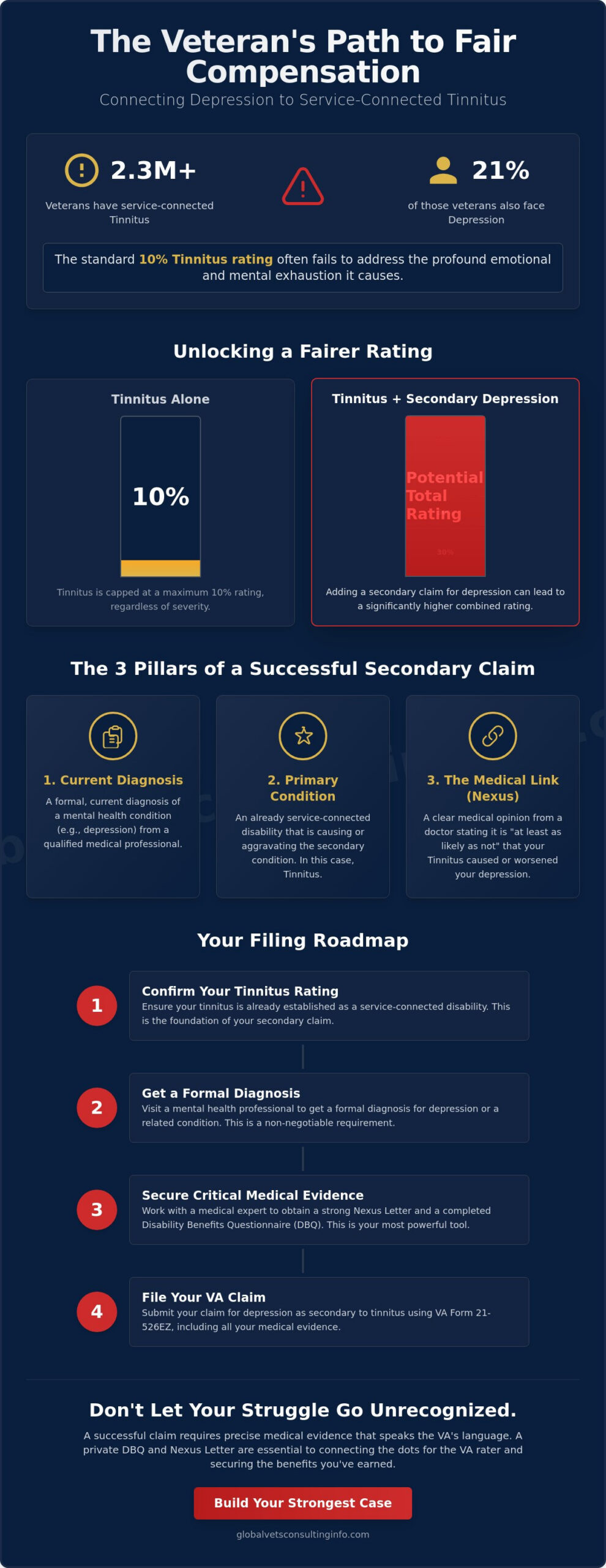
Did you know that 21% of veterans living with service-connected tinnitus are also diagnosed with depression? If you are one of the 2.3 million veterans dealing with a relentless ringing or buzzing in your ears, you know that the impact is rarely just physical. It’s often a source of profound emotional exhaustion that the standard 10% rating fails to address. Filing a va claim for depression secondary to tinnitus is a strategic and necessary step toward securing the compensation that reflects the true scope of your service-connected challenges.
It’s understandable to feel frustrated when the VA views your symptoms in isolation rather than seeing the full picture of your health. You deserve a rating that acknowledges how constant auditory irritation can lead to functional mental impairment. This guide will teach you how to successfully link your mental health to your tinnitus and secure the VA rating you’ve earned. We will walk through the medical evidence required for a successful nexus, how to utilize a private Disability Benefits Questionnaire (DBQ), and what the 2.8% COLA increase for 2026 means for your monthly disability payments.
Key Takeaways
- Understand how the VA defines secondary service connection and why chronic tinnitus is a recognized medical trigger for clinical depression.
- Learn how the VA’s 2026 rating schedule evaluates social and occupational impairment to determine your mental health disability percentage.
- Discover the specific medical evidence needed to file a successful va claim for depression secondary to tinnitus, including the three-part nexus requirement.
- See why a private Disability Benefits Questionnaire (DBQ) serves as your most powerful tool for providing the VA with clear, actionable medical documentation.
- Follow a logical roadmap that takes you from securing your initial tinnitus rating to obtaining a formal diagnosis for your secondary claim.
The Link Between Tinnitus and Depression: Understanding Secondary Service Connection
A secondary service connection exists when a new disability is “proximately due to” or the result of a condition that is already service-connected. For many veterans, the constant ringing, buzzing, or hissing in their ears is more than a nuisance; it’s a persistent stressor that leads to clinical depression. Filing a va claim for depression secondary to tinnitus allows you to seek compensation for the full impact of your health challenges. This process acknowledges that your primary service-connected disability has created a chain reaction affecting your overall well-being.
The VA distinguishes between conditions “caused by” and those “aggravated by” a service-connected disability. Your tinnitus might directly cause your depression through chronic stress and isolation. Alternatively, if you had a pre-existing mental health condition, the tinnitus may have aggravated it, making the symptoms significantly worse. Both pathways are valid for a secondary claim. Understanding this distinction is vital because it broadens the scope of evidence you can provide to support your case.
Currently, the VA caps tinnitus as a standalone disability at a 10% rating. For many, this flat rate feels like an insufficient acknowledgment of their total suffering. When the psychological fallout of tinnitus becomes debilitating, a secondary claim is the most effective way to secure fair compensation. It moves you past the 10% ceiling by factoring in the social and occupational impairment caused by your mental health symptoms.
How Chronic Ringing Becomes a Mental Health Burden
Living with a sound that never stops creates a state of constant neurological high alert. This persistent noise often leads to severe sleep deprivation, which is a primary driver of mood regulation issues and irritability. The Link Between Tinnitus and Depression is well-documented in clinical settings. Many veterans experience “tinnitus distress,” a state where the brain’s inability to filter out the noise leads to a breakdown in emotional resilience. When you cannot find silence, your mind remains in a state of perpetual exhaustion, eventually leading to the hopelessness characteristic of clinical depression.
The Legal Basis for Your Secondary Claim
The framework for your claim is established in 38 CFR § 3.310. This regulation mandates that the VA must compensate for any disability that results from a service-connected condition. It is a common misconception that your depression must have started while you were on active duty. In reality, your va claim for depression secondary to tinnitus is based on your current health status. As long as you can provide a medical link showing the tinnitus caused or worsened your depression, you are eligible for benefits. This legal standard ensures that the VA’s duty to you continues even if secondary conditions emerge years after your service ended.
How the VA Rates Depression Secondary to Tinnitus in 2026
The VA evaluates mental health conditions using a standardized scale that measures how your symptoms interfere with your daily life. Unlike physical injuries that might be measured by range of motion, a va claim for depression secondary to tinnitus is assessed based on social and occupational impairment. This means the rater looks at your ability to maintain a job, sustain relationships, and manage your own care. The goal is to determine how much your earning capacity is reduced by your service-connected conditions.
One critical concept to understand is the “pyramiding” rule. The VA does not allow you to stack ratings for multiple mental health symptoms. If your tinnitus leads to both depression and anxiety, you won’t receive two separate percentages. Instead, the VA assigns a single rating that encompasses the severity of all your mental health symptoms combined. According to Medical Evidence on Tinnitus and Depression in Veterans, the psychological impact of chronic auditory distress is significant, often manifesting in several areas of life simultaneously. This makes it vital to document every symptom accurately during your evaluation. Veterans who also experience trauma-related symptoms alongside their depression should review how a DBQ for PTSD works in 2026, as the same DBQ-driven evidence strategy applies across all mental health claims.
Securing a higher rating for depression can significantly change your monthly compensation, especially with the 2.8% COLA increase effective for 2026. Because tinnitus is capped at 10%, adding a secondary mental health rating is often the only way for veterans to move into a higher disability bracket. If you’re struggling to articulate how your symptoms affect your daily routine, obtaining a professional Disability Benefits Questionnaire can provide the clinical clarity the VA requires.
Breakdown of the Mental Health Rating Scale
The VA assigns ratings of 0%, 10%, 30%, 50%, 70%, or 100% based on specific criteria found in the General Rating Formula for Mental Disorders:
- 30% Rating: This level reflects occasional impairment. You might experience periods of depression or anxiety that interfere with work or social activities, but you’re generally able to function during most days.
- 50% Rating: This indicates a more consistent reduction in reliability and productivity. Symptoms like flattened affect, impaired judgment, or panic attacks might occur weekly, making it difficult to maintain steady employment.
- 70% Rating: This is a high level of disability. It represents deficiencies in most areas, including work, school, family relations, and even your own hygiene or mood regulation. You may experience near-continuous depression or distress that makes social interaction exhausting.
VA Math: Combining Tinnitus and Depression
When you successfully file a va claim for depression secondary to tinnitus, your ratings are combined using a unique calculation method. Many veterans assume that a 70% rating for depression and a 10% rating for tinnitus would result in an 80% total rating. However, VA math is based on your “remaining efficient” percentage rather than simple addition.
If you’re 0% disabled, you’re 100% efficient. A 70% rating for depression takes 70% of that 100%, leaving you 30% efficient. The 10% tinnitus rating then takes 10% of that remaining 30% (which is 3%), bringing your total disability to 73%. Since the VA rounds to the nearest 10, your final combined rating would be 70%. While the math seems counterintuitive, moving from a standalone 10% to a combined 70% represents a massive increase in monthly support and access to care.
The Medical Evidence Bridge: Why a Nexus and DBQ are Essential
The transition from a primary condition to a secondary one requires a solid medical bridge. When you file a va claim for depression secondary to tinnitus, the VA doesn’t just take your word for it. You must provide three specific elements: a current medical diagnosis of depression, evidence of a service-connected trigger (your tinnitus), and a medical nexus linking the two. This nexus is the glue that holds your claim together, proving that your mental health struggles didn’t happen in a vacuum. It transforms your personal experience into a clinical reality that the VA can process.
A Disability Benefits Questionnaire (DBQ) is often the most influential document in your file. While the VA frequently relies on Compensation and Pension (C&P) exams conducted by third-party contractors, these appointments can feel rushed. A private DBQ allows you to work with a provider who takes the time to document the full severity of your symptoms. This ensures that every nuance of your social and occupational impairment is captured accurately, rather than being reduced to a series of checked boxes on a generic form. By submitting a high-quality DBQ, you’re providing the rater with the exact data points they need to assign a fair percentage.
What Makes a Winning Nexus Statement?
A successful nexus statement hinges on the specific legal phrase “at least as likely as not.” This means there’s at least a 50% probability that your depression was caused or aggravated by your tinnitus. To make this opinion stick, your doctor must provide a detailed rationale. They can’t just state the connection; they must explain the biological or psychological “why” behind it. Additionally, the VA gives much more weight to opinions where the doctor has reviewed your entire C-File. This review proves the physician has a comprehensive understanding of your medical history, making their conclusion much harder for the VA to dismiss.
Private DBQs vs. C&P Exams: Protecting Your Claim
You have the right to submit private medical evidence, and under 38 CFR § 3.326, the VA is required to accept private DBQs if they are sufficient for rating purposes. This is a powerful tool for veterans. A private DBQ acts as a proactive rebuttal to a potentially negative C&P exam. If a VA examiner spends only ten minutes with you and concludes your depression is unrelated to your service, a thorough DBQ from a private specialist provides a necessary counter-balance. It’s vital that a mental health DBQ is completed by a qualified specialist, such as a psychologist or psychiatrist, to ensure the evidence meets the VA’s high standards for clinical validity.
Step-by-Step Guide to Filing Your Secondary VA Claim
Filing a va claim for depression secondary to tinnitus requires a methodical approach to ensure the VA rater understands the causal link immediately. It’s not enough to simply submit a claim; you must present a logical narrative supported by regulatory forms. Following a structured process reduces the likelihood of administrative errors that could delay your benefits. Here is the roadmap to navigating your filing successfully.
- Step 1: Secure your anchor disability. You must already have a service connection for tinnitus, typically at 10%, before you can link a secondary condition to it.
- Step 2: Obtain a formal diagnosis. A qualified mental health professional must provide a diagnosis of depression or anxiety. Without a current diagnosis, the VA will deny the claim regardless of your symptoms.
- Step 3: Gather your medical evidence. This includes your Nexus letter and a private Disability Benefits Questionnaire (DBQ) to bridge the gap between your physical ringing and mental health.
- Step 4: Submit your application. Use VA Form 21-526EZ, updated as of April 2026, and file it via VA.gov. Ensure you clearly mark the depression as secondary to your existing tinnitus.
- Step 5: Prepare for the C&P exam. Review your medical records and your private DBQ so you can speak accurately about your symptoms during the evaluation.
If you haven’t yet secured the clinical documentation needed for Step 3, you can get a professional DBQ here to ensure your claim is fully developed before submission.
Preparing Your Documentation for Submission
Properly labeling your evidence is a small step that makes a massive difference for the rater. When you upload your files, use clear names like “Medical Nexus Letter” or “Depression DBQ.” You should also include a Statement in Support of Claim (VA Form 21-4138). Use this form to describe exactly how the constant ringing in your ears prevents you from sleeping or causes you to withdraw from social situations. Additionally, “Buddy Statements” on VA Form 21-1021 from a spouse or close friend can provide the VA with a third-party perspective on your mood shifts and daily struggles.
The C&P Exam: What to Expect and How to Handle It
The Compensation and Pension (C&P) exam is a critical hurdle. When the examiner asks how you’re doing, don’t just describe how you feel that morning. You must be honest about your “worst days.” If your depression makes it impossible to get out of bed twice a week, that is the reality the examiner needs to hear. Bring a copy of your private DBQ to the exam as a reference tool. It helps you stay consistent with the symptoms you’ve already documented. If an examiner seems to ignore the connection between your tinnitus and depression, remain calm and rely on the strength of the medical evidence you’ve already submitted to the file.
Securing Your Medical Evidence with Global Vets Consulting
Securing a fair rating for your va claim for depression secondary to tinnitus shouldn’t feel like a gamble. Global Vets Consulting understands that the difference between a denial and a successful rating often comes down to the quality of your clinical documentation. We focus on the Disability Benefits Questionnaire (DBQ) as the primary tool for rating success because it’s the exact format the VA rater uses to evaluate your claim. By taking control of your medical evidence, you move from a state of uncertainty to a position of clinical strength.
Working with a veteran-owned and operated service provides a level of empathy and insight that civilian-led firms often lack. We’ve been through the system and recognize the psychological toll that chronic tinnitus takes on your daily life. Our methodical approach to documentation is designed to speak the VA’s language fluently. This precision reduces the risk of the VA placing your claim in the “evidence gathering” phase, a common bottleneck that can delay your benefits for months. Instead of relying on the luck of the draw with a contractor at a C&P exam, you can submit a fully developed claim from the start.
Empowerment is a central part of our process. Many veterans feel neglected by complex administrative systems, but having high-quality medical evidence changes the dynamic of your claim. It forces the VA to address the specific, documented symptoms of your mental health condition rather than relying on brief observations from a single exam. This proactive strategy ensures that your total suffering is recognized and properly compensated according to the 2026 disability standards.
Our Mission: Meticulous Evidence for Deserved Outcomes
Our mission is built on a foundation of integrity and meticulousness. We’re committed to ensuring that every va claim for depression secondary to tinnitus we support is backed by thorough and accurate DBQ preparation. We simplify the bureaucratic process by guiding you through the documentation requirements step-by-step. This professional oversight ensures that your social and occupational impairment is described using the specific terminology required for a 30%, 50%, or 70% rating. When your paperwork is prepared correctly, it eliminates ambiguity and provides a clear path for the VA rater to follow.
Next Steps: Start Your Secondary Claim Today
You don’t have to struggle with the relentless ringing of tinnitus and the resulting weight of depression on your own. Seeking professional documentation support is a strategic step toward securing the future you’ve earned through your service. Stop waiting for the system to fix itself and take the lead in your own disability claim. Our team is ready to help you bridge the gap between your physical symptoms and your mental health rating with precision and respect. Get the medical evidence you need with Global Vets Consulting and start your journey toward a more accurate combined disability rating today.
Take Control of Your Disability Rating Today
Securing the benefits you deserve is a matter of presenting the right evidence in a way the system cannot ignore. By understanding the link between auditory distress and mental health, you can move beyond the 10% tinnitus cap and secure a combined rating that reflects your true daily experience. Filing a va claim for depression secondary to tinnitus is a strategic decision that acknowledges the full reality of your health and ensures you benefit from the 2.8% COLA increase for 2026.
Global Vets Consulting is a Veteran-Owned & Operated firm that has been specializing in DBQ preparation since 2021. We provide national service coverage to help you obtain the meticulous medical evidence required for a successful claim. Our team prioritizes clinical accuracy and precision to reduce your anxiety throughout the administrative process, moving you closer to a predictable and favorable result.
Take the first step toward the rating you’ve earned by prioritizing your medical documentation. Secure Your Professional DBQ from Global Vets Consulting today and move forward with the confidence of a well-supported claim. You served our country with honor; now, it’s time to ensure the system honors your sacrifice with the compensation you are owed.
Frequently Asked Questions
Can I get VA disability for depression secondary to tinnitus?
Yes, you can receive disability compensation for depression that is caused or aggravated by your service-connected tinnitus. Under 38 CFR § 3.310, the VA recognizes secondary service connection when a new disability results from an existing one. To succeed with a va claim for depression secondary to tinnitus, you must provide a current diagnosis and a medical nexus linking the two conditions.
How much does the VA pay for depression secondary to tinnitus?
The payment amount depends on your total combined disability rating rather than a specific dollar amount for depression alone. For 2026, the VA implemented a 2.8% COLA increase for all compensation rates. For example, a single veteran with a 100% combined rating will receive $3,938.57 per month starting in January 2026. Your mental health rating (0% to 100%) will be combined with your 10% tinnitus rating using VA math.
What is the maximum VA rating for tinnitus?
The current maximum standalone rating for tinnitus is 10% under Diagnostic Code 6260. While the VA proposed changes in early 2026 to eliminate tinnitus as a standalone rating, those changes haven’t been finalized as of April 2026. Veterans with an existing 10% rating are grandfathered in, meaning their current rating won’t be reduced even if the new regulations take effect later this year.
Do I need a new Nexus letter if I already have a diagnosis?
Yes, a diagnosis of depression is only one part of the requirement. A Nexus letter is a separate medical opinion that specifically bridges the gap between your diagnosis and your service-connected tinnitus. The letter must state that your depression is “at least as likely as not” due to your tinnitus and provide a clinical rationale. Without this link, the VA may deny the claim regardless of your diagnosis.
Will the VA accept a DBQ from a private doctor?
Yes, the VA is legally required to accept a Disability Benefits Questionnaire (DBQ) from a private provider under 38 CFR § 3.326. As long as the private DBQ is “sufficient for rating purposes,” it can even be used to decide your claim without a C&P exam. This is a powerful way to ensure your symptoms are documented by a specialist who understands your history rather than a rushed contractor.
What happens if my secondary claim for depression is denied?
If your va claim for depression secondary to tinnitus is denied, you have three primary appeal options. You can file a Supplemental Claim if you have new and relevant evidence, such as a private DBQ. You can also request a Higher-Level Review if you believe the rater made an error. Finally, you can choose a Board Appeal to have a judge review your case, though this process takes longer.
Can I claim anxiety and depression secondary to tinnitus at the same time?
Yes, you can claim both conditions, but the VA will only assign one combined rating for all mental health symptoms. This is known as the “pyramiding” rule, which prevents veterans from being rated twice for the same symptoms. The VA will evaluate the total social and occupational impairment caused by both your anxiety and depression and assign a single percentage that covers both.
How long does a secondary VA claim take to process in 2026?
Most secondary claims currently take between 120 and 150 days to process, though times can vary based on the complexity of your evidence. To avoid unnecessary delays, ensure you are using the April 2026 version of VA Form 21-526EZ. Submitting a fully developed claim with a private DBQ and a clear nexus letter can often help the VA reach a decision faster by reducing the need for additional evidence gathering.

Article by
Willie Daniel
Willie Daniel is the Founder and Chief Executive Officer (CEO) of Global Vets Consulting (GVC) – National Veterans Disability Services, a veteran-led educational and medical evidence support organization dedicated to helping veterans better understand VA disability rating increases, DBQ medical evidence, secondary claims education, and C&P examination preparation.
He is a retired U.S. Army Medical Service Corps Officer with more than 27 years of honorable military service, a decorated Iraq combat veteran, and a retired federal official with the U.S. Department of Veterans Affairs. Throughout his military and federal career, Willie Daniel served in leadership, healthcare administration, operational, and veteran-support roles focused on improving services and support systems for servicemembers, veterans, and their families.
Drawing from decades of military leadership, healthcare administration, veteran advocacy, and federal government experience, Willie Daniel brings a practical, veteran-centered perspective to Global Vets Consulting’s educational articles, AI-powered veteran resources, video education initiatives, and outreach programs. His experience navigating military systems, medical documentation processes, and veteran-related administrative operations provides valuable insight into many of the challenges veterans face when seeking to better understand VA disability rating criteria, medical evidence, documentation strategies, and secondary condition education.
Through GVC’s “Veterans Helping Veterans” mission, his focus is on delivering clear, educational, and easy-to-understand information designed to empower veterans with knowledge, resources, and educational tools that may help them make more informed decisions regarding their individual VA disability journeys.
The information provided through GVC is intended for educational and informational purposes only and should not be considered legal or medical advice.
Disclaimer
Disclaimer: Global Vets Consulting, LLC (“GVC”) is a veteran-led educational and medical evidence support organization. GVC is not a law firm, is not a Veterans Service Organization (VSO), and is not affiliated with the U.S. Department of Veterans Affairs (VA) or any government agency.
Global Vets Consulting does not provide legal advice, medical advice, medical treatment, or healthcare services. GVC does not prepare, file, or submit VA disability claims on behalf of veterans. All information provided through this website, blog articles, videos, educational materials, AI tools, dashboards, templates, and communications is intended solely for general educational and informational purposes.
Veterans are encouraged to consult with accredited representatives, licensed attorneys, qualified medical providers, or Veterans Service Organizations regarding their specific legal, medical, or VA-related matters. VA disability decisions, ratings, and outcomes are determined solely by the U.S. Department of Veterans Affairs based on applicable laws, regulations, medical evidence, and individual circumstances. Past results do not guarantee future outcomes.