
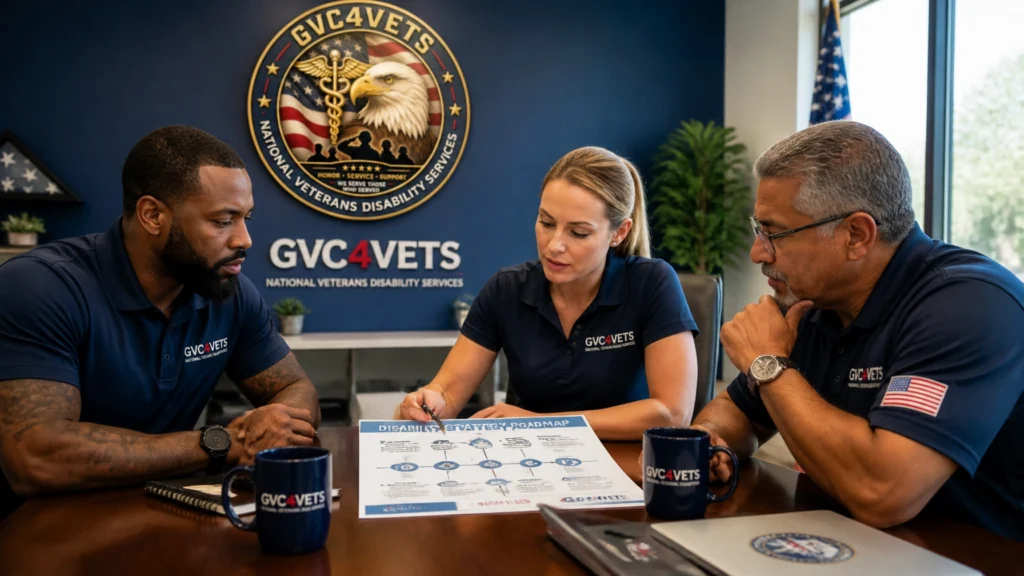
What if the reason your claim keeps getting denied isn't that you aren't "sick enough," but that you’re speaking a different language than the VA rater?
For many of us, the transition from active duty to civilian life is marked by a "quiet struggle." We push through the chronic fatigue, the hypervigilance, and the restless nights because that’s what we were trained to do. But when it comes to securing the benefits you earned through your service, "toughing it out" is a losing strategy. In the world of VA disability, your pain is subjective, but your rating is objective. To win, you need to stop thinking like a patient and start thinking like a strategist.
At GVC4Vets, we treat the disability claim process like a mission. This guide is your blueprint for mastering the two most critical "high-value" claims: Mental Health and Sleep Apnea.
Table of Contents
- The High-Value ROI: Why These Claims Matter
- The Blueprint for Mental Health Ratings (38 CFR § 4.130)
- The Roadmap for Sleep Apnea (Diagnostic Code 6847)
- Bridging the Gap: The Role of DBQs and Medical Evidence
- The Mission: Navigating Your C&P Exam
- Actionable Checklist & FAQ
The High-Value ROI: Why These Claims Matter {#the-high-value-roi}
In VA terminology, a "high-value claim" is one that has a high probability of resulting in a 50% rating or higher. Mental health conditions (PTSD, Depression, Anxiety) and Sleep Apnea are the pillars of a successful increase claim or initial claim.
Why? Because these conditions rarely exist in isolation. They are the "force multipliers" of your disability portfolio. A 70% mental health rating combined with a 50% sleep apnea rating doesn't just add up; it can fundamentally shift your total compensation and access to healthcare.
The Blueprint for Mental Health Ratings (38 CFR § 4.130) {#mental-health-blueprint}

The VA doesn't rate you based on your diagnosis (e.g., PTSD vs. General Anxiety Disorder). They rate you based on occupational and social impairment. This is governed by 38 CFR § 4.130, the General Rating Formula for Mental Disorders.
- The 70% Threshold: This is often the goal for veterans with significant symptoms. The "language of the rater" here includes terms like "suicidal ideation," "near-continuous panic," and "impaired impulse control." If your symptoms cause deficiencies in most areas (work, school, family relations), you are likely under-rated if you are currently at 30% or 50%.
- The 100% Mark: This requires "total occupational and social impairment." We’re talking about symptoms like gross disorientation, persistent delusions, or the inability to perform activities of daily living (ADLs).
Strategic Move: Stop telling the examiner "I'm doing okay." Instead, describe your "worst days." If your depression leads to "neglect of personal appearance" or "inability to maintain effective relationships," those are the data points the rater needs to see in your dbq for mental health.
The Roadmap for Sleep Apnea (Diagnostic Code 6847) {#sleep-apnea-roadmap}
Sleep apnea claims are often the victim of "administrative delays" because veterans fail to provide objective medical proof. Under 38 CFR § 4.97, Diagnostic Code 6847, the criteria are rigid:
- 0% Rating: Documented sleep-disordered breathing but asymptomatic.
- 30% Rating: Persistent daytime hypersomnolence (excessive daytime sleepiness).
- 50% Rating: Requires the use of a breathing assistance device, such as a CPAP or BiPAP machine.
- 100% Rating: Chronic respiratory failure or cor pulmonale.
The Strategy: If you are using a CPAP but only have a 30% rating, you are leaving money on the table. However, simply having a machine isn't enough; you must prove it was prescribed and is medically necessary due to your service-connected conditions. This is where Global Vets Consulting (GVC4Vets) excels, connecting you with independent physicians who understand the nexus between your service and your diagnosis.
Bridging the Gap: The Role of DBQs and Medical Evidence {#bridging-the-gap}

The biggest mistake veterans make is walking into a C&P exam empty-handed. You must "bridge the gap" between your subjective pain and the objective requirements of the VA.
- Subjective: "I can't sleep and I'm always tired."
- Objective: "Patient exhibits diagnostic code 6847 criteria; prescribed CPAP due to an AHI (Apnea-Hypopnea Index) of 15+."
At GVC4Vets, we facilitate the preparation of VA-compliant medical documentation, including Disability Benefits Questionnaires (DBQs). These documents are the "evidence-based" ammunition you need. A high-quality DBQ provides the rater with a clear, undeniable roadmap to your correct rating.
The Mission: Navigating Your C&P Exam {#cp-exam-tips}
The Compensation and Pension (C&P) exam is not a standard doctor’s visit. It is a forensic evaluation. Use these tactical tips to ensure you aren't "rushed" through the process:
- Verify the Credentials: Ensure the examiner is qualified to evaluate your specific condition.
- Identify Functional Limitations: Don't just list symptoms; explain how they stop you from working. Use phrases like "Due to my calcaneal eversion and subsequent back pain, I cannot stand for more than 15 minutes, which has led to my unemployment."
- Confirm the Record: Ask the examiner if they have reviewed your private medical records and DBQs.
- Be Honest, Not Stoic: If you are having a "good day" during the exam, tell them: "Today is an outlier. Usually, I cannot leave the house due to severe anxiety."
Actionable Checklist for High-Value Claims {#checklist-faq}
Before you hit "submit" on your next claim or appeal, ensure you have checked these boxes:
- Diagnosis Confirmed: Do you have a formal diagnosis for the condition?
- Nexus Established: Is there a clear "link" between your service and the condition (or is it secondary to an existing service-connected disability)?
- Functional Impairment Documented: Does your medical evidence clearly state how your life is impacted?
- DBQ Accuracy: Is your DBQ filled out by a provider who understands the 38 CFR requirements?
- Personal Statement: Have you drafted a "Statement in Support of Claim" (Form 21-4138) that outlines your daily struggle?
FAQ: High-Value Claims
Q: Can I claim Sleep Apnea secondary to PTSD?
A: Yes. Many veterans suffer from Sleep Apnea as a secondary condition to Mental Health disorders or weight gain caused by service-connected mobility issues. This requires a strong Independent Medical Opinion (IMO) to establish the nexus.
Q: What if I was denied because my C&P exam was only 10 minutes long?
A: This is a common "administrative delay." You can challenge a bad C&P exam by submitting a formal complaint and providing your own evidence from an independent physician through GVC4Vets.
Q: Do I need a lawyer for a VA claim appeal?
A: Not necessarily. Often, the missing piece is not legal counsel but medical evidence. Strengthening your medical file with a clear DBQ can often resolve a denial faster than a multi-year legal battle.
Take Objective Action Today
Don't let a complex system dictate your quality of life. Whether you are filing an initial claim or seeking a long-overdue increase, the strategy remains the same: Evidence is king.
Ready to secure the rating you deserve? Click here for a free consultation with the team at Global Vets Consulting (GVC4Vets) – National Veterans Disability Services. We've helped over 100,000 veterans navigate this roadmap. Let us help you find yours.


