
What if the secret to reaching the 100% pay rate has less to do with “VA math” and more to do with your specific workplace limitations? Many veterans feel trapped at a 70% rating, watching the bills pile up because their service-connected conditions make holding a steady job impossible. To bridge that gap, you need a precise understanding of the evidence needed for tdiu claim success. It isn’t just about proving you have a disability. It’s about proving that disability prevents you from maintaining substantially gainful employment.
We understand the anxiety that comes with C&P exams and the stress of facing a bureaucratic denial when your family’s financial security is on the line. It’s exhausting to feel like a file number rather than a person who served. This guide provides the exact medical and vocational roadmap required to secure Total Disability Individual Unemployability (TDIU) benefits in 2026. You’ll learn how to leverage VA Form 21-8940, manage the $15,960 income limit, and build a case that demonstrates your true vocational reality. We’ll walk through a clear checklist of evidence to help you secure the $3,938.58 monthly compensation you’ve earned.
Key Takeaways
- Understand how the VA defines “Substantial Gainful Employment” and why your documentation must focus on functional workplace limitations rather than just a medical diagnosis.
- Identify the specific medical and vocational evidence needed for tdiu claim success, including the role of detailed DBQs and employment history reports.
- Learn the step-by-step process for completing VA Form 21-8940 and verifying that your service-connected ratings meet the mandatory 60% or 70% schedular thresholds.
- Discover how positioning your submission as a Fully Developed Claim (FDC) can help you bypass common bureaucratic delays and speed up the 2026 VA decision timeline.
What is TDIU Evidence and Why is it the Key to 100% Pay?
Total Disability Individual Unemployability (TDIU) serves as a critical bridge for veterans whose service-connected disabilities prevent them from working, yet their combined rating hasn’t reached 100%. While “VA math” often makes it difficult to reach the maximum compensation level through standard ratings, TDIU allows you to receive the 100% pay rate of $3,938.58 per month. The challenge lies in the specific evidence needed for tdiu claim approval. You aren’t just proving you have a medical condition; you’re proving that your condition makes “substantial gainful employment” impossible. In 2026, the Veterans Benefits Administration has placed a much higher emphasis on the quality of private medical evidence that details exactly how your symptoms interfere with a standard work environment.
The VA looks for more than a simple diagnosis or a list of symptoms. They require proof of functional limitations. For example, if you have a back injury, a diagnosis of degenerative disc disease isn’t enough. You must provide evidence showing you can’t sit for more than 15 minutes or lift more than 10 pounds, effectively barring you from both sedentary and physical labor. High-quality medical evidence must bridge the gap between a clinical finding and a vocational reality.
Defining Substantial Gainful Employment (SGE)
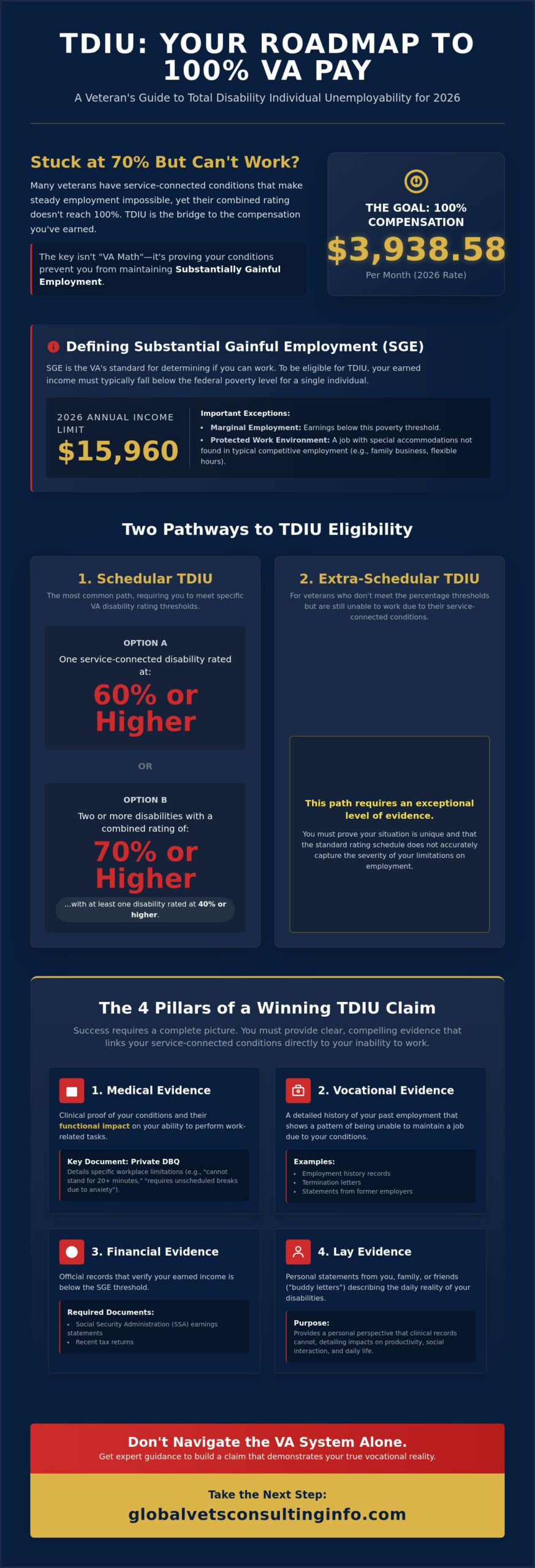
Substantial Gainful Employment is the standard the VA uses to determine if you’re capable of working. For 2026, the income threshold is set at the federal poverty level of $15,960 for a single individual. If your earned income exceeds this limit by even one dollar, the VA will likely trigger a denial because they’ll view you as capable of maintaining SGE. There are exceptions for “marginal employment,” which includes earnings below the poverty level, and “protected work environments.” A protected environment might be a family-owned business or a workplace where you receive special accommodations that wouldn’t be found in a typical job, such as unlimited breaks or flexible hours that don’t follow standard productivity requirements.
The Difference Between Schedular and Extra-Schedular TDIU
Most successful claims follow the “schedular” path, which requires specific rating thresholds. To qualify, you generally need one service-connected disability rated at 60% or higher, or two or more disabilities with a combined rating of 70% or more, with at least one individual disability rated at 40% or higher. If you don’t meet these percentages but still cannot work, you must pursue an “extra-schedular” claim. These cases are more complex and require a higher level of evidence needed for tdiu claim success, as you must demonstrate that your unique disability picture creates an exceptional situation that the standard rating schedule doesn’t accurately capture.
The 4 Pillars of Evidence Needed for TDIU Claim Success
Winning a TDIU claim requires a comprehensive approach that moves beyond simple medical records. The VA needs to see a clear picture of your life, finances, and physical capabilities. To build a solid case, you must focus on the four specific types of evidence needed for tdiu claim approval. These include medical documentation, vocational history, financial records, and lay evidence from those who know you best. According to the criteria for VA Individual Unemployability, the burden is on the veteran to prove that their service-connected conditions are the primary reason they cannot work.
- Medical Evidence: Clinical proof of your conditions and their functional impact on your ability to perform tasks.
- Vocational Evidence: Records of past employment and statements from former employers regarding your performance, attendance, or reasons for termination.
- Financial Evidence: Social Security Administration (SSA) earnings statements and tax returns that confirm your income remains below the $15,960 threshold for 2026.
- Lay Evidence: Personal statements that describe the daily reality of living with your disabilities and how they hinder your productivity.
Medical Evidence: The Role of the Private DBQ
Standard VA medical records are often focused on treatment rather than employment. They might note your pain levels but rarely document your “workplace limitations,” such as an inability to focus for more than an hour or a need for frequent unscheduled breaks. Using a private DBQ for VA claims allows your doctor to explicitly address exertional limits like lifting and non-exertional limits like memory issues. This documentation creates the medical foundation for your vocational argument by explaining why you cannot meet the demands of a typical job. If you feel your current records lack this detail, seeking medical evidence education can help you understand what your doctor needs to document.
Lay Evidence: Personal Statements and Buddy Letters
Never underestimate the power of a “buddy letter” or a Statement in Support of Claim (VA Form 21-4138). While doctors see you for a short time, your spouse or a former coworker sees the daily struggle. These letters should provide “day-in-the-life” descriptions, such as how your PTSD symptoms cause you to withdraw from colleagues or how chronic pain requires you to lie down multiple times a day. These first-hand accounts humanize the evidence needed for tdiu claim success and provide context that clinical data alone might miss.
How to File for VA Unemployability (TDIU): A Step-by-Step Checklist
Filing your claim is a procedural mission that requires tactical precision. You’ve already identified the types of evidence needed for tdiu claim success; now you must organize that data into a format the VA can’t ignore. Following a structured checklist ensures you don’t miss critical deadlines or leave your financial future to chance. The VA Individual Unemployability program relies on your ability to connect your medical files to your work history. 🇺🇸
- Step 1: Verify your ratings. Confirm you meet the schedular thresholds of a single 60% rating or a combined 70% rating with at least one condition at 40%.
- Step 2: Complete VA Form 21-8940. This is your formal application. It must be filled out completely to avoid immediate administrative delays.
- Step 3: Request VA Form 21-4192. Send this to any employer you’ve worked for in the last 12 months of your employment. It documents why you left and any accommodations you received.
- Step 4: Proof of Income. Gather 12 months of Social Security Administration (SSA) earnings records to prove you are below the 2026 poverty threshold of $15,960.
- Step 5: Finalize Medical Support. Ensure you have a professional medical opinion or a DBQ that explicitly links your service-connected conditions to your inability to work.
Avoiding Common VA Form 21-8940 Mistakes
The most frequent error veterans make is leaving the “employment history” section blank or being too vague. Don’t just list your job title. You must link each specific service-connected disability to a task you can no longer perform. If your service-connected knee prevents you from standing for more than 10 minutes, state that clearly. This turns a medical diagnosis into a vocational argument. If you need help articulating these limitations, consider professional DBQ preparation education to ensure your paperwork is airtight.
Handling Non-Cooperative Former Employers
It’s common for an old boss to refuse to sign Form 21-4192 or for a company to have gone out of business. If this happens, don’t panic. You can use personal affidavits or “buddy letters” from former coworkers to fill these gaps. Document your attempts to contact the employer and submit that as part of your evidence needed for tdiu claim package. For more details on managing this phase, see our guide on VA claim evidence gathering. 🇺🇸
Strengthening Your Claim with Global Vets Consulting 🇺🇸
Securing the 100% pay rate isn’t just about having a service-connected disability; it’s about the precision of the paperwork you submit. Many veterans face “lack of evidence” denials because their medical records don’t speak the VA’s language. At Global Vets Consulting, we focus on the specific evidence needed for tdiu claim approval by providing education on high-quality Disability Benefits Questionnaires (DBQs). These documents bridge the gap between your clinical diagnosis and your vocational reality. By submitting a Fully Developed Claim (FDC), you signal to the VA that your file is complete, which can significantly speed up the 2026 VA decision timeline.
Our “Veterans Helping Veterans” approach means we understand the mission because we’ve lived it. We prioritize transparency and meticulousness to reduce the anxiety of the claims process. We offer several ways to engage with our team immediately:
- 🌎 Worldwide Support: We assist veterans regardless of their location.
- 📞 24/7 National Client Services Hotline: Access immediate intake and guidance whenever you’re ready.
- 🤖 24/7 AI Veteran Intake Specialist: Integrated technology to start your journey without delay.
- 🇺🇸 Mission-Driven Focus: A partnership built on respect and earned outcomes.
The Power of a Private Medical Opinion
A rushed C&P exam often misses the nuances of how PTSD or chronic pain interferes with your productivity. A private doctor’s thoroughness ensures your DBQ is “VA-ready” and compliant with 38 CFR standards. This level of detail is often the deciding factor in proving unemployability. Learn how to get a DBQ from a private doctor to ensure your exertional and non-exertional limits are fully documented before you file.
Ready to Reach 100%? Contact Us Today
The path from a 70% rating to 100% compensation requires a strategic vocational argument backed by solid medical proof. You don’t have to navigate this bureaucratic system alone. From identifying the evidence needed for tdiu claim success to understanding your functional limitations, we’re here to help. Global Vets Consulting is ready to provide the education and resources you need to reach your goals. 🇺🇸
Secure Your Future with a Winning TDIU Strategy
Securing the 100% pay rate is a mission that requires tactical precision and the right documentation. You’ve learned that the evidence needed for tdiu claim success focuses on your functional limitations rather than just a medical label. By combining detailed DBQs with clear vocational statements, you can overcome the common hurdles that lead to denials. Global Vets Consulting has been veteran-owned and operated since 2021, and we specialize in the medical documentation education required to win these complex claims. Our 24/7 AI Veteran Intake Specialist is ready to assist you in organizing your case right now.
Don’t let the complexity of the VA system stand between you and the financial security you’ve earned. Whether you’re dealing with musculoskeletal issues or mental health challenges, the right evidence makes the difference. Contact Global Vets Consulting for Expert DBQ Assistance to start your journey toward maximum compensation. You stood the watch for our nation, and now we’re here to stand with you. Your service matters, and we’re committed to helping you reach the finish line.
Frequently Asked Questions
Can I get TDIU if I am currently working part-time?
Yes, you can qualify for TDIU while working part-time if your earnings don’t exceed the federal poverty level. For 2026, this threshold is $15,960 for a single individual. The VA classifies this as “marginal employment.” Additionally, if you work in a “protected work environment,” such as a family business where you receive special accommodations, you might still qualify even if your income is higher.
What is the most important evidence for a TDIU claim?
The most critical evidence needed for tdiu claim success is a Disability Benefits Questionnaire (DBQ) that clearly links your medical symptoms to specific workplace limitations. While a diagnosis is necessary, the VA focuses on functional impairment. You must prove your condition prevents you from maintaining “substantial gainful employment” by documenting why you cannot perform physical or sedentary tasks for a full workday.
How long does the VA take to process a TDIU claim in 2026?
Most veterans see a decision within 120 to 180 days, though timelines vary based on the complexity of your records. You can often speed up this process by filing a Fully Developed Claim (FDC). This means you provide all your medical and vocational evidence at the start. This prevents the VA from spending months trying to contact your former employers for missing information.
Do I need a vocational expert for my TDIU claim?
A vocational expert isn’t mandatory, but their report can be a powerful asset for your file. These specialists analyze your work history, education, and medical limitations to explain why you are unemployable in the current economy. If your medical records don’t clearly show why you can’t work a sedentary job despite a physical injury, a vocational report bridges that gap for the rater.
Can the VA reduce my current rating if I apply for TDIU?
Yes, applying for TDIU is legally considered a claim for an increased rating, which opens your entire file for review. The VA will examine your service-connected conditions to see if they have improved. If an examiner finds your symptoms are less severe than your current rating requires, the VA could propose a reduction. It’s vital to have updated, accurate medical evidence before you submit your application.
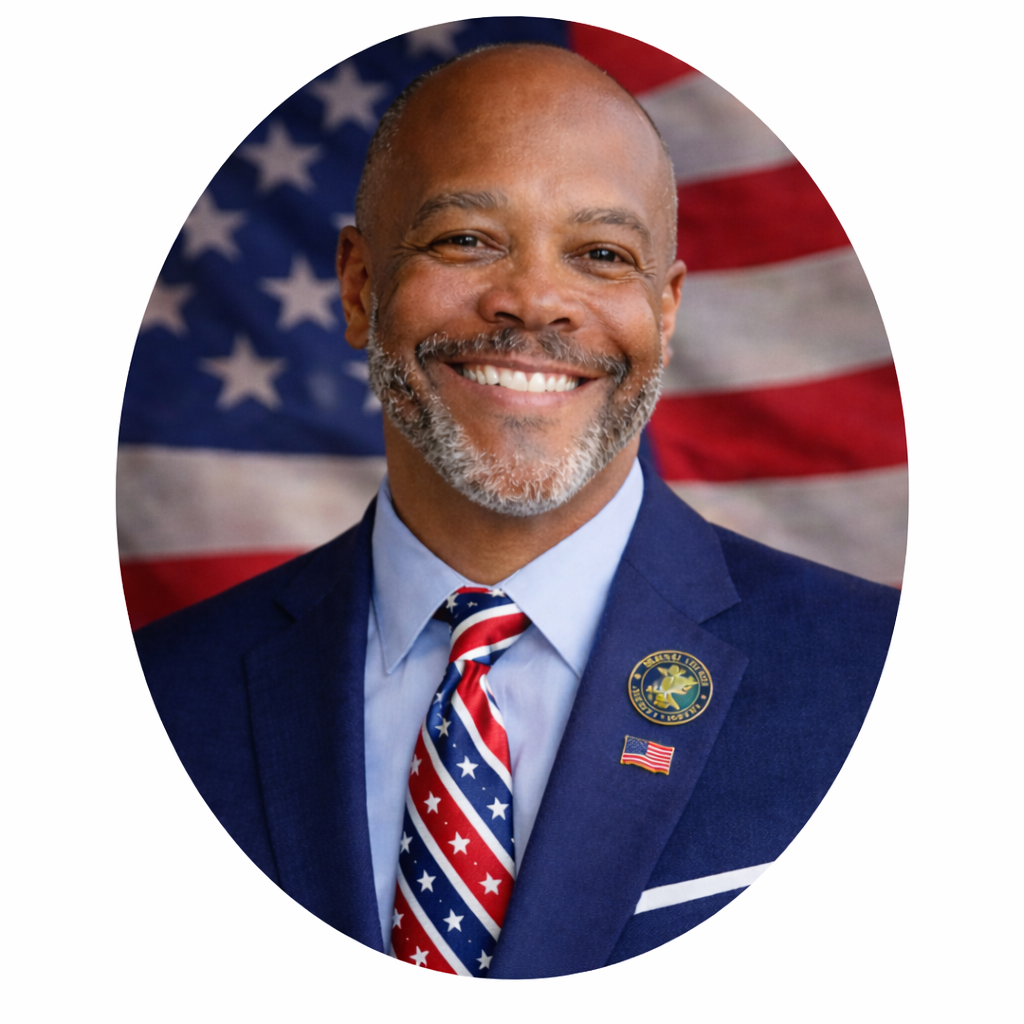
Article by
Willie Daniel
Willie Daniel is the Founder and Chief Executive Officer (CEO) of Global Vets Consulting (GVC) – National Veterans Disability Services, a veteran-led educational and medical evidence support organization dedicated to helping veterans better understand VA disability rating increases, DBQ medical evidence, secondary claims education, and C&P examination preparation.
He is a retired U.S. Army Medical Service Corps Officer with more than 27 years of honorable military service, a decorated Iraq combat veteran, and a retired federal official with the U.S. Department of Veterans Affairs. Throughout his military and federal career, Willie Daniel served in leadership, healthcare administration, operational, and veteran-support roles focused on improving services and support systems for servicemembers, veterans, and their families.
Drawing from decades of military leadership, healthcare administration, veteran advocacy, and federal government experience, Willie Daniel brings a practical, veteran-centered perspective to Global Vets Consulting’s educational articles, AI-powered veteran resources, video education initiatives, and outreach programs. His experience navigating military systems, medical documentation processes, and veteran-related administrative operations provides valuable insight into many of the challenges veterans face when seeking to better understand VA disability rating criteria, medical evidence, documentation strategies, and secondary condition education.
Through GVC’s “Veterans Helping Veterans” mission, his focus is on delivering clear, educational, and easy-to-understand information designed to empower veterans with knowledge, resources, and educational tools that may help them make more informed decisions regarding their individual VA disability journeys.
The information provided through GVC is intended for educational and informational purposes only and should not be considered legal or medical advice.
Disclaimer
Disclaimer: Global Vets Consulting, LLC (“GVC”) is a veteran-led educational and medical evidence support organization. GVC is not a law firm, is not a Veterans Service Organization (VSO), and is not affiliated with the U.S. Department of Veterans Affairs (VA) or any government agency.
Global Vets Consulting does not provide legal advice, medical advice, medical treatment, or healthcare services. GVC does not prepare, file, or submit VA disability claims on behalf of veterans. All information provided through this website, blog articles, videos, educational materials, AI tools, dashboards, templates, and communications is intended solely for general educational and informational purposes.
Veterans are encouraged to consult with accredited representatives, licensed attorneys, qualified medical providers, or Veterans Service Organizations regarding their specific legal, medical, or VA-related matters. VA disability decisions, ratings, and outcomes are determined solely by the U.S. Department of Veterans Affairs based on applicable laws, regulations, medical evidence, and individual circumstances. Past results do not guarantee future outcomes.