
A PTSD rating increase isn’t awarded because your symptoms have simply “gotten worse”; it’s granted because you’ve successfully documented how those symptoms disrupt your ability to work and maintain relationships. Many veterans find themselves stuck at a 50% rating because they’ve spent years learning to “tough it out” or minimize their struggles when speaking to others. When you walk into a C&P exam with that same resilient mindset, the VA often sees a version of you that doesn’t reflect your hardest days. This gap between your daily reality and your medical paperwork is usually why a claim for a higher rating stalls.
We understand the anxiety of facing a complex bureaucratic system while trying to manage your mental health. You deserve a rating that accurately reflects your level of impairment to ensure your family has the financial stability they need. This guide provides the specific medical evidence and documentation strategies required to move your rating from 50% to 70% or 100%. We will walk you through the Review DBQ process, explain the “Social and Industrial Impairment” criteria, and give you a clear roadmap to navigate your next exam with confidence.
Key Takeaways
- Understand the VA’s General Rating Formula for Mental Disorders and how it dictates your percentage based on social and occupational impairment.
- Identify the critical “impairment gap” between 50% and 70% ratings, including specific symptoms like suicidal ideation and near-continuous panic.
- Learn how a professional DBQ acts as a translator for your symptoms to secure a PTSD Rating Increase that reflects your true level of struggle.
- Explore the benefits of using a private medical opinion to provide a more accurate picture of your health than a standard C&P exam might capture.
- Follow a clear two-step roadmap to assess your symptoms and gather the medical evidence required for a successful claim.
Understanding the PTSD Rating Increase Process in 2026 🇺🇸
A PTSD Rating Increase is technically classified by the VA as a “claim for increase.” This specific type of claim is appropriate when your service-connected condition has worsened since your last evaluation or if you believe a clear and unmistakable error was made during your previous rating decision. Because Post-traumatic stress disorder is a condition that can fluctuate or intensify over years of civilian life, the VA provides a formal path to ensure your compensation matches your current level of struggle.
The VA evaluates nearly all mental health conditions using the General Rating Formula for Mental Disorders. This framework assigns ratings at specific intervals: 0%, 10%, 30%, 50%, 70%, or 100%. These percentages aren’t based on the “amount” of trauma you experienced, but rather on your “social and occupational impairment.” In simpler terms, the VA rater wants to know how much your symptoms interfere with your ability to hold a job and maintain healthy relationships. If you’re new to navigating these requirements, reviewing the VA disability claims process step by step: A 2026 Veteran’s Guide can provide the foundational context you need before filing.
Many veterans hesitate to file for an increase because they fear the VA might reduce their existing rating. It’s vital to understand that “protected ratings” exist to prevent arbitrary decreases. If you have held a specific rating for at least 5 years, the VA cannot reduce it based on a single exam; they must demonstrate “sustained improvement” over time. Ratings held for 10 years have protected service connection, and those held for 20 years are generally permanent and cannot be reduced unless the original claim was fraudulent.
Why Your Current PTSD Rating Might Be Too Low
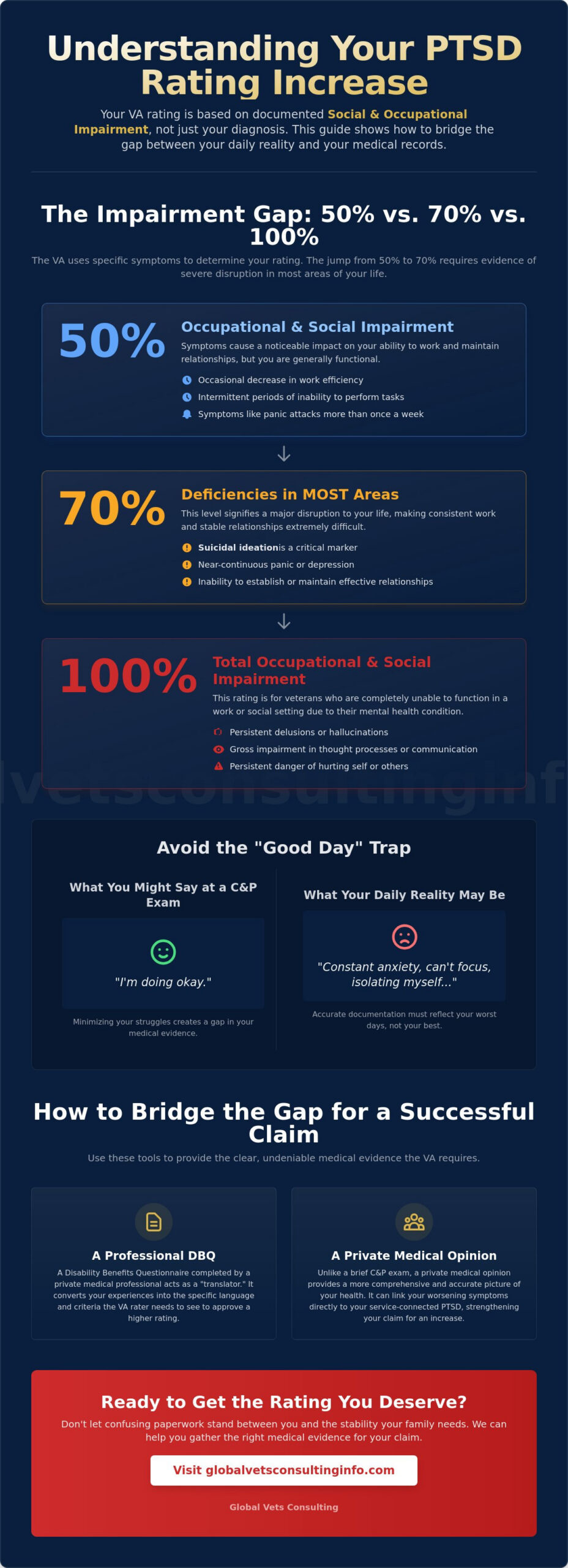
The most common reason for a low rating is the “Good Day Trap.” During a C&P exam, many of us reflexively say we’re “doing okay” because that’s how we were trained to respond. If you only report how you feel on your best days, the examiner will document a level of health that doesn’t reflect your daily reality. This leads to an “impairment gap” where your paperwork doesn’t match your life.
Another major factor is missing medical evidence. The VA rater can only make decisions based on what is documented in a Disability Benefits Questionnaire (DBQ). If your medical records lack specific examples of work-related conflicts, social isolation, or panic attacks, the rater has no evidence to support a higher percentage. Accurate documentation is the only way to bridge the gap between a 50% and a 70% or 100% rating.
The Impairment Gap: Comparing 50%, 70%, and 100% PTSD Ratings
The difference between rating levels is often found in the specific language used within your medical records. Social and Industrial Impairment is the primary metric the VA uses to determine the level of compensation for mental health conditions. Understanding these thresholds is essential when pursuing a PTSD Rating Increase, as the jump from 50% to 70% represents a significant shift in how the VA views your functional ability.
- The 50% Marker: This rating is assigned when there is occupational and social impairment with an occasional decrease in work efficiency and intermittent periods of inability to perform tasks. You might still be working, but your PTSD causes you to miss days or struggle with productivity.
- The 70% Jump: To reach this level, the evidence must show “deficiencies in most areas.” This often includes suicidal ideation, near-continuous panic or depression, and an inability to establish or maintain effective relationships. The VA’s Schedule of Ratings for Mental Disorders specifically looks for these more severe markers of distress.
- The 100% Total Rating: This is reserved for total occupational and social impairment. Symptoms at this level include persistent delusions or hallucinations, gross impairment in communication, or a constant danger of hurting self or others.
Key Symptoms That Trigger a Rating Increase
Documenting “Occupational Impairment” requires more than just saying work is hard. You need to show how symptoms like memory loss, anxiety, or irritability lead to disciplinary actions, frequent job changes, or the inability to work effectively with colleagues. If you’re unsure where your symptoms fall on this scale, reviewing mental health ratings education can provide the clarity needed for your claim.
Documenting “Social Impairment” focuses on your life outside of a professional setting. The VA looks for evidence of social isolation, the breakdown of a marriage, or a complete withdrawal from community involvement. For those in the LGBTQ+ veteran community, finding inclusive support through organizations like the Gender Identity Center can be a critical step in addressing these social challenges. When these symptoms are accurately captured in a DBQ, it creates a clear picture for the rater of why your current rating no longer reflects your daily reality.
Using a Private DBQ to Document Your PTSD Increase
A Disability Benefits Questionnaire (DBQ) serves as the primary translator between your daily struggles and the VA’s legal requirements. It takes your personal experience and frames it within the specific criteria needed for a PTSD Rating Increase. Most veterans describe their symptoms in general terms, but the VA rater looks for evidence of “Functional Loss.” This means documenting not just the presence of anxiety, but how that anxiety stops you from completing tasks at work or connecting with your family. When you pursue a PTSD Rating Increase, the goal is to bridge the gap between your lived reality and the VA’s rating schedule.
The National Center for PTSD highlights that symptoms can change significantly over time. Because of this, submitting a “fully developed” claim with a private DBQ is a strategic move. It allows you to present a complete picture of your health, rather than waiting for the VA to piecemeal your records together. You can learn more about the implementation by reading how to use a DBQ for a VA disability rating increase in 2026.
Why Private Medical Evidence Matters
Contract examiners are often under pressure to complete dozens of exams in a single week. This high volume can lead to rushed appointments where critical symptoms are missed. A private medical opinion provides a necessary safeguard. It ensures that a qualified mental health professional, who understands the nuances of your history, documents your impairment accurately. To satisfy VA “competency” rules, this professional must be a licensed specialist, such as a psychiatrist or psychologist. Having this evidence ready can effectively counter an unfavorable C&P exam result. If you are ready to strengthen your claim, we offer Disability Benefits Questionnaires (DBQ) education to help you navigate the process with confidence.
Next Steps: Preparing for Your C&P Exam and Filing 🇺🇸
Transitioning from education to action requires a methodical approach to ensure your paperwork is processed without delay. While previous sections detailed the criteria for a PTSD Rating Increase, this final phase is about the execution of your filing strategy. A structured submission reduces the likelihood of administrative errors and helps the VA rater understand the full scope of your functional loss.
- Step 1: Conduct a self-assessment of your symptoms over the last 6 months. Track specific instances where anxiety or irritability caused conflicts at work or social withdrawal at home.
- Step 2: Secure a professional DBQ that accurately reflects your current level of impairment. This clinical evidence is the backbone of your request for a higher percentage.
- Step 3: Submit your “Claim for Increase” as a Fully Developed Claim (FDC). By providing all medical evidence and private DBQs upfront, you allow the VA to move directly to the decision phase.
If you’ve already faced a setback, don’t lose heart. You can learn how to address missing documentation by reading VA Claim Denied for Lack of Evidence: How to Recover in 2026. Understanding why a previous claim failed is the first step toward a successful recovery.
Winning the C&P Exam Conversation
The Compensation and Pension (C&P) exam is often the most stressful part of the process. Many veterans struggle with the transition from military stoicism to medical honesty. You must talk about your “worst days” during the evaluation. If you present a “tough it out” attitude, the examiner will document a level of functioning that doesn’t match your daily reality. Additionally, utilize lay evidence such as “Buddy Letters” from family members. These statements provide the social context that a doctor cannot see in a brief exam, detailing how your symptoms affect your marriage and community life.
24/7 Support for Your VA Journey
You don’t have to navigate this complex system alone. Our 24/7 AI Veteran Intake Specialist at Global Vets Consulting is available to help you begin the process of gathering the right education and resources for your claim. We are dedicated to providing the clarity and peace of mind you deserve.
🌎 Worldwide
🇺🇸 GlobalVetsConsultingInfo.com
📞 24/7 National Client Services Hotline
You served your country with honor. Now, let us help you secure the benefits you earned through that service.
Take Control of Your VA Disability Rating 🇺🇸
Securing a PTSD Rating Increase depends on your ability to bridge the gap between your daily struggles and the VA’s technical requirements. By focusing on “functional loss” and utilizing private medical evidence, you ensure that your claim is backed by specialized mental health documentation rather than a rushed contract exam. Remember to prioritize honesty over stoicism during your evaluation; talking about your worst days is the only way to obtain the compensation you truly deserve.
Since 2021, our veteran-owned and operated consulting service has specialized in mental health DBQ documentation to help our peers navigate these complex hurdles. We are here to provide the steady guidance and meticulous support needed for a successful outcome.
Ready to secure your accurate rating? Connect with our 24/7 AI Veteran Intake Specialist today to begin your journey toward the benefits you’ve earned.
🌎 Worldwide
🇺🇸 GlobalVetsConsultingInfo.com
📞 24/7 National Client Services Hotline: 800-484-0551
You stood the watch for our country. Now, let us stand with you to ensure your service is properly recognized and supported.
Frequently Asked Questions
Can the VA decrease my PTSD rating if I ask for an increase?
Yes, the VA can technically decrease your rating if an exam shows sustained improvement, but this is unlikely if your symptoms remain the same or have worsened. Protected ratings provide a safeguard for those who have held their percentage for 5, 10, or 20 years. The VA must prove that your condition has significantly improved under ordinary conditions of life before they can legally reduce your benefits.
How much of a rating increase can I get for PTSD?
The financial impact of a PTSD Rating Increase is substantial due to the 2.8% COLA adjustment announced on October 24, 2025. Moving from a 50% rating ($1,155.49) to a 70% rating ($1,808.45) increases your monthly compensation by over $650. If you reach a 100% rating, the monthly payment jumps to $3,938.58 for a veteran alone, providing a much stronger safety net for your family.
What is the 70% PTSD rating criteria for 2026?
The 70% criteria focuses on occupational and social impairment with deficiencies in most areas. The VA looks for specific symptoms such as suicidal ideation, near-continuous panic attacks, or an inability to maintain effective relationships. While the VA proposed a new Five Functional Domains model, as of early 2026, they still primarily use the General Rating Formula for Mental Disorders to evaluate these severe symptoms.
Do I need a new Nexus Letter for a PTSD rating increase?
No, you generally don’t need a new Nexus Letter once your PTSD is already service-connected. Since the VA has already acknowledged your condition is related to your service, the focus shifts to proving that your symptoms have worsened. Instead of a Nexus Letter, you should prioritize a high-quality Review DBQ that clearly documents your current level of social and industrial impairment.
How long does a PTSD rating increase claim take to process?
A PTSD Rating Increase claim typically takes between 100 and 150 days to process, though timelines vary based on the VA’s current backlog. You can often speed up this decision by filing a Fully Developed Claim (FDC). By submitting all your private medical evidence and DBQs at the start, you reduce the time the VA spends searching for your records.
Article by
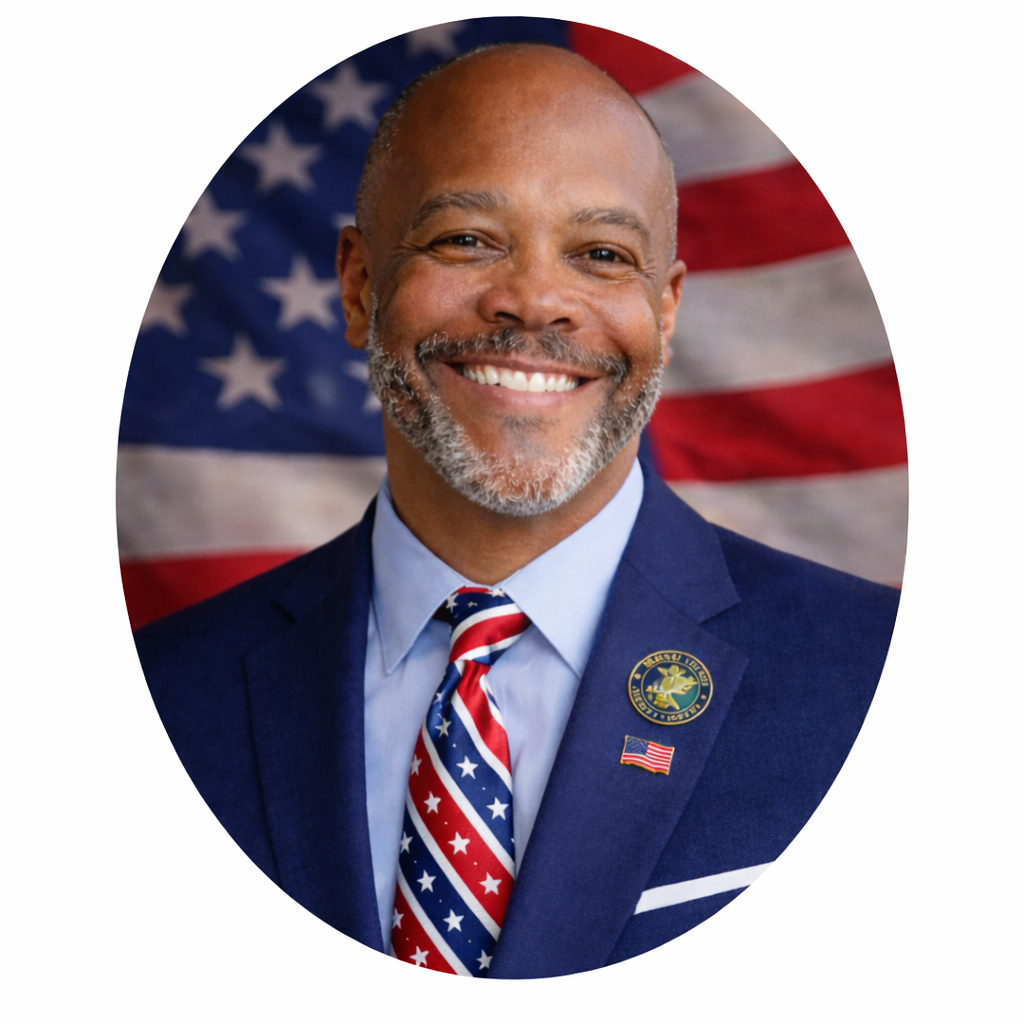
Willie Daniel
Willie Daniel is the Founder and Chief Executive Officer (CEO) of Global Vets Consulting (GVC) – National Veterans Disability Services, a veteran-led educational and medical evidence support organization dedicated to helping veterans better understand VA disability rating increases, DBQ medical evidence, secondary claims education, and C&P examination preparation.
He is a retired U.S. Army Medical Service Corps Officer with more than 27 years of honorable military service, a decorated Iraq combat veteran, and a retired federal official with the U.S. Department of Veterans Affairs. Throughout his military and federal career, Willie Daniel served in leadership, healthcare administration, operational, and veteran-support roles focused on improving services and support systems for servicemembers, veterans, and their families.
Drawing from decades of military leadership, healthcare administration, veteran advocacy, and federal government experience, Willie Daniel brings a practical, veteran-centered perspective to Global Vets Consulting’s educational articles, AI-powered veteran resources, video education initiatives, and outreach programs. His experience navigating military systems, medical documentation processes, and veteran-related administrative operations provides valuable insight into many of the challenges veterans face when seeking to better understand VA disability rating criteria, medical evidence, documentation strategies, and secondary condition education.
Through GVC’s “Veterans Helping Veterans” mission, his focus is on delivering clear, educational, and easy-to-understand information designed to empower veterans with knowledge, resources, and educational tools that may help them make more informed decisions regarding their individual VA disability journeys.
The information provided through GVC is intended for educational and informational purposes only and should not be considered legal or medical advice.
Disclaimer
Disclaimer: Global Vets Consulting, LLC (“GVC”) is a veteran-led educational and medical evidence support organization. GVC is not a law firm, is not a Veterans Service Organization (VSO), and is not affiliated with the U.S. Department of Veterans Affairs (VA) or any government agency.
Global Vets Consulting does not provide legal advice, medical advice, medical treatment, or healthcare services. GVC does not prepare, file, or submit VA disability claims on behalf of veterans. All information provided through this website, blog articles, videos, educational materials, AI tools, dashboards, templates, and communications is intended solely for general educational and informational purposes.
Veterans are encouraged to consult with accredited representatives, licensed attorneys, qualified medical providers, or Veterans Service Organizations regarding their specific legal, medical, or VA-related matters. VA disability decisions, ratings, and outcomes are determined solely by the U.S. Department of Veterans Affairs based on applicable laws, regulations, medical evidence, and individual circumstances. Past results do not guarantee future outcomes.