
What if the medication that finally brought your symptoms under control becomes the very reason the VA decides to lower your benefits? With the February 17, 2026, interim final rule now in effect, the VA can evaluate certain conditions based on how you function while medicated, making it critical to understand how to protect your VA disability rating from reduction. 🇺🇸
We understand the anxiety that comes with every C&P exam notice or the fear that a sudden reevaluation could strip away your financial stability. You’ve earned your benefits through service, and the complex “VA math” used in reevaluations shouldn’t feel like a threat to your future. We’re here to help you navigate this system with confidence rather than confusion.
This guide provides a clear, step-by-step breakdown of the 5, 10, and 20-year protection rules that shield your rating from arbitrary cuts. You’ll learn how to use medical evidence and Disability Benefits Questionnaires (DBQs) to prove your condition remains static. By the end of this article, you’ll have a professional strategy to maintain your 100% P&T status and ensure your hard-earned compensation stays exactly where it belongs.
Key Takeaways
- Master the specific 5, 10, and 20-year rules that create a legal shield around your earned service-connected benefits.
- Learn how to identify “static” disabilities on your VA Code Sheet to understand exactly how to protect your VA disability rating from reduction.
- Discover why a Disability Benefits Questionnaire (DBQ) is your best defense for providing the precise clinical data required to prove your condition hasn’t improved.
- Understand the critical 60-day and 30-day deadlines for submitting new medical evidence and requesting a Pre-Determination Hearing to stop a reduction before it starts.
Understanding VA Rating Protection: The 5, 10, and 20-Year Rules 🛡️
The VA system can feel like it is constantly shifting, especially with the medication rule changes implemented in early 2026. Federal law provides specific timelines that act as a shield for your benefits. Understanding these statutory protections is the first step in learning how to protect your VA disability rating from reduction. These rules create a higher burden of proof for the VA before they can legally lower your compensation.
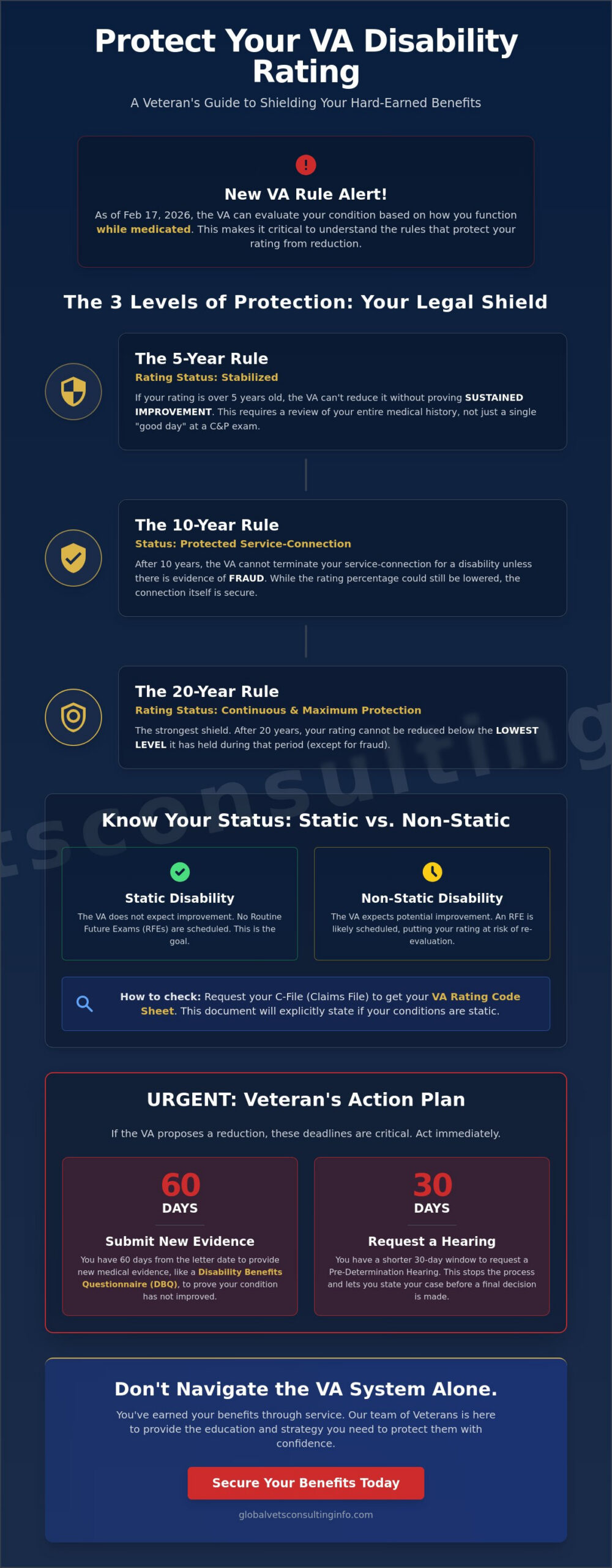
- The 5-Year Rule: If you’ve held a rating for five years or more, the VA considers it “stabilized.” They cannot reduce it unless they prove your condition has shown sustained improvement through a comprehensive medical history, rather than a single examination.
- The 10-Year Rule: Once a disability has been service-connected for ten years, the VA cannot terminate that connection unless there is evidence of fraud. While the rating percentage itself could still be lowered if improvement is documented, the service-connection status remains protected.
- The 20-Year Rule: This is the strongest level of protection. After 20 years, a rating is considered “continuous.” The VA cannot reduce the rating below the lowest level it has held during those two decades, except in rare cases involving fraud.
It is a common misconception that a protected rating is completely untouchable. The VA retains the right to reevaluate conditions if they receive evidence of significant medical improvement. Being proactive with your medical evidence ensures that “protection” remains a reality rather than just a legal theory.
Stabilized Ratings and the ‘Sustained Improvement’ Standard
A stabilized rating is one held for five or more years. To reduce these, the VA must meet a high legal burden called “sustained improvement.” This requires the VA to look at your entire medical history to see if you have truly gotten better over time. A single “good day” during a C&P exam isn’t enough to justify a reduction if your overall records show a pattern of recurring symptoms or flare-ups.
Permanent and Total (P&T) Status
When the VA grants 100% P&T status, they are acknowledging that your conditions are not expected to improve. This differs from a standard 100% rating because the VA typically removes you from the schedule for routine future exams. While this provides significant peace of mind, maintaining your medical records is still vital. Using tools like a Disability Benefits Questionnaire (DBQ) ensures your file remains current and accurate, which is essential for long-term security.
VA Rating Reduction Warning Signs: Static vs. Non-Static Conditions
Knowing your status is the first step in learning how to protect your VA disability rating from reduction. Most veterans look at their award letter and think they have the full picture. However, the real details are hidden in a document called the Rating Code Sheet. This internal record specifies whether your disabilities are “static” or if the VA has scheduled a Routine Future Exam (RFE). If you see a future date listed next to your disability, the VA is already planning to check if you have improved.
Certain conditions are naturally prone to reevaluation. Mental health ratings, for example, are often viewed by the VA as capable of improvement over time. Similarly, cancers that go into remission or musculoskeletal issues that might stabilize are frequently targeted for reduction during the evidence gathering phase. The VA targets these ratings because they assume treatment will eventually lower the functional impact of the disability. If you want to understand your specific standing, our team offers VA rating increase education to help you stay proactive.
How to Read Your VA Rating Code Sheet
To find your Code Sheet, you must request your complete Claims File, or C-File. This usually requires a FOIA request, but the effort is worth it. Once you have the document, look for the “Static” designation. If a condition is marked static, the VA does not expect it to improve and won’t automatically schedule a reexamination. If it is not static, you will likely see a reevaluation date, which is your signal to start gathering fresh medical evidence immediately.
The Danger of ‘Temporary’ Improvement
The interim final rule implemented on February 17, 2026, changed how the VA views medication. If your symptoms are well-managed by treatment, the VA may now attempt to lower your rating based on your medicated state rather than the underlying severity. You must document the frequency, severity, and duration of your symptoms during your “off” days. Showing that your condition only appears better because of medication, but still limits your life, is vital in learning how to protect your VA disability rating from reduction. 🇺🇸
The Documentation Defense: Using DBQs to Shield Your Rating 📋
Waiting for the VA to send a reevaluation notice is a reactive strategy that often leads to unnecessary stress. Proactive documentation is the most effective way to understand how to protect your VA disability rating from reduction. While C&P exams are frequently rushed and performed by generalists, your private medical evidence provides a continuous, accurate narrative of your health. 🇺🇸
Disability Benefits Questionnaires (DBQs) are standardized forms that allow your doctor to speak the VA’s language. They provide the specific clinical data required to prove your condition hasn’t improved. By using these forms, you ensure the VA sees the full scope of your disability, rather than a 15 minute snapshot from a contractor.
- Precision: DBQs focus on the exact symptoms the VA uses to determine rating percentages.
- Authority: Independent medical evidence from your treating physician carries significant weight.
- Consistency: Regular documentation prevents the VA from claiming “improvement” due to a lack of recent records.
Learn more about how to use a DBQ for a VA disability rating increase in 2026 to see how this documentation works in practice.
Building a Solid Medical Paper Trail
Gaps in your medical records are a major red flag for the VA. If you stop seeking treatment, the VA often assumes your condition has resolved or improved. Regular visits to your private doctor ensure that your records reflect the ongoing “frequency, severity, and duration” of your symptoms. Ensure your doctor’s notes explicitly mention how your condition limits your daily activities or ability to work, as this aligns directly with VA rating criteria.
Preempting the C&P Exam with a Private DBQ
The best time to submit a DBQ is before the VA even asks for a reevaluation. Establishing a current medical baseline in your C-File makes it much harder for a VA examiner to justify a reduction later. A DBQ completed by a specialist can outweigh a generalist C&P examiner. This proactive approach is the ultimate key for those wondering how to protect your VA disability rating from reduction. If you want to secure your benefits, explore our independent medical evidence education to start building your defense today.
Veteran’s Action Plan: What to Do if a Reduction is Proposed 📞
If you receive a letter from the VA proposing a reduction, your first instinct might be panic. Don’t let it be. This letter is simply a notice of intent, and you have a specific window to fight back. Understanding the timeline is the most critical part of learning how to protect your VA disability rating from reduction. You have rights in this process, and the burden of proof is on the VA to show that your condition has truly improved under ordinary conditions of life.
- Step 1: Know your deadlines. You have 60 days to submit new medical evidence and only 30 days to request a hearing.
- Step 2: Request a ‘Pre-Determination Hearing.’ This is a vital tactical move that stops the VA from lowering your monthly check while the dispute is active.
- Step 3: Get a fresh DBQ. An updated Disability Benefits Questionnaire from a specialist can provide the clinical proof that your condition hasn’t improved.
- Step 4: Submit VA Form 21-4138. Use this “Statement in Support of Claim” to tell your story and point the rater toward your strongest evidence.
The Power of the Pre-Determination Hearing
Requesting a hearing is the most effective way to maintain your current pay rate. When you request this within the 30-day window, the VA cannot legally reduce your benefits until the hearing is conducted and a final decision is made. This gives you precious months to gather independent medical evidence and prepare your case. It’s your opportunity to explain the daily reality of your disability to a human being, rather than just being a number on a page.
How Global Vets Consulting Can Help 🌎
We specialize in helping veterans navigate these high-stakes moments. Our process focuses on providing standardized DBQs that accurately reflect your current level of impairment. We assist you in gathering the comprehensive evidence needed to prove there has been “No Material Improvement” in your service-connected conditions. Don’t face the VA alone. Protect your rating with a professional DBQ from Global Vets Consulting and keep the benefits you’ve earned. 🇺🇸
Taking Command of Your VA Benefits Future 🇺🇸
Maintaining your disability rating is about more than just waiting out the clock; it’s about active documentation and understanding your legal rights. You now have the tools to identify “static” conditions on your Rating Code Sheet and leverage the 5, 10, and 20-year protection rules. These statutory shields are the foundation of how to protect your VA disability rating from reduction in a shifting regulatory landscape. By staying proactive with your medical records, you ensure the VA has a clear, accurate picture of your ongoing challenges.
The key to long-term stability is a professional medical paper trail that proves your condition remains severe. As a veteran-owned and operated consulting service, we are specialists in Disability Benefits Questionnaires (DBQ) and independent medical evidence education. Our team is dedicated to helping you gather the precise clinical data needed to shield your earned benefits from arbitrary cuts. You can begin securing your future right now through our 24/7 AI Veteran Intake Specialist.
Secure Your Medical Evidence: Contact Global Vets Consulting Today
You served our nation with honor, and you’ve earned every bit of your compensation. Stay vigilant, keep your treatment records current, and walk forward with the confidence that your benefits are protected.
Frequently Asked Questions
Can the VA reduce my 100% P&T rating?
Yes, the VA can reduce a 100% P&T rating, though it happens much less frequently than with standard ratings. P&T status means the VA doesn’t expect your condition to improve and has waived routine future exams. However, if you file a new claim for a secondary condition or if the VA discovers evidence of material improvement through other medical records, they can initiate a reduction. Protection isn’t absolute, so maintaining your treatment records remains a vital safeguard.
What happens if I miss a VA reexamination appointment?
Missing a VA reexamination appointment can lead to the immediate proposal of a reduction or termination of your benefits. The VA views a missed C&P exam as a failure to cooperate with the evidence gathering process. If you have a legitimate conflict, you must contact the VA or the third party medical contractor immediately to reschedule. Providing a good cause reason for the absence is the only way to prevent an automatic negative decision on your rating.
Is my VA rating protected after 5 years?
Your rating is considered stabilized after five years, which means the VA faces a higher legal burden to reduce it. Under this rule, the VA can’t lower your percentage based on a single exam; they must prove sustained improvement over a period of time. Understanding this timeline is a core part of how to protect your VA disability rating from reduction. You must ensure your medical paper trail reflects that your symptoms haven’t permanently improved.
How do I know if my VA disability is static or not?
You can determine if your disability is static by reviewing your VA Rating Code Sheet, which is located within your C-File. While award letters rarely use the word static, the Code Sheet will indicate if a Routine Future Exam (RFE) is scheduled. If there is no future date listed for a reevaluation, the VA considers the condition permanent. You can request this document through a FOIA request to understand your long term reexamination schedule.
Can the VA reduce my rating without an exam?
The VA typically cannot reduce your rating without first offering you a C&P exam or a hearing. They are required to send a 60-day notice of a proposed reduction, giving you time to submit new medical evidence. The only common exceptions are when the VA discovers a clear and unmistakable error in your original claim or evidence of fraud. For most veterans, learning how to protect your VA disability rating from reduction involves using that 60-day window to provide updated DBQs.

Article by
Willie Daniel
Willie Daniel is the Founder and Chief Executive Officer (CEO) of Global Vets Consulting (GVC) – National Veterans Disability Services, a veteran-led educational and medical evidence support organization dedicated to helping veterans better understand VA disability rating increases, DBQ medical evidence, secondary claims education, and C&P examination preparation.
He is a retired U.S. Army Medical Service Corps Officer with more than 27 years of honorable military service, a decorated Iraq combat veteran, and a retired federal official with the U.S. Department of Veterans Affairs. Throughout his military and federal career, Willie Daniel served in leadership, healthcare administration, operational, and veteran-support roles focused on improving services and support systems for servicemembers, veterans, and their families.
Drawing from decades of military leadership, healthcare administration, veteran advocacy, and federal government experience, Willie Daniel brings a practical, veteran-centered perspective to Global Vets Consulting’s educational articles, AI-powered veteran resources, video education initiatives, and outreach programs. His experience navigating military systems, medical documentation processes, and veteran-related administrative operations provides valuable insight into many of the challenges veterans face when seeking to better understand VA disability rating criteria, medical evidence, documentation strategies, and secondary condition education.
Through GVC’s “Veterans Helping Veterans” mission, his focus is on delivering clear, educational, and easy-to-understand information designed to empower veterans with knowledge, resources, and educational tools that may help them make more informed decisions regarding their individual VA disability journeys.
The information provided through GVC is intended for educational and informational purposes only and should not be considered legal or medical advice.
Disclaimer
Disclaimer: Global Vets Consulting, LLC (“GVC”) is a veteran-led educational and medical evidence support organization. GVC is not a law firm, is not a Veterans Service Organization (VSO), and is not affiliated with the U.S. Department of Veterans Affairs (VA) or any government agency.
Global Vets Consulting does not provide legal advice, medical advice, medical treatment, or healthcare services. GVC does not prepare, file, or submit VA disability claims on behalf of veterans. All information provided through this website, blog articles, videos, educational materials, AI tools, dashboards, templates, and communications is intended solely for general educational and informational purposes.
Veterans are encouraged to consult with accredited representatives, licensed attorneys, qualified medical providers, or Veterans Service Organizations regarding their specific legal, medical, or VA-related matters. VA disability decisions, ratings, and outcomes are determined solely by the U.S. Department of Veterans Affairs based on applicable laws, regulations, medical evidence, and individual circumstances. Past results do not guarantee future outcomes.