
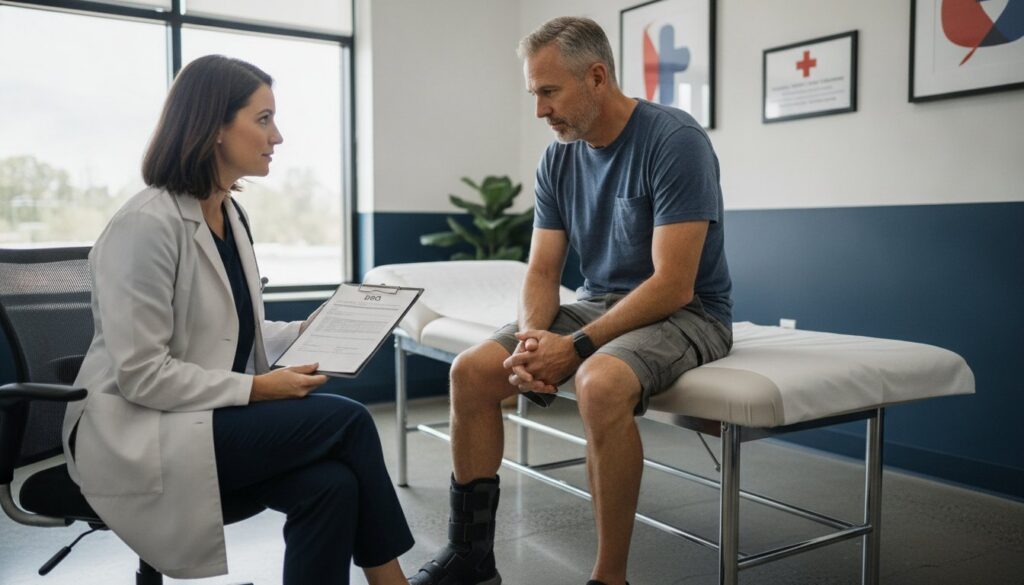
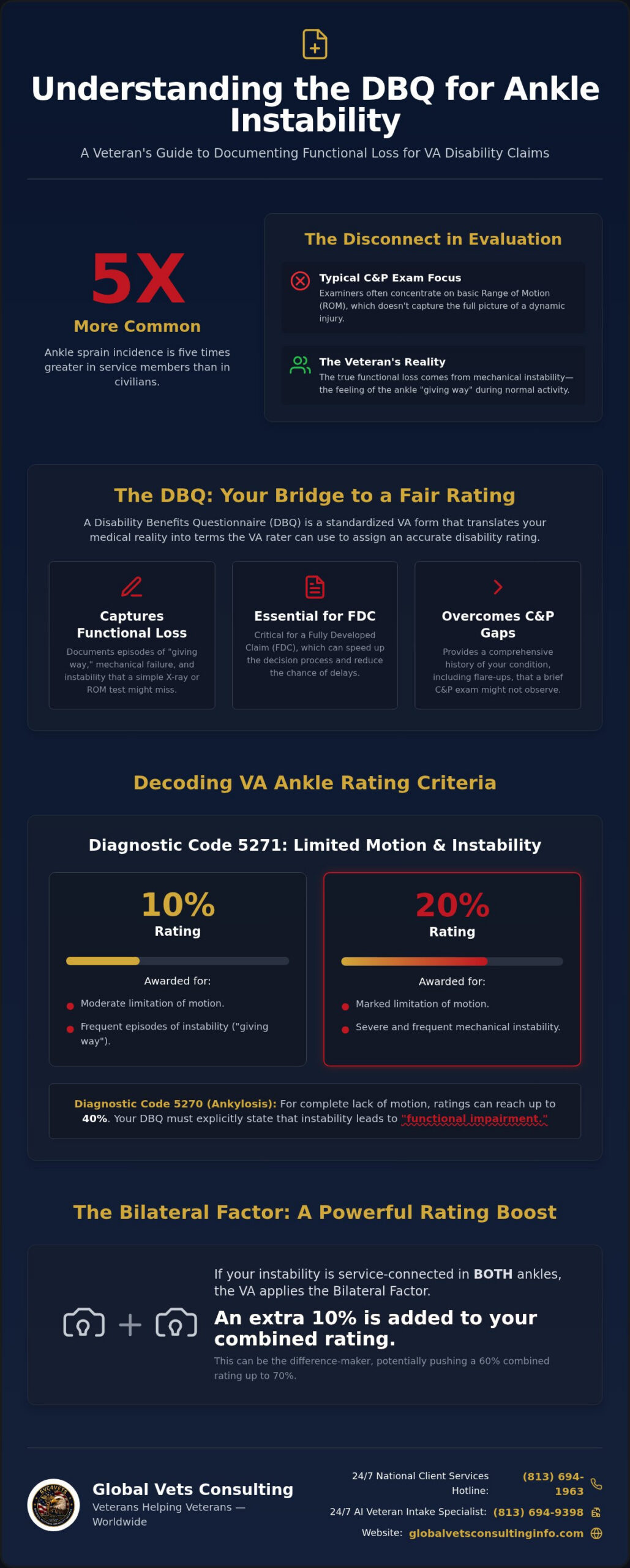
Did you know that the incidence of ankle sprains is five times greater in service members than in civilians? 🇺🇸 It’s incredibly frustrating when your ankle frequently gives way during a normal walk, yet your C&P examiner only seems interested in how far you can bend your foot. You know the instability is real, but translating that “giving way” sensation into the precise medical terminology the VA requires can feel like an impossible task.
We understand the struggle of proving a condition that isn’t always visible during a brief office visit. This guide will show you how to effectively use the dbq for ankle instability to document your functional loss and secure the VA disability rating you’ve rightfully earned. We’ll provide a clear path forward so you can approach your claim with steady confidence and peace of mind.
We’re going to break down the 2026 rating criteria under Diagnostic Code 5271 and explain how to ensure your medical evidence highlights the frequency of your ankle giving way. You’ll also learn how the 2.8% COLA increase impacts your monthly compensation and why thorough documentation on VA Form 21-0960M-2 is the key to a successful outcome.
Key Takeaways
- Learn how a dbq for ankle instability captures critical evidence of “giving way” and mechanical joint failure that standard tests often overlook. 🇺🇸
- Identify the specific 2026 VA rating criteria under Diagnostic Codes 5271 and 5270 to understand how the VA evaluates limited motion and ankylosis.
- Master the documentation of functional loss by ensuring your medical evidence addresses the DeLuca Criteria, including pain and lack of endurance.
- Discover how independent medical evidence can provide the comprehensive history needed to overcome claims denied for lack of evidence.
What is a DBQ for Ankle Instability and Why Does It Matter?
A Disability Benefits Questionnaire (DBQ) is a standardized form the VA uses to evaluate the severity of your ankle condition. Think of it as a bridge between your medical reality and the VA’s rating schedule. When you submit a dbq for ankle instability, you’re providing the rater with a clear map of your functional limitations. In 2026, this documentation is essential for anyone pursuing a Fully Developed Claim (FDC) because it speeds up the process and reduces the chance of a remand. 🇺🇸
For many veterans, the real issue isn’t just a dull ache. It’s the mechanical failure of the joint. The DBQ captures these instances of “giving way” and joint instability that a simple X-ray might miss. Accurate documentation ensures the VA rater sees how your injury impacts your ability to walk on uneven ground or stand for long periods. It’s not just about a snapshot in an exam room. It’s about your life.
The Difference Between Ankle Pain and Mechanical Instability
Pain is a subjective experience, but instability is a functional loss that clinicians can measure. Many veterans suffer from Chronic Ankle Instability (CAI) after years of service-related injuries. On the DBQ, your examiner must categorize this instability as slight, moderate, or severe. While pain might get you a 10% rating, proving mechanical instability through specific clinical tests can be the difference between a low rating and the compensation you actually deserve.
Why Your C&P Exam Might Miss the Full Picture
C&P examiners often work under tight schedules. They might only have a few minutes to evaluate a condition you’ve lived with for decades. Most exams focus heavily on basic Range of Motion (ROM) tests, which don’t always tell the whole story. A detailed dbq for ankle instability allows you to include information about flare-ups and functional loss that happens when you’re not in the clinic. If your ankle only gives way after a long day of work, a one-time exam might miss that evidence entirely.
VA Rating Criteria for Ankle Conditions in 2026
Understanding how the VA translates your physical symptoms into a percentage is the first step toward a successful claim. For most veterans dealing with a dbq for ankle instability, the VA primarily looks at Diagnostic Code (DC) 5271. This code covers “Limited Motion of the Ankle” and serves as the most common path for rating instability. The goal is to move beyond a simple diagnosis and prove how the joint’s failure affects your mobility. 🇺🇸
Understanding Diagnostic Code 5271
The VA assigns ratings under DC 5271 based on the severity of your motion loss and mechanical failure. A 10% rating is typically awarded for moderate limitation of motion or frequent episodes of instability. If your condition is more advanced, a 20% rating is given for marked limitation of motion or severe, frequent mechanical instability. To ensure your examiner has the right framework, it’s helpful to review the official Ankle Conditions DBQ form. This document is what the rater uses to confirm if your symptoms meet the “marked” or “moderate” thresholds.
While DC 5271 focuses on motion, DC 5270 addresses “Ankylosis,” which is the complete lack of motion in the joint. This rating can reach up to 40% depending on the foot’s position. However, for a higher rating to stick, the clinical notes in your dbq for ankle instability must explicitly state that your instability leads to “functional impairment.” Without this specific terminology, a rater might default to a lower percentage even if your daily life is significantly impacted.
The Bilateral Factor Rule
If your service-connected instability affects both ankles, the VA applies the Bilateral Factor. This rule adds an extra 10% to your combined disability rating before the final rounding occurs. The Bilateral Factor can be the difference between a 60% and 70% overall rating; it’s a powerful boost for those living with dual injuries. If you’re unsure if your current medical records clearly state your level of impairment, exploring educational resources for VA rating increases can help you prepare for your next evaluation.
How to Document Functional Loss and ‘Giving Way’ on Your DBQ
Functional loss is the cornerstone of a successful dbq for ankle instability. It occurs when your ankle cannot perform its normal duties, even if you still have a decent range of motion. For many veterans, this manifests as a persistent “giving way” sensation during simple activities. For a more detailed medical overview of chronic ankle instability, you’ll see that this condition involves repeated turning of the ankle, which leads to long-term joint weakness and mechanical failure.
To capture this properly, your examiner must document the “DeLuca Criteria.” This includes recording how pain, fatigue, and lack of endurance impact your mobility during repetitive use. If your ankle starts to wobble or feel weak after walking just half a mile, that’s a measurable functional loss. You should also ensure the doctor notes any compensatory movements you’ve developed, such as a visible limp or a change in your gait to avoid putting pressure on the unstable joint.
When completing the dbq for ankle instability, specificity is your best ally. Don’t just state that your ankle is weak. Instead, record the exact frequency of “giving way.” Does it happen once a week, or every time you step on uneven ground like grass or gravel? Providing these concrete examples helps the rater understand the severity of your mechanical instability beyond what a brief physical exam might show. 🇺🇸
The Importance of Flare-Ups
The VA is required to rate you based on your “worst days,” not just how you feel during a 15-minute appointment. Your documentation should describe how your instability worsens after a long day of standing or during cold weather. If you’re having a “good day” during the exam, the doctor must still record your history of flare-ups to provide an accurate picture of your disability. If you need help understanding how to present this evidence, our musculoskeletal claims education resources can guide you through the process.
Assistive Devices and Orthotics
If you use a brace, walker, or specialized orthotic shoes, these must be recorded on the questionnaire. Relying on these devices is concrete evidence of severe mechanical instability. Documenting the regular use of a brace proves that your ankle requires external support to function, which directly supports a claim for a higher disability percentage.
Securing a Private DBQ for Your Ankle Claim 🌐
A private DBQ provides a comprehensive look at your medical history that a one-time C&P exam often overlooks. When you visit a contract examiner, they often focus on a snapshot of your health rather than the long-term reality of your condition. Proactively securing independent medical evidence is often the key to overcoming a VA claim denied for lack of evidence. By submitting a dbq for ankle instability that you’ve reviewed and verified, you ensure the rater has the facts they need to make an accurate decision.
Global Vets Consulting specializes in helping veterans secure the high-quality documentation needed for VA disability rating increases. Your health is your history. You don’t have to leave your future in the hands of a stranger at a brief exam. Taking control of your evidence is the most effective way to support a dbq for ankle instability and achieve a result that reflects your service-connected limitations. 🇺🇸
The Global Vets Difference: Veterans Helping Veterans 🇺🇸
We understand the intricacies of “VA Math” and the specific evidence required to prove service connection for musculoskeletal conditions. Our approach is professional and transparent. We treat every veteran with the duty and respect they deserve. We’ve built our process to be a partnership, ensuring you feel empowered and informed throughout the entire administrative journey. We value meticulousness because we know how much these results matter to your family’s well-being.
Next Steps for Your Ankle Instability Claim
Begin by reviewing your service treatment records for any mentions of sprains or joint weakness. This history is the foundation of your claim. Once you’re ready to move forward, we’re available to help you organize your documentation for maximum impact. Our team is dedicated to simplifying the bureaucratic system for you.
- Review your records for “giving way” or mechanical failures during service.
- Reach out to our 24/7 National Client Services Hotline for assistance.
- Engage with our 24/7 AI Veteran Intake Specialist for immediate support.
📞 Get Started with Global Vets Consulting
Secure the Ankle Disability Rating You’ve Earned
Success in your VA claim depends on moving beyond simple pain descriptions to document true mechanical failure. A precisely completed dbq for ankle instability ensures that the rater understands your functional loss, including “giving way” and the need for braces or orthotics. These details are often the difference between a low percentage and the compensation that supports your quality of life. 🇺🇸
Global Vets Consulting has been veteran-owned and operated since 2021. We specialize in musculoskeletal DBQ education and provide a clear, predictable path forward for those who feel neglected by the system. Our 24/7 AI Veteran Intake Specialist is available round-the-clock to help you start gathering the medical evidence your claim requires. We’re a reliable ally dedicated to the well-being and earned outcomes of those we serve.
📞 Contact Global Vets Consulting 24/7 for your DBQ needs!
Don’t let a rushed C&P exam define your future. You’ve done the hard work of serving our nation; now it’s time to ensure the system works for you. We’re here to stand with you as you pursue the benefits you’ve rightfully earned.
Frequently Asked Questions
What is the highest VA rating for ankle instability?
The highest rating for ankle instability under Diagnostic Code 5271 is 20%. This percentage is awarded for “marked” limitation of motion or severe, frequent mechanical instability. If your condition involves ankylosis, which is a total lack of motion in the joint, you could receive a rating up to 40% under Diagnostic Code 5270. Your dbq for ankle instability must clearly document these severe functional failures to qualify for these higher percentages.
Can I get a separate rating for ankle pain and ankle instability?
You generally can’t receive separate ratings for pain and instability in the same ankle because the VA considers this “pyramiding.” Instead, the VA evaluates your symptoms together to determine a single disability percentage. However, the presence of painful motion ensures you receive at least a 10% minimum rating even if your range of motion is normal. Your medical evidence should focus on how pain and instability combine to create functional loss during your daily activities.
How do I prove my ankle instability is service-connected?
Proving service connection requires a current diagnosis, evidence of an in-service injury, and a “medical nexus” linking the two. You should gather service treatment records that mention sprains, strains, or “giving way” during your time in uniform. Providing a dbq for ankle instability completed by a clinician who has reviewed your military history is an effective way to establish this link. This documentation bridges the gap between your past service and your current physical limitations.
Is a private DBQ better than a VA C&P exam for ankle issues?
A private DBQ is often more thorough because your own doctor can spend more time evaluating your condition than a standard C&P examiner. Contract examiners frequently focus on a quick range of motion test and may miss the mechanical failures you experience daily. An independent medical opinion provides a comprehensive view of your history, including flare-ups and functional loss. This level of detail is critical for securing an accurate VA rating increase and ensuring your evidence is complete.
What happens if the VA examiner says my Range of Motion is normal but my ankle still gives way?
If your range of motion is normal but your ankle still gives way, you can still qualify for a rating based on functional loss. The VA is required to consider the “DeLuca Criteria,” which accounts for how pain, fatigue, and instability impact your ability to function. Your documentation must emphasize that “giving way” is a mechanical failure that prevents normal joint duty. This evidence ensures you aren’t rated solely on a static measurement taken during a brief office visit on a “good day.”

Article by
Willie Daniel
Willie Daniel is the Founder and Chief Executive Officer (CEO) of Global Vets Consulting (GVC) – National Veterans Disability Services, a veteran-led educational and medical evidence support organization dedicated to helping veterans better understand VA disability rating increases, DBQ medical evidence, secondary claims education, and C&P examination preparation.
He is a retired U.S. Army Medical Service Corps Officer with more than 27 years of honorable military service, a decorated Iraq combat veteran, and a retired federal official with the U.S. Department of Veterans Affairs. Throughout his military and federal career, Willie Daniel served in leadership, healthcare administration, operational, and veteran-support roles focused on improving services and support systems for servicemembers, veterans, and their families.
Drawing from decades of military leadership, healthcare administration, veteran advocacy, and federal government experience, Willie Daniel brings a practical, veteran-centered perspective to Global Vets Consulting’s educational articles, AI-powered veteran resources, video education initiatives, and outreach programs. His experience navigating military systems, medical documentation processes, and veteran-related administrative operations provides valuable insight into many of the challenges veterans face when seeking to better understand VA disability rating criteria, medical evidence, documentation strategies, and secondary condition education.
Through GVC’s “Veterans Helping Veterans” mission, his focus is on delivering clear, educational, and easy-to-understand information designed to empower veterans with knowledge, resources, and educational tools that may help them make more informed decisions regarding their individual VA disability journeys.
The information provided through GVC is intended for educational and informational purposes only and should not be considered legal or medical advice.
Disclaimer
Disclaimer: Global Vets Consulting, LLC (“GVC”) is a veteran-led educational and medical evidence support organization. GVC is not a law firm, is not a Veterans Service Organization (VSO), and is not affiliated with the U.S. Department of Veterans Affairs (VA) or any government agency.
Global Vets Consulting does not provide legal advice, medical advice, medical treatment, or healthcare services. GVC does not prepare, file, or submit VA disability claims on behalf of veterans. All information provided through this website, blog articles, videos, educational materials, AI tools, dashboards, templates, and communications is intended solely for general educational and informational purposes.
Veterans are encouraged to consult with accredited representatives, licensed attorneys, qualified medical providers, or Veterans Service Organizations regarding their specific legal, medical, or VA-related matters. VA disability decisions, ratings, and outcomes are determined solely by the U.S. Department of Veterans Affairs based on applicable laws, regulations, medical evidence, and individual circumstances. Past results do not guarantee future outcomes.