
Waiting for the government to adjust your pay for inflation isn’t a strategy; it’s a gamble with your financial security. You’ve likely noticed that while the cost of groceries and housing keeps climbing, your monthly check doesn’t always feel like enough to cover the bills. It’s common to feel frustrated when your service-connected symptoms worsen, but your official rating remains unchanged. If you’re seeking a VA Compensation Increase, you need to understand that the system requires proactive evidence to match your current needs. You aren’t alone in this struggle, and you deserve a monthly payment that reflects the true reality of your health today. 🇺🇸
This guide will show you how to secure a strategic boost to your benefits by leveraging the confirmed 2.8% COLA raise for 2026 and using stronger medical evidence. We’ll explain the difference between the automatic cost-of-living adjustment and the active steps you can take to update your rating. You’ll learn how to use Disability Benefits Questionnaires (DBQs) and current medical records to prove your condition has changed. By following this methodical approach, you can move from feeling stuck to feeling empowered. We’ll break down the specific forms and evidence needed to ensure you receive every dollar you’ve earned through your service. 🌐
Key Takeaways
- Prepare for the 2.8% COLA pay raise effective December 2025 and understand how it impacts your monthly benefits starting in January 2026.
- Identify the critical differences between a passive cost-of-living adjustment and a strategic VA Compensation Increase driven by new medical evidence.
- Master the two-step process for filing a rating increase, from evaluating the VASRD tiers to documenting your worsening limitations.
- Learn how standardized Disability Benefits Questionnaires (DBQs) provide the precise medical evidence needed for faster and more accurate rating decisions.
2026 VA Disability COLA Increase: What Every Veteran Should Expect 📈
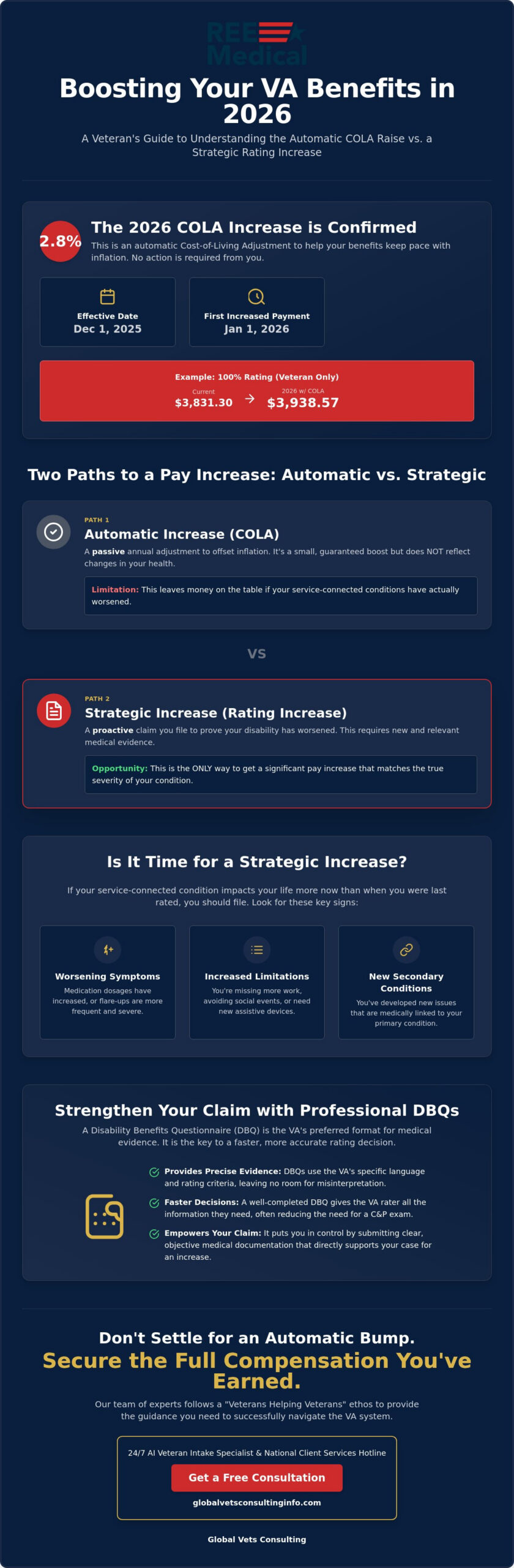
The 2026 Cost-of-Living Adjustment (COLA) has been finalized at a 2.8% increase. This adjustment is designed to help your benefits keep pace with the rising costs of housing, groceries, and fuel. Unlike a strategic VA Compensation Increase that requires new medical evidence, this annual raise happens automatically. It’s based on the Consumer Price Index (CPI-W), which tracks how much more expensive daily life has become for the average worker. Understanding the VA Disability Compensation History shows that these adjustments are vital for protecting the purchasing power of your hard-earned benefits. 🇺🇸
You don’t need to file any paperwork or call the VA to receive this boost. The change officially takes effect on December 1, 2025. Because the VA pays benefits in arrears, you’ll see the first increased payment in your bank account on January 1, 2026. While a 2.8% bump is slightly higher than the 2.5% increase seen in 2025, it remains a passive adjustment rather than a rating increase based on your health status.
How the 2026 COLA is Calculated
The Social Security Administration (SSA) determines the annual COLA percentage every October. Once the SSA sets the rate, the VA matches it exactly to ensure consistency across federal benefit programs. This process ensures that your VA Compensation Increase from COLA is predictable and fair. It’s a structured way to combat inflation without requiring veterans to undergo new medical evaluations or administrative reviews. 📊
2026 Pay Table Highlights
The 2.8% raise applies to all disability ratings and dependency levels. For example, a veteran with a 100% rating and no dependents will see their monthly check grow from $3,831.30 to $3,938.57. If you have a 70% rating, your monthly base pay will increase by roughly $50. Veterans with dependents, such as a spouse or children, will also see proportional increases in their additional monthly allowances. This ensures your entire household is supported as costs rise. 🌎
Automatic vs. Strategic Increases: Two Ways to Boost Your Pay 🇺🇸
Many veterans assume the annual COLA is the only way their monthly check grows. While the 2.8% boost for 2026 provides a welcome relief against inflation, it’s a passive “Automatic Increase.” It doesn’t account for how your specific injuries or illnesses have progressed over time. To achieve a true VA Compensation Increase, you must pursue a “Strategic Increase.” This involves proving to the VA that your service-connected condition is more severe today than when you were last rated. Legislative efforts like the Veterans Benefits Expansion Act highlight the ongoing focus on ensuring veterans receive proper support, but the responsibility to initiate a rating review still rests on your shoulders.
Relying solely on the cost-of-living adjustment often leaves money on the table. If your sleep apnea has worsened or your joint pain now severely limits your mobility, an automatic 2.8% raise won’t bridge the gap. Pursuing a va disability rating increase is the only way to ensure your monthly pay matches your current level of impairment. This path requires objective medical documentation and a clear understanding of how the VA evaluates symptoms. Without a strategic plan, you may be stuck at a rating that no longer reflects your reality. 🌎
When Should You File for a Rating Increase?
You should consider filing when your daily life is more restricted than it was during your last C&P exam. The VA uses the Schedule for Rating Disabilities (VASRD) to assign percentages based on specific criteria. If your symptoms now align with a higher tier in the VASRD, it’s time to gather evidence. Look for these specific signs:
- Your medication dosage or frequency has increased to manage flare-ups.
- You’re missing more time from work or social obligations due to your condition.
- Assistive devices or secondary conditions have become part of your daily routine.
Identifying these changes is the first step toward a successful VA Compensation Increase. Understanding where your symptoms fall within the VA’s legal framework is a key part of the veteran benefits education we provide to help you move forward with confidence. 🇺🇸
How to File for a VA Rating Increase in 2026
Securing a VA Compensation Increase requires a methodical approach to your medical documentation. You can’t simply tell the VA that your symptoms have worsened; you must prove it using their specific legal language. The first step involves reviewing your current rating against the VA Schedule for Rating Disabilities (VASRD). This document outlines the exact symptoms required for each percentage tier. Once you identify the next highest tier, you need to gather medical evidence that specifically documents these increased limitations. 🇺🇸
Standardizing your evidence is crucial for a successful outcome. We recommend using a Disability Benefits Questionnaire (DBQ) to ensure your medical provider records your symptoms in a format the VA understands. After your evidence is ready, you’ll submit your claim using VA Form 21-526EZ. For the official portal and submission instructions, you can learn How to File for a VA Disability Increase directly through the VA’s website. 🌎
The Role of Private Medical Evidence
Private medical evidence often provides a more comprehensive view of your daily struggles than a standard C&P exam. While a VA examiner might only see you for a few minutes, your own doctor understands the long-term progression of your health. A private DBQ allows your physician to detail your functional loss and flare-ups with precision. It’s vital that your doctor reviews the specific rating criteria to ensure the documentation is accurate and relevant to your claim for a VA Compensation Increase.
Common Mistakes in Increase Claims
Many veterans face immediate denials because they file without new and relevant evidence. If you submit a claim based on the same records used for your last rating, the VA will likely keep your percentage the same. Another frequent error is failing to link secondary conditions. If a service-connected injury has caused new, related health issues, documenting that connection is essential for your total rating. If you’re unsure how to document these changes, explore our medical evidence education to build a stronger case for the benefits you’ve earned. 🇺🇸
Strengthening Your Claim with Professional DBQs 🌎
Global Vets Consulting streamlines the evidence-gathering process by focusing on the specific documentation VA raters need to see. Standardized Disability Benefits Questionnaires (DBQs) are the most effective tool for helping raters make faster, more accurate decisions. Instead of leaving your outcome to chance during a brief C&P exam, you provide a clear, medically supported roadmap of your condition. If you’ve previously dealt with a VA claim denied for lack of evidence, you know how frustrating the system can be. We help you move past those roadblocks by identifying exactly where your previous medical records fell short. 🇺🇸
Our “Veterans Helping Veterans” approach ensures that your documentation meets every compliance standard while respecting your history of service. We don’t just provide forms; we offer the strategic education needed to secure a successful VA Compensation Increase. By focusing on meticulousness and technical accuracy, we act as a steady guide through the bureaucratic maze. This partnership prioritizes your peace of mind and ensures your earned outcomes are finally recognized by the VA. 🌎
What to Look for in a DBQ Service
Accuracy and thoroughness are the two most important factors when choosing a medical evidence education service. You need a partner who understands complex VA terminology and can translate your physical or mental health struggles into the functional limitations the VA recognizes. A high-quality DBQ must capture the frequency, duration, and severity of your symptoms with precision. This level of detail is often what separates a successful VA Compensation Increase from a status quo decision. 📊
Take Control of Your 2026 Compensation
Don’t just wait for the automatic 2.8% COLA raise to hit your account in January. While that adjustment helps with inflation, it doesn’t address the progression of your service-connected disabilities. Take control of your financial future by ensuring your rating matches your current health status. Our team is ready to provide the immediate assistance you need to move your claim forward. 🇺🇸
- 📞 24/7 National Client Services Hotline
- 🤖 24/7 AI Veteran Intake Specialist
- 🌐 GlobalVetsConsultingInfo.com
Secure Your Earned Benefits for 2026 🇺🇸
Ensuring your benefits reflect your current health is a matter of financial integrity. While the 2.8% COLA raise for 2026 provides a helpful baseline, it’s the strategic evidence you provide that leads to a substantial VA Compensation Increase. The VA relies on clear, technical documentation to approve higher ratings. By using standardized DBQs and focusing on your functional limitations, you move closer to the maximum compensation you’ve earned through your service. 🌎
Global Vets Consulting is veteran-owned and operated since 2021. We specialize in Disability Benefits Questionnaires (DBQ) and medical evidence education to help you navigate this complex system with confidence. You don’t have to face the bureaucracy alone. Our team provides round-the-clock support through our 24/7 National Client Services Hotline and modern intake technology. 🇺🇸
Contact our 24/7 AI Veteran Intake Specialist to start your DBQ process today. Your dedication to this country deserves a rating that truly supports your future. We’re ready to act as your steady guide to help you secure the peace of mind you deserve. 🇺🇸 🌎
Frequently Asked Questions
Is the 2026 VA disability compensation increase automatic?
Yes, the 2.8% cost-of-living adjustment for 2026 is an automatic increase that requires no action from you. The VA applies this rate change based on Social Security Administration determinations to protect your purchasing power against inflation. You’ll see this change reflected in your January 1, 2026, payment without filing any paperwork or attending new exams. 🇺🇸
How much will VA disability pay increase in 2026?
Your monthly benefits will increase by exactly 2.8% starting with the December 2025 pay cycle. For a veteran with a 100% disability rating and no dependents, this results in a monthly jump from $3,831.30 to $3,938.57. This specific VA Compensation Increase ensures your benefits remain relevant as the costs of daily essentials like housing and food continue to rise. 📈
Can I lose my current rating if I apply for a VA compensation increase?
There is always a possibility of a rating reduction whenever you ask the VA to re-evaluate a service-connected condition. When you file for an increase, the VA reviews your entire medical file for that specific disability. If their evidence shows your condition has significantly improved, they may propose a lower rating. This is why submitting thorough, accurate medical evidence is vital to protect your status. 🛡️
What is the fastest way to get a VA rating increase in 2026?
Submitting a Fully Developed Claim (FDC) with a private Disability Benefits Questionnaire (DBQ) is often the most efficient path. By providing the VA with all necessary medical evidence upfront, you reduce the time they spend gathering records from outside providers. While the VA may still require a C&P exam, having standardized evidence that matches their rating criteria helps expedite the decision-making process. ⚡
Do I need a new nexus letter to file for a rating increase?
You generally don’t need a new nexus letter if the condition is already service-connected. Since the VA has already established the link to your military service, your focus should be on documenting the increased severity of your symptoms. Instead of a nexus, you need strong medical evidence or a DBQ that clearly shows how your limitations have worsened since your last rating decision. 🌎

Article by
Willie Daniel
Willie Daniel is the Founder and Chief Executive Officer (CEO) of Global Vets Consulting (GVC) – National Veterans Disability Services, a veteran-led educational and medical evidence support organization dedicated to helping veterans better understand VA disability rating increases, DBQ medical evidence, secondary claims education, and C&P examination preparation.
He is a retired U.S. Army Medical Service Corps Officer with more than 27 years of honorable military service, a decorated Iraq combat veteran, and a retired federal official with the U.S. Department of Veterans Affairs. Throughout his military and federal career, Willie Daniel served in leadership, healthcare administration, operational, and veteran-support roles focused on improving services and support systems for servicemembers, veterans, and their families.
Drawing from decades of military leadership, healthcare administration, veteran advocacy, and federal government experience, Willie Daniel brings a practical, veteran-centered perspective to Global Vets Consulting’s educational articles, AI-powered veteran resources, video education initiatives, and outreach programs. His experience navigating military systems, medical documentation processes, and veteran-related administrative operations provides valuable insight into many of the challenges veterans face when seeking to better understand VA disability rating criteria, medical evidence, documentation strategies, and secondary condition education.
Through GVC’s “Veterans Helping Veterans” mission, his focus is on delivering clear, educational, and easy-to-understand information designed to empower veterans with knowledge, resources, and educational tools that may help them make more informed decisions regarding their individual VA disability journeys.
The information provided through GVC is intended for educational and informational purposes only and should not be considered legal or medical advice.
Disclaimer
Disclaimer: Global Vets Consulting, LLC (“GVC”) is a veteran-led educational and medical evidence support organization. GVC is not a law firm, is not a Veterans Service Organization (VSO), and is not affiliated with the U.S. Department of Veterans Affairs (VA) or any government agency.
Global Vets Consulting does not provide legal advice, medical advice, medical treatment, or healthcare services. GVC does not prepare, file, or submit VA disability claims on behalf of veterans. All information provided through this website, blog articles, videos, educational materials, AI tools, dashboards, templates, and communications is intended solely for general educational and informational purposes.
Veterans are encouraged to consult with accredited representatives, licensed attorneys, qualified medical providers, or Veterans Service Organizations regarding their specific legal, medical, or VA-related matters. VA disability decisions, ratings, and outcomes are determined solely by the U.S. Department of Veterans Affairs based on applicable laws, regulations, medical evidence, and individual circumstances. Past results do not guarantee future outcomes.