
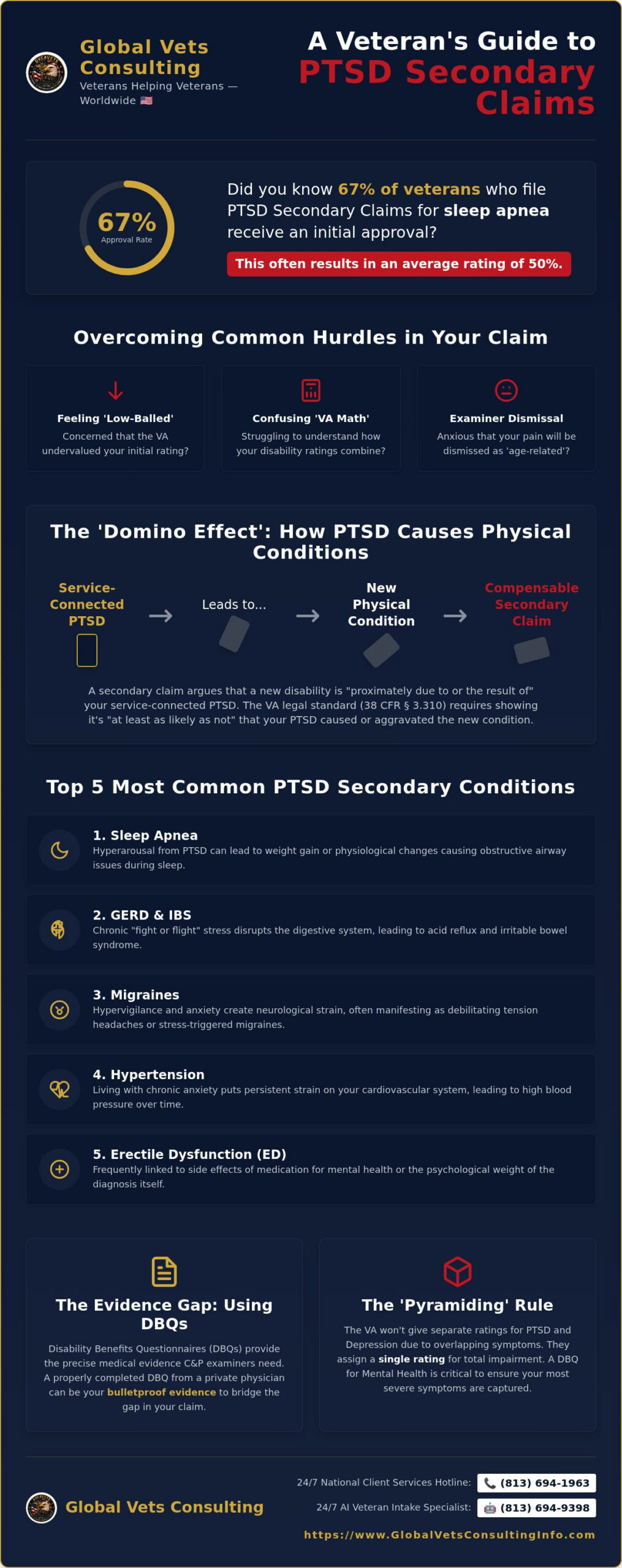
Did you know that 67% of veterans who file PTSD Secondary Claims for sleep apnea receive an initial approval? This often results in an average rating of 50%. It is a powerful way to secure the compensation you earned. 🇺🇸
We understand the weight of these challenges:
- 🇺🇸 Feeling ‘low-balled’ by the VA on your initial rating.
- 🇺🇸 Confusion over ‘VA Math’ and how your ratings combine.
- 🇺🇸 Anxiety that a C&P examiner will dismiss your pain as ‘age-related.’
You earned your benefits through your service. We are here to help you document the physical conditions caused by your mental health. This guide provides a clear roadmap to navigate the claim process with confidence.
You will learn which conditions have the highest success rates. We also explain how to use a DBQ to provide bulletproof medical evidence. Let’s get you the rating you rightfully deserve.
Key Takeaways
- Learn how the legal standard of ‘proximately due to’ allows you to file PTSD Secondary Claims for physical conditions caused by your mental health.
- Discover why conditions like sleep apnea, GERD, and IBS have high success rates when linked correctly to service-connected PTSD.
- Master the use of Disability Benefits Questionnaires (DBQs) to provide the precise medical evidence that C&P examiners often overlook.
- Navigate the complexities of ‘VA Math’ and the Fully Developed Claim process to maximize your combined rating and speed up your decision.
What are PTSD Secondary Claims and the ‘Domino Effect’?
PTSD is not a diagnosis that stays confined to the mind. It acts as a physiological catalyst that can trigger a cascade of physical health issues throughout your body. When you file PTSD Secondary Claims, you are telling the VA that a new disability is “proximately due to or the result of” your already service-connected PTSD. In the 2026 VA landscape, examiners are placing a much higher priority on functional impairment and objective medical evidence. They want to see the documented “why” and “how” behind your physical symptoms to ensure your rating reflects your true level of disability.
You don’t necessarily need a brand new diagnosis to succeed. The VA also recognizes “aggravation,” which applies when your service-connected Post-Traumatic Stress Disorder (PTSD) makes a pre-existing condition worse. For example, if your chronic anxiety causes muscle tension that severely worsens a pre-existing neck injury, that increase in severity is compensable. Understanding this “Domino Effect” is vital because it shifts the focus from what happened years ago in service to how your service-connected conditions are impacting your health right now.
Direct vs. Secondary Service Connection
A direct service connection means your injury or illness happened specifically during your time in uniform. A secondary connection is different; it means your current physical struggle exists because of your PTSD. For many veterans, identifying these links is the most effective way to reach a 100% rating. It allows you to build a comprehensive map of your health rather than fighting for individual, unrelated service connections that the VA might otherwise dismiss.
The Legal Standard: 38 CFR § 3.310
The VA follows a specific legal standard found in 38 CFR § 3.310. This regulation states that any disability which is the proximate result of a service-connected disease is also service-connected. We often call this the “Domino Effect.” If the VA service-connects your mental health, they must also consider the physical conditions it causes. To win PTSD Secondary Claims, your medical evidence must show that it’s “at least as likely as not” that your secondary condition was caused or aggravated by your service-connected mental health symptoms.
Top 5 Most Common PTSD Secondary Conditions in 2026
Identifying the physical toll of mental health is the first step toward a successful PTSD Secondary Claims strategy. When you examine What is PTSD from a clinical perspective, it becomes clear that chronic stress is not just a feeling. It’s a physiological state that alters your body’s internal chemistry. In 2026, the VA continues to recognize specific conditions that frequently stem from this biological disruption, making them strong candidates for secondary service connection.
- Sleep Apnea: Veterans with PTSD often experience hyperarousal and fragmented sleep. This can lead to weight gain or physiological changes that cause obstructive airway issues.
- GERD and IBS: The “fight or flight” mode associated with PTSD keeps your body in a state of high alert. This chronic stress disrupts your digestive system, often leading to gastroesophageal reflux disease or irritable bowel syndrome.
- Migraines: Hypervigilance and constant anxiety create significant neurological strain. This often manifests as debilitating tension headaches or migraines triggered by stress.
- Hypertension: Living with chronic anxiety puts a persistent strain on your cardiovascular system. Over time, this elevated heart rate and stress response can lead to permanent high blood pressure.
- Erectile Dysfunction: This condition is frequently linked to the side effects of medications used to treat mental health or the overwhelming psychological weight of the diagnosis itself.
Secondary Mental Health Conditions: The Pyramiding Rule
It’s vital to understand that the VA generally applies a “pyramiding” rule to mental health. This means you won’t receive separate ratings for Depression and PTSD because they share many overlapping symptoms. Instead, the VA assigns a single rating that captures the total occupational and social impairment of all your mental health conditions combined. To ensure your most severe symptoms are captured accurately, using a DBQ for Mental Health Conditions is a critical step in providing the necessary medical evidence.
Lesser-Known Pairings: Tinnitus and Back Pain
PTSD can also aggravate musculoskeletal issues in ways you might not expect. Chronic stress often leads to a more sedentary lifestyle, which can worsen spinal health and lead to significant back pain over time. Additionally, the heightened sensory awareness caused by PTSD can make existing tinnitus feel much more intrusive and debilitating. Documenting how your mental health worsens these physical pains is essential for winning your PTSD Secondary Claims. If you’re feeling overwhelmed by the process, exploring secondary VA claims education can provide the clarity you need to move forward.
The Evidence Gap: Using DBQs to Prove Your Secondary Claim
A Disability Benefits Questionnaire (DBQ) is a standardized form designed to capture the specific medical evidence the VA needs to process your claim. For PTSD Secondary Claims, these forms are the preferred language of the VA. They ensure that every necessary box is checked and every symptom is accounted for. Many veterans find that a standard C&P exam feels rushed, sometimes lasting only 15 minutes. In contrast, a Private DBQ offers the power of a thorough evaluation. It allows a medical professional to spend the time necessary to document how your secondary condition truly impacts your daily life.
Research from the National Center for PTSD highlights the medical link between PTSD and cardiovascular disease, providing a clinical basis for secondary service connection. When documenting these links, it’s vital to move beyond a simple diagnosis. You must show functional limitations. If your PTSD-induced hypertension prevents you from exercising or causes severe fatigue, that information belongs on your What is a DBQ? form to bridge the evidence gap.
The Three Elements of a Winning Nexus
To secure a rating for a secondary condition, your evidence must establish three specific elements. First, you need a current medical diagnosis of the secondary condition itself. Second, you must have an existing service-connected primary condition, which in this case is PTSD. Finally, you need a medical professional’s ‘Nexus’ statement. This statement must conclude that your secondary condition is ‘at least as likely as not’ caused or aggravated by your PTSD. Without this third piece, the VA will likely deny the connection, even if the symptoms are obvious.
How Global Vets Streamlines Your Documentation
We focus on providing the education you need to document your medical status accurately. Our team helps you understand Independent Medical Evidence and how it applies to your specific PTSD Secondary Claims. By ensuring your medical history is reflected correctly on the questionnaire, you can walk into a C&P Examination with solid paperwork in hand. This preparation reduces anxiety and puts you in the best position to receive the rating you’ve earned. If you’re ready to take the next step, you can explore our DBQ preparation education to see how we can help.
Strategy for a VA Rating Increase: Next Steps for Veterans
Winning your PTSD Secondary Claims requires more than just a diagnosis. It takes a strategic understanding of how the VA evaluates multiple conditions. Many veterans are surprised by “VA Math,” where a 50% PTSD rating and a 30% secondary rating don’t equal 80%. Instead, the VA calculates disabilities based on what percentage of your body is “efficient.” In this example, they take 30% of the remaining 50% healthy portion, adding 15% to your total for a combined 65%, which rounds to 70%. Knowing this helps you plan for the exact ratings you need to reach your financial goals.
To move your claim through the system faster, we recommend the Fully Developed Claim (FDC) advantage. By submitting your medical evidence, Nexus letters, and DBQs all at once, you signal to the VA that your file is complete. This reduces the back-and-forth and often leads to a quicker decision. If you find your VA Claim Denied for Lack of Evidence, don’t be discouraged. You have the option to file a Higher-Level Review (HLR) or a Supplemental Claim to provide the missing clinical links.
When to File for a Rating Increase
You should consider filing for an increase the moment your secondary condition begins to interfere more severely with your daily life. If your migraines are becoming more frequent or your gastrointestinal symptoms are worsening, your current rating may no longer be accurate. A new, professional DBQ can document these changes with precision. For a detailed roadmap on this process, see our guide on How to Use a DBQ for a VA Rating Increase.
Your 2026 Action Plan 🇺🇸
- Step 1: Secure a formal diagnosis from a medical professional for your secondary symptoms.
- Step 2: Connect with a consultant to educate yourself on the specific medical evidence required for PTSD Secondary Claims.
- Step 3: Submit your claim through the FDC program with a clear, professional DBQ that highlights your functional limitations.
Taking these steps ensures you aren’t just another number in the system. You are a veteran taking control of your health and the benefits you’ve rightfully earned through your service.
Secure the Compensation You Have Earned
Managing your PTSD Secondary Claims doesn’t have to be a solitary battle. You now understand how chronic mental health struggles trigger a physical domino effect, impacting everything from your respiratory system to your digestive health. By focusing on meticulous medical documentation and using the standardized language of DBQs, you can bridge the evidence gap that often leads to denied claims. It’s about presenting a clear, undeniable link between your service-connected PTSD and the physical conditions that impact your quality of life today.
We’re here to serve as your steady guide through this bureaucratic process. As a veteran-owned and operated organization, we specialize in secondary claims education to ensure your medical evidence is accurate and thorough. If you have questions or need immediate assistance, our 24/7 National Client Services Hotline is always available to support you. You’ve served your country with honor; now it’s time to ensure the system works for you.
Frequently Asked Questions
Can I claim sleep apnea secondary to PTSD without a sleep study?
No, you cannot successfully claim sleep apnea without a formal sleep study. The VA requires objective medical evidence to confirm a diagnosis before they consider service connection. A sleep study provides the specific data points, such as your Apnea-Hypopnea Index (AHI), that a doctor needs to complete a DBQ. Without this clinical data, your claim will likely be denied for a lack of a formal diagnosis.
What is the most common secondary condition to PTSD?
Sleep apnea is currently one of the most frequent PTSD Secondary Claims filed by veterans. Other common conditions include GERD, migraines, and hypertension. These pairings are common because the physiological stress of mental health conditions often leads to respiratory, digestive, and cardiovascular issues. The VA recognizes these links when they are supported by strong medical evidence and a clear nexus statement.
How does the VA rate GERD secondary to PTSD in 2026?
The VA rates GERD based on the severity and frequency of symptoms like acid reflux or heartburn that impact your daily life. Ratings typically range from 10% to 60% depending on the level of impairment. In 2026, examiners are looking for specific documentation of functional impairment, such as how often your symptoms occur and whether they require a restricted diet or significant medication to manage.
Do I need a nexus letter if I have a DBQ for my secondary claim?
While a DBQ provides the medical evidence of your current condition, a nexus letter is often the missing link that specifically connects that condition to your PTSD. A well-written DBQ from a private provider often includes a nexus statement. However, having a separate, detailed nexus letter can provide the ‘at least as likely as not’ language that makes your PTSD Secondary Claims much stronger during the review process.
Can I get 100% disability through PTSD secondary claims?
Yes, many veterans reach a 100% rating by successfully linking multiple secondary conditions to their primary mental health diagnosis. While ‘VA Math’ makes it challenging to reach 100% through a single rating, the combined effect of several secondary ratings can push your total rating to the maximum level. Documenting each condition with a professional DBQ ensures that every symptom is counted toward your final combined rating.

Article by
Willie Daniel
Willie Daniel is the Founder and Chief Executive Officer (CEO) of Global Vets Consulting (GVC4Vets) – National Veterans Disability Services, a veteran-led educational and medical evidence support organization dedicated to helping veterans better understand VA disability rating increases, DBQ medical evidence, secondary claims education, and C&P examination preparation.
He is a retired U.S. Army Medical Service Corps Officer with more than 27 years of honorable military service, a decorated Iraq combat veteran, and a retired federal official with the U.S. Department of Veterans Affairs. Throughout his military and federal career, Willie Daniel served in leadership, healthcare administration, operational, and veteran-support roles focused on improving services and support systems for servicemembers, veterans, and their families.
Drawing from decades of military leadership, healthcare administration, veteran advocacy, and federal government experience, Willie Daniel brings a practical, veteran-centered perspective to Global Vets Consulting’s educational articles, AI-powered veteran resources, video education initiatives, and outreach programs. His experience navigating military systems, medical documentation processes, and veteran-related administrative operations provides valuable insight into many of the challenges veterans face when seeking to better understand VA disability rating criteria, medical evidence, documentation strategies, and secondary condition education.
Through GVC’s “Veterans Helping Veterans” mission, his focus is on delivering clear, educational, and easy-to-understand information designed to empower veterans with knowledge, resources, and educational tools that may help them make more informed decisions regarding their individual VA disability journeys.
The information provided through GVC is intended for educational and informational purposes only and should not be considered legal or medical advice.
Disclaimer
Disclaimer: Global Vets Consulting, LLC (“GVC”) is a veteran-led educational and medical evidence support organization. GVC is not a law firm, is not a Veterans Service Organization (VSO), and is not affiliated with the U.S. Department of Veterans Affairs (VA) or any government agency.
Global Vets Consulting does not provide legal advice, medical advice, medical treatment, or healthcare services. GVC does not prepare, file, or submit VA disability claims on behalf of veterans. All information provided through this website, blog articles, videos, educational materials, AI tools, dashboards, templates, and communications is intended solely for general educational and informational purposes.
Veterans are encouraged to consult with accredited representatives, licensed attorneys, qualified medical providers, or Veterans Service Organizations regarding their specific legal, medical, or VA-related matters. VA disability decisions, ratings, and outcomes are determined solely by the U.S. Department of Veterans Affairs based on applicable laws, regulations, medical evidence, and individual circumstances. Past results do not guarantee future outcomes.