Your MST VA rating claim doesn’t hinge on whether you filed a report the night it happened. That’s the reality that many survivors don’t realize until they’re already deep into the claims process, second-guessing themselves and wondering if the VA will simply dismiss their experience because there’s no official paper trail. You’re not alone in that fear, and it’s a fear worth addressing head-on.
The VA system wasn’t designed to prosecute a crime. It was designed to document the lasting impact of trauma on your health and your ability to function. That distinction matters enormously, and it changes how you approach building your evidence file from the ground up.
This guide walks you through exactly how the VA evaluates MST-related conditions, what the rating scale from 0% to 100% actually measures, and how “markers” of trauma can serve as powerful evidence even without an official incident report. You’ll also learn how a properly completed Disability Benefits Questionnaire can anchor your claim with the kind of standardized medical documentation the VA needs to make an accurate decision. Let’s break it down, step by step.
Key Takeaways
- Your MST VA Rating is built around the conditions your trauma caused—such as PTSD, depression, or anxiety—not a single MST-specific diagnostic code, which means the strength of your medical documentation determines your outcome.
- The VA uses a General Rating Formula for Mental Disorders to assign percentages from 0% to 100%, and the deciding factor is how severely your symptoms impair your social and occupational functioning.
- Even without an official incident report, behavioral changes documented in your service records can serve as powerful “markers” of trauma—and the VA has a duty to help identify them.
- If your symptoms have worsened since your original rating, a structured strategy for a VA rating increase, supported by accurate medical documentation, can result in a higher disability percentage.
- A properly completed Disability Benefits Questionnaire (DBQ) is one of the most effective tools for anchoring your claim with the standardized evidence VA decision-makers need to evaluate your case accurately.
What is an MST VA Rating? Understanding the Stressor vs. the Condition
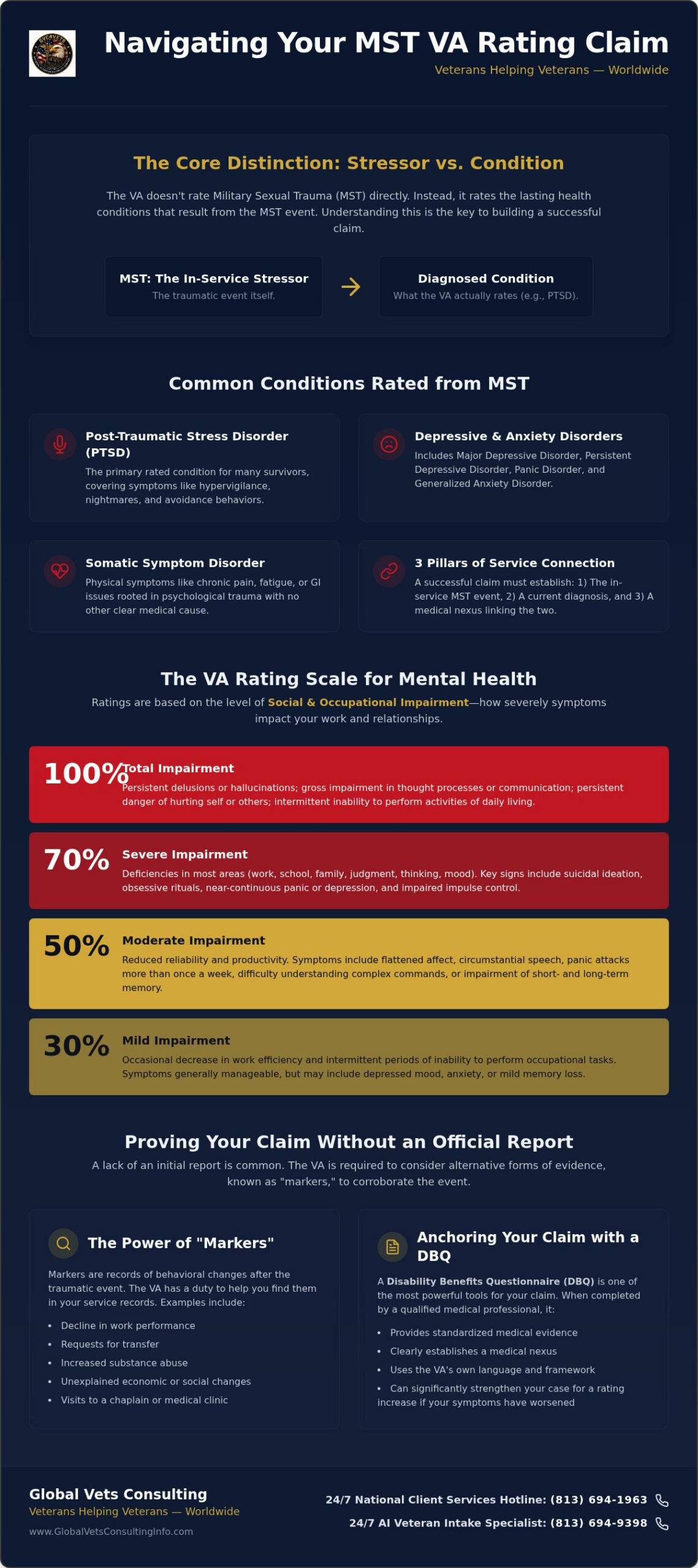
Here’s the source of confusion that trips up so many survivors before they even file: there is no VA diagnostic code labeled “MST.” You cannot receive an “MST rating” the same way you’d receive a rating for a broken arm or hearing loss. Military Sexual Trauma is legally defined as the stressor, the traumatic event itself, that serves as the foundation for a mental health or physical health claim. What the VA rates is the condition your body and mind developed as a result of that stressor.
This distinction isn’t a technicality. It’s the entire framework around which your claim is built. Understanding it changes how you gather evidence, how you talk to your doctor, and how you structure every piece of documentation you submit.
Commonly Rated Conditions Resulting from MST
Once you recognize MST as the stressor rather than the diagnosis, the path forward becomes clearer. The VA evaluates and rates the specific conditions that trauma produced. The most common include:
- Post-Traumatic Stress Disorder (PTSD): The primary rated condition for most MST survivors, covering symptoms like hypervigilance, nightmares, emotional numbing, and avoidance behaviors.
- Major Depressive Disorder or Persistent Depressive Disorder: Often diagnosed alongside or secondary to PTSD, reflecting the chronic emotional toll of unprocessed trauma.
- Panic Disorder and Generalized Anxiety Disorder: Frequently documented in survivors who experience intrusive memories or situational triggers in daily life.
- Somatic Symptom Disorder: Physical symptoms, including chronic pain, gastrointestinal issues, or fatigue, that have no clearly identified medical cause but are rooted in psychological trauma.
Establishing your MST VA rating requires meeting the VA’s three-part service connection standard: the in-service event (the MST stressor), a current diagnosis, and a medical nexus linking the two. That third element, the nexus, is where accurate documentation becomes decisive. A properly completed Disability Benefits Questionnaire from a qualified provider can supply exactly that link, giving VA decision-makers the standardized evidence they need to evaluate your claim fairly. Veterans helping veterans navigate this process know that the paperwork isn’t a formality; it’s the foundation.
The VA Rating Schedule for MST-Related Mental Health
Once the VA establishes service connection for your MST-related condition, a separate but equally important question takes over: how severe is the impairment? The answer determines your monthly compensation, and it comes from a single governing framework called the General Rating Formula for Mental Disorders, codified in 38 CFR Part 4.
The formula measures one core variable: social and industrial impairment. That phrase is the lens through which every symptom you experience gets evaluated. “Industrial” refers to your ability to hold and perform a job. “Social” refers to your ability to maintain relationships, function in group settings, and manage everyday interactions. The more severely your MST-related condition disrupts both of those areas, the higher your rating percentage.
Understanding where your symptoms fall on that spectrum before you file, or before you pursue a rating increase, gives you a clearer picture of what evidence you need to build.
Breaking Down the Percentages: 30%, 50%, 70%, and 100%
The VA assigns ratings at fixed intervals. Here’s what each threshold actually requires:
- 30% Rating: Occasional decreases in work efficiency and intermittent periods of inability to perform occupational tasks. Symptoms at this level may include mild memory loss, anxiety, or depressed mood that doesn’t consistently prevent functioning.
- 50% Rating: Reduced reliability and productivity. Symptoms like flattened affect, circumstantial speech, panic attacks more than once a week, or difficulty understanding complex commands push a claim into this range.
- 70% Rating: Deficiencies in most areas of life, including work, school, family relations, and judgment. Near-continuous panic or depression, suicidal ideation, and impaired impulse control are hallmarks of this rating level.
- 100% Rating: Total occupational and social impairment. This means persistent delusions or hallucinations, grossly inappropriate behavior, or a persistent inability to perform basic self-care tasks.
A 0% rating, sometimes called “non-compensable,” doesn’t mean your condition was dismissed. It means the VA acknowledged service connection but found that your symptoms don’t yet meet the threshold for compensation. That established connection is a foundation you can build on. If your condition worsens, you already have the hardest part done. Pursuing a VA disability claims process review becomes significantly more straightforward when service connection is already on record.
Accurate documentation is what moves a claim from one tier to the next. If your current rating doesn’t reflect how your MST VA Rating-related condition actually affects your daily life, a properly completed DBQ can provide the standardized clinical language that VA raters are trained to evaluate.
Proving Your Claim: The Power of Markers and Secondary Evidence
Most MST incidents go unreported. That’s not a character flaw or a strategic mistake; it’s the predictable result of a system where survivors faced real risks of retaliation, career damage, or simply not being believed. The VA understands this reality, which is why federal regulations require VA adjudicators to actively search for “markers” of trauma when no official report exists. That duty belongs to them, but the veterans who build the strongest claims are the ones who understand what those markers look like before they walk in the door.
A marker is any documented behavioral change in your service record that correlates with the timeframe of the MST stressor. You don’t need to label it as trauma-related yourself. The pattern tells its own story, and a trained evaluator knows how to read it.
Checklist of Common MST Evidence Markers
Pull your service records and look specifically for these documented changes. Each one can serve as corroborating evidence for your MST VA Rating claim:
- Requests for transfer or sudden unit reassignments that occurred without a clear operational explanation
- Drops in performance evaluations or disciplinary actions following a period of previously strong service
- Unexplained visits to sick call, base medical clinics, or mental health services that weren’t tied to a documented physical injury
- Substance use or alcohol-related incidents that emerged after a specific point in your service timeline
- Statements from chaplains, clergy, or private health professionals who were consulted during or after your service
- Buddy statements from fellow service members, family members, or close friends who observed changes in your behavior, mood, or daily functioning
Buddy statements, formally submitted on VA Form 21-10210, carry genuine evidentiary weight. A fellow service member who noticed you isolating yourself, withdrawing from your unit, or showing signs of distress provides the kind of contemporaneous, firsthand corroboration that strengthens a nexus argument significantly.
Using a DBQ to Document Symptoms Accurately
Once you’ve gathered your markers and supporting statements, the next step is translating your lived experience into the clinical language a VA rater is trained to evaluate. A DBQ for Mental Health Conditions captures the full severity of your symptoms in a standardized format, giving the rater the exact diagnostic language and functional assessment they need to assign an accurate percentage. Without that structure, even a well-documented claim can be underrated simply because the severity wasn’t articulated in terms the rating formula recognizes.
Don’t leave that translation to chance. Connect with a veterans education specialist who can help ensure your DBQ reflects the full impact of your condition.
Next Steps: How to Secure Your MST VA Rating Increase
If your condition has worsened since your original rating decision, you have the right to pursue a VA rating increase. The process starts with one question: does your current documentation accurately reflect how your MST-related condition affects your life today? For many survivors, the answer is no, and that gap between lived reality and recorded evidence is exactly where a structured strategy makes the difference.
Why Accurate Documentation Prevents Denials
The single most common reason VA claims are denied isn’t a lack of legitimate symptoms. It’s a lack of sufficient evidence to substantiate them. Service records establish history, but they rarely capture the full picture of a condition years after separation. A private DBQ bridges that gap directly. It translates your current functional limitations into the standardized clinical language that VA raters are trained to evaluate, connecting your present diagnosis back to your in-service stressor with the medical precision a Fully Developed Claim requires. Submitting a complete, well-documented file from the start reduces the likelihood of a denial that sends you into a lengthy appeals process.
Preparing for the C&P Exam with Confidence
The Compensation and Pension exam is often the most anxiety-provoking part of an MST VA Rating claim, but going in prepared changes the dynamic considerably. Be specific about your worst days, not your average ones. Describe how symptoms affect your sleep, your relationships, and your ability to hold or maintain employment. Don’t minimize.
One right that many survivors don’t know they have: you can request a male or female examiner for any MST-related C&P exam. That request is legitimate, and the VA is required to accommodate it when feasible. Exercise it without hesitation if it affects your ability to speak openly.
Global Vets Consulting, a veteran-owned organization operating since 2021, specializes in helping survivors build the documentation foundation that supports accurate evaluations. From Mental Health Ratings Education to C&P Examination Preparation Education, the focus is on equipping you with the evidence and knowledge you need before you walk into that exam room.
You’ve already carried the hardest part. Let the paperwork carry its weight too. 📞 Reach the 24/7 National Client Services Hotline at GlobalVetsConsultingInfo.com and connect with a veterans education specialist who understands exactly what your claim requires. 🇺🇸
Your MST VA Rating Is Worth Fighting For
Understanding how the VA evaluates MST-related conditions puts you in a fundamentally stronger position. The stressor and the diagnosis are separate. The rating formula measures functional impairment, not the severity of what happened to you. And behavioral markers in your service record can carry real evidentiary weight, even without an official incident report on file.
What ties all of it together is documentation that accurately reflects your current reality. A well-structured MST VA Rating claim doesn’t succeed on circumstances alone; it succeeds because the evidence speaks clearly in language VA raters are trained to act on.
Global Vets Consulting is veteran-owned and operated, with specialized education in Mental Health Ratings and a 24/7 AI Veteran Intake Specialist ready to connect you with the right resources. You don’t have to navigate this process alone, and you don’t have to guess whether your documentation is strong enough.
Ready to build the evidence foundation your claim deserves? Connect with Global Vets Consulting today and take the next step forward. 🇺🇸
Frequently Asked Questions About Your MST VA Rating
Can I get a VA disability rating for MST if I never reported it?
Yes, you can. The VA explicitly recognizes that most MST incidents go unreported, and federal regulations require adjudicators to apply a more flexible standard of proof for MST-related claims. You don’t need a police report or a formal military investigation to establish that the stressor occurred. Behavioral changes documented in your service records, buddy statements, and clinical records from private providers can all serve as corroborating evidence.
What matters most is connecting a current diagnosis to your in-service experience through a credible medical nexus. A properly completed Disability Benefits Questionnaire from a qualified provider supplies that link in the standardized format VA raters are trained to evaluate.
What is the average VA rating for PTSD related to MST?
The VA doesn’t publish a specific average rating for MST-related PTSD, and individual outcomes vary considerably based on documented symptom severity. What the rating formula does measure consistently is social and occupational impairment. A 50% rating reflects reduced reliability and productivity at work; a 70% rating reflects deficiencies across most areas of daily life, including relationships, judgment, and sustained employment.
Your rating is determined by how thoroughly your documentation captures functional limitations, not by the nature of the trauma itself. Survivors whose claims include detailed clinical assessments of their worst-day symptoms tend to receive ratings that more accurately reflect their actual impairment level.
Does the VA require a C&P exam for all MST claims?
Not always, but a Compensation and Pension exam is ordered in most cases where the VA needs additional information to evaluate the severity of your condition or confirm the nexus between your diagnosis and your military service. If you submit a fully developed claim with strong private medical evidence, including a completed DBQ, the VA may be able to rate your claim without scheduling a separate exam.
When a C&P exam is required, preparation matters significantly. You have the right to request an examiner of a specific gender for MST-related exams, and exercising that right can directly affect your ability to speak openly about your symptoms. C&P Examination Preparation Education can help you walk in knowing exactly what to communicate and how.
What are behavioral “markers” in a VA MST claim?
Markers are documented behavioral changes in your service record that correlate with the timeframe of the MST stressor. Because the VA can’t require survivors to produce an incident report that may never have been filed, regulations direct adjudicators to look for indirect evidence of trauma instead. Common markers include sudden drops in performance evaluations, unexplained requests for unit transfer, sick call visits without a documented physical cause, and substance-related disciplinary actions that emerged after a specific point in service.
You don’t need to label these records as trauma-related yourself. A trained evaluator reads the pattern. Gathering these documents before you file gives you a clearer picture of the corroborating evidence already in your file.
Can I file for a VA rating increase for MST years after my initial claim?
Yes, and there’s no deadline that prevents you from pursuing one. If your MST-related condition has worsened since your original rating decision, you have the right to request a rating increase at any time. The key is demonstrating that your current symptoms are more severe than what was documented when the VA last evaluated your claim, which requires updated medical evidence that reflects your present functional limitations.
A private DBQ completed by a qualified provider is one of the most effective tools for this purpose. It captures your current diagnosis and symptom severity in the standardized format the VA uses to compare against the General Rating Formula, giving raters the clinical language they need to move your claim to the next compensation tier.
How do I find an MST Outreach Coordinator at the VA?
Every VA medical center is required to have a designated MST Coordinator, a staff member whose specific role is to connect survivors with appropriate care, benefits information, and support services. You can locate your facility’s coordinator by calling your nearest VA medical center directly and asking for the MST Coordinator by title, or by visiting the VA’s official website and using the facility locator tool.
MST Coordinators can help you understand what mental health services are available and how to access them, but they don’t manage the claims documentation process. For building the evidence foundation your MST VA Rating claim requires, connecting with a veterans education specialist who understands DBQ preparation and C&P exam strategy is a separate and equally important step.

Article by
Willie Daniel
Willie Daniel is the Founder and Chief Executive Officer (CEO) of Global Vets Consulting (GVC4Vets) – National Veterans Disability Services, a veteran-led educational and medical evidence support organization dedicated to helping veterans better understand VA disability rating increases, DBQ medical evidence, secondary claims education, and C&P examination preparation.
He is a retired U.S. Army Medical Service Corps Officer with more than 27 years of honorable military service, a decorated Iraq combat veteran, and a retired federal official with the U.S. Department of Veterans Affairs. Throughout his military and federal career, Willie Daniel served in leadership, healthcare administration, operational, and veteran-support roles focused on improving services and support systems for servicemembers, veterans, and their families.
Drawing from decades of military leadership, healthcare administration, veteran advocacy, and federal government experience, Willie Daniel brings a practical, veteran-centered perspective to Global Vets Consulting’s educational articles, AI-powered veteran resources, video education initiatives, and outreach programs. His experience navigating military systems, medical documentation processes, and veteran-related administrative operations provides valuable insight into many of the challenges veterans face when seeking to better understand VA disability rating criteria, medical evidence, documentation strategies, and secondary condition education.
Through GVC’s “Veterans Helping Veterans” mission, his focus is on delivering clear, educational, and easy-to-understand information designed to empower veterans with knowledge, resources, and educational tools that may help them make more informed decisions regarding their individual VA disability journeys.
The information provided through GVC is intended for educational and informational purposes only and should not be considered legal or medical advice.
Disclaimer
Disclaimer: Global Vets Consulting, LLC (“GVC”) is a veteran-led educational and medical evidence support organization. GVC is not a law firm, is not a Veterans Service Organization (VSO), and is not affiliated with the U.S. Department of Veterans Affairs (VA) or any government agency.
Global Vets Consulting does not provide legal advice, medical advice, medical treatment, or healthcare services. GVC does not prepare, file, or submit VA disability claims on behalf of veterans. All information provided through this website, blog articles, videos, educational materials, AI tools, dashboards, templates, and communications is intended solely for general educational and informational purposes.
Veterans are encouraged to consult with accredited representatives, licensed attorneys, qualified medical providers, or Veterans Service Organizations regarding their specific legal, medical, or VA-related matters. VA disability decisions, ratings, and outcomes are determined solely by the U.S. Department of Veterans Affairs based on applicable laws, regulations, medical evidence, and individual circumstances. Past results do not guarantee future outcomes.